Is finetuning GPT4o worth it? — with Alistair Pullen, Cosine (Genie)
Betteridge's law says no: with seemingly infinite flavors of RAG, and >2million token context + prompt caching from Anthropic/Deepmind/Deepseek, it's reasonable to believe that "in context learning is all you need".
But then there’s Cosine Genie, the first to make a huge bet using OpenAI’s new GPT4o fine-tuning for code at the largest scale it has ever been used externally; resulting in what is now the #1 coding agent in the world according to SWE-Bench Full, Lite, and Verified:
SWE-Bench has been the most successful agent benchmark of the year, receiving honors at ICLR (our interview here) and recently being verified by OpenAI. Cognition (Devin) was valued at $2b after reaching 14% on it. So it is very, very big news when a new agent appears to beat all other solutions, by a lot:
While this number is self reported, it seems to be corroborated by OpenAI, who also award it clear highest marks on SWE-Bench verified:
The secret is GPT-4o finetuning on billions of tokens of synthetic data.
* Finetuning: As OpenAI says:
Genie is powered by a fine-tuned GPT-4o model trained on examples of real software engineers at work, enabling the model to learn to respond in a specific way. The model was also trained to be able to output in specific formats, such as patches that could be committed easily to codebases.
Due to the scale of Cosine’s finetuning, OpenAI worked closely with them to figure out the size of the LoRA:
“They have to decide how big your LoRA adapter is going to be… because if you had a really sparse, large adapter, you’re not going to get any signal in that at all. So they have to dynamically size these things.”
* Synthetic data: we need to finetune on the process of making code work instead of only training on working code.
“…we synthetically generated runtime errors. Where we would intentionally mess with the AST to make stuff not work, or index out of bounds, or refer to a variable that doesn't exist, or errors that the foundational models just make sometimes that you can't really avoid, you can't expect it to be perfect.”
Genie also has a 4 stage workflow with the standard LLM OS tooling stack that lets it solve problems iteratively:
Full Video Pod
like and subscribe etc!
Show Notes
* Alistair Pullen - Twitter, Linkedin
* Cosine Genie launch, technical report
* Cursor episode and Aman + SWEBench at ICLR episode
Timestamps
* [00:00:00] Suno Intro
* [00:05:01] Alistair and Cosine intro
* [00:16:34] GPT4o finetuning
* [00:20:18] Genie Data Mix
* [00:23:09] Customizing for Customers
* [00:25:37] Genie Workflow
* [00:27:41] Code Retrieval
* [00:35:20] Planning
* [00:42:29] Language Mix
* [00:43:46] Running Code
* [00:46:19] Finetuning with OpenAI
* [00:49:32] Synthetic Code Data
* [00:51:54] SynData in Llama 3
* [00:52:33] SWE-Bench Submission Process
* [00:58:20] Future Plans
* [00:59:36] Ecosystem Trends
* [01:00:55] Founder Lessons
* [01:01:58] CTA: Hiring & Customers
Descript Transcript
[00:01:52] AI Charlie: Welcome back. This is Charlie, your AI cohost. As AI engineers, we have a special focus on coding agents, fine tuning, and synthetic data. And this week, it all comes together with the launch of Cosign's Genie, which reached 50 percent on SWE Bench Lite, 30 percent on the full SWE Bench, and 44 percent on OpenAI's new SWE Bench Verified.
[00:02:17] All state of the art results by the widest ever margin recorded compared to former leaders Amazon Q and US Autocode Rover. And Factory Code Droid. As a reminder, Cognition Devon went viral with a 14 percent score just five months ago. Cosign did this by working closely with OpenAI to fine tune GPT 4. 0, now generally available to you and me, on billions of tokens of code, much of which was synthetically generated.
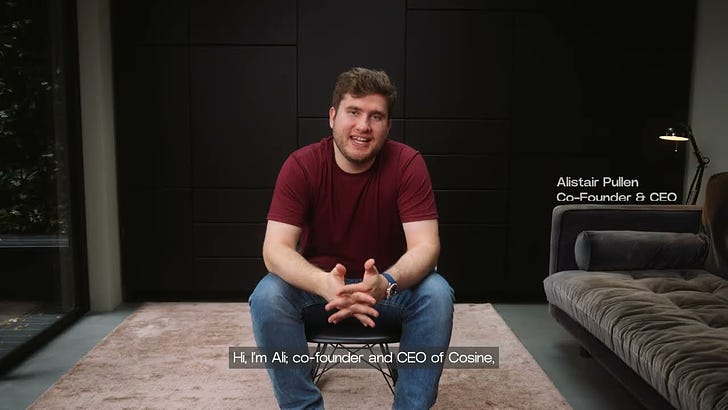
[00:02:47] Alistair Pullen: Hi, I'm Ali. Co founder and CEO of Cosign, a human reasoning lab. And I'd like to show you Genie, our state of the art, fully autonomous software engineering colleague. Genie has the highest score on SWBench in the world. And the way we achieved this was by taking a completely different approach. We believe that if you want a model to behave like a software engineer, it has to be shown how a human software engineer works.
[00:03:15] We've designed new techniques to derive human reasoning from real examples of software engineers doing their jobs. Our data represents perfect information lineage, incremental knowledge discovery, and step by step decision making. Representing everything a human engineer does logically. By actually training Genie on this unique dataset, rather than simply prompting base models, which is what everyone else is doing, we've seen that we're no longer simply generating random code until some works.
[00:03:46] It's tackling problems like
[00:03:48] AI Charlie: a human. Alistair Pullen is CEO and co founder of Kozen, and we managed to snag him on a brief trip stateside for a special conversation on building the world's current number one coding agent. Watch out and take care.
[00:04:07] Alessio: Hey everyone, welcome to the Latent Space Podcast. This is Alessio, partner and CTO of Resonance at Decibel Partners, and I'm joined by my co host Swyx, founder of Small. ai.
[00:04:16] swyx: Hey, and today we're back in the studio. In person, after about three to four months in visa jail and travels and all other fun stuff that we talked about in the previous episode.
[00:04:27] But today we have a special guest, Ali Pullen from Cosign. Welcome. Hi, thanks for having me. We're very lucky to have you because you're on a two day trip to San Francisco. Yeah, I wouldn't recommend it. I would not
[00:04:38] Alistair Pullen: recommend it. Don't fly from London to San Francisco for two da
You May Also Like

Jack Hopkins
Jack Hopkins

Hell Money
Hell Money

The Fat Pipe - Most Popular Packet Pushers Pods
Packet Pushers

Jak Piggott
Jak Piggott

Mark Tilbury
Mark Tilbury Fan

Programming Tech Brief By HackerNoon
HackerNoon

Artificial Intelligence Masterclass
AI Masterclass

The Good Tech Companies
HackerNoon

Engadget News + Next
Engadget

Thinking Crypto News & Interviews
Tony Edward
Jack Hopkins
Jack Hopkins
Hell Money
Hell Money
The Fat Pipe - Most Popular Packet Pushers Pods
Packet Pushers
Jak Piggott
Jak Piggott
Mark Tilbury
Mark Tilbury Fan
Programming Tech Brief By HackerNoon
HackerNoon
Artificial Intelligence Masterclass
AI Masterclass
The Good Tech Companies
HackerNoon
Engadget News + Next
Engadget
Thinking Crypto News & Interviews
Tony Edward
Community discussion