Inside the Model Factory — Eiso Kant, Poolside AI
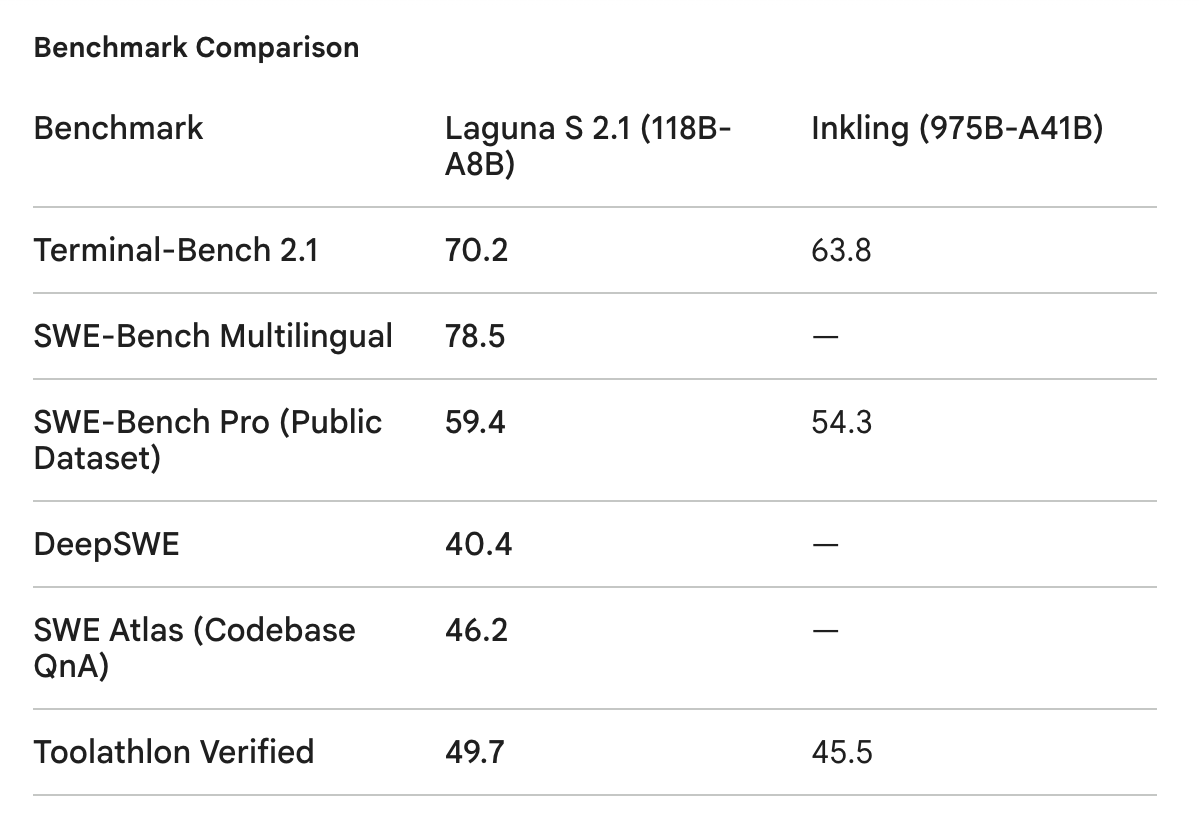
In recent months, the open vs closed, and US vs China discussions on model ownership and sovereign/local AI have heated up to a fever pitch. So it is very very good news that Poolside AI are finally emerging with new models, like Laguna S 2.1, that are beating Thinking Machines’ recent release nearly 10 times their size.
Poolside’s recent tech report got a lot of praise due to their level of detail, and Vibhu first covered Laguna’s recent technical report on our paper club:
From spending $12 million building language models for code before the world cared to creating a Model Factory that can take a model from pre-training to release in eight weeks, Eiso Kant has spent more than a decade betting that code is the path to AGI. In this episode, the Poolside co-founder joins swyx and Vibhu to explain why ChatGPT felt like vindication, why Poolside embraced open weights and open research, and why he would rather live in a world with 100 foundation model companies than five even if Poolside were one of the five.
We go deep on Poolside’s Model Factory: the engineering systems behind 10,000–20,000 experiments per month, streaming data directly into training, reproducible experimentation, low-precision compute, and agents that increasingly write code, launch jobs, evaluate results, and modify the pipelines used to train future models. Eiso also unpacks their recent launch Laguna S, why persistence, verification, and backtracking may matter more than raw intelligence, how much capability remains inside smaller models, why reinforcement learning will move earlier into pre-training, and why next-token prediction is still extracting too little from the web.
We also discuss model-harness co-design, Poolside’s path from coding agents to AGI, why Eiso thinks MCP and traditional tool calls are “stupid,” the real economics behind frontier-model training, Poolside’s $500 million raise, open-source AI, regulation, NVIDIA and TSMC’s influence, engineering productivity in the agent era, high-agency teams, and hiring at Poolside.
We discuss:
* How Andrej Karpathy’s RNN work inspired Eiso to start building language models for code in 2015
* Why Eiso spent four years and $12 million pursuing an idea before the market cared
* Why ChatGPT felt like vindication and brought Poolside back to open source
* Why Eiso would prefer 100 foundation model companies over an oligopoly of five
* The difference between releasing open weights and publishing genuinely open research
* Why Poolside deliberately built a global research organization outside the Bay Area talent war
* Why model building is ultimately 90% engineering
* The Model Factory: Poolside’s end-to-end system for rapidly training and improving models
* How fewer than 70 researchers run roughly 10,000–20,000 experiments each month
* How Poolside moved from six-month model cycles to five- and eight-week launches
* Why streaming data directly into training unlocked faster experimentation
* How immutable data, versioned code, and reproducibility enable rigorous model research
* Why Eiso wants capable researchers to leave their labs and become Poolside’s competitors
* Why 95% of model building can be reduced to better data or compute efficiency
* Laguna S and why persistence, verification, and backtracking can outperform raw intelligence
* Why smaller models may handle far more knowledge work than previously expected
* Why reinforcement learning will move earlier into pre-training
* Why next-token prediction is still failing to extract enough knowledge from the web
* Why distillation and environments have become the AI industry’s favorite “drugs”
* Why mid-training is really an early form of curriculum design
* Low-precision training, networking bottlenecks, and the next gains in compute efficiency
* Laguna S: 118 billion total parameters, 8 billion active, and eight weeks from training to launch
* Why model builders can often evaluate a new checkpoint within its first 30 minutes
* Model versus harness: where agent capabilities actually come from
* Why Poolside sees coding and long-horizon software tasks as a path to AGI
* Why Eiso thinks MCP and traditional tool calls are “stupid”
* Why future agents will write scripts instead of choosing from dozens of predefined tools
* The case for minimal harnesses, containers, and model freedom
* Why Poolside is prioritizing vision but does not expect to work on audio soon
* Why language may be the most compute-efficient modality for encoding knowledge and reasoning
* The real cost of model development and why the final training run is anticlimactic
* The story behind the Poolside name and why it represents refusing to lower ambitions
* How Poolside raised $500 million while investors still questioned whether AGI was real
* Why intelligence could become the world’s most demanded and commoditized resource
* When open models may become too capable to release without restrictions
* Why unilateral AI safety does not work in a globally competitive environment
* How regulation could accidentally lock in an oligopoly of two or three AI companies
* NVIDIA, TSMC, and the hardware systems underpinning foundation-model progress
* Why reinforcement-learning wall-clock time is one of Poolside’s biggest bottlenecks
* Why Poolside trains models from scratch instead of simply distilling larger models
* How AI changes the way companies should measure engineering productivity
* Why agency may become the most important quality for employees in the AI era
* How leaders align high-agency people through shared goals and clear constraints
* Hiring across research, post-training, pre-training, architecture, evals, and engineering at Poolside
Eiso Kant
LinkedIn: https://www.linkedin.com/in/eisokant
Poolside: https://poolside.ai
Timestamps
00:00:00 Introduction
00:00:54 Karpathy, RNNs, and Building Code Models Before Transformers
00:02
You May Also Like

TED Tech
TED Tech

Jack Hopkins
Jack Hopkins

The Good Tech Companies
HackerNoon

The Times Tech Podcast
The Sunday Times

Theo - t3․gg
Theo - t3․gg
The Deep Dive Radio Show and Nick's Nerd News
Nick Espinosa, Chief Security Fanatic
Elon Musk Podcast
Stage Zero

Engadget News + Next
Engadget
TBPN
John Coogan & Jordi Hays

The Vergecast
The Verge
TED Tech
TED Tech
Jack Hopkins
Jack Hopkins
The Good Tech Companies
HackerNoon
The Times Tech Podcast
The Sunday Times
Theo - t3․gg
Theo - t3․gg
The Deep Dive Radio Show and Nick's Nerd News
Nick Espinosa, Chief Security Fanatic
Elon Musk Podcast
Stage Zero
Engadget News + Next
Engadget
TBPN
John Coogan & Jordi Hays
The Vergecast
The Verge
Community discussion