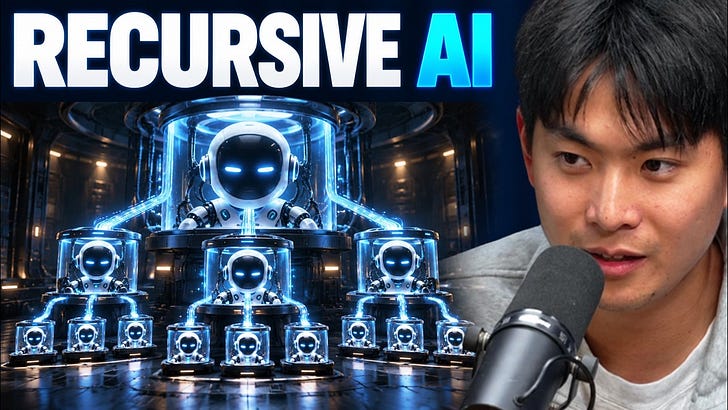
Academia is for Ambition — Alex Zhang, MIT
Last call for regular tickets for AI Engineer NYC! As an exclusive for Latent Space subscribers, the first 30 of you can take a 30% off code if it helps - for new tickets only, no refunds! See you in 2 weeks!
While we tend to cover industry on the pod, every so often we celebrate a clearly emerging superstar PhD. In 2024 we featured Shunyu Yao, who went on to build Operator at OpenAI and is now Chief AI Scientist of Tencent. In 2025 we featured Jack Morris, who went on to cofound Engram at $600m and is now a leading voice on continual learning.
This year we are proud to feature the work of Alex Zhang of MIT.
From GPU kernels and KernelBench to Recursive Language Models, Mismanaged Geniuses, and massive multi-agent swarms, Alex Zhang is exploring how much capability we’re leaving on the table by wrapping increasingly powerful models in primitive systems.
RLMs took over the timeline early this year:
and an RLM based harness was the first to ~solve ARC-AGI-3 before OpenAI’s Astra:
and is even today, influencing new research that has more extreme implications than RLMs:
We go deep on GPU Mode and AI-written kernels, research taste and why academics should take bets industry labs won’t, GEV and alternatives to the standard autoregressive language model, and the idea of harnesses as compositional generalizers. Alex explains RLMs, context offloading, programmatic subagent calling, Prime Agent, persistent subagents, and why the “language model” of the future may actually be an invisible swarm of agents underneath a simple interface. We also discuss OpenAI’s massive agent experiments, Kimi swarms, open-ended research at Sakana AI, speculative programmatic tool calling, capability overhang, Neuralese, and where Alex thinks the next big research opportunities may lie.
We discuss:
* Why AI-generated GPU kernels still leave substantial room for human expertise
* How one expert insight can potentially replace enormous amounts of brute-force token search
* Why PhD students should take research bets that initially look trivial, weird, or pointless
* What SWE-bench, RLMs, ReAct, and Quiet-STaR reveal about research taste
* GEV and why a language model does not have to mean an autoregressive text-to-text decoder
* Why Claude Code, Codex, and Pi are structurally more similar than they look
* How harness design can improve compositional generalization across tasks and domains
* RLMs: context offloading, code execution, recursive subagents, and shared memory
* Prime Agent, continual harnesses, and persistent agent-to-agent communication
* Why the model you query in the future may secretly be an entire swarm or scaffold
* OpenAI’s 10,000-agent experiment, 130B output tokens, and ~$40M-equivalent problem solving
* Why much of an agent swarm may be wasted search — and why convergence is still hard
* Kimi versus OpenAI and different approaches to multi-agent systems
* Open-endedness, Sakana AI, and finding hidden gems in enormous amounts of generated work
* Why current frontier models may already have a large capability overhang
* Speculative programmatic tool calling and overlapping tool execution with generation
* Whether English, code, or an entirely new “Neuralese” constrains how models reason
* AI for science, fast-moving benchmarks, and how Alex chooses what research problems to bet on
Alex Zhang
* Website: alexzhang13.github.io
* X: @a1zhang
Timestamps
00:00:00 Introduction
00:00:49 GPU Mode, KernelBench, and AI-Written Kernels
00:07:38 Human Expertise vs. Brute-Force AI Search
00:13:20 Research Taste and Taking Big Bets
00:19:28 GEV and Rethinking the Language Model
00:29:03 Video Game Agents and the Harness Problem
00:31:01 Why Claude Code, Codex, and Pi Are So Similar
00:36:42 Harnesses as Compositional Generalizers
00:44:24 RLMs Explained
00:52:01 Prime Agent and Persistent Subagents
00:57:41 RLMs in the Wild
01:00:30 OpenAI Swarms and the Future of Language Models
01:07:26 Open-Endedness and Sakana AI
01:15:52 Kimi vs. OpenAI Agent Swarms
01:20:06 Capability Overhang and Speculative Tool Calling
01:28:19 Neuralese, Future Research, and AI for Science
Transcript
Introduction: Alex Zhang, RLMs, and GPU Mode
Swyx [00:00:00]: All right, we’re here in the studio with Alex Zhang, I guess most famously of, RLMs, but you have a few other affiliations. Welcome to the show.
Alex Zhang [00:00:12]: Yeah. Thank you for having me.
Swyx [00:00:13]: Yeah. I guess GPU Mode as well?
Alex Zhang [00:00:15]: Yes, GPU Mode as well.
Swyx [00:00:16]: You were shepherded in by Mark Saroufim. Not everyone gets that kind of welcome.
Alex Zhang [00:00:19]: Yep. Yeah. Yeah. I’m very close to all the people in GPU Mode, so yeah
Swyx [00:00:23]: Yeah
Alex Zhang [00:00:23]: We often end up working together in various capacities, like even beyond just GPU Mode itself, so.
Swyx [00:00:29]: Yeah. Can we explain, so people who are not that close Don’t know about this. It’s just a-- it’s a Discord. It used to be focused on, I guess, CUDA Mode, and then generalized a little bit. it was started by Mark.
Alex Zhang [00:00:41]: Yep.
Swyx [00:00:42]: It was basically like. To me, it’s like the hiring pipeline of the PyTorch team.
Swyx [00:00:45]: And then you left PyTorch.
Alex Zhang [00:00:47]: Yep.
Alex Zhang [00:00:49]: Yeah. So it used to be, I think, it started actually around when I was in college, in like 2023. I think it was started by Mark, Andreas, and Jeremy Howard. The original premise was just like, it was a GPU-- or it was a D
You May Also Like
Syntax - Tasty Web Development Treats
Wes Bos & Scott Tolinski - Full Stack JavaScript Web Developers

Jack Hopkins
Jack Hopkins
AI Fire Daily
AIFire.co

a16z Show
Andreessen Horowitz

Taylor Lorenz’s Power User
Taylor Lorenz
Tech Update | BNR
BNR Nieuwsradio
Chat GPT Infinite Intelligence
Sol Good Network
ChatGPT - Sol Good Shorts
Sol Good Network

Security Weekly Podcast Network (Audio)
Security Weekly Productions

Mark Tilbury
Mark Tilbury Fan
Syntax - Tasty Web Development Treats
Wes Bos & Scott Tolinski - Full Stack JavaScript Web Developers
Jack Hopkins
Jack Hopkins
AI Fire Daily
AIFire.co
a16z Show
Andreessen Horowitz
Taylor Lorenz’s Power User
Taylor Lorenz
Tech Update | BNR
BNR Nieuwsradio
Chat GPT Infinite Intelligence
Sol Good Network
ChatGPT - Sol Good Shorts
Sol Good Network
Security Weekly Podcast Network (Audio)
Security Weekly Productions
Mark Tilbury
Mark Tilbury Fan
Community discussion