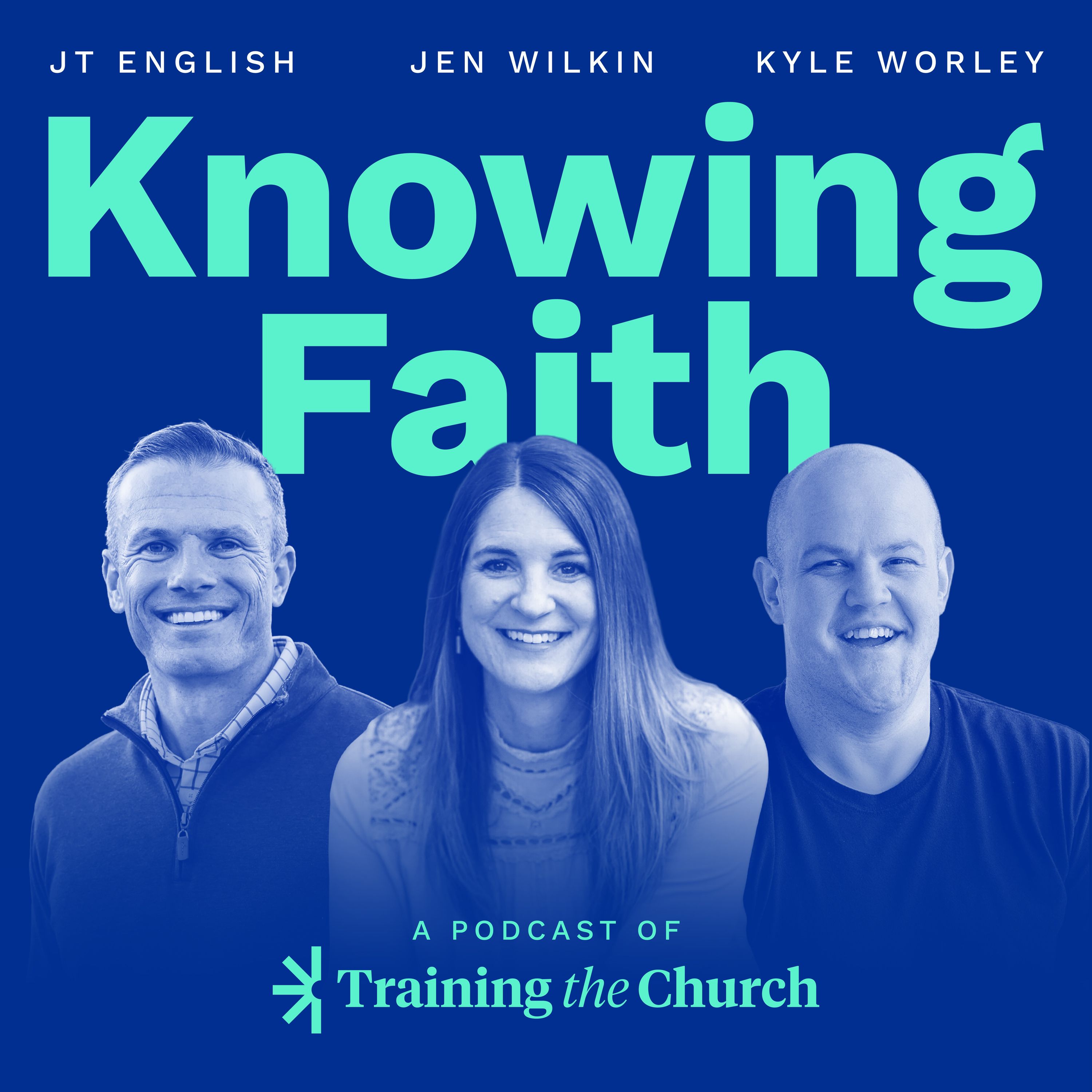
#133 – Q&A For Days
Jen Wilkin, JT English, and Kyle Worley answer questions submitted from their patron supporters! To learn more and become a patron visit patreon.com/knowingfaith.
Questions Covered in This Episode:
- “Do you have recommendations for books/podcasts/resources/etc for doing something similar but age appropriate for older kids?”
- “Is the language about God being Father & Son literal or figurative or both?”
- “Are we ever at risk of reading too much into parallels, types, significant numbers etc. and drawing conclusions that weren’t intended as we attempt to comprehend and interpret on our own?”
- “Why do you think that in the New Creation there will be no darkness (Rev. 21:22-25) yet in the first creation, before there was sin, God created darkness and light? 1 Jn 1:5 says there is no darkness in God, but why then did God create night in the first place?”
- “Regarding Gen 3:24. What happened to the garden, the cherubim & flaming sword after Adam and Eve left? What happened to the tree of life or tree of knowledge of good & evil?”
- “What is a theological belief or tradition that you used to hold too firmly but changed your mind (or at least you are no longer as confident in)?”
- “I’ve been wrestling with postmillennialism, amillennialism, and premillennialism eschatology and have been leaning towards post. I know it’s not an essential of our faith but I was wondering what you guys can comment on this and any good resources as well.”
- “Are you ever worried about how much influence you are having through the podcast?”
- “Is justification by faith alone a first-tier ("essentials") issue in your view? It seems that many evangelicals do think so, but if so, how does that affect how we view people in church history like Thomas Aquinas, if this doctrine is an "essential" belief to be saved?”
- “Is there a resource that charitably explains what different Christian denominations believe?”
- “What is one of your favorite things about your fellow cohosts/friends/frohosts? How do they encourage you?”
- “Is the Son the only person of the Trinity we see "embodied" (I'm not even sure if it's ok to use that word in relation to the Trinity at this point) in the scriptures or do we see the Father and the Spirit take on a form? For example, is the one Isaiah sees on the throne in Isaiah 6 the Son? The Father? The Father, Son, and Holy Spirit? Outside of the incarnation, how do we apply good Trinitarian theology to moments when we see God taking on "embodied" forms like in Isaiah, Ezekiel, and Revelation or more general forms like the burning bush, pillar of cloud and fire, etc.?”
- “I only recently came to understand that the resurrection of Jesus Christ actually changes my reality now (on this side of eternity). How should we think about the transformative power of the resurrection as it relates to the topic of besetting sins?”
- “Is it important that Adam was a historical figure? If so, why?”
- “Each of y’all’s simple tips for studying scripture on your own.”
- “Historically God has always had masculine pronouns but recently I’ve noticed gender-neutral pronouns are being used more often (particularly in scholarly writings). Is our understanding of God as masculine or gender-neutral an important aspect of our relationship with God? How does that impact our view of men and women being made in the image of God?”
- “When reading Acts, it seems like the apostles go out of their way to lay hands on new converts and ensure they are specifically filled/baptized with the Holy Spirit in a way that causes them to prophecy, speak in tongues, etc. This seems like an additional step, not synonymous with water baptism. The apostles didn’t seem to think that we are filled upon conversion, but rather manually through specific prayer. As believers today, are we missing something? Should we be doing this after we baptize someone? Am I lacking the Spirit if I haven’t been converted with this procedure?”
- “In Isaiah 9:6 Jesus Christ, the Son is referred to both as Son and as Everlasting Father...How does this work out in the Trinitarian community? Is there a lending of their titles? ‘For to us a child is born, to us a son is given; and the government shall be upon his shoulder, and his name shall be called Wonderful Counselor, Mighty God, Everlasting Father, Prince of Peace.’”
- “In the OT, the Angel of the Lord is often a Christophany. In Matthew 1:20 is this also a Christophany?“
- “How should Protestants read the early fathers if their leanings are more Catholic (the church)? Should we ignore their beliefs on Mary or communion?”
- “References are made to the gift of tongues throughout the NT. There seem to be two types, one of which is speaking a known language, and the other which is a bit less clear - some sort of tongues of angels or heavenly language. Paul says in Corinthians not to forbid tongues. Why is this not commonly exercised in our circles? Are we missing out on some sort of joyous fellowship with the Spirit by not pursuing this, at least in personal prayer, if not in community with other saints?”
- “Can you give a run through of some of the differences between dispensationalism and covenant theology. Are they in direct conflict with one another or can they be harmonized?”
- “Lately I’ve had real difficulty accepting an impassible view of God, especially when considering the suffering of Jesus on the cross. It is hard for me to think that the Father, so intimately united with the Son, did not also suffer out of compassion for him. Did God feel nothing as he watched his son die? The last thing I gather from the incarnation/crucifixion is that the Father is apathetic, so my understanding of impassibility must be off. But I don’t understand how God who is capable of love could be incapable of suffering or emotion, and I would love to hear y’all’s thoughts.”
- “Per Scripture, is baptism presented as being a part of salvation? Or, put another way, is baptism when your sins are forgiven?”
- “Thanks for the JL Packer essay - Early in the essay Packer defines "Unconditional election" as God's free, sovereign, unconditional choice for sinners, as sinners to be redeemed. He then goes on to define "Limited atonement" as "The redeeming work of Christ had as its end and goal the salvation of the elect." Is there any easy way to understand how this can be a free choice for sinners and yet you are also elect?”
- “What advice would you give your 25-year-old self or a 25-year old Patron with a desire to pastor?“
- “What would your recommendation be regarding the use of outside curriculum in your church classes/studies? How would you balance using outside resources as opposed to training up your own teachers and developing your own materials?”
- “Why does it say in Romans 5:15 “many” died by the trespass of [Adam], versus everyone/all? Don’t we all experience death and it’s only through faith & allegiance to Christ that we can be born and experience true life again? Interestingly, almost all main translations have “the many.”
- “What book of the Bible do you think you’ve read/reread the most and what is it about that book that keeps drawing you back?”
- “Do you all reject or affirm the concept of “autotheos”? Currently reading Arminian Theology by Roger Olson in order to have a more well rounded understanding.”
- Where do you think the line is for having a proper place of spiritual authority?
- “I am wondering all y'all's thoughts on the movement of evangelicals to embrace "Torah Observance" and return to keeping the OT law. In discussing this with a friend who is being drawn to this new (old) way of life, my thoughts have been on Paul's comments about the Law in Romans. She brought up 2 Peter 3:16-17 and Peter's comments about Paul's te
You May Also Like

Let the Bible Speak Radio
Dr. Alan Cairns
Arroe Collins The Choice The Silent Wolf
Arroe Collins
God's Dear Child
Lanre Rex Onasanya

Charles Stanley Sermons
WatchersPod
Hello Fred!
KCUR Radio
Wretched Radio with Todd Friel
Fortis Institute

WGKM
KGOR Radio

Steve Deace Show
Blaze Podcast Network
Paul VanderKlay's Podcast
Paul Vander Klay
The Patrick Madrid Show
Relevant Radio
Let the Bible Speak Radio
Dr. Alan Cairns
Arroe Collins The Choice The Silent Wolf
Arroe Collins
God's Dear Child
Lanre Rex Onasanya
Charles Stanley Sermons
WatchersPod
Hello Fred!
KCUR Radio
Wretched Radio with Todd Friel
Fortis Institute
WGKM
KGOR Radio
Steve Deace Show
Blaze Podcast Network
Paul VanderKlay's Podcast
Paul Vander Klay
The Patrick Madrid Show
Relevant Radio
Community discussion