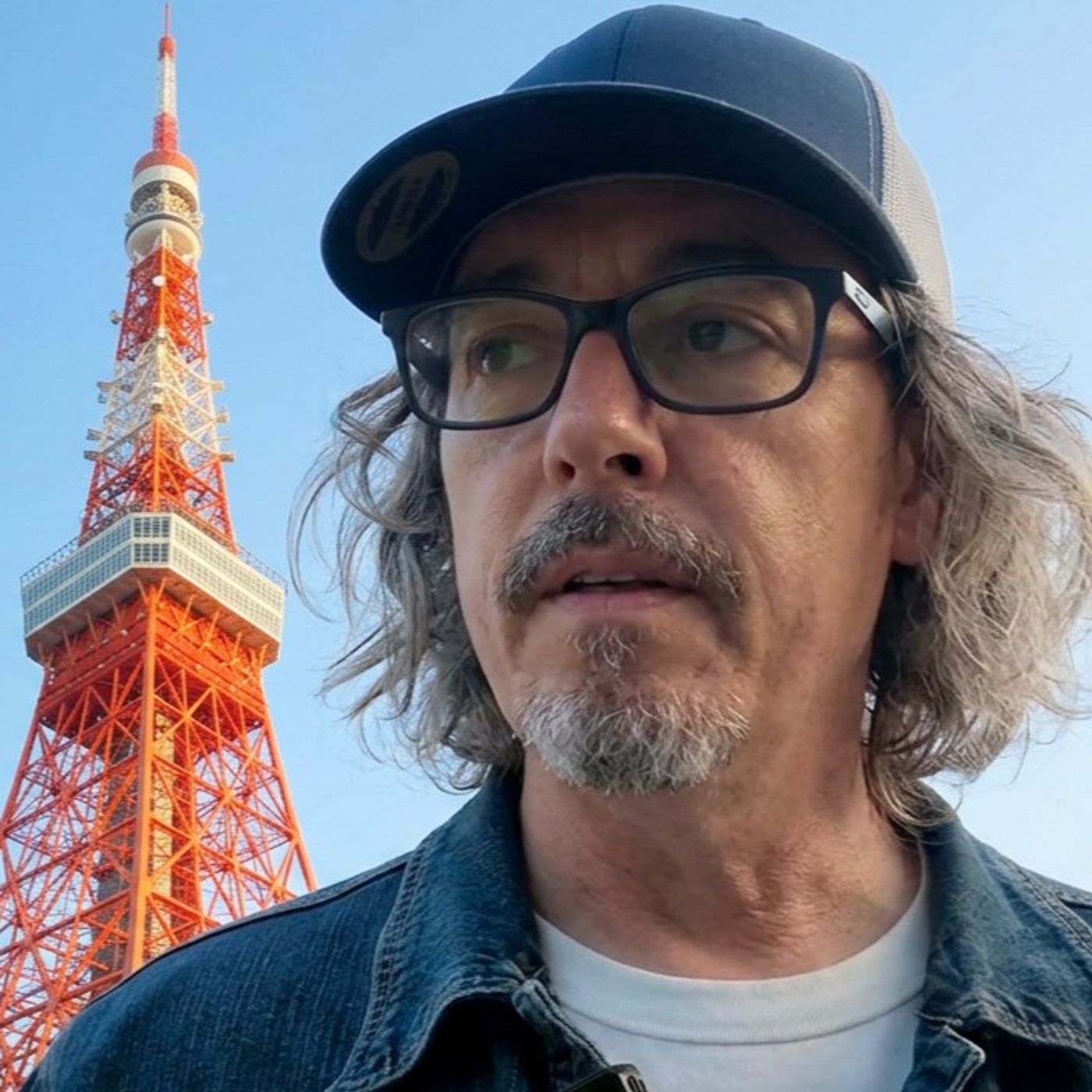
Do New Technologies Have to Kill the Old Ones? | Recorded at Tokyo Tower, Tokyo, Japan
A new transmission from An Analog Brain In A Digital Age, by Marco Ciappelli
Prefer to watch? I recorded this one standing under Tokyo Tower:
On YouTube: https://youtu.be/glGHghhhXWc
On Tik Tok: https://vm.tiktok.com/ZN8MM8Hd9/
On Instagram: https://www.instagram.com/reel/DdlAe7tAOQK/?stkn=NTc4MTIwNjQ2YQ==
I spent twenty minutes looking for the right angle.
A small camera, a mini tripod, a patch of sidewalk that wasn't full of people taking the exact same photo. Behind me, 333 meters of orange and white steel. In front of me, nobody. No guest, no co-host, no second microphone to hide behind. Just me, talking to a lens on the other side of the world.
I've interviewed more people than I can count. It turns out talking alone is a different sport entirely. It felt weird. I decided that was okay.
And this was the right place to feel weird, because Tokyo Tower is a monument to something that should have been replaced and wasn't.
It was born out of a television boom. Once Japan started broadcasting TV in 1953, every new station began raising its own antenna, and the city was heading toward a forest of them. One tower for everyone was the answer. Ground broke in June 1957, and by December 1958 it was open to the public, a country barely more than a decade out of war building something taller than the tower in Paris it so openly borrowed from. The Eiffel silhouette, repainted in international orange and white. Colors chosen not by an artist but by aviation law. A safety regulation that became an identity. Some of the most iconic things we make start as constraints nobody would have picked.
Its job was simple: send television and radio across the Kanto plain. For more than fifty years, that's what it did.
Then the future arrived the way it usually does. Taller. Tokyo Skytree, 634 meters, built because the old tower wasn't tall enough for digital broadcasting. Television moved across the city. By every logic of our time, the story should end right there. Obsolete. Replaced. Maybe demolished, maybe left as a postcard.
Except it's still standing. Still lit every night. Still sending FM radio into Tokyo cars and kitchens. Still on standby, ready to carry the television signal if the new tower ever goes quiet. Still pulling visitors up to its observation decks, where on a clear day you can look across the skyline at the tower that replaced it.
Two towers. One city. Nobody had to choose.
I think about that a lot, and not only in Tokyo.
We live inside a story that treats every new technology as an eraser. AI arrives, so writing is over. Streaming arrives, so records are over. Po
You May Also Like
Theo - t3․gg
Theo - t3․gg

Jak Piggott
Jak Piggott
The Deep Dive Radio Show and Nick's Nerd News
Nick Espinosa, Chief Security Fanatic

Jack Hopkins
Jack Hopkins

The Cloudcast
Massive Studios

Two Blokes Talking Tech
Trevor Long and Stephen Fenech

Daily Tech News Show
Tom Merritt

Artificial Intelligence Masterclass
AI Masterclass

Programming Tech Brief By HackerNoon
HackerNoon

No Tiene Nombre
elbruno
Theo - t3․gg
Theo - t3․gg
Jak Piggott
Jak Piggott
The Deep Dive Radio Show and Nick's Nerd News
Nick Espinosa, Chief Security Fanatic
Jack Hopkins
Jack Hopkins
The Cloudcast
Massive Studios
Two Blokes Talking Tech
Trevor Long and Stephen Fenech
Daily Tech News Show
Tom Merritt
Artificial Intelligence Masterclass
AI Masterclass
Programming Tech Brief By HackerNoon
HackerNoon
No Tiene Nombre
elbruno
Community discussion