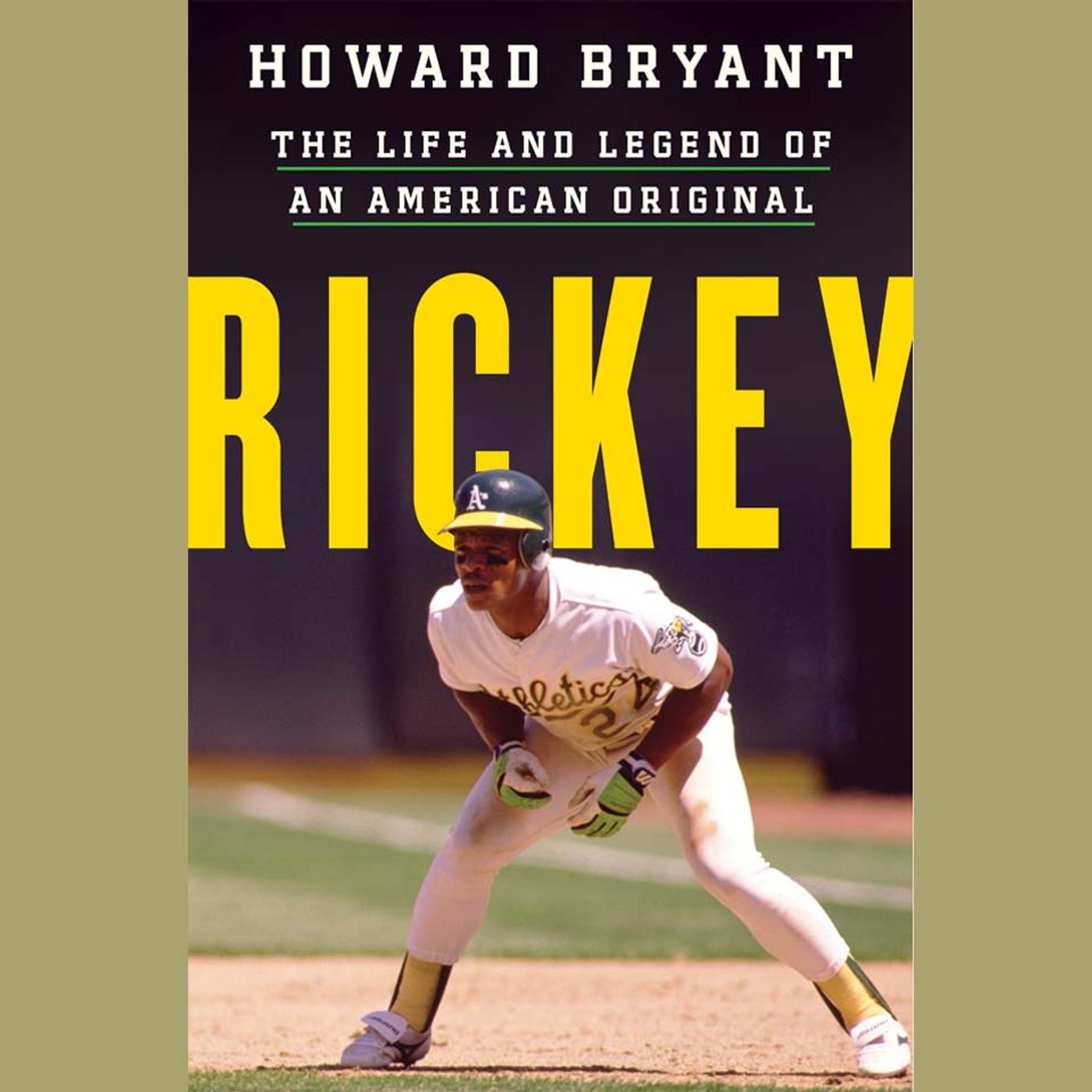
ESPN Senior Writer Howard Bryant, author of Rickey: The Life And Legend Of An American Original
ABOUT HOWARD BRYANT AND RICKEY On June 7, Mariner Books is proud to publish RICKEY: The Life and Legend of an American Original by Howard Bryant-acclaimed sports journalist and three-time nominee for the National Magazine Award. Bryant is also the author of nine previous books, including The Last Hero: A Life of Henry Aaron, The Heritage: Black Athletes, A Divided America and the Politics of Patriotism, and Juicing the Game: Drugs, Power, and the Fight for the Soul of Major League Baseball. Now, he offers the definitive biography of Hall of Famer Rickey Henderson, baseball's epic leadoff hitter and base-stealer who dazzled fans over four electric decades in the game. Few names in baseball history evoke the excellence, dynamism, and curiosity of Rickey Henderson. The panther-like strides off first base. The fingers wiggling, a sign of imminent threat-and then Rickey was gone: the powerful headfirst slide into second base in an eyeblink. On and off the field, Rickey was explosive, unique, electric, and the most polarizing and enigmatic player in baseball. In the hands of critically acclaimed sportswriter and culture critic Howard Bryant, RICKEY is one of baseball's greatest and most original superstars finally getting his due. Bryant draws on scores of interviews with many of baseball's top players, managers, and professionals, as well as conversations with Rickey himself and his longtime wife, Pamela Henderson. The result is the first and only book to comprehensively cover the baseball legend's life and full career. Moreover, Bryant chronicles the evolution of baseball over the past five decades into the era of free agency, pay equity for Black players, the emergence of napologetically flamboyant Black athletes like Rickey, and resistance to all of this from baseball's overwhelmingly white establishment. Bryant also tells a broader story of Black America, the promise of the Great Migration from the Deep South to the North and West, and the overall influence of sports on American culture, most notably in the context of Rickey's hometown of Oakland, California. Rickey's achievements have long been undeniable. From 1979 to 2003, he played 24 seasons in Major League Baseball with nine different teams: the New York Yankees, the Toronto Blue Jays, the San Diego Padres, the Anaheim Angels, the New York Mets, the Seattle Mariners, the Boston Red Sox, the Los Angeles Dodgers, and four separate stints with his original team, the Oakland Athletics. Widely recognized as the sport's greatest leadoff hitter and baserunner, the so called "Man of Steal" holds the all-time major league records for career stolen bases, runs, unintentional walks, and leadoff home runs. Rickey is the only player in the history of the game to have surpassed a combination of 3,000 hits, 2,000 runs, and 2,000 walks-not Ruth or Cobb, DiMaggio or Mantle, Mays, or Aaron. Inducted into the Baseball Hall of Fame in 2009 on his first ballot appearance, he was the American League's Most Valuable Player in 1990, a ten-time American League All Star, and the leadoff hitter for two World Series championship teams: the 1989 Oakland A's and the 1993 Toronto Blue Jays. Grandstander or all-time great? For many years, Rickey's feats on the field were overshadowed by his reputation as a disrespectful underachiever-a player not fully committed to the game or sufficiently deferential to its hallowed traditions. He delighted fans with "Rickey Style"-antics like his "snatch-catch," his meandering "wide turn" approach to the base line after hitting a home run, and his "pick" at his jersey after a particularly satisfying play. But he was also disparaged as an arrogant, self centered "hot dog" who sat out too many games, nursed dubious injuries, and neglected to learn the names of teammates and umpires. Or as the legendarily dysfunctional Yankees owner George Steinbrenner once memorably put it, Rickey too often was "jaking it" (milking an injury). The situation wasn't helped by the mutually antagonistic relationship between Rickey and the press, his habit of shouting "It's Rickey Time!" as he burst into the locker room, or his often-hilarious malapropisms. While playing for the Yankees, for example, he lived in an apartment across the Hudson River from Manhattan in Hoboken, New Jersey, from which he claimed to be able to see the "Entire State Building." But as Bryant observes, the amusement at Rickey's expense was unquestionably fed by racial and class prejudice. For "underneath the laughter was the cruelty of inequity," Bryant writes. "There was no question that Rickey suffered from an early reading disability that had not been addressed, that his education had not received adequate attention, and no question that his athletic ability had reduced the academic rigor required of him in the classroom, allowing him to play sports and not learn." [p. 347] Nevertheless, Rickey's keen intelligence was recognized by none other than renowned Yankees manager (currently New York M
You May Also Like

Les Nuits de France Culture
France Culture
Thomas Paine Podcast
mike moore

Under the Influence with Jo Piazza
Jo Piazza
ReThinking
TED

El Faro
SER Podcast

Promo Estereo Podcast
PROMO ESTEREO PODCAST

Almanacco del giorno
Streammo
The Documentary Podcast
BBC World Service

Money Making Conversations Master Class
Rushion McDonald

Värvet
Acast
Les Nuits de France Culture
France Culture
Thomas Paine Podcast
mike moore
Under the Influence with Jo Piazza
Jo Piazza
ReThinking
TED
El Faro
SER Podcast
Promo Estereo Podcast
PROMO ESTEREO PODCAST
Almanacco del giorno
Streammo
The Documentary Podcast
BBC World Service
Money Making Conversations Master Class
Rushion McDonald
Värvet
Acast
Community discussion