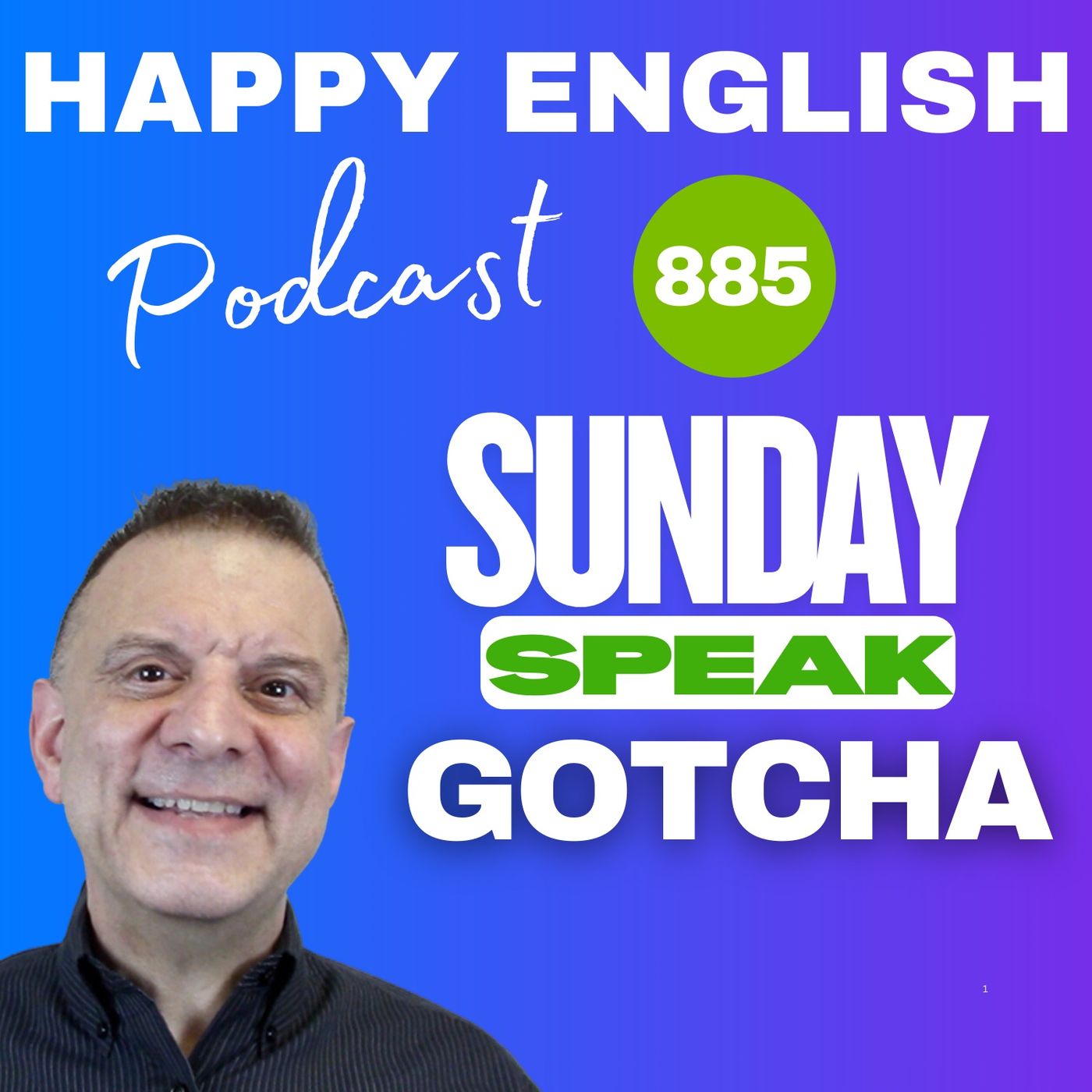
885 - Sunday Speak - How To Use Gotcha To Show Understanding In English
Hey there! It’s Michael here — and welcome back to another Happy English Sunday Speak. Every Sunday, I’ll be here with a quick one-point tip to help you speak English more naturally.
One thing you need to know how to do in English is to communicate that you understood what someone said. Like if someone gives you directions on the street. You could say, Oh ok, I understand. And sure, that’s correct English — but it can sound a little formal or stiff in everyday conversation. In everyday, English conversation, we use the compact form of I understand, gotcha. Gotcha is the short and quick version of “I got what you said.” “I gah-twa-cha-said” “gotcha!
Like, your friend says, “Let’s meet at 7 instead of 6.” You can just reply, “Gotcha.”
Or your coworker says, “Don’t forget to send that email before lunch.” You can answer, “Gotcha.”
Or if someone gives you directions — “Turn left at the bank and then right at the station.” — you can simply say, “turn left, and then right. Gotcha.”
It’s short, it’s casual, and it sounds super natural. So next time instead of “I understand,” try saying “Gotcha.”
So what do you think of these Sunday Speak podcasts? Leave a comment below!
Join my Podcast Learner's Study Group here: https://www.myhappyenglish.com/plsg
Visit my website for over 3,000 free English lessons: https://www.myhappyenglish.com/
My AI English Tutor is HERE
The Happy English Podcast
Helping people speak English better since 2014
Over 1,000 episodes • 8 million downloads
📘 Get free weekly English lessons plus instant access to my FREE Vocabulary Workshop.:
https://learn.myhappyenglish.com/free-english-lessons
🎥 Watch video versions of the Happy English Podcast on YouTube
https://www.youtube.com/@HappyEnglishNY/podcasts
🌐 Learn more about my English lessons and courses
https://www.myhappyenglish.com
You May Also Like

Motivational Speeches
Motivationly

La vie suffit !
Chloé Bloom
Kabbalah Media | mp3 #kab_eng
Bnei Baruch Kabbalah Education and Research Institute, Бней Барух – Ассоциация "Каббала Ла-Ам"

Heal Squad x Maria Menounos
Heal Squad

I Love Public Speaking with Bishal Sarkar
Mr. Bishal Sarkar
Kabbalah Media | mp4 #kab_fre
Bnei Baruch Kabbalah Education and Research Institute, Бней Барух – Ассоциация "Каббала Ла-Ам"

60 Seconds of Hope with Horace McMillon
Horace McMillon

Shimon Davis
Shimon Davis
Das Kalenderblatt
Bayerischer Rundfunk

Learn Polish Podcast
Roy Coughlan
Motivational Speeches
Motivationly
La vie suffit !
Chloé Bloom
Kabbalah Media | mp3 #kab_eng
Bnei Baruch Kabbalah Education and Research Institute, Бней Барух – Ассоциация "Каббала Ла-Ам"
Heal Squad x Maria Menounos
Heal Squad
I Love Public Speaking with Bishal Sarkar
Mr. Bishal Sarkar
Kabbalah Media | mp4 #kab_fre
Bnei Baruch Kabbalah Education and Research Institute, Бней Барух – Ассоциация "Каббала Ла-Ам"
60 Seconds of Hope with Horace McMillon
Horace McMillon
Shimon Davis
Shimon Davis
Das Kalenderblatt
Bayerischer Rundfunk
Learn Polish Podcast
Roy Coughlan
Community discussion