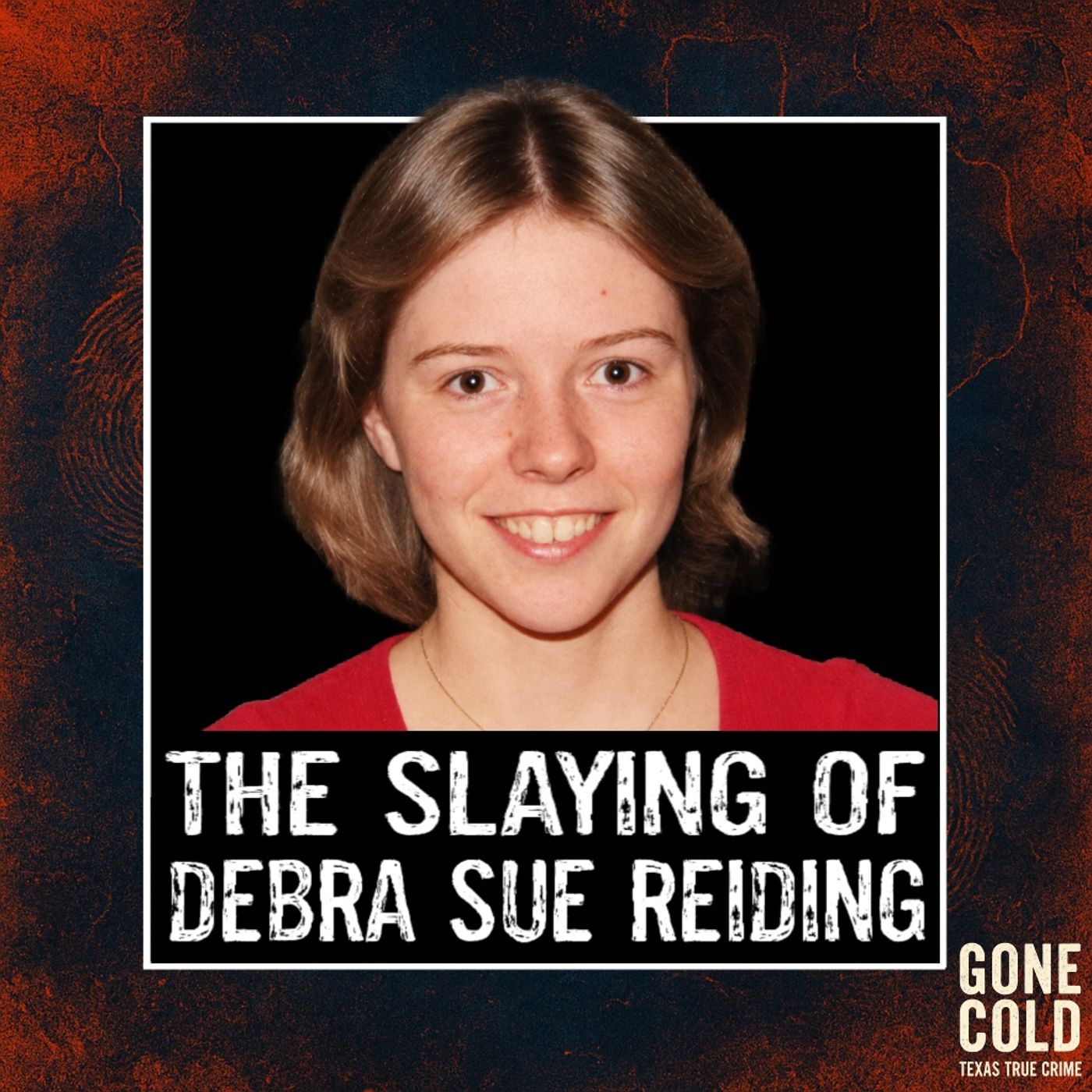
0:01 The Gone Cold podcast may contain violent or graphic subject matter. 0:05 Listener discretion is advised. In the 1970s, police in Austin, Texas, couldn't get a break from the savage and seemingly motiveless homicide cases that they'd began calling faceless crimes due to the lack of evidence. As soon as the trail of 0:25 leads dried up on one case, another almost always followed. 0:31 A handful of murders in the capital city's south and southwest ends proved to be especially difficult. First, in February of 1975, at the southwest Austin apartment she shared with her husband, 21-year-old Phyllis Lee Buto was found brutally stabbed 0:51 to death nearly a dozen times in her hand, arms, chest, back, and neck. Not a soul had seen or heard anything, and the story quickly disappeared from news reports, until when, in June of the same year, 18-year-old Martha Lynn Reed 1:10 was slain. Martha had also been repeatedly stabbed in her upper body and her throat slashed by a still-unknown man who had pretended to be interested in viewing an apartment at the complex she lived in and managed. Phyllis Butoh 1:28 also managed the apartment complex where she lived, and Austin police detectives discovered evidence that a man who seemed disinterested in renting or deceptive in his desire to rent had tried to lure other apartment managers into vacant units. Police 1:46 also considered the fact that both Phyllis and Martha were killed on Mondays in the morning hours a significant similarity. 1:55 neither woman was sexually assaulted. Though a witness provided a description of a suspect in the case of Martha Reed, her case also went cold relatively quickly. In June of 1977, the charred remains of 23-year-old Victoria Sue Palmer were found 2:15 after firefighters responded to the scene of a blaze in south-central Austin. She'd been shot and her throat slashed before the depraved perpetrator set fire to her apartment. The following year, within the two-square-mile perimeter of where all three of these 2:35 slayings took place, the body of 66-year-old widow Hazel Oletta Ivey was found. She'd been suffocated as her killer raped her. 2:46 Because she didn't fit the victim profile, Considering both specific descriptors and cause of death, police discounted a connection between Hazel's murder and those of Phyllis Buto, Martha Reed, and Victoria Palmer. Within months, however, the heinous crime against another 3:06 woman would have the cops scrambling when the body of 18-year-old Deborah Reading was discovered at her South Austin apartment. 3:37 Deborah Sue Wilt was born in Enid, Oklahoma, on October 18, 1960, to parents Harvey and Dolores Wilt. Less than a year and a half later, Dolores and Harvey welcomed a baby boy into their lives, Deborah's brother, Rodney. As a military family, 3:57 the Wilts moved around the United States semi-regularly until 1973, when Harvey retired from service. The family settled in the sunny slope area of Montana, near the heart of the Rocky Mountains. In Choteau, Montana, the Wilts operated a hamburger 4:16 joint called the Log Cabin Drive-In. The establishment was a popular hangout for locals, a staple in the quaint and idyllic northwestern Montana town, and in 1977, Harvey Wilt became a partner in the business. Deborah attended Fairfield High School 4:36 her freshman, sophomore, and junior years, where she was in the pep club, sang in choir, and worked on the yearbook staff. Her senior year, Deborah transferred to Choteau High School. 4:50 After she graduated in 1978, Deborah Sue Wilt was ready to escape small-town life. Her dream was to become a cosmetologist. 5:02 Under her senior yearbook photo, Deborah's nicknames are listed, Debbie and Trouble. The latter was perhaps an endearing moniker given to the warm, outgoing teenager for a predilection for pulling pranks, but most of her classmates, friends, and family referred to 5:21 her as a cheerful and loyal friend who was always willing to help someone out of a jam. Also, under her senior pictures, Deborah's after-graduation plans could be found. They were simple and read, quote, work at the log cabin till I have enough money to move out of this town, 5:42 end quote. Whether she knew it or not, when she submitted those words to the Choteau High School yearbook staff, that plan was set in motion when, on November 18, 1978, she married local young man and ex-high school football star 5:59 Robert Readings who'd graduated from Choteau High a few years before her. Seeking to escape the bitterly cold Montana winter, and since his uncle owned an air conditioning parts manufacturing plant down in Texas, newlyweds Robert and Deborah Reading headed 6:19 to the state's capital to enjoy the moderate climate and make some money while they did. The drive down was their honeymoon, in fact, and they took their time getting there, as they checked out the sights along the way. Upon 6:34 arriving in Austin in early December 1978, Debra and Robert Reading moved their few things into the Cascades Apartments on the 1200 block of Algarita Avenue in the city's south. 6:48 They planned to go back to Choteau eventually, but for now, the couple was settling into life in Austin. The weather notwithstanding, there was plenty there to remind the couple of home. Cowboys, or ropers, could be seen practically everywhere, and the nightlife, 7:07 even at the rock and roll joints, had a western feel. 7:12 Perhaps another attempt to ward off homesickness, Debra landed a job hosting at local bar and grill-style restaurant, the Montana Mining Company, working their lunch rush shift, 11 a.m. to 2 p.m. Though the establishment was founded in El Paso, Texas, 7:32 the name alone might have been a comfort. Most likely, Debra chose to work there because of the restaurant's close proximity to where the couple lived, and because she'd been passed on when she applied for an assistant manager position 7:46 at the Cascades Apartments due to her age and inexperience. 7:52 Every now and then, she'd pick up a 4 to 9 p.m. shift, but because Deborah and Robert did without a telephone in order to make ends meet, she was hard to get a hold of. The job at Montana Mining Company wasn't much, anyway, but it supplemented Robert's salary 8:10 just enough to get by and save some. The winter of 1979 proved to be a little colder than most in Austin. but it was still a relief from what they would have seen had they stayed in Montana. Deborah was getting along with her neighbors and co-workers well. All 8:30 found her to be a delight. Even the manager of the apartment complex where she and Robert lived was taken by the young woman. She said Deborah was the type of person you fall in love with immediately upon meeting them. Together, 8:46 neighbors described Deborah and Robert as a friendly and loving couple. 8:52 They'd taken in a small dog, a peek-a-poo, which gave Deborah good company while Robert was away at work. While their young romance was all hearts and flowers, seemingly, getting by was difficult. Like most young folks setting out to 9:09 make it on their own, The couple struggled some as they pinched every penny and made do with the scant amount of items they brought from Montana, little more than their clothes, a couch, and a bed. Despite all this, and by all known accounts, the newlyweds were getting along 9:27 fine in their new surroundings and with each other. At about 5.40 p.m. on Monday, January 22, 1979, Robert Reading turned the knob on the front door of Cascades Apartment 137. Deborah, who was most often close by, or at least making her way toward the door when she heard it open, 9:52 had not made herself known. All Robert heard after entering was the whimpering of their new dog as he walked. 10:00 through the door. It was not the canine's usual excited whimper the young man knew, but instead an anxious and alerting one. Robert quickly made his way down the short, narrow apartment hallway toward his and Deborah's bedrooms. There, in 10:18 the bed, under the covers, he saw the obvious outline of his wife's body, a pillow placed atop her head. 10:27 Robert removed the pillow, then pulled back the covers. He was shocked and horrified to find Deborah deceased, bound, gagged, and positioned on their bed in a way that suggested rape was the motive. Robert Reading ran to a convenience 10:46 store payphone about a block away to call police. When the Austin police arrived at the scene of 18-year-old Deborah Sue Reading's murder, they were in disbelief. It wasn't as though they hadn't seen many brutal, senseless, and frankly bizarre 11:15 homicides in the past several years. To the contrary, they'd seen plenty. But this one, detectives thought, was different. An experienced sex crimes unit officer told a reporter for the Austin American-Statesman that sexual bondage was the key to finding 11:35 the killer. A police photographer tactlessly described the scene as ghoulish. 11:43 One anonymous source who claimed familiarity with the evidence collected at the scene told the newspaper that the killing was ceremonial, likely a descriptor that's more a sign of law enforcement beliefs at the time than something that has any bearing 11:59 on reality. Still, there is no denying the depravity with which the sadistic crime was carried out. When she was found, Deborah was laying face up with her hands bound behind her back. She wore only her lightweight flannel nightgown and robe. 12:19 Her legs were apart, and there was evidence that each one had been bound separately at some point. The killer used a markedly sharp blade to cut Deborah once across her shoulder and twice across her neck. It wasn't meant to cut deep enough to cause her death, only to 12:38 torture her. Deborah's death was caused by a combination of manual strangulation and asphyxia by gagging. Travis County Medical Examiner Dr. 12:51 Roberto Bayardo told the press that he found no conclusive evidence the young woman had been raped, though he had sent some to be tested. Austin police detectives, meanwhile, wholeheartedly believed Deborah was sexually assaulted post-mortem, her face and eyes covered, 13:11 they thought, as the monster performed his sick act. Dr. 13:16 Beardo never alluded to such. Before too much time had passed, the newspapers began reporting that Deborah was indeed raped. Robert Reading, police made clear to reporters relatively quickly, was not a suspect in his wife's murder. Although it seemed strange at 13:38 the get-go that the young man went all the way to a convenience store payphone to report Deborah's violent death to police instead of simply alerting a neighbor, it was easily and reasonably understandable. When he saw the body of 13:53 his partially unclothed wife, the unusual bindings and strange cuts, police figured he immediately went into shock. Unable to make sense of what he'd seen, let alone collect and hold a single thought, it never occurred to him to go 14:09 to a neighbor's apartment. He was, after all, accustomed to using the convenience store payphone. Detectives theorized, and the medical examiner estimated, that Deborah was killed between 7 and 11 a.m. 14:25 Robert left the apartment for work at approximately 6.50 a.m., and Deborah was supposed to be at work by 11. 14:34 She probably would have been at the apartment office using their phone to call the Montana Mining Company to ask for a ride in well before that. A Relative presumably of Roberts, came by the newlyweds' home in the early afternoon, 14:51 but there was no answer at the door. Virtually every apartment neighbor of Deborah and Robert Reading reported that the complex seemed especially quiet on the day of the murder, even the woman who lived directly above the couple. Since 15:08 there were no signs whatsoever of forced entry, Detectives were working under the assumption that either Debra knew and trusted her killer, or she'd answered a knock at the door, and he forced his way in. They also discovered that 15:23 the patio door was unlocked, which provided a third theory. 15:28 And considering the fact that there wasn't evidence of a struggle anywhere in the apartment, it seemed just as plausible the perpetrator snuck in while Debra was in bed. It should be noted that the readings had very little furniture 15:43 or belongings, so it was possible a struggle occurred without leaving telltale signs. Whatever the case, and whether he knew the couple or not, police commented, the suspect was almost certainly familiar with their routine. Every possible scenario seemed to 16:02 indicate at least that much. Within days, Robert Reading was given a polygraph examination and was determined to be telling the truth when claiming no knowledge of the death of his wife, Deborah Sue Reading. Although they'd considered many facets 16:21 of the case quite different than the others they'd seen in recent years, it was also similar in many ways. 16:29 There were no witnesses. Deborah's profile matched that of victims Phyllis Butoh and Martha Reed both slain in 1975 and Victoria Sue Palmer, who was killed in 1977. All women were young, petite, and known to be friendly and trusting. 16:49 All the terrible crimes took place in South or Southwest Austin. 16:55 Austin police detectives expressed optimism as far as finding the person who murdered Deborah Sue Reading within a reasonable period of time. but newspaper and television reporters could read between the lines. Using the go-to, everyone's a suspect, often meant 17:13 detectives had no good suspect at all, and everyone's a suspect is exactly what they said. They viewed the killing as ritualistic and commented that they were sure this person had struck before, and will strike again. Ultimately, the cops 17:34 decided there was no connection between Deborah Reading's case and the others slain within the two-mile radius of South and Southwest Austin they were looking at. Though the police were diligent in checking out the few leads they had, Deborah's 17:49 murder case grew cold. As was the situation with all the other area unsolved murders, they began pleading with the public to come forward with information. Someone saw something, whether they knew it or not, lawmen believed. It was becoming 18:08 a pattern. It seemed that the department's officers and detectives were neither equipped nor trained to handle such cases. Deborah Sue Reading's case was at least partially stifled by the fact that she was new in town. Though she and 18:26 Robert had made plenty of acquaintances during the two months they'd been in Austin, they hadn't necessarily made close friends yet, and in all probability, had not had time to make any bitter enemies. Though detectives did a good job withholding 18:43 information from the press and in turn the public, it became apparent much later that a co-worker of Deborah's at the Montana Mining Company restaurant was on a short list of suspects. 25-year-old Michael Anthony Galvan quit his job at 19:00 Montana Mining Company about a week before Deborah's murder and began working at a different establishment. As police tracked down everyone who knew the slain woman, Galvan denied ever having met her, something detectives discovered was not true. Deborah almost 19:20 always asked her colleagues for rides to and from work, And on at least a couple of occasions, police learned, Galvan was happy to oblige. But lying to the cops hardly makes someone guilty of murder, and the Austin police 19:37 had absolutely no evidence that put Michael Anthony Galvan at the scene of the crime. The case was officially cold. 19:49 Multiple serializers of rapes and murders continued taking place in the Texas State Capitol in the following decades. The murders of Susan Lee Wolfe in 1980 and Connie Jane Bibb in 1986 were among the cases that still awaited justice. 20:07 They still do today in 2023. Surprisingly, there appear to have been no attempts by the Austin police to seek a confession from Henry Lee Lucas for Deborah Reading's murder, even though his whereabouts during this period of 1979 are 20:24 almost completely unaccounted for. It's the exact opposite of how law enforcement jurisdictions usually used Lucas and or his friend Otis Toole. Through the years, Deborah's little brother, Rodney Wilt, continually reminded police that his sister's case was still unsolved, 20:46 prompting some fresh eyes to give it a look. But there were never any results. But after a few decades, there finally were. About a decade after the formation of the Austin Police Department's Cold Case Unit, the 1979 unsolved 21:15 murder of Deborah Sue Reading was reopened. It was spring of 2013 when Detective Jeff Gabler picked up Deborah's case file. 21:26 He quickly became interested in a man who had never been ruled out as a suspect, a co-worker of Deborah's at the Montana Mining Company. Though different detectives had visited and questioned this man many times in the past 36 years, 21:43 Michael Anthony Galvan always refused to provide them with a DNA sample. In fact, he was the only person of interest in Deborah Reading's murder who'd refused. The man's prior record added to Gabler's enthusiasm that he'd gotten his guy. 22:02 It included a 1981 arrest for peeping into residential windows and a charge in 1987 for assaulting his girlfriend. The detective wasted no time. In mid-April of 2013, he asked the Texas Department of Public Safety to review evidence in 22:22 which they determined plenty was suitable for DNA testing. By the end of the month, Gabler had Galvan surveilled. When he discarded a toothpick after eating at a restaurant, officers collected it and it was sent to DPS labs for testing. 22:40 In the meantime, during the four-year period the case was awaiting movement, Austin.com included Deborah Sue Reading as one of the city's most notorious cold case murders. It might sound sensational, but the list was actually beneficial. because everyone listed was 23:00 far lesser known than the actual most notorious crime in the Texas capital city. Deborah's name accompanied Esther Broberg, murdered May 22, 1983, Ernest Vasquez Jr., murdered April 27, 1985, Natalie Antonelli, murdered October 13, 1985, and Steve Longoria, murdered 23:14 March 7, 1993. For whatever reason, it was four years until a search warrant was obtained for Michael Anthony Galvan's DNA in July of 2017, which police said positively matched a DNA profile lifted from a semen stain on the robe Deborah Sue Reading was wearing when she was slain. 23:48 But the match took time. As they awaited the results, detectives questioned the suspect. For a while, he continually denied he knew Debra, but the man finally admitted to knowing her and told police he'd dropped her off at home after her shift a few times. When the results of 24:09 the DNA test came back as a match, Galvan changed his story again and told the cops that he and Debra had been having an affair. 64-year-old Michael Anthony Galvan was arrested on May 24, 2019, after a jury indicted him on one count of capital murder and one count 24:30 of murder. Galvan had lived in Austin practically the entire past four decades and had long worked as a barber. 24:39 The suspect's bond was set the previous month at $ 750, 000. 24:46 Although her father had died in 1998 without seeing the man who killed his daughter put behind bars, the rest of Deborah Reading's family, her brother Rodney and mother Dolores, were thrilled that justice was on the horizon. But then, 25:03 everything flipped. In September of 2019, with the scheduled trial date only days away, Michael Anthony Galvan was released from the Travis County Jail. Prosecutors announced that they were testing other items of evidence and that the trial could not 25:21 proceed without the results. Then came the final nail. A new trial for Michael Anthony Galvan was set to take place in April of 2020, but the COVID-19 pandemic shut down Travis County criminal trials. It didn't matter. On Thursday, 25:41 November 14, 2020, the Travis County District Attorney's Office announced that they had concerns about the strength of the case against Galvan. They filed a motion to dismiss all charges. 25:56 Galvan's lawyer, known as one of Austin's top criminal attorneys and colloquially as the Queen of Acquittals, Amber Vasquez, refused to accept. Vasquez had done plenty investigating of her own by hiring independent crime scene experts and exploring alternative suspects 26:17 by methods that included old-fashioned, boots-on-the-ground detective work. The investigation took her across her city, to Montana, and even to Washington, D.C. 26:30 She looked forward to exonerating her client in a court of law. Telling District Judge Brad Yerusha she wanted to shut down the DA's chance of being able to try Galvan again and that he deserved his day in court, Vasquez asked that the trial go forward. Ultimately, however, the 26:52 charges were dismissed. After reviewing the evidence Attorney Amber Vasquez uncovered, Deborah Reading's brother believes Michael Anthony Galvan is innocent of the murder of his sister. He told us over email that neither the Travis County District Attorney's Office nor the 27:12 Austin Police Cold Case Unit are willing to pursue the evidence Vasquez uncovered. It also appears authorities have no other avenues to pursue concerning Galvan. After charges were dismissed, Then, 67-year-old Michael Anthony Galvan started the GoFundMe, Donate to Michael 27:34 Galvan's Documentary. Donate, the campaign says, so I can tell my story of how I was wrongly charged, arrested, and persecuted by Travis County, Texas District Attorney and Austin Police Department. 27:49 He raised $ 700. If you have any information about the murder of 18-year-old Deborah Sue Wilt Reading in January of 1979, please call the Austin Police Homicide Tip Line at 512-477-3588, the Homicide Unit at 512-947-5210, or Capital Area Crime Stoppers 28:08 at 512-472 If you have not already, look for Gone Cold on Instagram, Facebook, and Twitter by searching Gone Cold and looking for the Texas logo. If you'd like to support the show and get the episodes ad-free, go to patreon.com 28:41 forward slash gonecoldpodcast. Thanks to all of you who support us there. It's a huge deal to us. If you're not in a position to help Gone Cold financially but would like to in some other way, well, I've got just the thing. Leaving us a 5-star rating and written 29:01 review on iTunes particularly helps Gone Cold's visibility. The more folks who find us and listen, the greater chance someone with information about a case hears the show and comes forward with what they know. Every little bit helps, and 29:17 we appreciate y'all's support immensely, however you choose to give it. 29:22 Sources for this episode can be found in the episode's show notes. Thanks for listening, y'all.










Community discussion