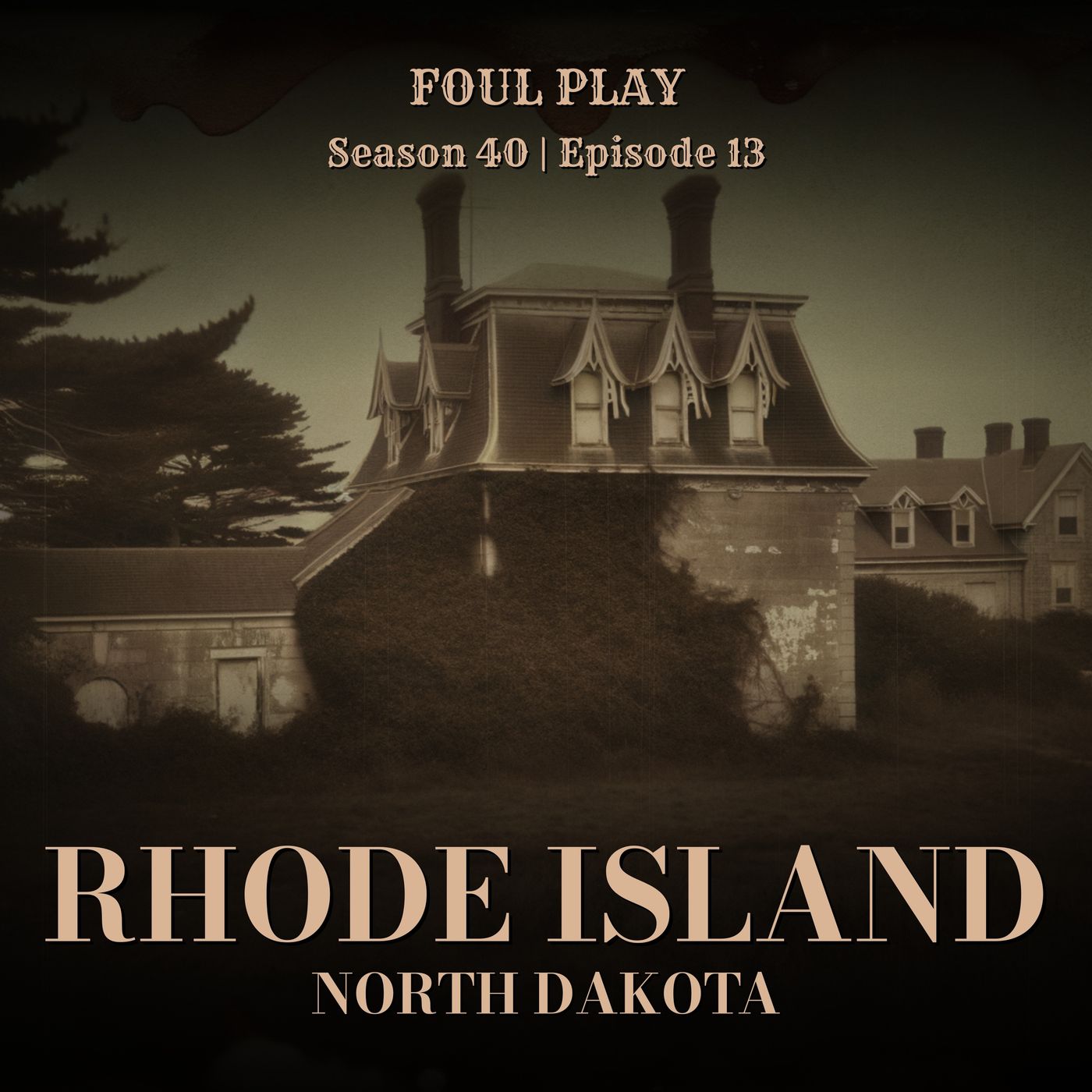
Rhode Island & North Dakota: Who Killed the King?
Season 40: America's 250th Anniversary -- 50 states, 25 double-feature episodes. This is Episode 13, coveringRhode Island and North Dakota with two true crime cases from the 1880s and 1890s that circle the samequestion: who do you believe when the dead cannot speak?October 1885. A wealthy Black businessman in Newport, Rhode Island, is found dead at his kitchen table -- twogunshot wounds, unchewed bread still in his mouth. The city calls it suicide before the day is over. Eight yearslater, a hired hand in North Dakota murders six members of the family that trusted him, and a fifteen-year-oldgirl walks barefoot to town to report it.Both killers were inside the circle. Both were trusted. Both destroyed the people who let them in. This episodeexamines what trust costs in a country still deciding which lives deserve investigation and which can be dismissedwith a shrug from the mayor's office.The VictimsBenjamin J. Burton was the wealthiest Black businessman in Rhode Island when he was killed in October 1885.He had arrived in Newport around 1845 from Connecticut and spent four decades building a baggage transferempire -- the Original Express and the Bellevue Avenue Express Line -- moving trunks between the wharvesand the Gilded Age mansions. Burton was a civil rights organizer who helped desegregate Rhode Island's publicschools in 1866, working alongside Isaac Rice and George T. Downing. He was fifty-nine years old. He had beeneating breakfast when he was shot.Daniel and Barbara Kreider were a Mennonite farming family who had relocated from Lancaster County, Penn-sylvania, to a homestead southeast of Cando, North Dakota. Daniel was born in 1856; Barbara came from oneof Lancaster County's most established Mennonite families -- the Rissers, whose meeting house had been incontinuous operation since the 1700s. By summer 1893, they had eight children. Four of those children -- Bernice,thirteen; Murbey, eleven; Mary, nine; and David, seven -- were killed alongside their parents on the morning ofJuly 7, 1893.The CrimesIn Newport, Burton's son-in-law Allen Dorsey -- a medical student at the University of Pennsylvania, one year fromfinishing his degree -- shot Burton at 63 Levin Street on October 6, 1885. The wound sequence was medicallydamning: a shot to the head first, a shot to the heart second. No powder burns. Unchewed bread in the victim'smouth. The city ruled it suicide anyway. The coroner signed off. The mayor ridiculed the idea of murder.In North Dakota, Albert Bomberger -- a twenty-two-year-old hired hand who had lived with the Kreider family forfive years -- killed six family members with a shotgun in thirty minutes after the eldest daughter, Annie, rejectedhis advances and her father told him to leave. After the killings, Bomberger forced fifteen-year-old Annie to cookhis breakfast while the bodies lay in the rooms around her. He ate, ransacked the house, beat Annie with a rope,and fled toward Canada on a stolen pony.The InvestigationIn the Burton case, Newport's official investigation went nowhere. The community Burton had spent forty yearsbuilding ran a parallel investigation through church and civic networks. Seven weeks later, Burton's youngerdaughter Emmie came forward and named Allen Dorsey as the killer and Maria Dorsey as complicit. Her testimonymade prosecution possible. The trial began in late June 1886. Allen and Maria Dorsey were convicted andsentenced to life. Emmie was also convicted -- she had served as lookout -- and died of consumption in the prisoninfirmary within six months. In June 1887, the Burton case was presented to the American Medical Associationat their 38th Annual Meeting as an example of physical evidence clearly indicating murder that official authoritychose to read otherwise.Annie Kreider walked to Cando barefoot. No shoes, no horse, no telephone. Her testimony was the entirefoundation of the prosecution. Bomberger was captured at Deloraine, Manitoba, three days later. The threat oflynching was...
You May Also Like
Solved Murders - True Crime Stories
RedditKing

The Lets Read Podcast
Audioboom Studios
Hidden Killers With Tony Brueski | True Crime News & Commentary
True Crime Today
Hidden Killers Live! Daily True Crime News & Breakdowns
Hidden Killers Podcast
Situational Awareness Tactics
Circle Of Insight Productions

True Crime Podcast 2025 - Police Interrogations, 911 Calls and True Police Stories Podcast
True Crime Podcast 2026

Legally Brunette
iHeartPodcasts

The Devil Within
EVIO Creative

CRIMES • Histoires Vraies
Minuit

Crime Alert Hourly Update
Crime Online
Solved Murders - True Crime Stories
RedditKing
The Lets Read Podcast
Audioboom Studios
Hidden Killers With Tony Brueski | True Crime News & Commentary
True Crime Today
Hidden Killers Live! Daily True Crime News & Breakdowns
Hidden Killers Podcast
Situational Awareness Tactics
Circle Of Insight Productions
True Crime Podcast 2025 - Police Interrogations, 911 Calls and True Police Stories Podcast
True Crime Podcast 2026
Legally Brunette
iHeartPodcasts
The Devil Within
EVIO Creative
CRIMES • Histoires Vraies
Minuit
Crime Alert Hourly Update
Crime Online
Community discussion