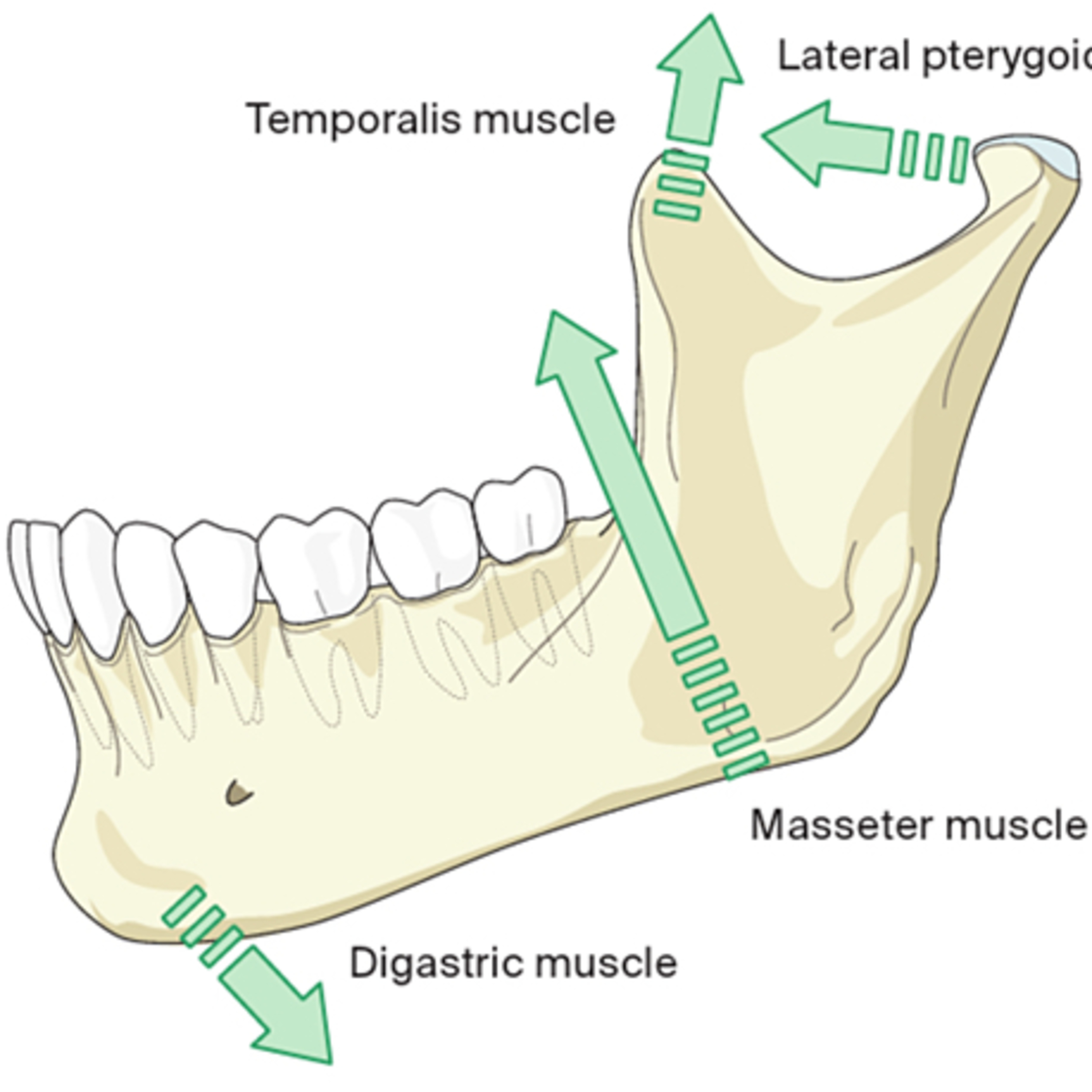
“What Muscle Pull Vectors Affect Displacement of Mandible Fractures?”
12.22.23 Quick Review #83 - #trauma #fracture #facialtrauma #doctorgallagher #oralsurgery #oralsurgeon #dentist #dentistry #dental Muscle pull plays a significant role in the displacement of mandibular fractures. When a fracture occurs, the balance of these forces can significantly influence the displacement of the fracture segments: 1. Symphyseal and Parasymphyseal Fractures: •The muscles involved include the genioglossus, geniohyoid, and mylohyoid muscles. These muscles tend to pull the fractured segments posteriorly and inferiorly, leading to an overlapping of fragments. As fractures progress anteriorly toward the cuspid region, the digastric, geniohyoid, genioglossus, and mylohyoid exert a posterior-inferior force on the distal segment. 2. Body Fractures: •Muscles like the masseter, medial pterygoid, and temporalis tend to pull the upper fragment upwards (due to their attachment above the line of fracture), while muscles such as the digastric and mylohyoid pull the lower fragment downwards. 3. Angle Fractures: •The masseter and medial pterygoid muscles exert an upward pull on the proximal segment, while the pterygomandibular sling (formed by the medial pterygoid muscle) supports the distal segment, reducing its downward displacement. 4. Ramus Fractures: •The temporalis, masseter, and medial pterygoid attached to the medial aspect of the ramas can cause superior and medial displacement of the proximal, fractured segments. 5. Condylar Fractures: •The lateral pterygoid muscle, attached to the condylar head, tends to pull the fractured condylar segment anteriorly and medially, because of its insertion on the pterygoid fovea. This results in a common displacement pattern where the condylar head is displaced towards the middle cranial fossa. The displacement patterns are also influenced by the direction and magnitude of the force causing the fracture and the presence of teeth which can offer some degree of stability to the fractured segments. Understanding these muscle forces is crucial for planning the reduction and fixation of mandibular fractures to ensure proper alignment and healing. References: 1. Tay, A. B., Lai, J. B., Lye, K. W., Wong, W. Y., Nadkarni, N. V., Li, W., & Bautista, D. (2015). Inferior Alveolar Nerve Injury in Trauma-Induced Mandible Fractures. Journal of Oral and Maxillofacial Surgery, 73(7), 1328-1340. 2. Song, Q., Li, S., & Patil, P. M. (2014). Inferior alveolar and mental nerve injuries associated with open reduction and internal fixation of mandibular fractures: a Seven-Year retrospective study. Journal of Craniomaxillofacial Surgery, 42(7), 1378-1381. 3. Bede, S. Y., Ismael, W. K., Al-Assaf, D. A., Omer, S. S. (2012). Inferior alveolar nerve injuries associated with mandibular fractures. Journal of Craniofacial Surgery, 23(6), 1776-1778. 4. Abubaker, A.O., Lam, D., & Benson, K. (2016). OMFS Secrets (3rd ed.). Elsevier. 5. ChatGPT. 2023.
You May Also Like

Hamza Selfimprovement
Adonis Gang

Playlist Culture G : les podcasts pour apprendre chaque jour
Acast France

Lana Blakely
Lana Blakely

Whole Again: A Fresh Approach to Mindfulness and Resilience Through Kintsugi Wisdom
Michael OBrien | Mindfulness & Resilience Coach

Hoy Hablamos: Podcast diario para aprender español - Learn Spanish Daily Podcast
Hoy Hablamos

The Happiness Habit: Building a Joyful and Fulfilling Life
Liquid Studios

Bloco Podcast
Hugo Quinteiro
The Sevan Podcast
Sevan Matossian

Mission To The Moon
Mission To The Moon Media
BHN: Peaceful Empowerment Works
WGSN-DB Going Solo Network
Hamza Selfimprovement
Adonis Gang
Playlist Culture G : les podcasts pour apprendre chaque jour
Acast France
Lana Blakely
Lana Blakely
Whole Again: A Fresh Approach to Mindfulness and Resilience Through Kintsugi Wisdom
Michael OBrien | Mindfulness & Resilience Coach
Hoy Hablamos: Podcast diario para aprender español - Learn Spanish Daily Podcast
Hoy Hablamos
The Happiness Habit: Building a Joyful and Fulfilling Life
Liquid Studios
Bloco Podcast
Hugo Quinteiro
The Sevan Podcast
Sevan Matossian
Mission To The Moon
Mission To The Moon Media
BHN: Peaceful Empowerment Works
WGSN-DB Going Solo Network
Community discussion