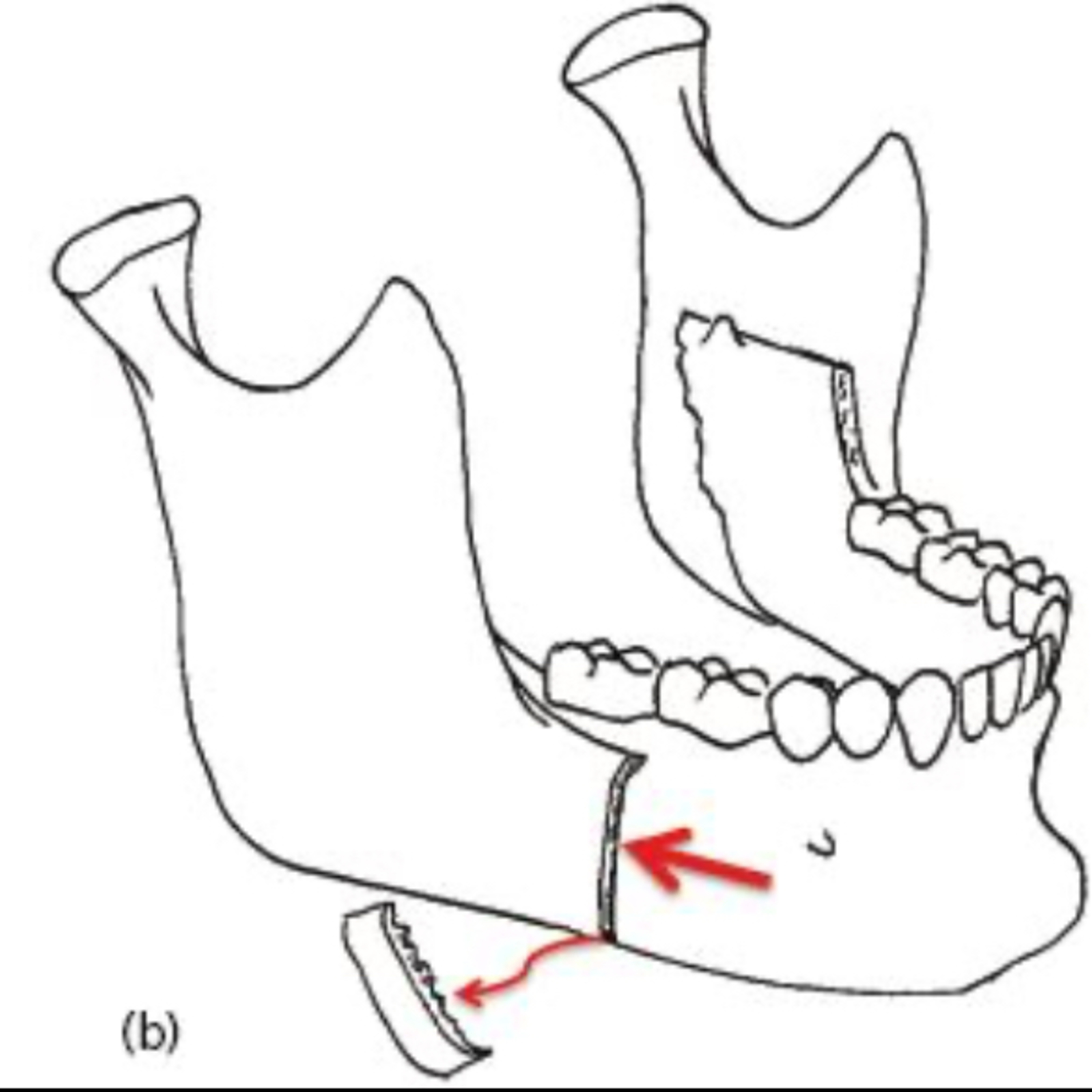
📝 "What is the Biggest Complication of BSSO Mandibular Setback?"
Quick Review #285 - #surgery #surgeon #doctorgallagher #oralsurgery #oralsurgeon #omfs #dentist #dentistry #dental #orthognathics
When evaluating the complications of a bilateral sagittal split osteotomy (BSSO) for mandibular setback, it is important to distinguish between what residents often recall first—relapse—and what examiners emphasize as the single most significant complication: temporomandibular joint (TMJ) disc displacement.
TMJ Disc Displacement occurs when the condyle is improperly seated during fixation or when excessive manipulation of the proximal segment alters joint mechanics. Patients present with preauricular pain, deviation on opening, joint sounds, and limited motion. This makes it the “red flag” complication of BSSO setback on board exams. Prevention relies on precise condylar positioning, meticulous split technique, and avoiding torque across the joint during fixation.
Relapse, although common, is more of a long-term skeletal adaptation rather than an acute postoperative complication. After setback, the suprahyoid musculature (genioglossus, geniohyoid, digastrics) tends to pull the mandible forward, causing gradual drift. Relapse is most pronounced in large setbacks (>7 mm) and in patients with high mandibular plane angles. Rigid fixation provides short-term stability but increases risk if condyles are not perfectly seated. On exams, relapse is tested as a stability issue, not the “biggest complication.”
Inferior alveolar nerve (IAN) injury is another known complication, presenting as numbness or paresthesia of the lower lip and chin. However, this is generally considered a frequent but expected risk rather than the most serious complication.
Finally, airway considerations play an important role in orthognathic planning. Setbacks reduce oropharyngeal airway space, which can worsen sleep apnea risk. Yet, this is viewed more as a long-term functional consequence than the immediate intraoperative complication tested.
Key distinctions for exams:
- Most significant complication: TMJ disc displacement
- Most common neurosensory deficit: IAN injury
- Most common skeletal consequence: Relapse (due to suprahyoids, large setback, high angle cases)
Stability hierarchy studies by Proffit & Turvey also remind us that mandibular setbacks are among the least stable procedures, reinforcing the need for surgical precision and careful patient selection.
References:
1. Pocket Dentistry. (n.d.). Correction of dentofacial deformities (Chapter 30). Pocket Dentistry. Retrieved September 22, 2025, from https://lnkd.in/eN6Y8D6h
2. Proffit, W. R., & Turvey, T. A. (2003). Stability of surgical treatment for mandibular prognathism. Seminars in Orthodontics, 9(1), 2–9.
3. Miloro, M., Ghali, G. E., Larsen, P. E., & Waite, P. (Eds.). (2022). Peterson’s Principles of Oral and Maxillofacial Surgery (4th ed.). Springer.
4. ChatGPT.2025
- 9.23.25
#podcast #dentalpodcast #doctor #dentist #dentistry #oralsurgery #dental #dentalschool #dentalstudent #dentistlife #oralsurgeon #doctorgallagher
You May Also Like

Learn Polish Podcast
Roy Coughlan

Motivational Speeches
Motivationly

LE TAROSCOPE DE STELLINE
ACTIV RADIO

Shimon Davis
Shimon Davis
Spartan Mindset | Train Savage, Live Free, Dominate Every Day
Peak State Labs

Sadhguru Français
Sadhguru Français
ADHD, But Make It Spiritual
Peak State Labs
Make Your Damn Bed
Julie Merica

Daily Boost - Motivation and Coaching
Scott Smith

Choses à Savoir - Culture générale
Choses à Savoir
Learn Polish Podcast
Roy Coughlan
Motivational Speeches
Motivationly
LE TAROSCOPE DE STELLINE
ACTIV RADIO
Shimon Davis
Shimon Davis
Spartan Mindset | Train Savage, Live Free, Dominate Every Day
Peak State Labs
Sadhguru Français
Sadhguru Français
ADHD, But Make It Spiritual
Peak State Labs
Make Your Damn Bed
Julie Merica
Daily Boost - Motivation and Coaching
Scott Smith
Choses à Savoir - Culture générale
Choses à Savoir
Community discussion