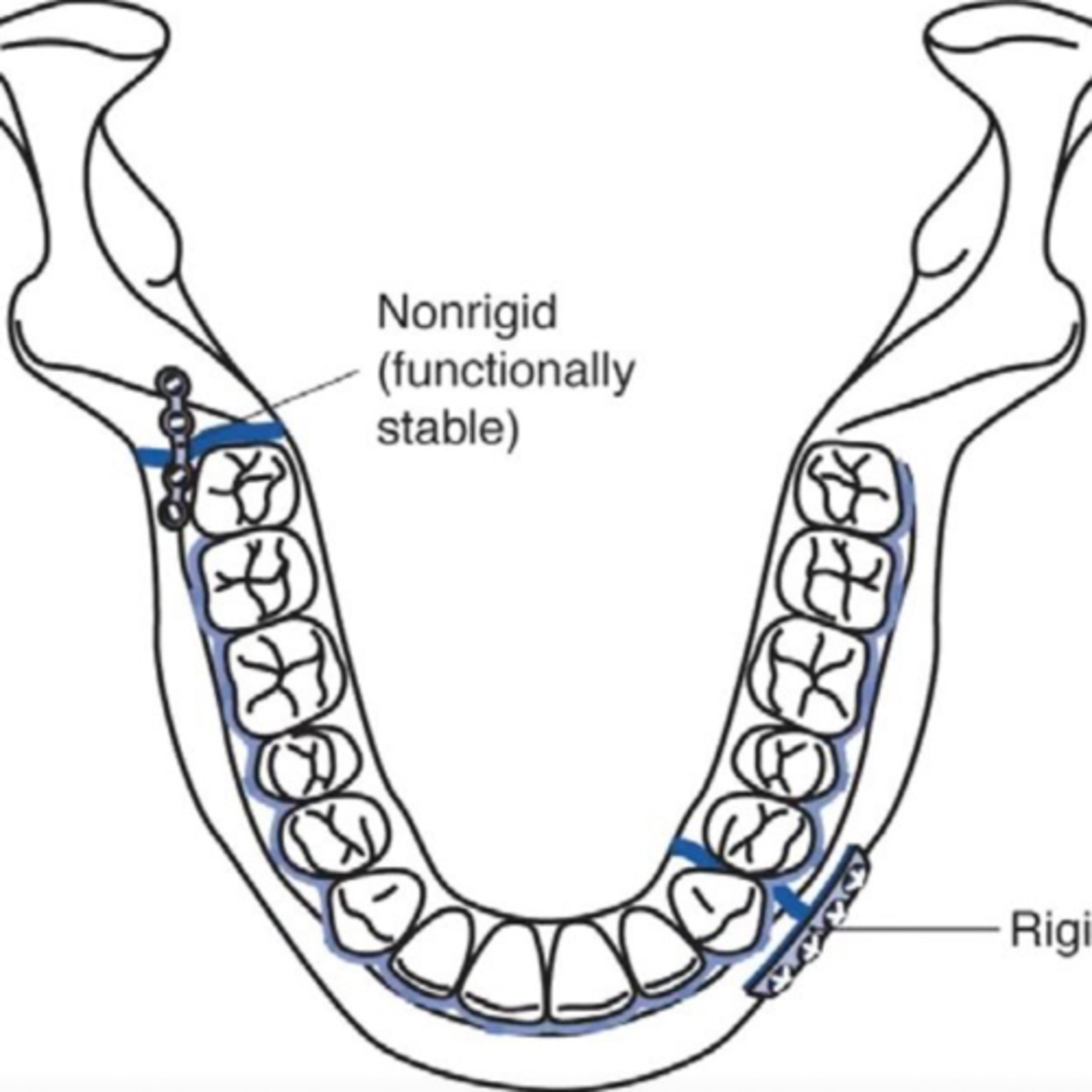
“What Is ‘Rigid’ vs. ‘Non-Rigid’ Fixation?”
6.17.24 Quick Review #151 - #surgery #surgeon #doctorgallagher #oralsurgery #oralsurgeon #omfs #dentist #dentistry #dental In the context of mandibular fracture repair, “rigid” and “non-rigid” fixation refer to different techniques used to stabilize the fractured bone segments: Rigid Fixation: Rigid fixation involves the use of plates and screws to hold the fractured segments of the mandible firmly in place, preventing any movement between them. Techniques: • Commonly uses titanium plates and screws. • Plates can be placed either intraorally or extraorally. • Often requires more extensive surgical exposure. Advantages: • Provides stable fixation, allowing for immediate function and early mobilization. • Reduces the need for maxillomandibular fixation (MMF), which is often uncomfortable for patients. • Generally associated with lower rates of malunion and nonunion. • Allows for more predictable and precise anatomical reduction. Disadvantages: • More invasive, potentially leading to increased surgical time and risk of complications. • Higher cost due to the materials and techniques used. Indications: • Used in more complex or comminuted fractures. • Indicated in fractures where precise anatomical alignment is crucial. • Preferred in situations where early function is desired. Non-Rigid Fixation: Non-rigid fixation typically involves the use of wires, arch bars, or other devices that allow for some movement between the fractured segments. Techniques: • Common methods include intermaxillary fixation (IMF) using wires or arch bars. • Less invasive than rigid fixation techniques. • Often performed intraorally. Advantages: • Simpler and less invasive, usually resulting in shorter surgical time. • Lower cost compared to rigid fixation. • Suitable for less complex fractures. Disadvantages: • Generally requires prolonged MMF, which can be uncomfortable for the patient. • Limited stability compared to rigid fixation, potentially leading to higher rates of malunion or nonunion. • Patients may need to be on a liquid diet for an extended period. Indications: • Used for simple fractures, especially those with favorable fracture lines. • Suitable for children or patients with less complex fractures. • Often employed in resource-limited settings or when rigid fixation is not feasible. Summary • Rigid Fixation: More stable, allows early function, suitable for complex fractures, but is more invasive and costly. • Non-Rigid Fixation: Simpler, less invasive, suitable for less complex fractures, but usually requires longer MMF and provides less stability. References: 1. Ellis, E. (2022). Rigid versus nonrigid fixation. In M. Miloro, G. E. Ghali, P. E. Larsen, & P. Waite (Eds.), Peterson’s Principles of Oral and Maxillofacial Surgery (4th ed., pp. 539-554). Springer. 2. Fonseca, R. J., Barber, H. D., Powers, M. P., & Frost, D. E. (2000). Oral and Maxillofacial Trauma (2nd ed.). W.B. Saunders Company. 3. ChatGPT. 2024. - #podcast #podcasts #dentalpodcast #dentalpodcasts #doctorgallagherpodcast #doctorgallagherspodcast #doctor #dentistry #oralsurgery #dental #viral #dentalschool #dentalstudent #omfs #surgeon #doctorlife #dentistlife #residency #oralsurgeon #dentist #doctorgallagher
You May Also Like

FluentFiction - Irish
FluentFiction.org

FluentFiction - Romanian
FluentFiction.org

Fluent Fiction - Portuguese (Brazil) 🇧🇷
FluentFiction.org

FluentFiction - Welsh
FluentFiction.org

Fluent Fiction - Russian
FluentFiction.org

Fluent Fiction - French
FluentFiction.org

Fluent Fiction - Hindi
FluentFiction.org

Fluent Fiction - Arabic
FluentFiction.org

Fluent Fiction - Portuguese (Portugal) 🇵🇹
FluentFiction.org
Kabbalah Media | mp3 #kab_fre
Bnei Baruch Kabbalah Education and Research Institute, Бней Барух – Ассоциация "Каббала Ла-Ам"
FluentFiction - Irish
FluentFiction.org
FluentFiction - Romanian
FluentFiction.org
Fluent Fiction - Portuguese (Brazil) 🇧🇷
FluentFiction.org
FluentFiction - Welsh
FluentFiction.org
Fluent Fiction - Russian
FluentFiction.org
Fluent Fiction - French
FluentFiction.org
Fluent Fiction - Hindi
FluentFiction.org
Fluent Fiction - Arabic
FluentFiction.org
Fluent Fiction - Portuguese (Portugal) 🇵🇹
FluentFiction.org
Kabbalah Media | mp3 #kab_fre
Bnei Baruch Kabbalah Education and Research Institute, Бней Барух – Ассоциация "Каббала Ла-Ам"
Community discussion