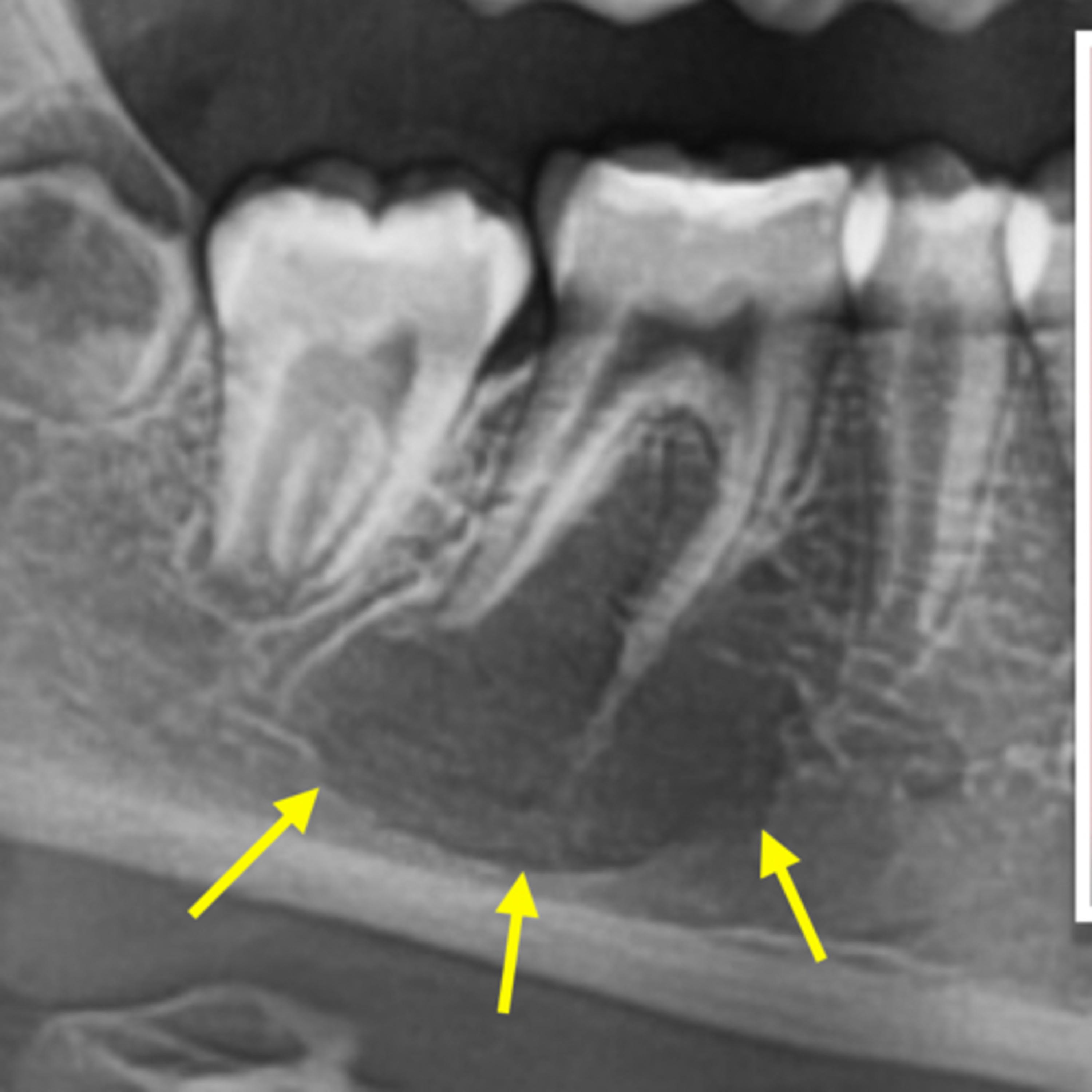
“What Are Key Differences Between The Traumatic vs. Aneurysmal Bone Cysts?”
6.3.24 Quick Review #140 - #pathology #oralpathology #doctorgallagher #oralsurgery #oralsurgeon #dentist #dentistry #dental Traumatic Bone Cyst (TBC) and Aneurysmal Bone Cyst (ABC) are two distinct types of bone cysts with different characteristics: Traumatic Bone Cyst (TBC): 1. Etiology: - Believed to result from trauma, although the exact cause is not always clear. - Trauma leads to intraosseous hemorrhage, which fails to organize and resorb, resulting in a cyst. 2. Location: - Commonly found in the mandible (jawbone) but can also occur in long bones. - Predominantly affects adolescents and young adults. 3. Clinical Presentation: - Often asymptomatic and discovered incidentally on radiographs. - If symptomatic, it may present with swelling or mild pain. 4. Radiographic Appearance: - Appears as a well-defined, unilocular radiolucent lesion. - The lesion usually has a scalloped border and may cause slight expansion of the cortical bone. 5. Histology: - Lacks an epithelial lining. - The cyst cavity is typically empty or contains serosanguineous fluid. 6. Treatment: - Simple curettage or aspiration often leads to resolution. - Spontaneous healing can occur after biopsy. Aneurysmal Bone Cyst (ABC) 1. Etiology: - Considered a reactive bone lesion, possibly arising secondary to other bone lesions (e.g., giant cell tumor, chondroblastoma). - May be related to a local vascular disturbance. 2. Location: - Can occur in any bone but is most commonly found in the spine and long bones. - Affects a broader age range, including children and young adults. 3. Clinical Presentation: - Often presents with pain, swelling, and sometimes neurological symptoms if it occurs in the spine. - Rapid growth can lead to significant bone expansion and deformity. 4. Radiographic Appearance: - Appears as a well-defined, expansile, multilocular radiolucent lesion with a "soap-bubble" appearance. - May cause thinning of the cortical bone and can extend into the soft tissues. 5. Histology: - Consists of blood-filled spaces separated by fibrous septa containing multinucleated giant cells and fibroblasts. - No epithelial lining. 6. Treatment: - Surgical curettage and bone grafting are common treatments. - More aggressive lesions may require resection. References: 1. Kazemi Oral Surgery & Dental Implants. (n.d.). Traumatic (simple) bone cyst in a 10-year-old patient. (https://lnkd.in/e5-pQnAH) 2. Feller, L., Khammissa, R. A. G., & Lemmer, J. (2016). Traumatic bone cysts: A review of the literature and report of two cases. International Journal of Dentistry, 2016, Article ID 9084573. https://lnkd.in/e5yzuhZz 3. Mascard, E., Gomez-Brouchet, A., & Lambot, K. (2010). Bone cysts: Unicameral and aneurysmal bone cyst. Orthopaedics & Traumatology: Surgery & Research, 96(6), 668-674. https://lnkd.in/enE677yn 4. ChatGPT. 2024. - #podcast #podcasts #dentalpodcast #dentalpodcasts #doctorgallagherpodcast #doctorgallagherspodcast #doctor #dentistry #oralsurgery #dental #viral #dentalschool #dentalstudent #omfs #surgeon #doctorlife #dentistlife #residency #oralsurgeon #dentist #doctorgallagher
You May Also Like

Playlist Culture G : les podcasts pour apprendre chaque jour
Acast France

Un bonbon sur la langue
RTL
Neville Goddard - Classic Radio
Neville Goddard

Neville Goddard - Old Time Radio
Neville Goddard
Chat GPT Collective Consciousness
Sol Good Network

The Mnemonic Memory Podcast
Peter Jans

Estoicismo para Ganadores
Estoicismo Para Ganadores

【本・再放送】英語の語源が身につくラジオ (heldio)
堀田隆一

Motivational Speeches
Motivationly

Fluent Fiction - Catalan
FluentFiction.org
Playlist Culture G : les podcasts pour apprendre chaque jour
Acast France
Un bonbon sur la langue
RTL
Neville Goddard - Classic Radio
Neville Goddard
Neville Goddard - Old Time Radio
Neville Goddard
Chat GPT Collective Consciousness
Sol Good Network
The Mnemonic Memory Podcast
Peter Jans
Estoicismo para Ganadores
Estoicismo Para Ganadores
【本・再放送】英語の語源が身につくラジオ (heldio)
堀田隆一
Motivational Speeches
Motivationly
Fluent Fiction - Catalan
FluentFiction.org
Community discussion