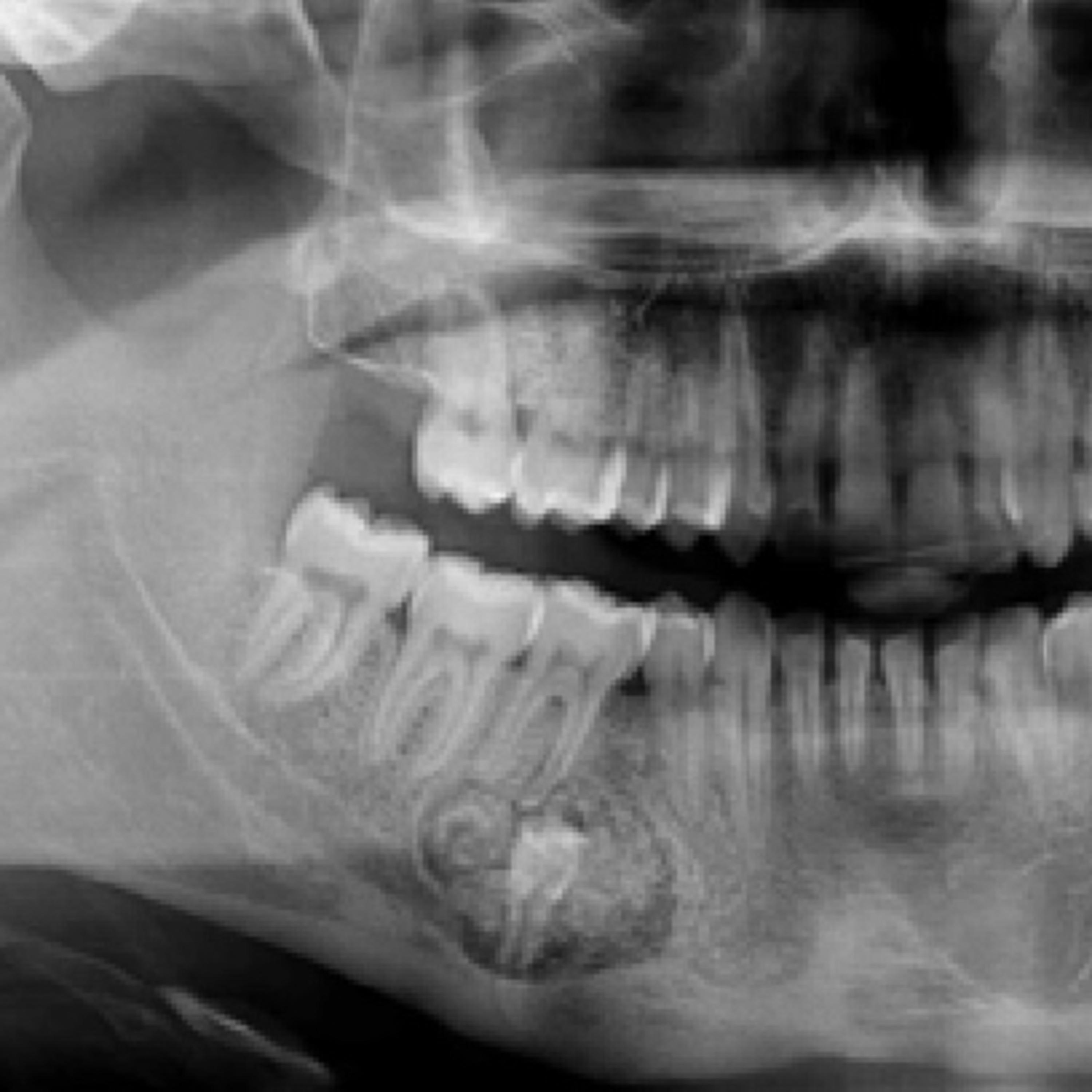
“Key Characteristics & Treatment for the Calcifying Epithelial Odontogenic Tumor (CEOT)”
Full Title: “What are the Key Characteristics & Treatment for the Calcifying Epithelial Odontogenic Tumor (CEOT)?” - 2.8.24 Quick Review #104 - #pathology #oralpathology #doctorgallagher #oralsurgery #oralsurgeon #dentist #dentistry #dental Calcifying Epithelial Odontogenic Tumors (CEOTs), also known as Pindborg tumors, have several key characteristics: 1. Histological Appearance: They are characterized by the presence of polyhedral epithelial cells with clear, eosinophilic cytoplasm and distinct intercellular bridges. The cells are arranged in sheets and islands within a fibrous stroma. 2. Calcification: CEOTs often contain calcifying structures, including concentric calcified rings known as Liesegang rings, as well as homogenous acellular masses that may resemble enamel matrix. 3. Amyloid Deposits: A unique feature of CEOTs is the presence of amyloid-like material, which stains positively with Congo red and exhibits apple-green birefringence under polarized light. 4. Radiographic Features: On radiographs, these tumors may show a mixed radiolucent-radiopaque pattern due to the presence of calcified material. They can present as unilocular or multilocular lesions with well-defined or irregular borders. 5. Clinical Presentation: Patients with CEOT usually present with a slow-growing, painless mass in the jaw, which may cause expansion of the bone. Teeth displacement and root resorption can also occur. 6. Location Preference: While CEOTs can occur in both the mandible and maxilla, they are more commonly found in the mandible, particularly in the premolar and molar regions. 7. Potential for Recurrence: CEOTs are generally benign but can exhibit aggressive behavior, with a propensity for local invasion and recurrence after surgical removal. 8. Treatment: Complete surgical excision with 1.0-1.5 cm margins is the treatment of choice. In cases of aggressive or recurrent tumors, a more radical surgical approach may be necessary. 9. Prognosis: The overall prognosis for CEOT is good, but due to the potential for recurrence, long-term follow-up is recommended. CEOTs are considered rare among odontogenic tumors and are distinct due to their histopathological features, potential for calcification, and the presence of amyloid deposits. References: 1. Akay, M. C., Tetik, A., & Zeytinoğlu, M. (2014). The Calcifying Epithelial Odontogenic Tumor (Pindborg Tumor): A Case Report. Open Access Library Journal. https://doi.org/10.4236/OALIB.1101036 2. Neville, B. W., Damm, D. D., Allen, C. M., & Chi, A. C. (2015). Oral and Maxillofacial Pathology (4th ed.). Saunders. 3. Abubaker, A.O., Lam, D., & Benson, K. (2016). OMFS Secrets (3rd ed.). Elsevier. 4. Miloro, M., Ghali, G. E., Larsen, P. E., & Waite, P. (Eds.). (2022). Peterson’s Principles of Oral and Maxillofacial Surgery (4th ed.). Springer. 5. ChatGPT. 2024.
You May Also Like

Choses à Savoir - Culture générale
Choses à Savoir

EconTalk
Russ Roberts

Shimon Davis
Shimon Davis

Jabulujule 9 -12
ukhozi fm

Lana Blakely
Lana Blakely

Financial Coaching for Women: How To Budget, Manage Money, Pay Off Debt, Save Money, Paycheck Plans
Vanessa and Shana | Budget Besties | Bougie On A Budget | Dave Ramsey Fans

Neville Goddard Daily
Neville Goddard

Chat GPT Questions
Sol Good Network

Chat GPT Collective Consciousness
Sol Good Network

Teach 4 the Heart
Linda Kardamis | Educational Consultant & Founder of Teach 4 the Heart
Choses à Savoir - Culture générale
Choses à Savoir
EconTalk
Russ Roberts
Shimon Davis
Shimon Davis
Jabulujule 9 -12
ukhozi fm
Lana Blakely
Lana Blakely
Financial Coaching for Women: How To Budget, Manage Money, Pay Off Debt, Save Money, Paycheck Plans
Vanessa and Shana | Budget Besties | Bougie On A Budget | Dave Ramsey Fans
Neville Goddard Daily
Neville Goddard
Chat GPT Questions
Sol Good Network
Chat GPT Collective Consciousness
Sol Good Network
Teach 4 the Heart
Linda Kardamis | Educational Consultant & Founder of Teach 4 the Heart
Community discussion