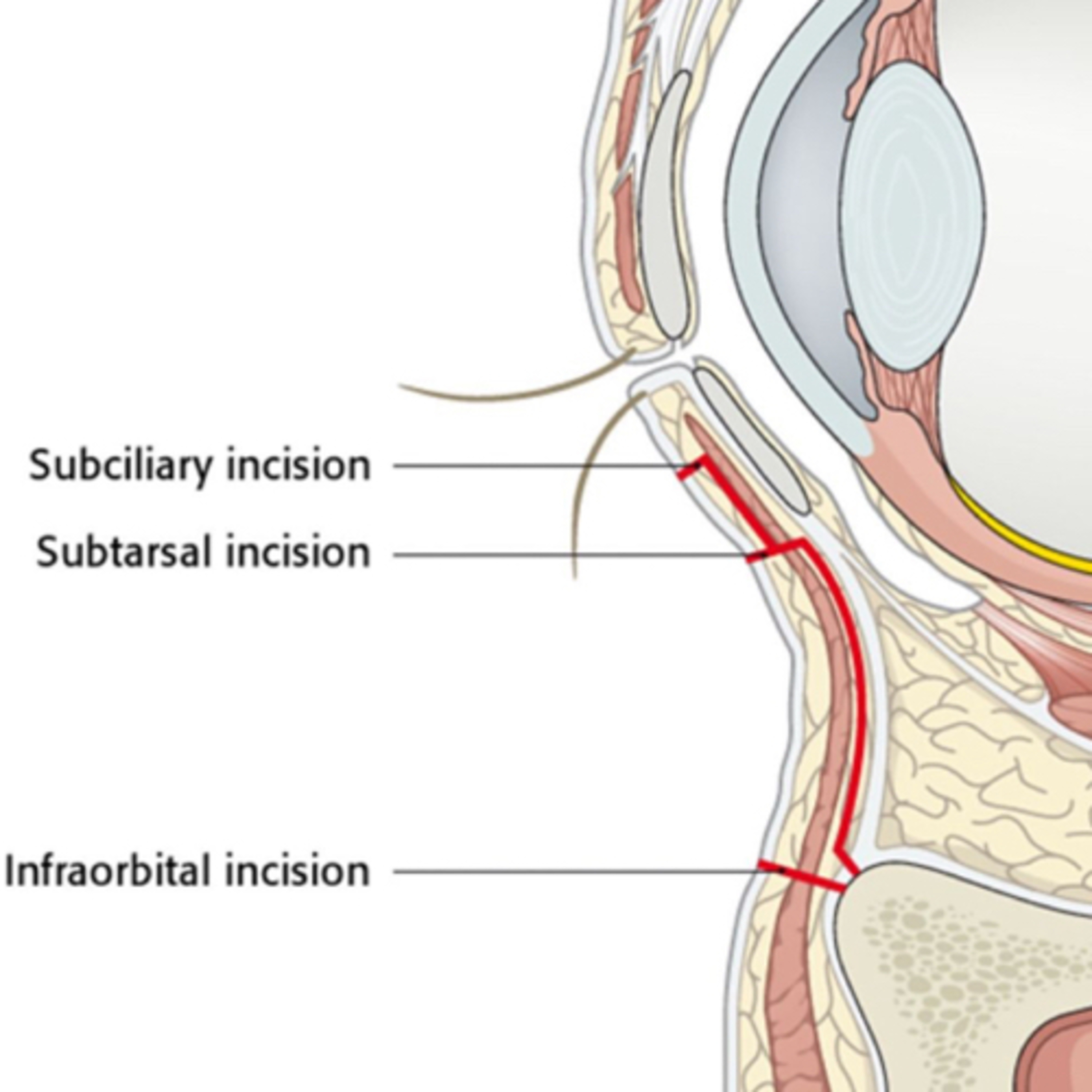
“Differences Between The Subciliary, Subtarsal and Infraorbital Incisions When Approaching The Orbit
5.3.24 - “What Are Key Components & Differences Between The Subciliary, Subtarsal and Infraorbital Incisions When Approaching The Orbit During Surgery?” Quick Review #131 - #surgery #surgeon #doctorgallagher #oralsurgery #oralsurgeon #omfs #dentist #dentistry #dental #orbit Accessing the orbit during surgery, particularly for procedures involving the eyelids, tear ducts, or orbital floor, can be performed through various incisions including three shown below: 1. Subciliary Incision: - Location: Just below the eyelashes along the lower eyelid. - Purpose: Commonly used for accessing the lower eyelid and orbital floor, particularly in cosmetic procedures such as lower eyelid blepharoplasty or orbital fracture repairs. - Advantages: Provides good exposure and a cosmetic result with a scar that typically blends well with the natural eyelid crease. - Disadvantages: There is a risk of lower eyelid malposition (like ectropion), especially in older patients due to potential damage to the lower eyelid support structures. 2. Subtarsal Incision: - Location: Approximately 2-3 mm below the tarsal plate of the lower eyelid, aligned with the eyelid margin. - Purpose: Used for similar indications as the subciliary incision, such as exposure of the orbital floor and midface, but it may also be preferred for removing benign lesions or addressing tear duct issues. - Advantages: It typically results in a less noticeable scar compared to subciliary because it falls in a natural eyelid crease, and it has a potentially lower risk of eyelid malposition. - Disadvantages: Can be technically more demanding and requires careful dissection to avoid damage to the eyelid retractors. 3. Infraorbital Incision: - Location: Positioned just below the rim of the orbital bone, in the cheek area, aligned with the infraorbital rim. - Purpose: Primarily used for accessing the orbital floor or the infraorbital rim, particularly in the context of maxillofacial surgery or severe trauma repairs. - Advantages: Offers excellent exposure of the infraorbital rim and floor, allowing for repair of fractures and direct visualization of the infraorbital nerve. - Disadvantages: More likely to leave a visible scar compared to subciliary and subtarsal incisions and can have a higher risk of sensory loss in the distribution of the infraorbital nerve. References: 1. AO Foundation. (n.d.). AO Surgery Reference. Retrieved from https://lnkd.in/effrrBzH 2. Rohrich, R. J., & Zoumalan, R. A. (2011). Periorbital Rejuvenation: An Overview of Surgical and Nonsurgical Techniques. Plastic and Reconstructive Surgery, 128(2), 834–843. doi:10.1097/PRS.0b013e31821e6eae 3. Mathijssen, I. M. J. (2010). Surgical Correction of Severe Orbital Fractures. Facial Plastic Surgery, 26(4), 320–328. doi:10.1055/s-0030-1265024 4. Patel, B. C., & Morgan, L. H. (2008). Surgical Approaches to the Orbital Region. In Ophthalmic Plastic and Reconstructive Surgery. Springer, Berlin, Heidelberg. 5. ChatGPT. 2024. - #podcast #podcasts #dentalpodcast #dentalpodcasts #doctorgallagherpodcast #doctorgallagherspodcast
You May Also Like

Shimon Davis
Shimon Davis

STOPTIME: Live in the Moment.
Lisa Hopkins, Wide Open Stages
The You Project
Craig Harper
Studying Kabbalah #kab_eng
Bnei Baruch Kabbalah Education and Research Institute, Бней Барух – Ассоциация "Каббала Ла-Ам"

Motivational Speeches
Motivationly

Hamza Selfimprovement
Adonis Gang

Rick Warren Sermons
Word Life

Playlist Culture G : les podcasts pour apprendre chaque jour
Acast France

Life Hacks DIY & More - Transform Your Everyday With Simple Tricks and DIY Magic!
Byte & Pieces

Happy English Podcast
Michael DiGiacomo Happy English
Shimon Davis
Shimon Davis
STOPTIME: Live in the Moment.
Lisa Hopkins, Wide Open Stages
The You Project
Craig Harper
Studying Kabbalah #kab_eng
Bnei Baruch Kabbalah Education and Research Institute, Бней Барух – Ассоциация "Каббала Ла-Ам"
Motivational Speeches
Motivationly
Hamza Selfimprovement
Adonis Gang
Rick Warren Sermons
Word Life
Playlist Culture G : les podcasts pour apprendre chaque jour
Acast France
Life Hacks DIY & More - Transform Your Everyday With Simple Tricks and DIY Magic!
Byte & Pieces
Happy English Podcast
Michael DiGiacomo Happy English
Community discussion