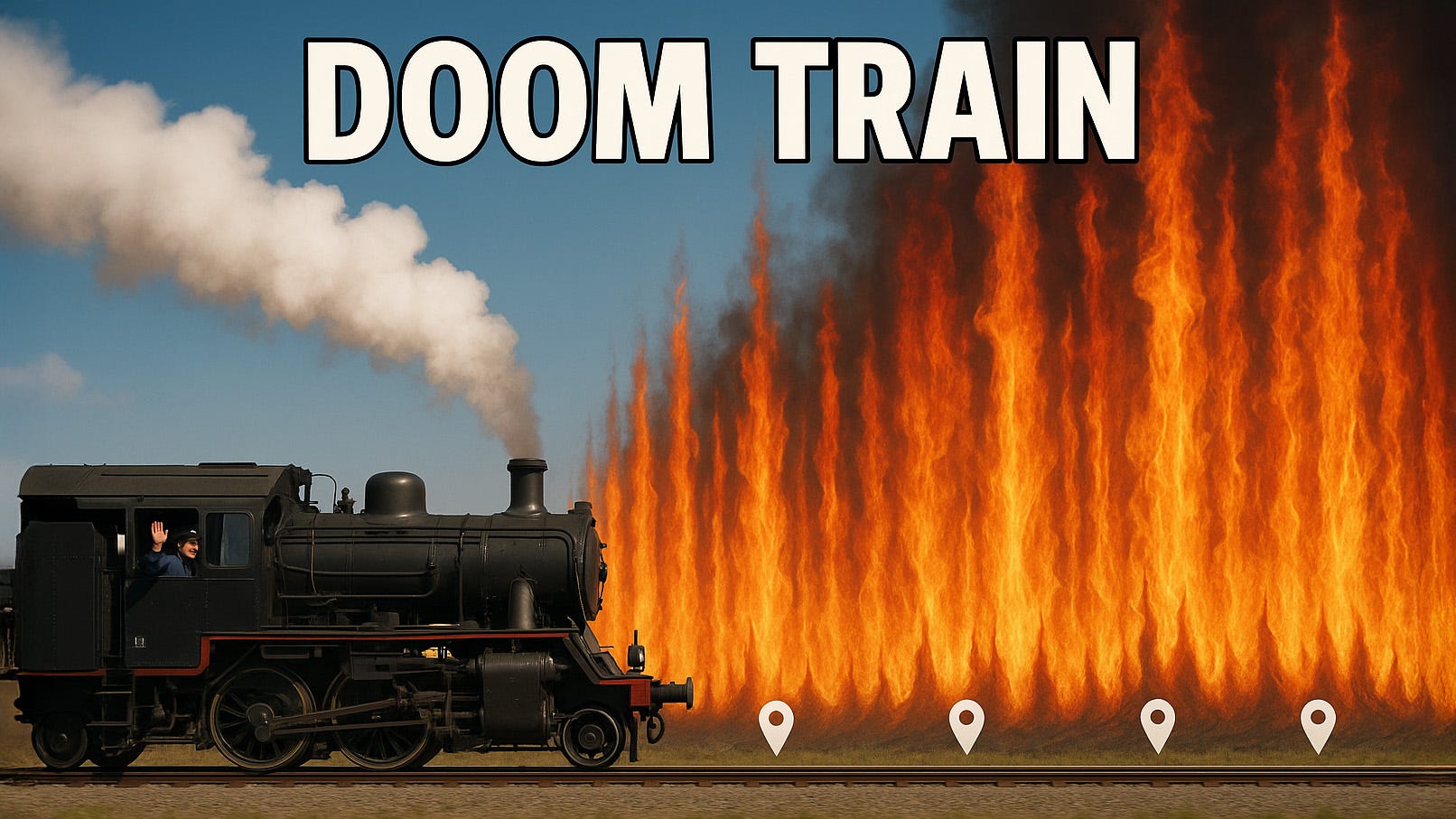
I often talk about the “Doom Train”, the series of claims and arguments involved in concluding that P(Doom) from artificial superintelligence is high. In this episode, it’s finally time to show you the whole track! 00:00 Introduction 01:09 “AGI isn’t coming soon” 04:42 “Artificial intelligence can’t go far beyond human intelligence” 07:24 “AI won’t be a physical threat” 08:28 “Intelligence yields moral goodness” 09:39 “We have a safe AI development process” 10:48 “AI capabilities will rise at a manageable pace” 12:28 “AI won’t try to conquer the universe” 15:12 “Superalignment is a tractable problem” 16:55 “Once we solve superalignment, we’ll enjoy peace” 19:02 “Unaligned ASI will spare us” 20:12 “AI doomerism is bad epistemology” 21:42 Bonus arguments: “Fine, P(Doom) is high… but that’s ok!” Stops on the Doom Train AGI isn’t coming soon * No consciousness * No emotions * No creativity — AIs are limited to copying patterns in their training data, they can’t “generate new knowledge” * AIs aren’t even as smart as dogs right now, never mind humans * AIs constantly make dumb mistakes, they can’t even do simple arithmetic reliably * LLM performance is hitting a wall — GPT 4.5 is barely better than GPT 4.1 despite being larger scale * No genuine reasoning * No microtubules exploiting uncomputable quantum effects * No soul * We’ll need to build tons of data centers and power before we get to AGI * No agency * This is just another AI hype cycle, every 25 years people think AGI is coming soon and they’re wrong Artificial intelligence can’t go far beyond human intelligence * “Superhuman intelligence” is a meaningless concept * Human engineering already is coming close to the laws of physics * Coordinating a large engineering project can’t happen much faster than humans do it * No individual human is that smart compared to humanity as a whole, including our culture, corporations, and other institutions. Similarly no individual AI will ever be that smart compared to the sum of human culture and other institutions. AI won’t be a physical threat * AI doesn’t have arms or legs, it has zero control over the real world * An AI with a robot body can’t fight better than a human soldier * We can just disconnect an AI’s power to stop it * We can just turn off the internet to stop it * We can just shoot it with a gun * It’s just math * Any supposed chain of events where AI kills humans is far-fetched science fiction Intelligence yields moral goodness * More intelligence is correlated with more morality * Smarter people commit fewer crimes * The orthogonality thesis is false * AIs will discover moral realism * If we made AIs so smart, and we were trying to make them moral, then they’ll be smart enough to debug their own morality * Positive-sum cooperation was the outcome of natural selection We have a safe AI development process * Just like every new technology, we’ll figure it out as we go * We don’t know what problems need to be fixed until we build the AI and test it out * If an AI causes problems, we’ll be able to turn it off and release another version * We have safeguards to make sure AI doesn’t get uncontrollable/unstoppable * If we accidentally build an AI that stops accepting our shutoff commands, it won’t manage to copy versions of itself outside our firewalls which then proceed to spread exponentially like a computer virus * If we accidentally build an AI that escapes our data center and spreads exponentially like a computer virus, it won’t do too much damage in the world before we can somehow disable or neutralize all its copies * If we can’t disable or neutralize copies of rogue AIs, we’ll rapidly build other AIs that can do that job for us, and won’t themselves go rogue on us AI capabilities will rise at a manageable pace * Building larger data centers will be a speed bottleneck * Another speed bottleneck is the amount of research that needs to be done, both in terms of computational simulation, and in terms of physical experiments, and this kind of research takes lots of time * Recursive self-improvement “foom” is impossible * The whole economy never grows with localized centralized “foom” * Need to collect cultural learnings over time, like humanity did as a whole * AI is just part of the good pattern of exponential economic growth eras AI won’t try to conquer the universe * AIs can’t “want” things * AIs won’t have the same “fight instincts” as humans and animals, because they weren’t shaped by a natural selection process that involved life-or-death resource competition * Smart employees often work for less-smart bosses * Just because AIs help achieve goals doesn’t mean they have to be hard-core utility maximizers * Instrumental convergence is false: achieving goals effectively doesn’t mean you have to be relentlessly seizing power and resources * A resource-hungry goal-maximizer AIs wouldn’t seize literally every atom; there’ll still be some leftover resources for humanity * AIs will use new kinds of resources th