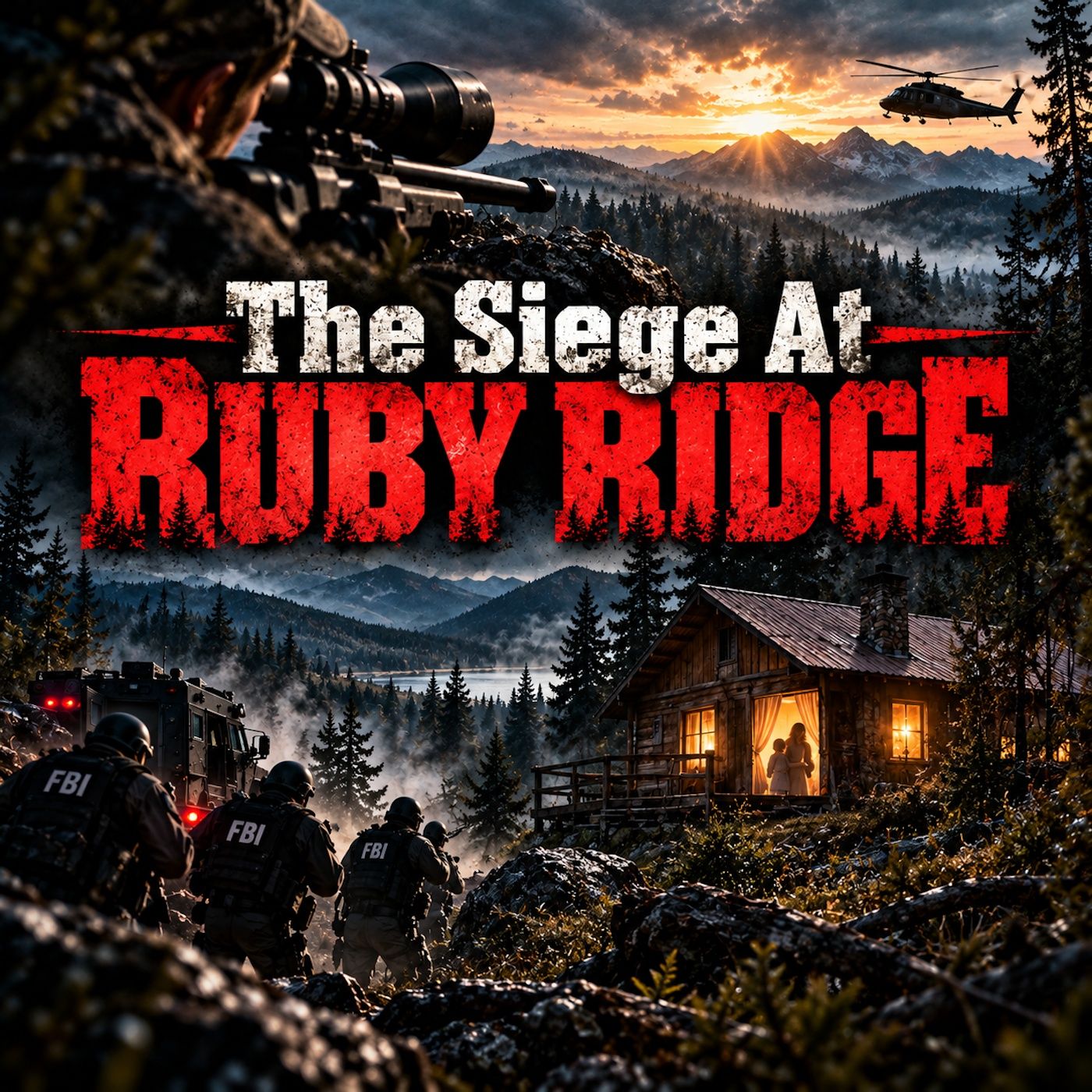
The Siege At Ruby Ridge
Listener discretion is advised. This episode contains descriptions of real-life violence and death, including the shooting deaths of a fourteen-year-old boy, his mother, and a federal law enforcement officer. It also includes direct quotations expressing racist and extremist beliefs. Some listeners may find this material disturbing or offensive.
On August 22, 1992, an FBI sniper positioned roughly two hundred yards above a remote cabin in northern Idaho fired two shots. The first struck Randy Weaver as he moved near the shed where the body of his fourteen-year-old son, Sammy, had been placed after being killed the previous day. The second bullet passed through the curtained window of the cabin door and killed Weaver’s wife, Vicki, as she stood inside holding their ten-month-old daughter.
At the time, no one had formally told the family who surrounded the cabin or ordered them to surrender. Federal authorities would not learn that Vicki Weaver had been killed until days later.
This episode of Disturbing History takes a deep look at Ruby Ridge—not the simplified version that became a political slogan, but the complicated chain of decisions, mistakes, intelligence failures, disputed gunfire, and deadly consequences documented in the government’s own investigations.
Brian traces the story back years before the siege, beginning with Randy and Vicki Weaver’s decision to leave Iowa and move their family into the mountains of Idaho. From there, the episode follows the growing interest of federal authorities, allegations made by a neighbor, Weaver’s contact with white separatist circles, and an undercover ATF investigation involving two illegally shortened shotguns. Government investigators would later question parts of that operation and acknowledge they could not completely rule out whether Weaver had been improperly encouraged into committing the offense.
Then came the bureaucratic mistake that helped transform a firearms case into a federal fugitive operation.A probation officer sent Weaver a letter listing the wrong trial date—March 20 instead of February 20. By the time the mistake was discovered, a bench warrant had already been issued. Despite knowing Weaver had received incorrect information, the warrant remained active, and prosecutors later indicted him for failure to appear before the erroneous date he had been given had even arrived.
The Justice Department would later describe the situation as creating an “appearance of governmental overreaching.” The episode also examines how letters written by Vicki Weaver and references to extremist figures helped shape the government’s threat assessment of the family, eventually contributing to comparisons between Weaver and violent white supremacist organizations.
Then, on August 21, 1992, six deputy U.S. marshals conducting surveillance encountered the Weaver family’s dog, Striker. What followed at a trail junction known as “the Y” remains one of the most disputed moments of the entire case.Within seconds, Deputy U.S. Marshal William Degan and fourteen-year-old Sammy Weaver were dead. Investigators were ultimately unable to conclusively determine who fired the first shot.
The next day, the FBI arrived.Special rules of engagement were drafted during the flight to Idaho—rules that would later become one of the most controversial aspects of the operation. Within hours, FBI sniper Lon Horiuchi fired the shots that wounded Randy Weaver and killed Vicki Weaver.
From there, the episode reconstructs the extraordinary details of the siege: failed communications, surrender announcements broadcast after Vicki was already dead, FBI snipers suffering from exposure because they were not equipped for the mountain weather, armored vehicles approaching the cabin, negotiations conducted over loudspeakers, and the eventual arrival of former Green Beret and presidential candidate Bo Gritz, who...
On August 22, 1992, an FBI sniper positioned roughly two hundred yards above a remote cabin in northern Idaho fired two shots. The first struck Randy Weaver as he moved near the shed where the body of his fourteen-year-old son, Sammy, had been placed after being killed the previous day. The second bullet passed through the curtained window of the cabin door and killed Weaver’s wife, Vicki, as she stood inside holding their ten-month-old daughter.
At the time, no one had formally told the family who surrounded the cabin or ordered them to surrender. Federal authorities would not learn that Vicki Weaver had been killed until days later.
This episode of Disturbing History takes a deep look at Ruby Ridge—not the simplified version that became a political slogan, but the complicated chain of decisions, mistakes, intelligence failures, disputed gunfire, and deadly consequences documented in the government’s own investigations.
Brian traces the story back years before the siege, beginning with Randy and Vicki Weaver’s decision to leave Iowa and move their family into the mountains of Idaho. From there, the episode follows the growing interest of federal authorities, allegations made by a neighbor, Weaver’s contact with white separatist circles, and an undercover ATF investigation involving two illegally shortened shotguns. Government investigators would later question parts of that operation and acknowledge they could not completely rule out whether Weaver had been improperly encouraged into committing the offense.
Then came the bureaucratic mistake that helped transform a firearms case into a federal fugitive operation.A probation officer sent Weaver a letter listing the wrong trial date—March 20 instead of February 20. By the time the mistake was discovered, a bench warrant had already been issued. Despite knowing Weaver had received incorrect information, the warrant remained active, and prosecutors later indicted him for failure to appear before the erroneous date he had been given had even arrived.
The Justice Department would later describe the situation as creating an “appearance of governmental overreaching.” The episode also examines how letters written by Vicki Weaver and references to extremist figures helped shape the government’s threat assessment of the family, eventually contributing to comparisons between Weaver and violent white supremacist organizations.
Then, on August 21, 1992, six deputy U.S. marshals conducting surveillance encountered the Weaver family’s dog, Striker. What followed at a trail junction known as “the Y” remains one of the most disputed moments of the entire case.Within seconds, Deputy U.S. Marshal William Degan and fourteen-year-old Sammy Weaver were dead. Investigators were ultimately unable to conclusively determine who fired the first shot.
The next day, the FBI arrived.Special rules of engagement were drafted during the flight to Idaho—rules that would later become one of the most controversial aspects of the operation. Within hours, FBI sniper Lon Horiuchi fired the shots that wounded Randy Weaver and killed Vicki Weaver.
From there, the episode reconstructs the extraordinary details of the siege: failed communications, surrender announcements broadcast after Vicki was already dead, FBI snipers suffering from exposure because they were not equipped for the mountain weather, armored vehicles approaching the cabin, negotiations conducted over loudspeakers, and the eventual arrival of former Green Beret and presidential candidate Bo Gritz, who...
You May Also Like

Bloomin' Legends with Johnny Vaughan & Gavin Woods
Global

Catholic Saints
Augustine Institute
The Secret Teachings
Ryan Gable
Interesting Things with JC
JC
The Stupid History Minute
Keb Pound

The Art Bell Archive
Arthur William Bell III

Cool People Who Did Cool Stuff
Cool Zone Media and iHeartPodcasts

Best of the US
Mechanical Music Radio

The Ancients
History Hit

Geschichte Europas
Tobias Jakobi
Bloomin' Legends with Johnny Vaughan & Gavin Woods
Global
Catholic Saints
Augustine Institute
The Secret Teachings
Ryan Gable
Interesting Things with JC
JC
The Stupid History Minute
Keb Pound
The Art Bell Archive
Arthur William Bell III
Cool People Who Did Cool Stuff
Cool Zone Media and iHeartPodcasts
Best of the US
Mechanical Music Radio
The Ancients
History Hit
Geschichte Europas
Tobias Jakobi
Community discussion