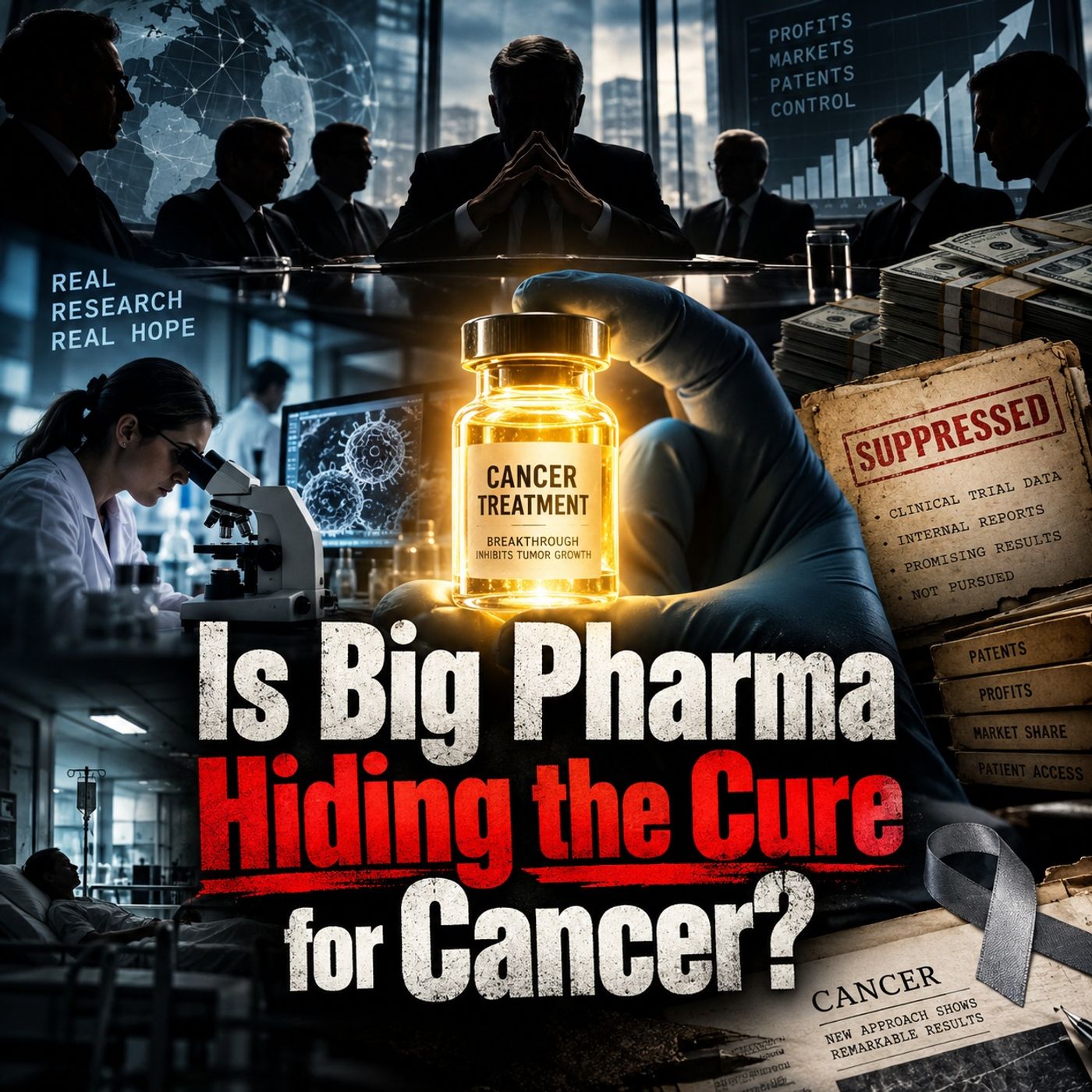
Is Big Pharma Hiding the Cure for Cancer?
This episode asks a simple question: if someone really discovered a cure for cancer, would the medical industry suppress it? Brian begins with a clear disclaimer that he is not a doctor and is making no medical claims, then looks at the history behind one of the most persistent conspiracy theories in modern medicine.
The episode briefly examines Brown’s Gas, Yull Brown’s 1977 welding patent, and early research involving hydrogen and oxygen inhalation before turning to the larger claim of medical suppression. It starts with the infamous 2018 Goldman Sachs report that asked whether curing patients was a sustainable business model, using Gilead’s hepatitis C treatment as an example of what happens when a highly effective therapy eventually reduces its own customer base.
From there, Brian traces more than a century of controversial cancer treatments and alleged suppressed cures, including William Coley, Royal Rife, Harry Hoxsey, Max Gerson, Krebiozen, Laetrile, Linus Pauling’s vitamin C research, Stanislaw Burzynski, and several alternative cancer clinics. Some were dismissed too quickly, others became major scientific disputes, and many ultimately failed when tested under controlled conditions.
The episode also examines cases where powerful industries really did hide dangerous information, including the tobacco industry’s decades-long campaign to obscure the health risks of smoking, asbestos companies suppressing evidence, the sugar industry abandoning research that produced troubling results, and DuPont’s history with C8 contamination.
Then Brian looks at what successful cancer treatments actually look like when evidence holds up. Cisplatin transformed survival for testicular cancer. Childhood leukemia went from nearly hopeless to highly treatable. Taxol emerged from a federal plant-screening program. Gleevec revolutionized treatment for chronic myeloid leukemia, and modern checkpoint inhibitors grew from ideas about using the immune system to attack cancer.
The episode closes by asking where the line should be drawn between skepticism of powerful institutions and claims that cannot survive scientific testing.
History shows that corporations and medical institutions have sometimes hidden inconvenient truths. It also shows that when a treatment truly works, repeated evidence has a way of becoming impossible to ignore.
Email Brian
Get Brian's Books
Leave Us A Voicemail
Visit Our Website
Have a forgotten historical mystery, disturbing event, unsolved crime, or hidden conspiracy you think deserves investigation?
Send your suggestions to [email protected].
Disturbing History is a dark history podcast exploring unsolved mysteries, secret societies, historical conspiracies, lost civilizations, and the shadowy stories buried beneath the surface of the past.
Follow the show and enable automatic downloads so you never miss a deep dive into history’s most unsettling secrets.
Because sometimes the truth is darker than fiction.
The episode briefly examines Brown’s Gas, Yull Brown’s 1977 welding patent, and early research involving hydrogen and oxygen inhalation before turning to the larger claim of medical suppression. It starts with the infamous 2018 Goldman Sachs report that asked whether curing patients was a sustainable business model, using Gilead’s hepatitis C treatment as an example of what happens when a highly effective therapy eventually reduces its own customer base.
From there, Brian traces more than a century of controversial cancer treatments and alleged suppressed cures, including William Coley, Royal Rife, Harry Hoxsey, Max Gerson, Krebiozen, Laetrile, Linus Pauling’s vitamin C research, Stanislaw Burzynski, and several alternative cancer clinics. Some were dismissed too quickly, others became major scientific disputes, and many ultimately failed when tested under controlled conditions.
The episode also examines cases where powerful industries really did hide dangerous information, including the tobacco industry’s decades-long campaign to obscure the health risks of smoking, asbestos companies suppressing evidence, the sugar industry abandoning research that produced troubling results, and DuPont’s history with C8 contamination.
Then Brian looks at what successful cancer treatments actually look like when evidence holds up. Cisplatin transformed survival for testicular cancer. Childhood leukemia went from nearly hopeless to highly treatable. Taxol emerged from a federal plant-screening program. Gleevec revolutionized treatment for chronic myeloid leukemia, and modern checkpoint inhibitors grew from ideas about using the immune system to attack cancer.
The episode closes by asking where the line should be drawn between skepticism of powerful institutions and claims that cannot survive scientific testing.
History shows that corporations and medical institutions have sometimes hidden inconvenient truths. It also shows that when a treatment truly works, repeated evidence has a way of becoming impossible to ignore.
Email Brian
Get Brian's Books
Leave Us A Voicemail
Visit Our Website
Have a forgotten historical mystery, disturbing event, unsolved crime, or hidden conspiracy you think deserves investigation?
Send your suggestions to [email protected].
Disturbing History is a dark history podcast exploring unsolved mysteries, secret societies, historical conspiracies, lost civilizations, and the shadowy stories buried beneath the surface of the past.
Follow the show and enable automatic downloads so you never miss a deep dive into history’s most unsettling secrets.
Because sometimes the truth is darker than fiction.
You May Also Like

Sleepy History
Slumber Studios

ВИВАТ, ИСТОРИЯ!
MOTORADIO.ONLINE
BELLUMARTIS PODCAST
Bellumartis Historia Militar

فواصل ثقافية
Fawasel Thaqafeya

Bloomin' Legends with Johnny Vaughan & Gavin Woods
Global
Catholic Saints
Augustine Institute
The Secret Teachings
Ryan Gable
Interesting Things with JC
JC
The Stupid History Minute
Keb Pound

The Art Bell Archive
Arthur William Bell III
Sleepy History
Slumber Studios
ВИВАТ, ИСТОРИЯ!
MOTORADIO.ONLINE
BELLUMARTIS PODCAST
Bellumartis Historia Militar
فواصل ثقافية
Fawasel Thaqafeya
Bloomin' Legends with Johnny Vaughan & Gavin Woods
Global
Catholic Saints
Augustine Institute
The Secret Teachings
Ryan Gable
Interesting Things with JC
JC
The Stupid History Minute
Keb Pound
The Art Bell Archive
Arthur William Bell III
Community discussion