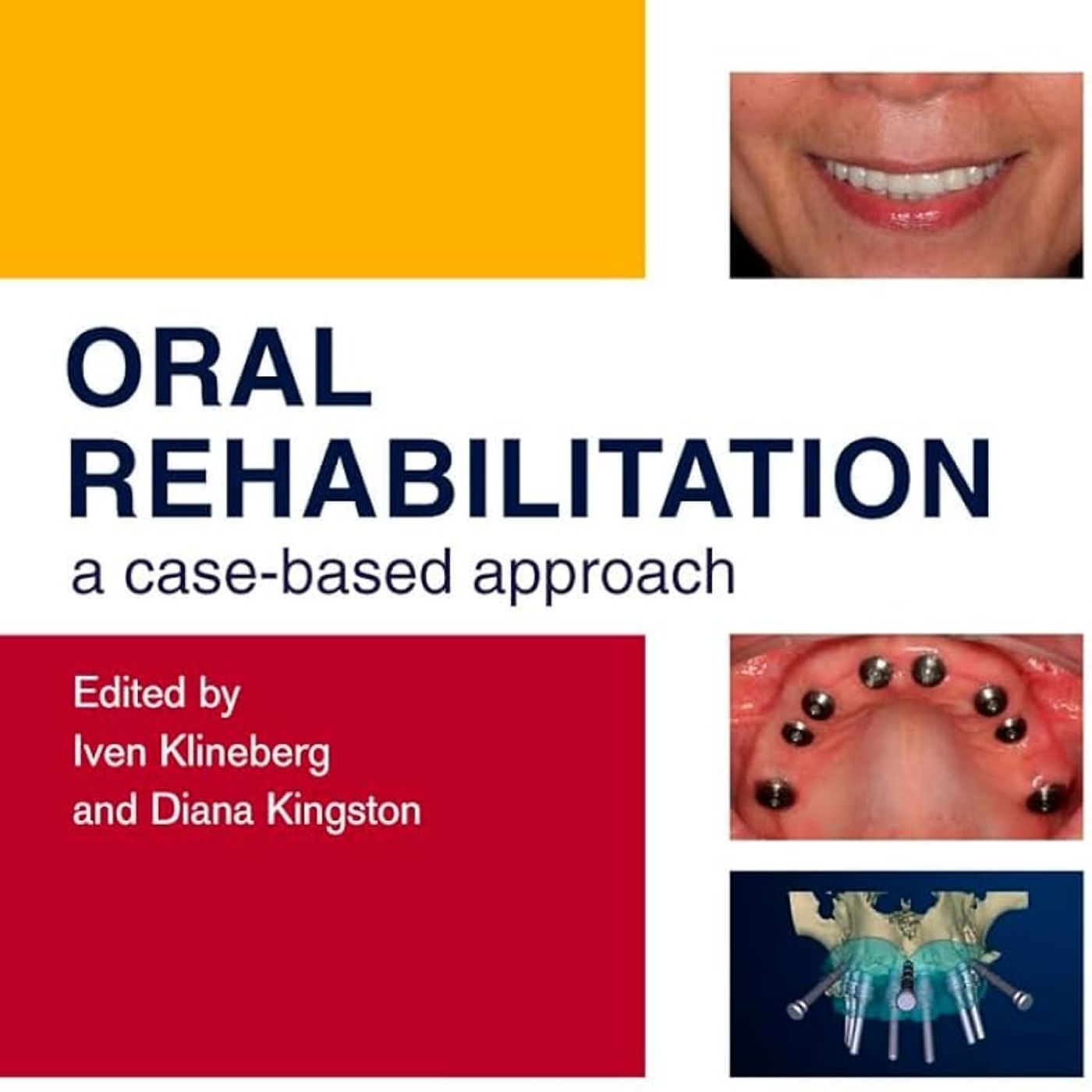
0:00 You know, I was thinking recently, when you take your car into the shop for a repair, there's this comforting sort of absolute certainty to the whole thing. 0:08 Oh, for sure. 0:09 Right? 0:09 It's very cut and dry. Right. 0:11 Like your transmission is shot, the mechanic takes the old one out, bolts a new one in, and you just drive away. It's purely mechanical. 0:17 Yeah, parts and labor. 0:18 Exactly. And the car doesn't have an opinion about the new transmission. It just accepts the hardware. But when a patient walks into a clinic and demands a Hollywood smile, like they're just buying a new bumper for their car. 0:31 We run into a massive biological wall. 0:33 Yes, a huge one. And that's exactly what we are tearing into today. Welcome to our deep dive on the textbook Oral Rehabilitation, a Case-Based Approach, edited by Ivan Kleinberg and Diana Kingston. 0:45 It's such a foundational text for anyone in the field, really. 0:48 It is. We're going to be pulling from the books forward the core theoretical chapters on treatment planning and some incredibly detailed clinical case studies. 0:56 And the mission here, really, is to extract that ultimate evidence-based roadmap for oral rehabilitation. Right. 1:04 Shifting the perspective from just, you know, simple mechanical tooth fixing to a profound biologically driven approach. It's basically a masterclass for your clinical practice. 1:14 It really is a vital shift. And frankly, it's an urgent one. If you look at the foreword, which was written by Dr. George Zarb, he calls out what he sees as the single biggest modern threat to the dental profession today. 1:25 Which is what exactly? 1:27 The blurring line between patient care and consumerism. He points out that commercial pressures and all this web-based information are pushing clinical practice to feel like a retail transaction. 1:39 Like they're just shopping. 1:40 Exactly. Patients come in shopping for cosmetic solutions as if they were buying a custom suit or a new appliance. 1:47 Okay, but let's be realistic about this for a second. 1:50 Put yourself in the clinic, a patient walks in, They have a massive budget. They view themselves as a consumer and they are demanding 28 units of blinding white porcelain. 1:58 Because they saw it on Instagram. Right. 2:00 And their teeth are structurally sound, maybe just mildly worn. 2:04 If you don't do it, the guy down the street absolutely will take their money. 2:08 Oh, without hesitation. 2:09 So how do we navigate that without just sounding like, I don't know, moralizing gatekeepers? Like how do we ethically redirect a consumer who wants to buy a product back to what their biological needs actually are? 2:21 That is the exact tension Chapter 3 tackles. It breaks down the clinician-patient relationship and informed consent. 2:28 Okay, but consent is usually just a form you sign. 2:31 Well, in this text, consent isn't framed as just some legal shield you get the patient to sign so you don't get sued. 2:37 Oh, interesting. Right. 2:39 It's actually a diagnostic boundary. It comes down to establishing a relationship built strictly on bioethics. 2:45 So how do you actually redirect that demanding patient then? 2:49 You map out the long-term biological cascade of their requested cosmetic treatment. You literally walk them through the biological cost of aggressively prepping their virgin enamel. 2:59 Ah, so you show them the consequences. 3:02 Exactly. You clearly outline the inevitable failure rates, the difference between, say, routine maintenance and a major catastrophic retreatment five or ten years down the line. 3:12 So you're basically refusing to let commerce override actual erudition and clinical analysis. 3:18 Precisely. You base your clinical decision-making on the actual biological framework, not their shopping list. 3:24 Which means we need a rock-solid understanding of what that biological framework actually is. Because, you know, we can't refuse to run a retail store unless we know exactly what kind of healthcare facility we are running instead. 3:36 I love that analogy. And that framework the book demands clinicians use is the stomatognathic system. 3:43 The jaw muscle system. Yes. I always look at the stomatonathic system almost like a massive suspension bridge. 3:50 That's a good way to look at it. 3:51 Right? Like the teeth are the road deck, the temporomandibular joints are the anchoring towers, and the massatory muscles are the suspension cables. Right. 4:00 So they all rely on each other. Exactly. 4:03 If you arbitrarily alter the deck, say by placing a crown that is even a fraction of a millimeter too high, you don't just affect that one tooth. 4:11 You altered the tension on the cables. 4:12 Yes. And eventually the anchoring tower takes the stress. You alter the entire network. Painting the walls of a house that has a crumbling foundation just doesn't work. 4:22 That is a phenomenal way to visualize it. And Chapter 4 divides this entire system into two distinct but completely inseparable paradigms. 4:31 Form and function, right? 4:33 Exactly. Form is the architecture of your bridge. It's the facial profile, the lip support, tooth orientation, the smile line. 4:41 But isn't form kind of just the vanity part? 4:44 Not at all. We cannot dismiss form as mere vanity because it's absolutely crucial for the patient's psychosocial well-being. I mean, how a patient presents to the world directly dictates their confidence and self-esteem. 4:58 Okay, that makes sense. But then we have function. 5:01 Right. The mastication, the swallowing, the speech patterns. These directly dictate the patient's nutrition and overall systemic health. 5:10 And you really can't alter the form without immediately impacting the function, can you? 5:14 No, you can't. But here is the really critical piece the text focuses on. When you alter that form and function, the body doesn't just sit there passively. 5:24 It reacts. 5:25 It reacts through central neuroplasticity. 5:28 Okay, this is where the textbook absolutely blew my mind. Because, you know, we are so used to thinking of teeth as static objects. 5:35 Right, just hard tissue. 5:36 Yeah. But when a clinician makes intraoral changes, whether it's a single restoration or a full mouth rehab that changes the occlusal vertical dimension, the OVD, the patient neurologically adapts to the new hardware. 5:49 The biomechanics of this adaptation are just staggering. The text highlights that if a clinician increases the OVD to restore severely worn teeth, the jaw muscles don't just stretch like rubber bands. 6:00 Wait, they don't just stretch out? 6:02 No, they physically adapt by lengthening and adding sarcomeres in series. 6:07 to accommodate that new vertical dimension. 6:09 Okay, let's just pause on that for a second because that is wild. You bond a piece of ceramic to a tooth and the patient's brain sends a signal to their musculature to physically construct new muscle segments. Exactly. So the jaw can function at that new height. 6:23 Your central nervous system is literally restructuring your muscle tissue to adapt to the bite. 6:28 That is exactly what's happening. 6:30 The muscle fibers elongate to establish a new resting length. 6:34 Wow. And if they didn't do this? 6:36 If they didn't, the muscles would remain in a state of constant hypercontraction. And that leads to immediate fatigue, spasms, and TMJ pain. The central nervous system rewires the periphery to find a new homeostasis. 6:49 Man, this biological rewiring is exactly why the initial assessment protocol outlined in the book has to be so exhaustive. 6:57 You have to know what you're dealing with. 6:58 Right. If you are about to trigger massive biological adaptations in muscle growth, you need to know exactly what the baseline is. He can't just poke the gums, take a quick bite wing, and start prepping. 7:09 Definitely not if you want predictable success. The roadmap in this book demands a really meticulous sequential protocol. 7:17 Walk us through that sequence. 7:19 Sure. It starts extraorally, assessing the smile dynamics, the lip posture, the TMJ function, the phonetics. 7:28 And then you move intraorally. Right. 7:30 You're logging CPITN scores for periodontal needs, checking probing depths, looking for caries, and performing a severe occlusal analysis. 7:39 I want to push on the imaging aspect of this assessment for a second, though, because the text specifies taking lateral cephalometric views. 7:46 Yes, the lateral cephs. 7:48 We usually associate cephs with orthodontics, right? Like plotting out skeletal growth in teenagers. Why is the text demanding a lateral ceph for a restorative rehab case? 7:58 That is a brilliant nuance in the book, actually. A lateral ceph radiograph is crucial in these cases because it helps you differentiate between skeletal and dental discrepancies. 8:08 How so? 8:09 Well, when a patient presents with severe tooth wear, it often looks like they've lost vertical dimension. But frequently, as the teeth wear down over decades, the alveolar bone actually erupts to compensate. 8:20 Oh, dental alveolar compensation. 8:22 Exactly. 8:23 So, wait, the teeth get shorter, but the bone grows taller. 8:27 Meaning the actual lower facial height hasn't changed at all. 8:30 You got it. And if you just assume they lost OVD and build their teeth back up to their original height without checking a CEPH, you're going to have a major problem. 8:39 Because you'd excessively increase their vertical dimension past their skeletal and muscular limits. Right. 8:45 The CEPH gives you the hard data on their actual facial proportions, so you aren't just guessing. 8:50 Which brings us perfectly to Chapter 7 and the concept of provisionalization. Because even with the best imaging, you still have to test the waters before you commit. 8:58 Oh, absolutely. 8:59 Too often, provisionals are treated as an afterthought, just a quick, you know, acrylic cover to stop the tooth from being sensitive, while the lab mills the definitive crown. 9:08 The book strongly argues against that. In fixed prosthodontics, treating the provisional as just a placeholder is a massive missed opportunity. 9:17 It's more than just a temporary cover. 9:19 Right. 9:20 A well-crafted provisional is a vital diagnostic tool. It's essentially a clinical prototype. 9:24 So when you increase a patient's OVD, you use the provisional to test that new height in the real world? Yes. 9:31 You're basically asking the patient's neuromuscular system, hey, can you adapt to this? Can your muscles add those sarcomeres in series without going into spasm? 9:41 It's real-time data collection. 9:43 You test the phonetics. Like, can they pronounce their S and F sounds without lisping? 9:48 You test the aesthetics, too. 9:50 But most importantly, the functional stability. I mean, if the patient comes back in two weeks and they fracture the acrylic provisional, that is a massive red flag. 10:00 But it's also the most valuable failure you can ask for. 10:03 Because it's better to break the cheap plastic than the expensive final crown. Exactly. Because if they fracture the acrylic, they are going to fracture the definitive zirconia or porcelain. 10:13 The provisional tells you that your occlusal scheme is flawed or Maybe the patient's parafunctional habits are just too aggressive for the current plan. 10:21 So you adjust the acrylic, you refine the guidance, and you do not move to the final fabrication until that provisional is completely stable. 10:29 Never. But, you know, even when the final prosthesis is seated and the patient is thrilled, the biology is still pretty hostile. Oh, yeah. 10:38 The oral cavity is a nightmare environment. Acid, bacteria, immense shear forces. Materials degrade. How do we keep this newly engineered system from falling apart five years later? 10:50 That's where Chapter 8 comes in. It focuses entirely on long-term maintenance. Patient satisfaction over the decades relies really heavily on dentist-patient rapport. 11:01 Because complications are going to happen. 11:03 They are inevitable. 11:05 Going back to our analogy, the suspension bridge will eventually need new paint or a cable tightened. 11:10 Precisely. And this requires meticulous documentation from day one. You have to categorize and explain to the patient the difference between routine maintenance versus a major retreatment. 11:22 Like what's an example of routine maintenance? 11:25 Like a minor occlusal adjustment or maybe polishing a composite margin. 11:30 And a major retreatment? 11:32 That would be something like an abutment failure under a multi-unit fixed dental prosthesis. 11:36 Got it. So if you set those expectations early, a fractured piece of porcelain in five years is seen as a maintenance event. Right. 11:44 Instead of them thinking it's a failure of your competence. 11:47 So let's take all of this theory, the bioethics, the neuroplasticity, the SEF assessments, the provisionals, and see what it actually looks like when the rubber meets the road. 11:56 Let's do it. 11:57 Section four of the book is loaded with clinical case studies. 12:00 And I want to dive into the multifactorial nightmare that is the broken down dentition. Oh, man. 12:06 It is arguably the most intimidating presentation a clinician will ever face. 12:11 We're talking about a patient who walks in with a brutal combination of things. Attrition from grinding, erosion from acid reflux or diet, abrasion. 12:19 Usually failing under-contoured restorations from previous dentists, too. 12:24 Right, guys who just did single-tooth dentistry, and their occlusal plane is just completely warped. 12:29 Let's look at a specific scenario from the text to see how this is managed in an evidence-based way. There's this fascinating case study, Case 10, involving a patient named Mr. 12:40 Graham S. 12:41 What were his issues? 12:42 He had a severely worn, stained dentition, profound posterior interferences, a long history of nocturnal grinding, and he had completely lost his anterior guidance. 12:53 See, the old mechanical tooth-fixing mindset would look at that patient and say, great, 20 crowns, we'll grind all his teeth down to pegs, open his bite, and cement porcelain everywhere. 13:02 Which would be catastrophic for his remaining pulp tissue and enamel. 13:06 So what did they do instead? 13:07 Well, the objectives derived from the literature dictate that we must eliminate those posterior interferences and increase his OVD to restore guidance. But we have to do it while preserving his remaining tooth structure. 13:20 So what is the evidence-based solution the textbook provides for his worn anterior mandible? 13:25 Direct composite restorations. 13:27 Wow. See, this is what I love about this approach. 13:30 It isn't always the most expensive or aggressive option. We're talking about meticulously layered direct composite to build up the worn anterior teeth. 13:39 And the literature validates this beautifully in Appendix 2. Using direct composite on the worn anterior mandible is remarkably cost-effective. 13:47 And simple to repair, right? If he grinds and chips a margin. 13:50 Exactly. But the paramount reason is biomechanical. It requires virtually zero sacrifice of healthy tooth structure. compared to prepping for indirect porcelain veneers or full-coverage crowns. 14:02 Because you're restoring the function and the vertical dimension entirely additively. 14:06 Yes. You preserve the enamel ring, which is the ultimate defense for the tooth. 14:11 It is the ultimate expression of erudition and prudence. You solve the complex functional problem, you trigger the neuroplastic adaptation to the new OVD, and you do it without touching a burr to healthy tooth structure. 14:23 It's beautiful. 14:24 But we also have to face reality, right? Sometimes the dentition is so broken down, so decimated by decay and wear that we cannot save the roots. We have to turn to implants. 14:34 And the text provides critical biomechanical insights there as well, particularly regarding the vast differences between restoring the maxilla versus the mandible with implants. 14:43 So if a patient needs full arch rehabilitation, we can't treat the upper and lower jaws like they are the same material. 14:49 Not at all. 14:50 Right. 14:51 When you're restoring the maxilla with implants, you have to remember that the upper jaw is primarily composed of type 3 or type 4 trabecular bone. 14:58 Which means it's softer. 14:59 Right. Softer, less dense bone. Because of that architecture, implants in the maxilla carry a significantly higher complication and failure rate, particularly when subjected to the sheer forces of fixed complete prostheses. Okay. 15:13 So I imagine the dense cortical bone of the mandible is a totally different playground then. Does the taxolotus be more aggressive or Perhaps simpler with our mandibular treatments? 15:23 Absolutely. The anterior mandible is typically type 1 or type 2 bone, highly dense cortical bone. Oh, nice. Because of this phenomenal primary stability, the evidence strongly supports a much simpler approach. Appendix 3 details the incredibly high success rate 15:38 of mandibular overdentures retained by bars or ball attachments using just two implants. 15:44 Wait, just two implants to stabilize an entire lower denture? 15:48 Just two. And it completely transforms the biomechanics of the lower jaw. 15:53 Because it stops the denture from floating around. 15:55 Exactly. It restores incredible masticatory efficiency, and it profoundly improves the patient's oral health-related quality of life. Wow. It is a highly effective, evidence-based treatment that doesn't over-engineer the solution. 16:10 You respect the biology of the bone, you utilize that dense cortical plate, and you provide a life-changing functional result. 16:17 It constantly comes back to that biological balance. If we step back and look at the whole picture we've extracted from oral rehabilitation today, it really is a complete paradigm shift. 16:28 It forces you to think differently. 16:30 It's a rigorous demand to move past limited vision dentistry, that piecemeal, single-tooth fixing mentality where we just act like mechanics bolting on parts. Right. It requires stepping back, embracing 16:43 interdisciplinary planning... thoroughly searching the literature for the evidence base, and truly respecting the stomatonathic system's capacity for biological adaptation. 16:53 It's a transformational process for the patient and the clinician. 16:57 It truly is. And, you know, to ensure you retain this methodology and make it actionable, I have a brief clinical review exercise for you to complete. 17:05 Oh, homework for the listener? Let's hear it. 17:08 Before your next clinical session, take out a piece of paper and write down the complete sequential protocol for for assessing a patient who presents with severe tooth wear. Detail the extraoral, intraoral, and specific radiographic steps we discussed. 17:23 Like the lateral Cephs. 17:24 Exactly. Then next to that list, write down exactly how you will use provisionalization to functionally test your proposed changes to their occlusal vertical dimension before you ever commit to fabricating a final ceramic restoration. Force yourself to map the 17:39 biology before you ever pick up a handpiece. 17:42 I love that. It turns the theory into immediate muscle memory. 17:47 And that leaves me with one final lingering thought based on everything we've unpacked today. 17:51 What's that? 17:52 Think back to that suspension bridge analogy and think about central neuroplasticity. If our central nervous system can physically adapt to changes in our bite by literally adding sarcomeres to our jaw muscles just to find a new balance. Yeah. 18:07 How much of what we typically call restorative failure in the clinic is actually a failure of the materials? And how much of it is actually a failure of the clinician to properly map, test, and respect the mouth's profound neurological limits? Something to think about.







Community discussion