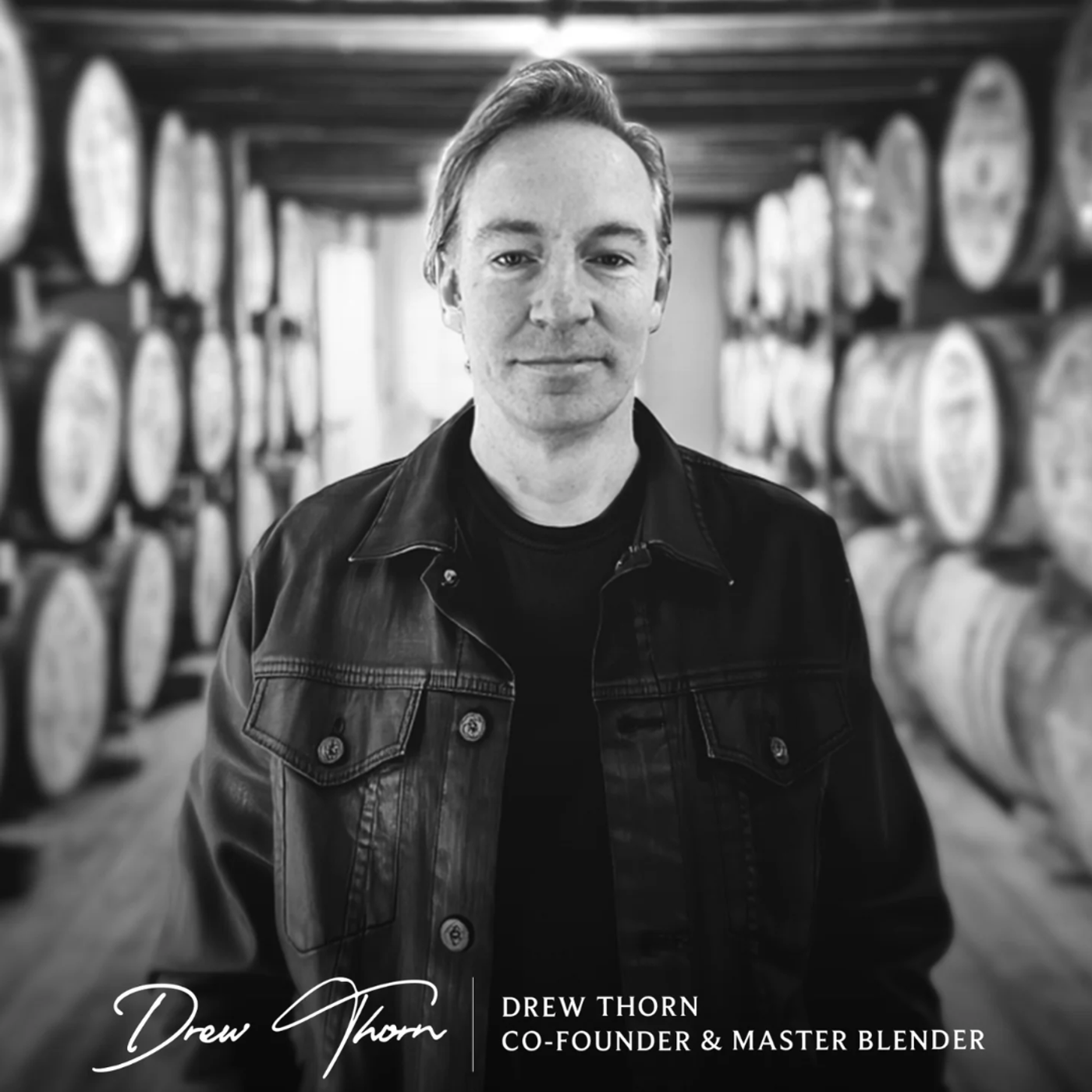
408: Silverthorn Reserve with Founder and Master Blender Drew Thorn
Drew Thorn helped build Sagamore Spirit from a three-person startup and later became its CEO. In 2026 he launched Silverthorn Reserve, a Maryland bottler focused on 10- to 14-year-old whiskeys and small, intentional blends. In its first year, Silverthorn's Blender's Art Bourbon scored 98 points and Double Gold at the San Francisco World Spirits Competition. It's now a Best-in-Class finalist, and the winner will be announced Nov. 8.
Drew walks Jake through how he sourced barrels in six months and why he bottled a 13-year-old Georgia whiskey. He explains the three-part bourbon blend, which includes a high-malt MGP bourbon originally distilled by Greg Metze. He also explains why he thinks the 10- to 14-year range is the sweet spot of the aging curve, and why he'll only bottle what he likes himself.
Chapters
Time
Chapter
- 0:00: Welcome, with Scott on vacation
- 1:02: Crab cakes, the Ravens and the Terps
- 2:31: From craft beer to Sagamore Spirit
- 6:27: Pulling a retirement hobby forward: Silverthorn Reserve
- 7:18: First bottling and a soft launch in Baltimore
- 8:46: Licenses, subleases and sourcing barrels in six months
- 11:21: Why 13-year-old Georgia whiskey?
- 15:31: Small-batch blends and the NDP advantage
- 16:32: Inside the Blender's Art bourbon blend
- 20:32: Malt, grapefruit and balance at 115 proof
- 23:15: Blending at Sagamore, and how Drew builds a blend
- 26:26: Two Double Golds at San Francisco
- 28:24: The 13-year-old MGP rye single barrel
- 30:40: The portfolio and the $100 price point
- 32:20: Do age and proof matter to buyers?
- 35:21: Why the founder's own palate matters
- 38:31: What 2027 looks like: staying in Maryland and DC
- 41:47: Where to buy Silverthorn
Chapter times come from the Riverside edit; confirm against the final published file.
Blender's Art bourbon blend, batch 1
- Component Share Notes
- Kentucky bourbon
- 62%
- 10 years old, 74% corn, 18% rye, 8% malt
- MGP high-malt bourbon
- 28%
- 34% malted barley, distilled by Greg Metze and acquired through Old Elk
- Georgia four-grain bourbon
- 10%
- 14 years old, from Ivy Mountain stock bought through Bardstown Bourbon Co.
The blend is 10 years old and 115 proof. Its awards are 98 points, a Double Gold and a Best-in-Class finalist spot at SFWSC 2026. Percentages are as discussed on the show. Drew notes that batch 2 differs slightly.
In this episode
- Guest: Drew Thorn, Founder and Master Blender, Silverthorn Reserve
- Host: Jake Lewellen
Links
- Buy or learn more: silverthornreserve.com and Seelbach's
- Support the show: Patreon · The Weekly Pour newsletter · YouTube · Instagram
Keywords: Silverthorn Reserve, Silverthorn Reserve Blender's Art, Blender's Art Bourbon, Drew Thorn, Silverthorn whiskey, Maryland whiskey, Sagamore Spirit, non-distiller producer, NDP whiskey, bourbon blend, high malt bourbon, Georgia whiskey, Ivy Mountain, 13 year rye, San Francisco World Spirits Competition 2026, Best in Class, double gold bourbon, Seelbach's, whiskey podcast, Bourbon Lens, Bourbon Lens News
#bourbon #whiskey #whiskeyaging #silverthornreserve #marylandwhiskey #bourbonlens
Jake Lewellen: Welcome back to another episode of the Bourbon Lens with your host Jake. Scott is enjoying another vacation because he's still gallivanting across summer. But we are excited to talk to a new brand to us. So sit back and buckle into the latest episode of the Bourbon Lens. I'm joined by Drew Thorne of Silver Thorne to talk about his whiskey, his progression in life, and where all things are going with this brand. So sit back and enjoy this conversation, Drew. Thank you for spending a few minutes, I was gonna say hours, with me this this evening.
Drew: Right on, Jake. I appreciate you having having me on tonight.
Jake Lewellen: Yeah, excited about it. it is been a while since we've podcasted. We've gotten far ahead, so it's been weird to to get you know going. But appreciate you spending a few minutes with me prior to the show, getting my, you know, vocal cords lubricated here for the the conversation.
Drew: Mm-hmm.
Jake Lewellen: but you know, first I just have to ask, you're in Maryland. crab cakes and football. Is that what Maryland does best?
Drew: they're certainly excellent at that. Yeah, it it it it wasn't
Jake Lewellen: It's my favorite it's my favorite line from Wedding Crashers. Yeah.
Drew: wrong. we love our crab cakes. we we've got we've got really good ones here.
Jake Lewellen: Yeah.
Drew: one of my favorite local places called Nick's Fish House. kinda right on the water in Baltimore City. great crab cakes, great like waterfront vibe, deck deck vibe.
Jake Lewellen: Yeah.
Drew: you can bring boats right I mean I don't have a boat, but you can bring boats right in if if you are someone that has a boat. so it's it's it's a great place to get a crab cake.
Jake Lewellen: I I need to get there because I hear Ole Bay's and everything and love old bay. And then obviously
Drew: Mm-hmm.
Jake Lewellen: crab cakes can't go wrong. I like a nice Ramelade or Rumelade, whatever you call on top of crab cake, and we're we're good to go. the
Drew: Yeah.
Jake Lewellen: Terrapins are not looking great at football, but the Ravens, you know, pulled one out recently.
Drew: Yeah. Th this this week, I think you kinda nailed it. Both both the commanders pulled out a surprise and
Jake Lewellen: Yep.
Drew: the Ravens had a nice close win at the end there and the Terrapins, which I I did go to Maryland, they they they had a rough one. Yeah. Yeah.
Jake Lewellen: Yeah, to say the least. They may be on the hunt for a new football coach at the end of the season. but man, excited to talk about you know, what have going on. but before that, before we get into, you know, your new brand, elevator pitch on just who Drew is, just a a brief bit about your a brief bit about your background so everybody knows that we're talking to somebody who knows a thing or two about whiskey.
Drew: Sure, absolutely. So I mean I I kind of entered the field of beverage alcohol manufacturing back in the in the late nineties. this was through craft beer and I started off as a brewer in in craft beer and worked at a a brew pub in in Montgomery County, Maryland, just outside of DC. Did that for a number of years while I was in college. And then after getting out of college, eventually I worked for a larger craft brewery that had national and global distribution. And I was there for about a decade and built my way up through that organization into like kind of the executive level. And at that point I things took a bit of a little bit of a an exciting turn and and The concept for Sagamore Spirit was being developed at that point. And the the owners of of Sagamore kinda reached out and and tapped me on the shoulder and said, Hey, any interest in transitioning from Kraft Beer to whiskey? that was in 2015, and I had I'd had north of 15 years in in craft beer at that point. And
thought it would be a really great time to make that transition. So I I jumped over. I joined the startup team for Sagamore Spirit back in in 2015. there was three of us at the time. Brian Tracy was the the president and kind of the first hire. They brought me in. on the operations and and finance side, and we got to work flushing out business plans, getting the distillery built, hiring employees four through 90, and and and building that that project up over the next many years. so there at Sagamore I I was the COO and and ran all of the production operations and worked with the production team and product development and h help with the innovation and and also just quality sensory lab all all of that and then on the finance side ran the the finance team and right yeah yeah
Jake Lewellen: Ran the numbers, baby. You gotta gotta make sure you're making a profit, right?
Drew: you you can't give the whiskey away at least not for too long And and so did that for many years, nine, ten years, eventually rose to become the CEO of of Sagamore. and after in that role for about a year, the Owners had an opportunity to sell the company. I helped facilitate that process and then stayed on for about another 18 months to facilitate a a a smooth transition for the existing leadership team and and the the acquiring team and make sure that like there was a nice, stable, successful transfer. But then at that point, it for me it was a great opportunity. But like in my my career path. To start Silver Thorn Reserve, which was a concept I had in my pocket. Like honestly, I had it is a thing that I had wanted to do more as kind of a retirement hobby business, where maybe it was a twenty hour a week thing to keep me busy doing something I'm passionate about and love. and but then I I decided that actually at this point, rather than starting fresh with some other new brand
as I'm approaching 50 years old, I'm going to pull my retirement hobby forward and and and craft it into a a business. And then that's going to be my next chapter.
Jake Lewellen: Yeah. Well we're we're here now. The chapter has has the book has been opened, for lack of better terms.
Drew: Yeah.
Jake Lewellen: and so, you know, you all when did the first liquwood of Silver Thorn get into marketplace? 'Cause I I remember I think it was earlier in February this year that I saw it kind of like pop up. a little bit. and I know I think you had some conversations with Scott and Scott tried it and that bottle did not last long because I did not get a sample of it. and he literally
Drew: Yeah.
Jake Lewellen: said it disappeared because that he enjoyed it. So when when did you all hit market?
Drew: So we We we our first bottling was in November of twenty twenty-five. And we didn't launch at that point. We did what I would call a soft launch, where there were there were two retailers in Baltimore that like we we had a a good history with. And we we just opened the brand up just because we were late into OND when we went into the bottle. We were like, Look, look you two have this, we'll We'll get feedback and and you know customer impressions and and work with you for the next six weeks before the end of the year, and then we will begin our actual launch in the beginning of 2026. So
Jake Lewellen: Mm-hmm.
Drew: bottles going out or us distributing to additional retail accounts really didn't start until the beginning of 2026.
Jake Lewellen: And so what's that process, right? You you leave Sagamore, what's that look like? You know, me and you talked about this in pre-show, but everyone knows that there's an opportunity for garnering great barrels in this climate that we're living in. So you leave and you start to, you know, put this together. What's the quick timeline in that? So we we get to bottle in, you know, late November. So let's backtrack, you know, what happens in that six, seven months, not to be too Gen Z about that one.
Drew: Yeah.
Jake Lewellen: how did this all come together? How did, you know, obviously you had context, how did it go to source these barrels so quickly to be able to get this spun up? 'Cause that's no small feat in itself.
Drew: Yeah, I had a bit of a I think advantage in this area, just with my industry experience where
Jake Lewellen: Mm-hmm.
Drew: I mean a fair amount of that time was really just putting business and compliance structures in place. So
Jake Lewellen: Yeah.
Drew: getting my getting my DSP, getting my state licensing, getting all of these things in place. as I had mentioned to you pre-show, I'm I'm subleasing with both Sagamore and Old Line Spirits. So like agreements, legal frameworks, all of these things had to go into place. so part of that six months was really just getting the the the infrastructure set up to be able to even buy barrels and take possession of them. But in the background, we, you know, I've have a lot of relationships around the industry with with other distilleries. And so I'm also kind of on the phone talking to people about what they might have in small quantities that is of interest to get started. And so I I was working with a number of different distilleries across that period to get a an initial round of of whiskey purchased and ta kind of time that out. So like we got our DSP, Then it's like, okay, we can close on these barrels, we can get these barrels shipped, and then from there, you're just really getting
your initial start, right? It's like all the blending
Jake Lewellen: Mm.
Drew: and all of those things happen after that.
Jake Lewellen: Yeah.
Drew: so then there was a a couple of months of putting together what initial release products would would look like.
Jake Lewellen: Yeah. And and you came out with with an older stock Georgia as one of your first releases, if I'm not mistaken. Is that correct? So
Drew: Yeah.
Jake Lewellen: why Georgia, right? Because I I I know a couple of distilleries that use Georgia distillate. I know a lot of people that are producing in Georgia, but there's been, you know, one distillery kind of went belly up and there's a Kentucky distillery that bought a lot of that stock. you know, and you know The stuff that's come out of there, I think, is really unique. So what kind of made you land on on Georgia? Was it just like, hey, this is really unique or different? Like the I that's one of the things I was kinda like, huh, why Georgia? because you don't think of distillation right off the the top of the head. Like Georgia's not one
Drew: Sure.
Jake Lewellen: of the top of the top three.
Drew: Yeah. No, totally. and again, like I would say so the Georgia a and like This wasn't the intention. I wasn't like, let's go to Georgia and see what their best whiskey is, because I want
Jake Lewellen: Ha ha
Drew: to launch with Georgia. and kind of reverse engineering the interest. I've I I've kind of found that people kind of like in your in the same way that you sort of did, you're like, huh, Georgia. Why?
Jake Lewellen: Yeah.
Drew: so it it did like almost get people's attention in in an unintentional way, to be like, what what what is Is this 13-year-old Georgia whiskey? What even has been distilling for 13 years in Georgia? So the it it it created some questions.
Jake Lewellen: For sure.
Drew: And for for me, you know, the kind of the path to that was I was working directly with Bardstown. And Bardstown had a variety of stocks. Some were self-distilled, but they haven't been around 13 years. So I was working with them on on other things they had available that that they had acquired. And they had through basically Ivy Mountain was the original distillery that went out of business I I think around twenty twenty-one. and then Bardstown through a broker arrangement purchased a a substantial quantity of their inventories. And Bardstown, you know, they're great to work with. I've I've known those folks for years at this point. And they gave me a a lot of access to in a very detailed way work through those stocks and
Jake Lewellen: Mm.
Drew: understand what I thought was of interest and wanted to buy. so basically I f from my perspective there there were some very interesting and also very good whiskeys in there but but they
Jake Lewellen: Yeah.
Drew: they needed to be found. and
Jake Lewellen: Yeah. For sure.
Drew: because again Ivy Mountain was a a smaller distillery. They were going through I think a lot of experimentation in what they were doing and that's gonna lead to some gems and some misses and and so being able to kind of pick through and and see what's of interest, made that possible for us to get involved with that. And Some really fun really fun whiskies that we we've had a lot of great feedback on and and it's a the single barrels are interesting in that like there's a curation role in it and you you can find these these little gems a and get them out. And the ones that that we've sent out have been well received and are are mostly gone at this point, like
Jake Lewellen: Yeah.
Drew: they they went pretty quickly, honestly. But that that in itself, you know, Georgia was one arm of what we were doing. And the the other arms where we we spend a lot of our time is on these very small batch, very intentional blends. And
Jake Lewellen: Yeah.
Drew: we use some Georgia in those, but they were not, they're a component but not the showpiece of the blends.
Jake Lewellen: Yeah.
Drew: They bring in a a distinct piece to them, but they aren't a majority of any of those blends. But to get back to your original question, A as an NDP, we have the luxury of being somewhat agnostic as to the origin of something. We're we're out looking for these fines and and to
Jake Lewellen: Yeah.
Drew: be able to bring to consumers something that might otherwise go unfound.
Jake Lewellen: Mm.
Drew: and and so I I really like the whiskey and that's kind of all it took to put in the bottle.
Jake Lewellen: Hey, sometimes simple is better than anything else, right? don't
Drew: Yeah.
Jake Lewellen: don't overthink it. so speaking of, let's let's talk a little bit about the blend because the the reserve single barrel that I have is is a rye, so it doesn't really allude to that. But the the blue label here, the I think it's called the Blender's Art. So this is, you know, one that you've blended together because you not only run the business as a co-founder, but you're also the master blender of the the team here. So this one does have that Georgia component in there, 10%, 14 years old, 80 10, 55. but you know, this is really a traditional Kentucky mash bill blended with a kind of higher malted rye, ride bourbon from
Drew: Mm-hmm.
Jake Lewellen: from Indiana. So So talk to talk to me a little bit about your blending components because me and you were talking pre-show again, I think this is the opportunity for NDPs to really reposition themselves in marketplace, right? To be seen as s purveyors of whiskey, kind of hearkening to, you know, pre-prohibition when people didn't own distilleries, but they knew how to kind of bring things together and and blend them to make them uniquely own their own. so talk to us about how you got you know built this one and how you kind of look to move forward with this kind of blenders edition.
Drew: Yeah, no, absolutely. So that that bourbon, essentially it it is on a Kentucky whiskey base. I I believe that batch is I think sixty-eight percent ten year Kentucky sixty-two? Okay.
Jake Lewellen: Sixty two. Yep.
Drew: Sixty-two percent Kentucky bourbon. and then we are functionally seasoning that. By dropping that 14-year-old barrel of Georgia foregrain on it. And then the other mash bill, which is from MGP but is a a less available mash bill, is this 34% malt bourbon.
Jake Lewellen: Small, yeah.
Drew: so it's a high malt bourbon. it was distilled by Greg Metz, and that was actually acquired through Old Elk. which you know it was distilled at MGP and then acquired through old elk. but it brings in a w in the quantities that I have it in there, which is two barrels out of eight, and by volume I think it was what, twenty two percent some somewhere around there.
Jake Lewellen: Yeah, twenty eight. So it was sixty two, twenty eight, ten.
Drew: Twenty eight. Okay, great. I I've already I'm already on the second batch, so the numbers have slid a little
Jake Lewellen: Yeah, yeah, you're on to the next thing.
Drew: bit, but but yeah, so we're in the twenty percentiles with with that. and it adds a what I think is a a a distinctive profile to the bourbon, but not not one that it like transforms it into something unrecognizable. in those quantities, it to me adds interest but still creates an excellent bourbon. And that malt is like it brings in some viscosity, it brings in a little bit of balancing sweetness, but it you also get some other flavors in there, like some some orchard fruits, some flavors that you might not find in a just a standard Kentucky mash bill. so Wanted to create something that was somewhat distinctive, still very much within the bourbon profile, and then showcases these what you can do when you bring these different bourbons together.
Jake Lewellen: Yeah, That was my eyes went to the malt characteristic on the the Indiana really quickly, like 'cause everything is displayed here on the back. We'll post pictures of this, you know, when it's done. But I love the transparency of that first and foremost. But you know, it goes to that because a lot of people in America don't understand like what malted barley actually can do to a whiskey. it can give it again, I think viscosity is the right term there. Like that's what I was thinking. It's really viscous. but it Also gives it this bitter grapefruit note that kind of weaves in throughout. The whiskey that balances, that darker, traditional Kentucky, you know, because you have a 74 percent corn here. So it's like 74, 18, 8. So you have a high corn bourbon, so it's gonna get some sweetness. You're gonna at 10 years, you're obviously getting some of that tobacco leather kind of note, but it needs that balance. And so I think that kind of bitter grapefruit note really kind of
balances this whole experience out. And then even like the small percent of weed in here gives it like some silkiness and some softness to it so it's not like harsh right and at 115
Drew: Yeah.
Jake Lewellen: proof it's a really balanced pour which I think is fun because that's what you're trying to achieve with a blend right you're trying to find balance when you bring these you know kind of hot homogenized three different whiskies together
Drew: Yeah. No, totally. I I mean I I'm glad that you that like that was your impression of it. that it's certainly what we are going for. Like in a blend, I think there's several things that we're trying to accomplish. one is to not have it be flat. Like it you don't like I don't really want like I I'm not It's less interesting to me if something is just one note. Even if that note's
Jake Lewellen: Yeah.
Drew: good. I want a little bit more of a journey a across the the palette than that. and but you want or I what I look to shoot for is what I would say like solid integration. So it's not choppy or
Jake Lewellen: Yeah.
Drew: kind of chaotic in that journey. and then what you had mentioned, which is kind of a balance where kind of in the classic almost culinary sense of the word balance, like you don't want something to be cloying or too salty or too bitter. but you put all of these different flavor components together and you you kind of get the the best of everything. and that's what we shoot for.
Jake Lewellen: For sure. and had you ever blended before and when you're tired at your time at Sagamore? Okay.
Drew: yeah, absolutely. we Sagamore Sagamore was a is a a bit larger scale. They're not like a large producer, but they're a bit larger than like what we're doing at Silverthorn. but everything we did there was blending.
Jake Lewellen: Yeah.
Drew: so even j even the Sagamore small batch kind of core products are blends of different rye mash bills in different quantities.
Jake Lewellen: Yeah, so like that's why I was wondering if like, you know, given all the things you did there, like were you actually like in the creation phase? Because if you went from, you know, guy looking at finance or guy, you know, orchestrating massive exits, and like now you're going into blending, that'd be a heck of a switch, right? so like glad that you have some experience because blending, I I competed in a competition for Bardstown many moons ago called World's Top
Drew: cool.
Jake Lewellen: Whiskey Taster. And one of the last components of the finals that I was lucky enough to be a part of was blending. And it's not easy to sit there and think about, hey, I've got these four or five distillates. How do I homogenize this together to be able to create something that is artful but also can tell a story, right? Because you want each of these individual liquids to kind of shine through and build through from a whiskey pro like a front back mid palette all that experience
Drew: Mm-hmm.
Jake Lewellen: and that's gotta be a kind of a jaw dropping task really in all honesty to be able to f think about how you engage with each consumer that might pick up your liquid.
Drew: Yeah, it is, it is a, I mean, one, very time consuming. to your point, like, it is, I would expect more challenging than what people might expect it to be, especially if they've haven't had any direct exposure to the process. but our process, for example, is we every barrel that we purchase I run full sensory on and catalog all of that sensory in a database. So every barrel is individually tagged with its flavor profiles and all its attributes. and then when you get into blending, like There are there are hundreds of barrels that you're trying to whittle down to ten.
Jake Lewellen: Mm.
Drew: and then within that, like once you get into the kind of ballpark of that 10, then you're still subbing in and out this one for that one, is that better or worse? This one for that one, is that better or worse? And so the process itself is one that it is. a trial and error sensory process to
Jake Lewellen: Yeah.
Drew: get to kind of the most cohesive and best representation of the blend concept that you are targeting.
Jake Lewellen: Mm-hmm.
Drew: And and so it is something that it really takes a lot of time and and a lot of sensory work to get it.
Jake Lewellen: Yeah. Well and that is again I think people don't understand, you know, what goes into creating these Really unique experiences, honestly, that you all are building for people to enjoy. And I am scrolling through your website right now and just to kind of get a lay of the land. this one did really well. It was a double gold winner at San Francisco in 2026. So congratulations. I know people that sit on that panel. And they talk about the long days and how hard it is. but you know, to to go out to San Francisco and do as well as you did, like, kudos to you all on that. Like, you know, first year really kind of like full bore. What's it what's it like to kind of see this blend, your first baby, you know, into to marketplace, you know, perform well with some of the best palettes in America coming to judge it.
Drew: Yeah, well I appreciate that. Yeah. I think honestly it was Great. like to to cut
Jake Lewellen: Keep it simple.
Drew: to come out of the gate with our first two batches of both the bourbon blend and our 10-year rye blend, have them both go double gold. you know, the bourbon blend got a 98-point rating and the rye blend got a 96-point rating. And these were our first two releases of those products. I think it's I think somewhat validating that our our approach to blending is at least well received within the that judging panel.
Jake Lewellen: Yeah.
Drew: the ultimate judge is is our consumers and people we're working with out in the market. And fortunately it's also been well received there. So again, I'm appreciative of the metals, but it it's more I think the bottom line i is really the consumer and they they've both been well received and doing very well in their first year.
Jake Lewellen: For sure. and it's always good when you go like I was looking at the website to see something sold out, right? it's always good when that's that happens because that's a good problem for you to have. Means you've got velocity through a skew, we were talking about and it's performing well. And you know, kind of the new kind of big whiskey out there that you all have is this single barrel straight rye whiskey. and this is a an
Drew: Mm-hmm.
Jake Lewellen: G P I mean you can't go wrong with the ninety five at thirteen years, right? Like It's one of the quintessential whiskeys that people have come to realize. especially like I'm a huge rye fan, so like older age stock MGP is exceptional. You older age stock mahonganila or mahong, whatever I say it wrong every time. like that Pennsylvania, Maryland-style rye whiskey, those older stocks are really great because they're unique and different. but like What's it like to be able to have access to, you know, one of the predominant, you know, rye whiskies and be able to put that in a in a bottle and you know say, Hey, look, we also are purveying really good whiskey for you to buy if you really like this flavor profile at a at a high level. because that's not sitting out in the marketplace every day.
Drew: Yeah. No, I think again that we're able to acquire that through relationships. I think
Jake Lewellen: Mm.
Drew: to your point it's not just like You don't go to a website and or order ten barrels of that. but yeah, that'd be nice.
Jake Lewellen: You wish you could. You wish you could.
Drew: but again, I think that like the single barrel series and what we're doing there with that 13-year-old 95 rye is it is that. It's like it's curating a classic almost and just saying this is good as it is, enjoy. Like we found
Jake Lewellen: Yeah.
Drew: it, we want you to have it, and that's kind of what that single barrel series is doing. I very much, you know, obviously coming from Sagamore and having a decade in rye whiskey, I have a taste for rye and I really enjoyed these barrels. So I wanted to put them out in a single barrel. We you know in the future we'll have we'll have bourbon single barrels. Like that program is is very fluid
Jake Lewellen: Yeah.
Drew: and when we find a good stock of something it goes through that program.
Jake Lewellen: Well, and I think that's what I liked about URL setup. You've got a port finish, so you got a little bit of a finishing series with again, not a crazy finish, but something people are acceptable to.
Drew: Yeah.
Jake Lewellen: From a palette perspective, you've got the blending series, you've got single barrels, right? So again, I think you're keeping it simple for the consumer. Hey, these are the kind of the four or five basic SKUs that you're gonna see from us. And that allows people to know and grow in favorites of you know what whiskeys that they are going to, you know, potentially you know, purchase from you all. Cause I mean, it let's call a spade of spade. It's not necessarily cheap, it's not inexpensive, but you all are sourcing. whiskey and artfully considering it at ages that most people aren't thinking about. there's obviously the big guys can do it at scale. and we've seen people like Beam flex their muscle or Heavenhill flex their muscle in recent years. and being like able to put nine and ten year age statements on pretty much whatever they want to. but for you all to get these unique mash bills and bring them together in a in a 10 year blend, like that's something very unique
in the marketplace. And I think that drives I wanna say it drives a little bit of a speciality to it, right? And so that hundred dollar price point is not really unapproachable because I think most bourbon consumers, whiskey consumers, fifty to a hundred dollars is where they want to spend their money. If they're looking for a gift that might go into the 150 category. But like
Drew: Mm-hmm.
Jake Lewellen: if you're in that fifty to one hundred and what you're in and you see an age statement, I think those things really matter to the consumer. and so Question from you from a marketing side and seeing the financials and all those things. what do you what have you seen move the needle? A lot of people say age and proof don't matter. I disagree with that. I think age and proof are, again, you buy with your eyes. I see age and I see a decent proof that I like, somewhere for me, 90 to 115. That's what I want to stay in. So this fits my profile. I like, you know, seven to eleven-year-old, 12-year-old whiskey. Like that's my flavor. Like, I'm buying with my eyes on this bottle alone. Like, you don't have to flip it around. I'm like, that's interesting. It's at a good price point. but like what has what's your all's marketing and your kind of background kind of shown you about people's purchasing habits on something like this?
Drew: Yeah, I think I do think that So from a from a product concept, let's say you're a consumer and you are exploring a brand that you aren't familiar with. Like you don't you don't have a history with them, you've never, maybe you've never tried anything of theirs, or even had a friend say, this stuff is good. you're I still think in those cases, you have At some level, you're considering these metrics of like what's the proof point, what is the age, what can I know about this without having tried it?
Jake Lewellen: Correct.
Drew: and these are some clues. what I wouldn't say is that age directly correlates with good whiskey by any means.
Jake Lewellen: Amen.
Drew: yeah. But I would say as a shopper that is new to something, I think these are clues that are still being considered in their their purchase decision. for me, I I tend to like whiskies in these age ranges. So
Jake Lewellen: Mm-hmm.
Drew: it's not that I was like, we need to have 10-year-old whiskies so that people will buy them because it needs to be 10. It was more that like I really like in this like 10 to 13, 14 year old age range, I I find that you get richness and complexity of age, but not Overcooked, overwooded, thing and it doesn't always happen. You can get things well above 13 that are absolutely mind-blowing, but there is this aging curve where you like have a peak and a a regression on pretty much every barrel. And if you're designing a portfolio around an age range, you are in my mind you're more in the sweet spot of most aging curves if you're in this 10 to 13 14 year old age range. and so it gives us the ability to maintain those product lines but also the flexibility to have what I find to be like the best flavor profiles
Jake Lewellen: Well and I think you said something there that's really interesting. I think you saying as a founder and a proprietor of these whiskies, this is what I like. I think a lot of times people distill for consumers and obviously you want them, but it's like I have to like it first, right? If you don't care for it and you don't it doesn't meet, you know, what Drew wants, then like how can you go tell the story if you're not passionate behind it, right? And so I think hearing what you said and how you got there made me connect with you more so that now now I'm connected more to the brand. And so as think as a consumer, is like first I'm going to I'm gonna I'm gonna fill you out with my wallet, right? obviously, I purchased it there, but now I hear Drew say something like I curated this because this is how I approach whiskey. This is the type of whiskey that I like, and here's why. I hear that and I'm like, okay, now n maybe that's telling me context clues about myself. What do
I like? What do I enjoy? Well, now I can connect with that brand. And I still think in today's climate where there's infinite choices for whiskey consumers, being able to connect with a brand at a personal level and hearing things that you resonate with, it's just like everything else in business. If I don't resonate with it, I'm out. Right? Like that's just
Drew: Yeah.
Jake Lewellen: it's you wash your hands with it and you move on. this an opportunity, I think hearing that from my I think it tells a unique story. and not one that everyone gets to hear. So as an NDP, you're like, hey, I'm curating this because I like it. And so now once you get on board with what I like because here's why. And I'm sure you're open to feedback on like, hey, let's maybe think about this or do that. and if you like it, great. If you're not new project.
Drew: Yeah. No, totally. Yeah. I mean I think you kind of nailed the process in a lot of ways. Is it's not that I do not value and incorporate feedback and I do have like a
Jake Lewellen: For sure.
Drew: network of people that I will run things by, you know, in the product development phase that you know, I value their opinions, Everyone has a different palette, right? And so things that I might love, someone else may be like, that is not my jam. And I'm like, okay, that's it's okay. That's all good. but to your initial point, I could not do this if it were not based on what I think is good.
Jake Lewellen: Yeah.
Drew: Because if I'm just guessing at some amorphous idea of what other people like, then my palate isn't even a part of the process. It's kinda just like I'm going out and finding some benchmark of what other people like and trying to match it. And it's like
Jake Lewellen: Yeah.
Drew: that is adding no value from my perspective. so it's it's kinda like I see no other way of doing it.
Jake Lewellen: For sure. you want to be a value ad, not a not a just a kind of booy in the ocean bobbing up and down, right? Like
Drew: Yeah.
Jake Lewellen: you want you wanna provide value. So so speaking of that, right, we are approaching fastly and this will launch this podcast will launch right around the time you launched your first barrels. your first bottles into market. what's 2027 look like? I can't believe it's here, really, in all honesty, but what's
Drew: Right.
Jake Lewellen: 2027, look like? I was talking to another distiller. They're thinking about 28 planning. how does this look for you all? you know, and what does success look like in 27?
Drew: Yeah. great question. I think for us, it is a deepening of twenty six. so
Jake Lewellen: Yeah.
Drew: we are not looking to expand geographies on the ground, We are going to really focused our our small company resources in the Maryland and DC footprint for actual on-the-ground engagement, so retail stores and ultimately on-premise. and and then continue to support national interests through online, through Sealbox, through our website. and working with some barrel clubs around the country. but our this business was designed small in intentionally and it is not in a it would make no sense to do a any sort of rapid geographic expansion
Jake Lewellen: Yeah.
Drew: So, we we're we have great partners here in Maryland and DC. we have just cracked the surface of going to on-premise establishments. Like we're 98% in retail establishments at this point. So
Jake Lewellen: Mm.
Drew: we have beyond a year's worth of progress still to support and build relationships here in Maryland and DC.
Jake Lewellen: Yeah. Well no, I think it's awesome to hear about regionality. I think this will be a great reset for companies to own and participate in their area. All fifty states don't need to know about you to be successful. I mean I can point to many brands who are successful because they own their state, right? Or own their area. it's I love that idea and I love the idea of consumerism through online, because I think that's a very vital piece of things. I wish legislation would change and we could go USPS, but you know, that's just my personal
Drew: Yeah.
Jake Lewellen: opinion. damn wine.
Drew: Ha ha ha.
Jake Lewellen: But I I'm excited. I I really like this blend. It's a lot of fun. I'm gonna take this to our tasting club. so we have a bourbon lens tasting club. And so
Drew: Mm-hmm.
Jake Lewellen: we'll allow 26 other people to give it a whirl, is what we'll do here. But man, I really, really excited for what y'all are doing. and so keep up the great work. really appreciate you spending some time with us. and excited to see what 2027, 28 and beyond looks like for you all.
Drew: Yeah, no, absolutely. I again I really appreciate you having us on. now that I know you really love Ryze, I have a Rye blend I need to send you also, so I'll get that headed your way. Yeah.
Jake Lewellen: Don't tempt me with a good time. well I you gotta plug you gotta plug. where can people go find out more about you all, get connected so they know that they're not missing out on the good whiskey that you all are coming out with.
Drew: Absolutely. So you most states can purchase us through our website, which is SilverthornReserve dot com. Also, we our full portfolio is available on sealbox.com. And they they hit some states that our website doesn't. It's different fulfillment channels, but between those two, most people around the country should be able to access Silver Thorn. and then if you are in the Maryland and DC area, we are in many major retailers. and if we aren't in your preferred retailer, don't hesitate to ask them about. And we'll be spending the next year getting e even broad more broadly distributed across Maryland and DC.
Jake Lewellen: Awesome. Well Drew, thank you for spending time with us. Thanks everybody for listening to this episode of the Bourbon Lens. We'll catch you next time. Cheers.
Drew: Thanks, Jake. Cheers.
You May Also Like
Classic Humorous Short Stories from America
The Podcast Network

Podcast Patapoe
0d0a

Daily Short Stories - Ghost and Horror Stories
Sol Good Network
Exchanges: A Cambridge UP Podcast
New Books Network

Daily Rosary Meditations | Catholic Prayers
Dr. Mike Scherschligt
SFFaudio
Jesse Willis

NPR's Book of the Day
NPR

This is Your Book Club Podcast
thisisyourbookclub
CyberSecurity Summary
CyberSecurity Summary
The Great Detectives of Old Time Radio| Daily Mystery Dramas
Adam Graham|Old Time Radio Detective Host
Classic Humorous Short Stories from America
The Podcast Network
Podcast Patapoe
0d0a
Daily Short Stories - Ghost and Horror Stories
Sol Good Network
Exchanges: A Cambridge UP Podcast
New Books Network
Daily Rosary Meditations | Catholic Prayers
Dr. Mike Scherschligt
SFFaudio
Jesse Willis
NPR's Book of the Day
NPR
This is Your Book Club Podcast
thisisyourbookclub
CyberSecurity Summary
CyberSecurity Summary
The Great Detectives of Old Time Radio| Daily Mystery Dramas
Adam Graham|Old Time Radio Detective Host
Community discussion