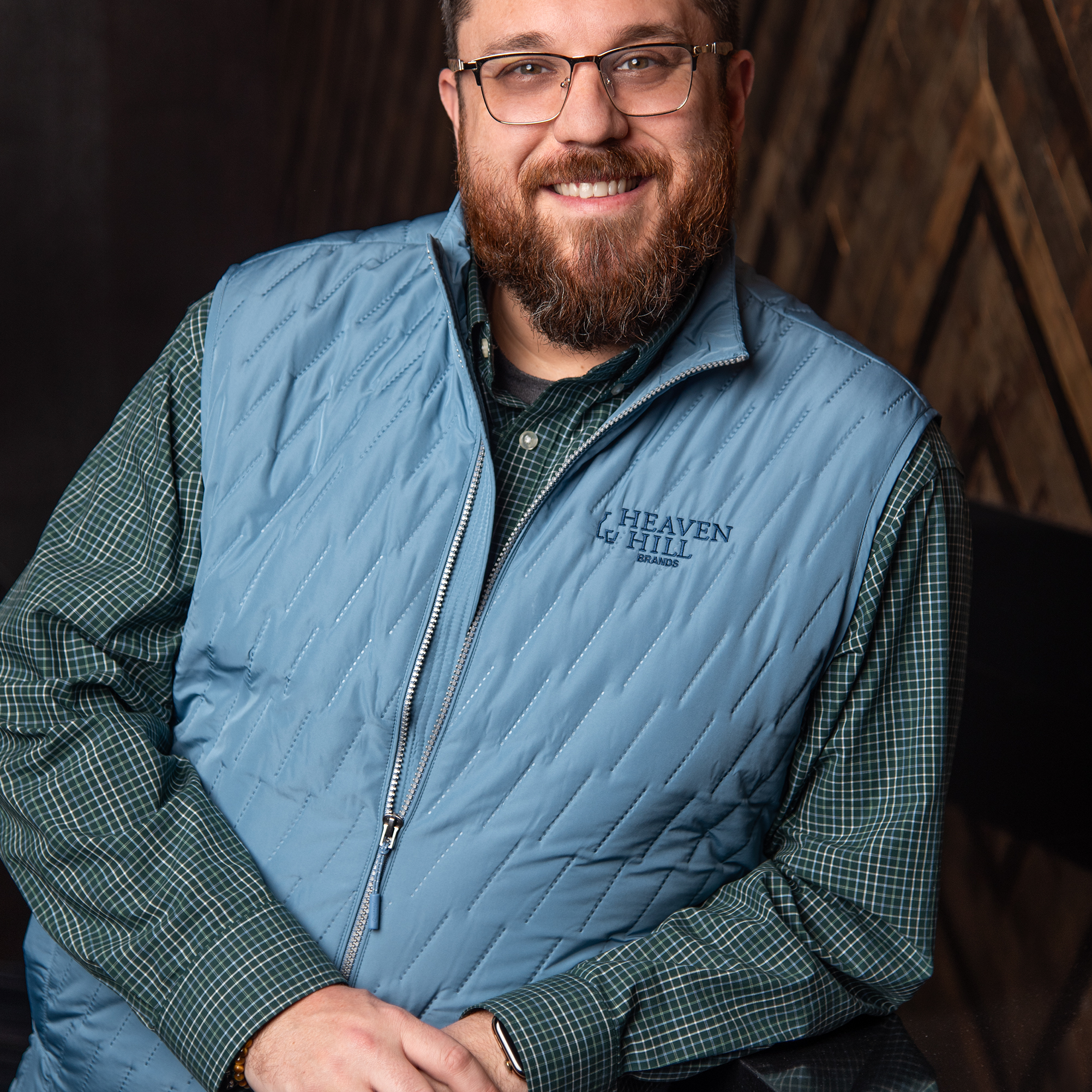
407: Heaven Hill Bottled-in-Bond Double Mash with Adam Edwards
Adam Edwards of Heaven Hill is the first five-time guest on the Bourbon Lens. He joins Jake and Scott at Kentucky Bourbon Festival to break down Heaven Hill Bottled-in-Bond Double Mash. It's a 9-year-old, $49.99 blend of Heaven Hill's traditional and wheated bourbon mash bills, and Adam calls it "one of one" on the market.
Adam explains why rye overpowers wheat in four-grain bourbons and why the blend needed nine years instead of seven. He also does the math on just how rare an age-stated bottled-in-bond blend is. Then the conversation widens to cover following in Bernie Lubbers' footsteps, the Old Fitz and Larceny flavor spectrum, why barrels older than eight years start to "fail," and why Heaven Hill is building more capacity during a bourbon slowdown.
Chapters
- 0:00: Live from Kentucky Bourbon Festival with five-time guest Adam Edwards
- 0:58: Following in Bernie's footsteps
- 2:19: A deep portfolio, a 40-second brand training and Christian Brothers
- 3:37: Two iconic mash bills in one bottle
- 6:21: Why rye dominates four-grain bourbon
- 8:09: Inside the blend, and why it's nine years old instead of seven
- 9:29: Tasting notes with Scott
- 11:13: $49.99 and "one of one": the bottled-in-bond rarity math
- 13:33: How the Heaven Hill name went premium
- 15:09: "Bourbon is dead?" Max Shapira's long view
- 17:49: Will Double Mash stay consistent?
- 18:45: The Heaven Hill bottled-in-bond portfolio
- 20:13: Old Fitz, Larceny and the Decanter Series flavor spectrum
- 22:13: Why barrels older than eight years start to "fail"
- 24:47 ;Bernheim, Old Springs and 3,000 barrels a day
- 25:44: Why big companies are betting on bourbon
- 27:21:Wrap-up and cheers
Double Mash at a glance
- Detail: Heaven Hill Bottled-in-Bond Double Mash
- Blend: About 2/3 traditional bourbon (78% corn, 10% rye, 12% malted barley) and 1/3 wheated bourbon (68% corn, 20% wheat, 12% malted barley)
- Age: 9 years
- Proof: 100, Bottled-in-Bond
- Official tasting notes:Toasted oak, honey and white pepper on the nose; honey and citrus oil on the palate; caramel and baking spice finish
- Price: $49.99 SRP
- Availability: Limited quantities nationwide since August 2026
In this episode
- Guest: Adam Edwards, Heaven Hill
- Hosts: Jake Lewellen and Scott
- Recorded at Kentucky Bourbon Festival, Bardstown, Ky.
Links
- Learn more: heavenhilldistillery.com
- Support the show: Patreon · The Weekly Pour newsletter · YouTube · Instagram
Jake Lewellen: Bucklin the latest episode of the Bourbon Lens. We are joined by our good friend and I think the first five-time guest of the Bourbon Lens, Adam Edwards, of Heaven Hill. Adam, thanks for spending some time here at Kentucky Bourbon Festival. I am very happy to be here. I really appreciate it. it's always fun to find parking down here during Bourbon Festival. That's my favorite part of the Bourbon Festival. Is Barstown is definitely set up really well for a major bourbon festival. lots of parking. Yeah, lots of parking, a lot of seating. Yeah. Lots of ways. I'm not gonna be sitting at all this weekend. I don't know what you're talking about. I'm gonna be on my feet all weekend. I love it. Yeah. I love it. Well, we're excited because Heaven Hill continues to do a lot of amazing things. you all are putting out new releases. whiskey's getting older. and you know, all continue to be one of the flagship heritage brands. and today in particular, we're gonna talk about a lineup
extension in the bottled and bond category. But first, like How's things going? Bernie has, taken an emeritus role and you've moved in and taken over some things. What's that like to just kind of follow in a legend's footsteps? You know, it's I think we talked about this right after I got hired. I think Bernie and I did a bottle in a bond episode with you guys. And, you know, I've known Bernie for a really long time. And I really when I first got hired, even internally, I would, you know, do market travel and I would get introduced as the next Bernie lovers. And I'm like, first of all, the like the bar that you're setting that I'm gonna have to hit right now in this moment with these people. but you know, I've learned so much from Bernie. But what's been really great this year is that Heaven Hill has really allowed me to really take my time and kind of find my voice within that Heaven Hill universe, right? And I mean, I take a lot from Bernie, obviously. I mean, when you talk about
bottle in the bond, like what am I gonna say bottle in the bond that Bernie has not already said. I'm not changing any of that. So I, I say a lot what Bernie's come up with because it's Mr. Bottlene Bond. That's what Garden a Gun called him. He loves to remind people that. but it's been great. And now I've really, you know, I've really kind of found my niche there a little bit more. you know, especially like the weededs. I'm doing a lot with the weeded lineup, both wheat whiskey and weeded bourbons. obviously that's hot. But I mean that's a god it's a deep portfolio. It is. deep portfolio and there's just banger after banger. I mean Scott's favorite brand. So Yeah, I mean favorite distillery hands down. But yeah, it is kind of difficult to keep up with all the brands. It's a lot. It's a lot. There are ti I mean I had to do there's a cruise line that we're partnering with and they needed it was funny. They needed 40 second brand like they said 40 second in-depth brand training. And I
was like, okay, 40 seconds. So they need Elijah Craig and then they sent me the other one. It was Christian Brothers. I was like, man, I forgot that we owned Christian Brothers, because I don't talk about you know, brandy a lot. Yeah. and so I had to kind of like dig into it. And I remember talking to Bernie, I was like, man, I need to know stuff about Christian Brothers. He was like, Well, Lynn House, you know, who has worked for Heaven Hill for like twelve, thirteen years, actually national mixologist. I mean, you talk about a wealth of knowledge, her. And then Max. Yeah. And I was like, I gotta sit down and talk to Max Shapiro about Christian Brothers? That's terrible. so you know, I mean, then I learned things about Christian Brothers and I was like, hell, that's incredible. Yeah. And it so that's really what it's been for me is just every day I continue to find something new about this and just really historic, you know, distillery and house of brands. And it just blows my mind
almost every day. Yeah, I mean it it's Crazy and then now we have things like the new release that's sitting in front of us, where you're taking the two iconic mash bills, the weeded mash bill and the H reg, as you know, we affectionately know it after sitting down with Mr. Connor a couple years ago. What's it like to create a new product like this? Well, you know, they know all know this. I don't even have to tell you this, but just in case somebody doesn't, when you start a bourbon brand, you have to wait a few years. Yeah. You know it takes a I always say it's like when you're even a not just a house, a new distillery, a new line, right? It's like you build this beautiful hotel and everyone's hyped for it. And then on opening night you shut the doors and you have to lock them. And everyone just has to stare at the building for four years or whatever, right? So I mean that's always a challenge. So they're always pretty far ahead of it, but you know, you're kind of talking about
like, yeah, H reg and then OFD, right? What is I think what's really cool about this, and of course, I mean this was getting developed long before I was with Heavenhill, right? What I think is amazing about this is they didn't so many times you can look at it and say, Yeah, this is this is HHREG, right? But it lives within Elijah Craig or Evan Williams or JTS Brown. Yeah, exactly. JTS Brown. Like what, right? I mean, just on and on and on. But in this case, it's not HHREG and OFD. It is specifically Heaven Hill Bottled and Bond. And specifically Old Fitz because they're both Bottled In Bond I don't get to say that a lot about stuff. I'm like, yeah, it lives within that flavor profile, like but I mean it is specifically drawn not only from those stocks, but the x-ray aged version of those stocks, right? Because those are seven years old. Yeah. I hesitate to say only seven years old. I love when people say, My God, it's only four years old. I'm like, Four years old? I was complete I was
a completely different person four years ago, right? Like, that's a long time. So nine years, I mean two extra years on it, that's That's pretty special. And I the putting this out and announcing it, you see the FOMO build. we saw it with Old Fit Seven. Yeah. We did that last year. Yeah, and we saw it with Heaven Hill Seven. We brought that back. it's people want it immediately. The number of times that I've had people ask me about this bottle only pales a comparison to single barrel mellow corns. That just pales a comparison to those DMs. Still looking for that one. I don't know what you're talking about. it may have hit the T V. I don't pay attention. Well, so s some somebody yelled loud enough in a room to try to get it, at least a label created. but I mean this is it's really interesting because I've been waiting for this kind of blended four-grain mash bill to come out because you do have a really, you know, iconic, you know, regular corn bourbon, that corn sweetness, and then
you obviously have a weeded recipe that goes way back. that you all have been able to adopt over the years and make it your own. so do you know like what went into creating this and how they kind of built the blend for this product? Absolutely. So what's really cool about this is like I'm traditionally four grains are tough for me. it wheat is so wheat is not a delicate grain. It's but it presents delicate right on the palate. It's soft, it's everybody's favorite word, smooth. Everyone loves that word, right? but when you put it in a four-grain recipe, I mean you can put six percent rye and fifty percent wheat, rye still dominates. It's wild how angular the rye flavor profile is, all the pentacans it has. it it really presents very quickly. That's why you can have two year old rye whiskey and it's great. It as soon as it hits that char, it immediately it's called a it's prephenolic load, which I love that term. that prephenolic load, it's activated right away by that char. And you
know, don't smell black pepper on ride distillate. You put it in a barrel, a brand new charred oak barrel for two weeks, you smell black pepper. That's how quickly that happens. Wheat takes forever. So when you think about those moving pri I that's why you can't you can't really have great wheated bourbon or wheat whiskey under five years. Yeah. Makersmart figured that out. Everything is at least five years old. Makersmart, they figure that out, right? You've gotta, it's gotta be at least five years old. When you look at Larseny, that's six to eight years old, right? You look at Old Fitz, seven years old and up for decanters. Bernheim, seven years old and up. You can't get anything under that, right? So when I think about the moving parts that like Tawny and her team, you know, the innovation team and the QC team had to do to taste this and figure out what is the blend where it works. And then my common sense says where you need 90% of the wheated blend and like 10% of the HH reg with
the rye in it. It's 65% Heaven Hill bottom and bond, and it's 35% Old Fitz Share. Wow. So in my head, I'm like, okay, well then that honestly explains the nine year. why wouldn't they do it seven years? Sounds easier. We've already got the stocks. Just take them and blend them, right? So why didn't they do that? It's because that wheat. flips after seven years old and it starts to become dominant. It starts to become dominant. So then all of a sudden, when you taste this, you still get the soft, silky mouthfeel of old Fitzgerald. But you also get that activation, that angular, you know, I always have anybody's ever done like W set or Spirits training, you know, talk about angular profiles, it's like a sticker that's kind of lost some of its glue. It's easy to pick up. Right? Rye, it's very well-defined edges. wheat sometimes is like trying to pick up a dime off a tile floor, like you can't get your fingers around it, right? So they need that extra age in there for it to activate and
really balance. And they I mean they did okay. Yeah. I think they did all right. So speaking of, right, Scott, have you just been able to like nose it, try it? What what's your thoughts here? He gave us a science back part of it. Well I was really confused by it because I do get I get both sides of the coin and it's and it's just like what part of the palate it hits. Absolutely. But like the sweetness is what I really enjoy. And it's not corn sweetness. No, it's which is what I really love about Heaven Hill and all their products, but the one thing for me is on the nose, it does have a little bit of like alcohol that kind of comes through. It is even on Hunterproof, I think it's got some astringency to it. It's not a bad thing. It just shows you like It's there. but the back end like really finishes rye forward, but the front end presents wheat. It's like if you think about this, it's like especially bringing down the mash bill, you'd think rye would present first and wheat would
present second. But really the wheat kind of takes the majority of your tongue and then the rye hits the back end on the finish, for me in particular. It's very coating. Yeah. Yeah. Well, X rays. Really everything you said. Is not really owed to the grains in that sense. Everything that you both just said is all owed to the extra time in the barrel. The astringency. that's barrel all day long, right? That's tannin. The sweetness. And it's not corn sweetness. It is definitely caramel sweetness. It is oak sugar sweetness. the rye shows up on the back end, but really, I feel like the rye kind of activates on the sides for me. Yeah, yeah. And the back end, that spice, that is all barrel spice. That is baking spice for days for It's like s and like makes me so Elevate a little bit. Yeah, well, we like that because you go back for more. Yeah. so you have to buy two bottles instead of one. Deal. Well, and so this came out of MSRP of what? So I think it is MSRP 49.99. but I've seen it, you
know, over fifty, like closer to sixty. For me, I mean when they sent me my bottle and the in and I got the press release with it and the brand talk about it. And there's a lot a big draw for this, I think for bourbon nerds, bourbon, right? Is it's got old Fitzgerald in there. It's got nine-year-old Old Fitzgerald, which is usually a decanter series. Right. So when I think about that No, I mean that's yeah. When I think about that, I'm like this is a nine-year-old bottled and bond. Also a bottled and bond that is never Been around before. There is no other bottled and bond blend of mash bills on the market. This is one of one. All right. And it's 50 bucks. I'm not a salesperson, but like I know what to do. Like that's I mean, come on. That's it. And I mean when you think about that, like you think about the rare air. Again, this is, you know, my Bernie impression at this point, right? Like you think about the rare air of bottled and bond. There's like fifteen thousand labels of
American whiskey on the market today. Only about a hundred are bottled and bond. So right there, a hundred out of fifteen thousand. Pretty rare, right? You really want to get into thin air? How many of those are age-stated over four years old? I've done it, I'll tell you, it's less than 20. So you're telling me less than 20 of something out of 15,000. And then the really rare air, how many are 10 years old? Yeah. Right? How many are nine years old blend of two bottled and bond mash bills? It's a one of one. One out of fifteen thousand you're telling it's rare, but yet it's gonna be on the shelf. How's the math on that one? That's well, like this is one of the few Heaven Hill labels that I actually missed on on the T B, you know, coming whiskey, shout out. But it's like when this came out I was shocked. Especially 'cause I was like, double mash, that sounds kinda cool, but then I'm like, and it's nine years old. It's not just the four year, the six year, seven year, you know. It's like
almost a decade old, but yeah, this when I saw this come out, I was very excited. And let's not forget, it's good. Yeah. I mean, you could hit all those marks and you could, you know, the stories you can tell about it, the math you can do behind it, the production of it and the balance of it and all that. If it's not good, it doesn't matter. But I also want to like hit on the fact that like the name Heaven Hill from a bourbon perspective has completely flipped over the last twenty years. Yeah. Because In college, we'd buy Heaven Hill bourbon. It was cheap and it was not it wasn't great at that point. College was twenty years ago. my knees. my knees are killing Some in the audience are looking at us saying thirty. But you know, like the Heaven Hill name has become premium. Yeah. And so like seeing that like flip, I'm sure Max and the team have like to protect the name. have really reinvented themselves in a big way. And people I don't think really appreciate what's happened to this
brand in the name Heaven Hill since they retired some of the younger six-year-old white labels and green labels and they moved into a prematization of it. I think is really good. But also there was price creep and now the price creeps come back down. And so they've landed in a consumer like honey hole. What were those brands? The house brands is that what they call them? The house brands, yeah. Listen, they're still around they just have a different name. Okay. Yeah. But those have their place too. That that's the thing is that and I think I mean what is this? What year is this for me in the industry? This is I think this is year 20 for me in the industry. this is my tenth year as an ambassador. You learn so like I said, you learn so much every single day. And there's so much history. And like I never claim to know all the history. I c I can't. It's massive. And to be honest, it's important. Like bourbon history is important, right? But when you s when you sit down, you think about
like the linear movement of houses and brands, and then you think about the people behind it. I mean Max. That's Max. Max. I cannot speak enough love letters about Max. the view that he has, the foresight he has. Every you know, everyone talk Bourbon is dead. Did you know that? That's what people tell me. Bourbon is dead. Is it? I don't know. I don't think so. We've seen it before. Max has seen it before. We've seen it four or five times before. There's nothing wrong with a little slowdown. And it's great when you have a great portfolio that also has amazing agaves. Yeah. Right? I'm telling you, vodka's gonna do great next year. Vodka's gonna do really well. It might feed my daughter. I'm fine with that, right? Hypnotic is back. We love hypnotic. We make it my the hypnotic is back. Maybe the nineties are back, right? So we're able to incredible hulks everywhere. Heck yeah, man. Heck yeah. But I mean, that's Max. You think about when Max really started stepping into the role in the
seventies and the eighties. Think about all those brands that we started acquiring. Yeah. 79 was a huge year for us. We got JTS Brown that year. Right? We got Anderson Club that year. But I mean, the things that he did to preserve these, because you know, when he talks to me, we talked about Old Fitz last year, Old Fitz 7. And I was like, why now? And he goes, Because it was time. He just knows. He has the view for it. And that is something you really can't teach. It's a hard thing to teach. Kate has it. Kate's got it too. So thank God for them. You've seen the cycle of it all. Yeah, they know, they know. and so you diversify, but at the same time, you take that moment to develop things like this. Right? A little bit of a bourbon slowdown. So now we may see some higher ages. Yeah. Right? We may see more diversification in the bourbon category. Listen, there is a place for Evan Williams, five years old and 86 proof. It's the number two selling bourbon in the world. Some people like it.
Some people are using it. That's a whole segment that we have to pay attention to. But then we've got this segment. I point to myself on that. Right? Like we got this segment. Boy, do they want nine-year-old a blend of bourbon, bottled and bur bond bourbons. And I mean you think about the logistics of that. One of those bourbon, those bottlenecks, it has to be in the same dis distillation season at one distillery. How do you with the moving pieces with that, right? It has to be you can't put one from one distilling season in another and put them together and call it call it bottled in bond. That's part of the same class materials. Yeah part of that law too. So that is a lot of moving parts. And at this point, it's almost like old hap heaven. We've only been doing it for ninety-five years. They can do it. And Max knows how to do it, Kate knows how to do it, Tawny knows how to do it, Connor, he's learning. Yeah. have there been how to do right? Yeah. Have there been discussions about
because of the age and keeping the nine year that the seasons may change and the proportions might change? I can't imagine they would. and the reason being is that this is a core product now. Yeah. We don't want the flavor to change. If this was Parker's or Heritage or William Heavenhill, right? That changes every year. Right. that's the whole point of those heritage brands, right? Or those heritage marks, this has to be consistent. Yeah. Old fit seven does not change season to season. We put it out seasonally, right? The flavor does not change. Right. Because when you're dealing with those many barrels, you can create that consistency. You know where you're getting them from the rick houses. You which rick houses Tommy's pulling these from, right? That is consistency. We don't want the flavor of that to change because this is an everyday product. So let's break down the portfolio a little bit, right? So now we have the bonded portfolio, right? Or the what would you call this
portfolio in particular? Bottle in bond. This is the bottle and bond portfolio, right? So now we've got what? Six national, is that right? So Henry McKenna, Evan Williams, bottom and bond seven, old fitts, bottlene, double mash, and what am I missing? Mellocorn. Okay. Right? Like those are national bottom and bonds. We've got six or seven of them at this point, right? So that's a whole portfolio in itself. That's so we got the bonded portfolio, and then we have Evan Williams has their own separate portfolio. Absolutely. I mean, you've got everything from Evan, you number two selling bourbon in the world. World, right? I love I love this stat. One out of every ten bottles of bourbon that leaves a liquor store in this country is a bottle of Evan Williams. How many other brands can say that? Nine others, apparently. But that's a burning joke, by the I steal that for Burnie. That's a great birdie joke. But I mean, yeah, Evan Williams, right? You bottled and bond. You got, you know, the
five-year-old 86 proof, you've got Twelve year, twenty three year, right? goes on the single barrel. Evan Williams single barrel still to this day is one of the greatest deals in bourbon history. I mean, like you flip it over and you check the dates and it's eight and a half years old and you're like thirty bucks or whatever. Like it's crazy. Damn, yeah. And then you have your kind of halo, right? Which sits in the Parker's the Heritage. The heritage releases, Parker's, William Heavenhill. Decanter. Select stock. Yeah. So, Decanter series, I think, is really interesting. So you've got that mash bill, right? the OFD mash bill, the 682012. And the way that I've kind of learned to break that down is if you think about it in a spectrum, right? So you've got Over here on this end of the spectrum, all the way at the end is what I call the crunchy bits of the barrel, the phenols, the smoke and the char and the teeth, the spice. And all the way on this end of that spectrum is the sweet parts
of the barrel, right? the vanilin and lignin and lactones and you know tropical and sweet flavors and caramel. Yeah. Ev the Larceny and Old Fitz kinda sit right in the middle of that spectrum. They're very balanced. And they lean slightly away from each other. Blue Tang Forever, by the way. so I'm going to see next week. at the end of this month, I can't wait. and so they kinda lean away from each other. And if you think about it, Old Fitz sort of leans towards the barrel, the crunchy bits, the barrel of the phenols. Well, that's the story of Old Fitz, right? He was going into the Rick Houses and finding the barrels they liked and yada yada yada, right? And then you think about Larseny. That is a little softer and it's a little sweeter and it's more approachable. And that's why that works at 92 proof, and why Old Fitz works at 100. So we even have to think about that within the portfolios. Those decanters sit in this little white space right there, in between those. What I have
learned about the decanters is there's certain notes they look for, and if it doesn't have that note, it doesn't fit in the decanter series. So it may be nine years old, it may be 12 years old, it may Be 22 years old. If it doesn't have certain, it doesn't sit in that flavor wheelhouse of what old Fitz decanters should taste like, it's gonna be used for something else. It'll be blended out. It might go into a larceny blend, you know, something like that. That's crazy. That's I mean, that's what you deal with. Once you get over Believe it or not, people think I'm crazy when I say this, but you can check with Jody. Jody will tell you the same thing. Once you get over about eight years on a barrel, and it doesn't matter what it is, rye, OFD, HH reg, corn well, corn whiskey's little different. Wheat whiskey. that fail rate starts to go up exponentially. When I say fail, I don't mean it's bad whiskey. It no longer fits in within that flavor profile of what maybe it would be if it was
larceny or Old Fitz or whatever, decanters or you know, it's gonna so then you have to figure out what are you gonna do with it. Yeah. Does it need more time? Does it need less time? Once you start hitting those fail rates and they fall out of what is considered, you know, QC, right in the middle of QC, you gotta figure out what to do with those. Yeah. And so when you have 2.3 million barrels and your fail rate's going up on some older whiskey, that's a problem no one wants to think about. Yeah. We gotta think about it. Yeah, I mean you gotta think about it. You all you all have as many barrels as half the population of Kentucky. Yeah. Well we were just at Willet and they were like, all of our Rick Houses contain this many barrels. Yeah. One Heaven Hill Rick House contains that many barrels. I mean like you think about the barrel preserve and then well barrel preserve we all grew that guy. Let's build another barrel preserve. Like I mean the growth obviously with the new distiller, we
haven't even talked about that, but that's come online, that's starting to be used, right? And so the future's bright for Heaven Hill. And I think, you know, you to go back to your whiskey is dead comment, obviously you all don't think it's dead. and I think most consumers, if you don't read the newspaper, you would see like there's bottles out there. We're entering an age where it's gonna be good for brands because they're gonna be able to sell a lot of stuff, but it's also gonna be good for consumers because there's gonna be new innovation at an affordable price that we all can enjoy. And I think people who wanna go after ultra premium, that's gonna be available. It'll be there. people who wanna go after like everyday drinkers that are innovative or age stated, I think those are gonna be there. So I think it's gonna be a nice sweet spot. It's gonna take another. Two to three years to get there, absolutely all in all, but I think it's gonna be a fun time for the bourbon consumer as
well. You can see the writing on the wall, and everyone talks about you know in the 2000s, right? like I saw in real time, I was running a liquor store, right? I saw it happen in real time in Kentucky, and it was a glut of older whiskey. Yeah, it was a glut of older whiskey, is what they said. We're about to see it again. You might see that again. Yeah. You might see that again. And there's nothing wrong with that. No. But again, To your point, right? You're just talking about springs. All right. So when we lost Old Springs in the 90s, right? We had to find that new distillery. We bought Burnheim, right? Bernheim make it has the capacity to make more bourbon than any distillery in the world. Or America, it's Bourbon, the Dor, right? That's 1,500 barrels a day. It's 1,500 barrels a day. Okay. So a whiskey. Yeah. We bought that in 1999. Is 1999 known as the year of bourbon? No. Everyone was still drinking vodka gimlets. Right? People were still drinking like Cupcake vodka and you know
what I mean? if that's what people were drinking. Why would we buy a distillery that had the most capacity of any bourbon in the world? Now you fast forward 26, 27 years, everyone's talking about the bourbon slowdown. Why in the world would we build and operate springs that is set up to match Burnheim? So now we're not making 1500 barrels a day. We have the capacity in a few years to make 3,000 barrels a day. Why do you think Max would do that? Why would Sazerac give Buffalo Trace $1.5 billion? Not their bourbon category. Buffalo Trace $1.5 billion. Why would Gallo buy four roses for ha for three-quarters of a billion dollars? Why would they do that? Because they're betting on bourbon. Planning. They know. We've been around. We know the heritage brands are. Why would two different massive houses put a bid in for Brown Foreman, who rejected it for some reason? I don't know. But why would they do that? Why would they do that? Yeah. Because they know. And honestly, I might tell you why
Brown Foreman also rejected it. Yeah. I can't speak for Brown Foreman. I'm saying. You see the writing on the wall. Yeah. I mean, people are still buying whiskey. We have production here, right? but people think that like can consumption has slowed down. It's like, no, no, no, no, no. Consumption's higher than it's ever been, but we have production at here. Economies of scales are not matching. So you slow down production, these get a little bit closer. Yeah. And then you can get your run rates, you know, ready. And that's why you see all these defunct distilleries getting purchased for, you know, pennies on the dollar. Good job on them. Yeah. it's gonna Be a very interesting time, I think. we should just be ready for experiences because that's what's gonna come out of this, whether it's a good one or a bad one. There'll be some experiences that people will try to create and for you to you know consume. So I'm just excited Heaven Hill is a part of that story because a family-owned
brand in the state of Kentucky, you know, giving almost a thousand people a job nationwide. and they're doing the doing it the right way. You know, and I think that's one of the greatest things. And, you know They keep coming out with good stuff, so I'm gonna keep buying it and drinking it. Yeah. So Adam, I appreciate you coming and hanging out with us. Thanks for sharing the new double mash with us. and we'll catch you for the sixth episode in not too much double. That's great. Yeah, the next time we release a new bottle, we want you. Thanks, guys. I appreciate it. Thanks everybody for listening to this episode of the Bourbon Lens. We'll catch you next time. Cheers. Cheers.
You May Also Like
Classic Humorous Short Stories from America
The Podcast Network

Podcast Patapoe
0d0a

Daily Short Stories - Ghost and Horror Stories
Sol Good Network

Exchanges: A Cambridge UP Podcast
New Books Network

Daily Rosary Meditations | Catholic Prayers
Dr. Mike Scherschligt

SFFaudio
Jesse Willis

NPR's Book of the Day
NPR

This is Your Book Club Podcast
thisisyourbookclub

CyberSecurity Summary
CyberSecurity Summary
The Great Detectives of Old Time Radio| Daily Mystery Dramas
Adam Graham|Old Time Radio Detective Host
Classic Humorous Short Stories from America
The Podcast Network
Podcast Patapoe
0d0a
Daily Short Stories - Ghost and Horror Stories
Sol Good Network
Exchanges: A Cambridge UP Podcast
New Books Network
Daily Rosary Meditations | Catholic Prayers
Dr. Mike Scherschligt
SFFaudio
Jesse Willis
NPR's Book of the Day
NPR
This is Your Book Club Podcast
thisisyourbookclub
CyberSecurity Summary
CyberSecurity Summary
The Great Detectives of Old Time Radio| Daily Mystery Dramas
Adam Graham|Old Time Radio Detective Host
Community discussion