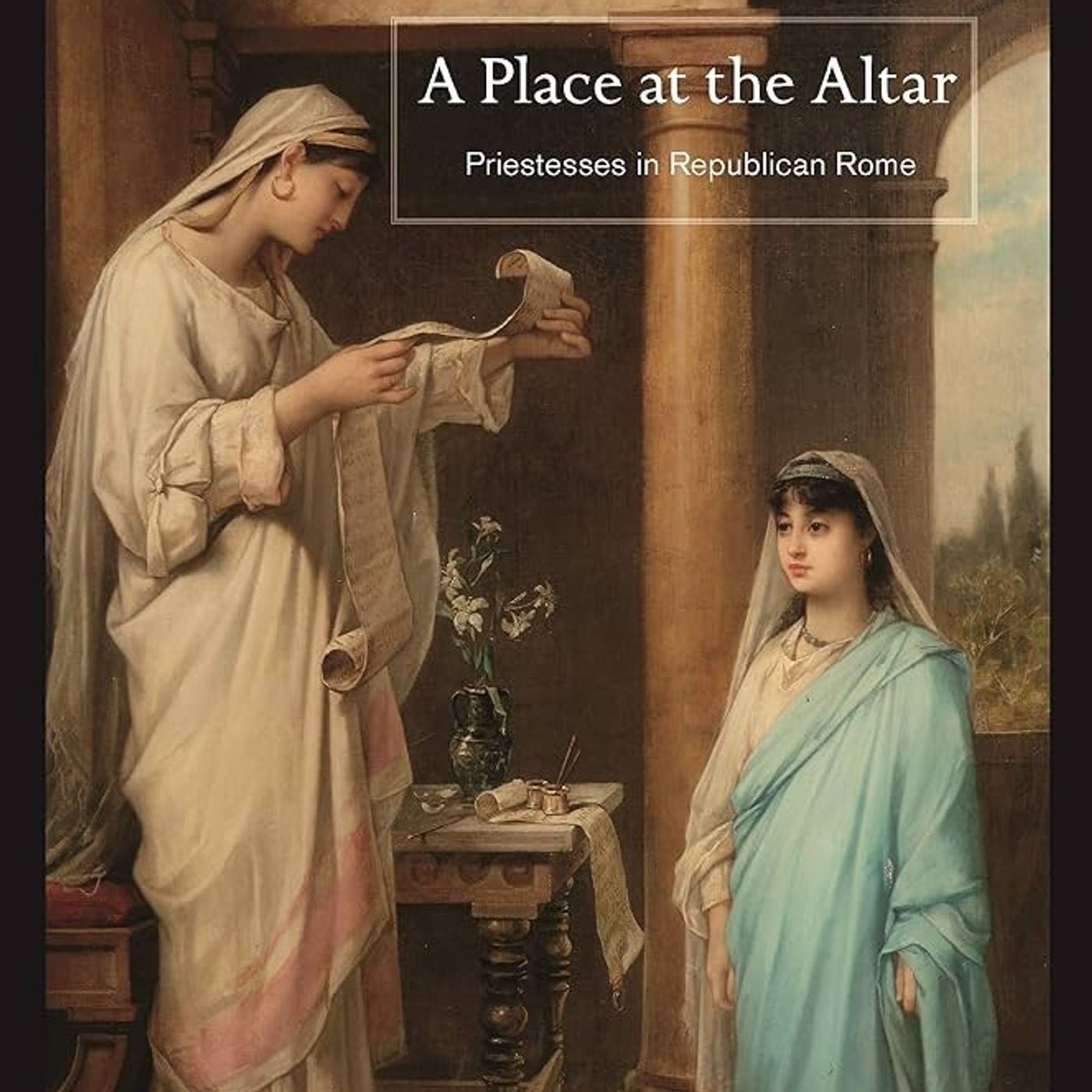
0:00 Welcome to today's Deep Dive. I am just so glad you're joining us today because our mission is to completely shatter this massive historical myth. 0:08 Yeah, it's a big one. 0:10 It really is. We are pulling our insights from Megan J. 0:13 Deluzio's book. It's called A Place at the Altar, Priestesses in Republican Rome. And, you know, the goal here is to basically dismantle this deeply ingrained idea that ancient Roman women were just marginalized. 0:26 Right. This idea that they were passive participants who were Legally incapable of taking part in civic life. 0:32 Exactly. Because it's a myth that has survived for centuries. 0:35 I mean, we've inherited this visual vocabulary of Rome that just leaves women entirely out of the frame. 0:41 Especially when it comes to the survival of the state itself. 0:44 Right. Think about the cinematic expectation you probably have when someone brings up the Roman Republic. It is a world built entirely out of marble and masculinity. 0:54 No, for sure. Lots of men in togas. Right. 0:57 You picture the sprawling forum, the marching legions, these grizzled senators standing on marble steps debating the fate of the world. 1:06 It looks and feels like the ultimate historical boys club. 1:08 It really does. And when you step into the world of Roman religion, that image somehow gets even more rigid. 1:15 Yeah, the state religion is almost always described to us as being led by these austere male priests reading auguries, you know, standing on a hill interpreting bird flights or looking at animal behavior to figure out what the gods want. 1:26 Well, the traditional historical narrative has always just placed Rome neatly into this box labeled run by men. 1:33 Right. 1:34 The assumption is that women were restricted to private household prayers, maybe leaving offerings at a small domestic shrine. And I mean, sure, historians always acknowledge the Vestal Virgins, but they usually treat them as this bizarre anomaly. 1:48 Yeah, like they don't really count. 1:50 Exactly. The academic establishment has frequently labeled the Vestals as honorary men. Which is just this collective shrug that essentially says, well, they were only important because they surrendered their womanhood. 2:02 But then you open up Deluzio's book and that boys club narrative just instantly collapses. 2:08 It completely falls apart. 2:09 Because we aren't looking at a religious landscape where women were sidelined. We are looking at a system that was completely and utterly reliant on women to function. 2:17 The text forces a total paradigm shift. I mean, Roman women were vital, official, highly visible public priests. Wow. 2:26 Yeah. 2:26 The Romans believed deeply in the Pax Diorum, the peace of the gods. And maintaining that peace was literally a matter of national security. Right. 2:34 They had to keep the gods happy or everything falls apart. 2:37 Exactly. And the core argument of this book is that securing the Pax Diorum absolutely required a coordinated, cooperative effort between men and women. The Republic quite literally could not function without priestesses standing at the altar. 2:52 This is such a great setup for our first major piece of evidence because, you know, if we want to prove that public religion required both men and women, we don't have to look at some obscure rural cult. 3:03 No, not at all. 3:04 We can look at the absolute peak of the religious hierarchy. 3:08 We are talking about a priesthood that wasn't just a solo gig you could apply for on your own. It was a package deal. It strictly required a married couple. 3:16 Yeah. We're looking at the Flamandialis and the Flaminica Dialis. 3:20 These were the high priest and high priestess of Jupiter. 3:23 And Jupiter is the big guy. Right. 3:25 Since Jupiter was the chief god of the Roman pantheon, the protector of the state, this couple held an incomprehensibly prestigious position. 3:33 For anyone listening who has ever tried to navigate a dual career household, this is going to sound wildly familiar, but amplified to just an extreme degree. 3:42 It really is. 3:43 It's the ancient equivalent of the modern two-body problem in academia where a university has to hire both spouses. Or like a political co-presidency where you just can't have one without the other. 3:54 And to even qualify for this role, the couple had to be married through a very specific archaic ritual known as confariadio. 4:01 Confariadio. 4:03 What is that exactly? Well, the ritual gets its name from the far, which was a cake of emmer wheat that the bride and groom shared during the ceremony. 4:11 Oh, so they share a cake. That sounds nice. 4:14 It does. But in Roman law, this specific type of marriage did something profound. It placed the wife entirely under her husband's legal control, a concept known as manas. 4:26 Okay, so she gives up her legal independence. 4:29 Right. She left her father's legal authority and entered her husband's. 4:33 But the crucial detail here is why they had to be married this way. 4:38 It wasn't just to be oppressive? 4:39 No, it wasn't about enforcing social submission just for the sake of it. It was a strict theological requirement. They had to belong to the exact same religious community, bound under the same legal umbrella, so they could approach the 4:52 altar of Jupiter together as a unified entity. 4:56 That distinction is so important. I mean, she isn't just the ancient equivalent of a pastor's wife who's culturally expected to silently arrange the flowers and smile at the congregation, you know? 5:06 Right. She's not just supporting his calling. 5:08 She was an equal half of a coordinated career. The Flaminica Dialis had her own distinct title, her own highly specific ritual clothing, and her own daily religious duties. 5:18 They were full-time professional partners. 5:21 And the interdependence of their roles is genuinely astonishing when you dig into the legalities of it. 5:26 Oh yeah, the resignation rule. 5:28 Yes, their lives were so intertwined in the service of Jupiter that if the Flaminica died, the flamen was forced to resign his priesthood immediately. 5:36 It loses his entire career just because his wife passes away. 5:40 Instantly. 5:41 The priesthood itself was considered broken and incomplete without her presence. 5:46 That is wild. 5:47 The Greek historian Plutarch actually compared this dynamic to the Roman censors. The censors were powerful magistrates, but they were always elected in pairs. If one censor died in office, the other had to step down immediately because the office 6:01 legally required two people to function. 6:03 Oh, so they applied that political logic to the religion. 6:06 Exactly. The Flaminé of Jupiter operated on the exact same logic. 6:11 And because their union represented this perfect, unbroken ritual stability for the entire Roman state, divorce was strictly forbidden. 6:20 You just couldn't do it. 6:21 You could not undo the marriage without angering the gods. 6:25 Which perfectly sets up one of the most thrilling historical anecdotes in the source material. I really want you to imagine this. It's the 80s BC. A ruthless dictator named Sulla has marched on Rome. He's taking control of the 6:37 city and he is actively purging his political enemies. 6:41 Just a terrifying time to be in Rome. Absolutely. 6:44 And he turns his attention to a young Julius Caesar, who was barely in his 20s at the time. So Sulla orders Caesar to divorce his wife Cornelia because she comes from a rival political family. Right. And this 20-something kid looks at the most dangerous man in the world 6:59 and says, no. 7:01 It's a legendary moment of defiance. And as a result, Caesar is stripped of his inheritance. His wife's dowry is confiscated. 7:10 A massive bounty is put on his head, and he's forced to flee into the Sabine Hills. 7:14 He's on the run. 7:15 He is constantly moving from safe house to safe house, suffering from a fever just to avoid Sulla's roving assassins. 7:23 And traditional history loves to frame this as the ultimate romantic and political stand. We get this image of Caesar as the principled rebel, deeply in love with his wife, refusing to bow to a tyrant. 7:34 Right. A great movie moment. 7:36 But the text adds this incredible religious layer to the story that changes the entire context. At that specific moment in time, Caesar was serving as the flamen dialis. 7:46 He'd been appointed to the priesthood just a few years earlier. 7:49 So his refusal to divorce Cornelia wasn't just a political middle finger to Sulla, nor was it purely a romantic gesture. 7:57 It was his job. 7:58 It was a religious and professional necessity. The marriage of a flamen couldn't be dissolved except by death. Sulla wasn't just asking Caesar to leave his wife. Sulla was ordering him to break a sacred ancient law and essentially detonate his own religious career. 8:13 Because if Caesar divorced Cornelia, he would immediately forfeit this incredibly prestigious priesthood anyway. 8:20 Exactly. 8:21 That makes the stakes so much clearer. But I want to push back on this a little bit on behalf of anyone listening who might still be skeptical. 8:28 Sure. Go for it. 8:30 It is one thing to say these women had a fancy title, they wore special clothes, they couldn't get divorced. 8:35 But did they actually do the heavy lifting of Roman religion? 8:39 You mean the sacrifices? 8:40 Yeah, the bloody, visceral work of animal sacrifice. Because I've always been taught that Roman law completely forbade women from handling sacrificial tools or even coming into contact with wine. 8:50 And if you can't touch the tools or pour the wine, how can you be a priestess? 8:53 You have just articulated the exact argument traditional historians have used for decades to sideline women in Roman religion. They even coined a term for it, sacrificial incapacity. 9:04 Sacrificial incapacity. 9:06 Right. The theory was that the Roman state deemed women to impure or simply lacking the legal standing to perform blood sacrifice. But as Delusio meticulously lays out in the text, that entire theory is built on a fundamental misreading of the historical evidence. 9:23 Let's talk about the wine ban first, because that is the piece of evidence everyone seems to cite. The Romans had this ancient rule forbidding women from drinking temitum, which was a strong, undiluted wine. 9:36 The rule definitely existed, but it was strictly a domestic regulation. 9:39 Oh, really? 9:40 Yeah. It was deeply tied to household management, anxieties about maternal chastity, and basically keeping the keys to the household storeroom secure. It had absolutely nothing to do with civic religion. 9:52 So they could drink wine at church, so to speak. Exactly. 9:56 A later Roman commentator named Servius actually cleared this up explicitly. 10:00 He noted that in ancient times, women refrained from drinking wine except for the sake of the sacred rites. 10:07 So they were doing it. 10:08 Women routinely handled, poured, and drank wine during religious ceremonies. 10:12 Okay, so the wine thing is completely debunked. But what about the physical act of sacrifice, the actual slicing of the animal's throat? 10:20 They did that too. Let's look back at our Flaminica de Alice. The historical record shows she possessed and used a highly specific sacred instrument called a sesapita. 10:31 A sesapita? 10:32 Yes. This was an oblong iron sacrificial knife featuring a rounded ivory handle bound with gold and silver. 10:40 I mean, you don't forge a sacred iron knife with a gold and silver ivory handle just to have a woman stand quietly in the background looking pious while her husband does the work. 10:48 Right. You just wouldn't. The person holding the cespeda was the presiding official, and we know exactly when and where the Flaminica used it. 10:57 When was it? 10:58 Every eight days, on the Roman market days known as the Nundina, the Flaminica independently sacrificed a ram to Jupiter. 11:06 And she didn't do this hidden away in some private suburban grove. She performed this sacrifice in the Regia. 11:13 Wow. And for those who might not know, the Regia is this ancient, highly sacred building located right in the absolute center of the Roman Forum. 11:21 The very center. 11:22 It served as the headquarters for the Pontifex Maximus, who was the chief high priest of Rome. It just doesn't get more central than the Regia. 11:29 It is the pulsing heart of Roman civic religion. So just visualize that scene. Every eight days, amidst the noise, the smells, the bustle of the market, and the chaotic political assemblies happening nearby, A woman was standing in the regia. 11:45 Holding the knife. 11:46 Holding the sacrificial knife. She is slitting the throat of a ram, and she is communicating with the chief god of the Roman state on behalf of the entire population. 11:56 It totally rewrites the visual we have of the Roman Forum. 11:59 But wait, what about that famous ritual formula? Because there's a well-known ancient text that says a public guard would literally shout at women to get away from the sacrifice. 12:09 Doesn't that prove they were banned? 12:11 Ah, yes. The Exesto formula. Right. This is perhaps the best example of modern historians missing the forest for the trees. 12:21 The antiquarian source Festus records that during certain sacred rites, a lictor, which is a type of public guard or bodyguard for magistrates, would shout out a warning. 12:30 Well, what was the warning? 12:31 He'd shout, foreigner, prisoner, woman, virgin, be away. And the Latin command for that is Exesto. 12:38 And past historians looked at that single sentence and said, aha. Look, they're shouting at women to leave, therefore women were banned from public sacrifices. 12:46 That was the consensus. But think about the underlying logic for a second. If women were categorically banned from all sacrifices by default, why on earth would you need a guy to specifically shout at them to leave during a few specific rituals? Right. 13:01 Because they were normally standing right there in the crowd. 13:03 I mean, think about it like a nightclub. 13:05 Oh, that's a good comparison. 13:07 If a certain group of people aren't allowed in the club in the first place, you wouldn't have to hire a bouncer to go around and kick them out during one specific song. The fact that you have to tell them to leave implies they were already in the room. 13:18 The exception proves the rule, absolutely. The existence of the Exesto formula actively proves that women were normally present, welcome, and participating at the Republican altar. 13:28 Okay, so the Flamenica de Alice is fascinating because she represents this elite married virtue. She is the ultimate model of the loyal aristocratic Roman wife. But the deep dive doesn't stop there. 13:39 No, it gets much wider. 13:41 Because a woman's religious authority wasn't just confined to domestic ideals or, you know, ensuring a good harvest. It extended into the dirtiest, most dangerous, most existential parts of running an empire, war and foreign policy. 13:55 This is where we truly see the sheer pragmatism of the Romans. They were incredibly practical people. 14:02 Right. 14:02 If they believed a specific theological crisis or a particular female deity required a woman's touch to keep the army safe, they did not hesitate to empower women. Take the Salian Virgins, the Salii Virginis. 14:16 We all know about the male Salian priests. They're famous for dancing through the streets of Rome in archaic bronze armor, beating their shields with spears to kick off the military campaigning season. 14:25 Yep, the classic image. 14:27 But the text reveals there were female counterparts doing this work too. 14:32 The Salian Virgins. They performed crucial sacrifices in the regia, and they didn't wear flowing dresses or traditional matronal garb. 14:40 They were dressed in paludatus, which is military clothing, basically a general's cloak. 14:46 Wow, so they're in armor, basically. 14:48 And they wore the apices, the spiked hats traditionally worn by male priests. Their rituals were directly, inextricably linked to the success of Rome's military campaigns. 14:58 But why? Why did the Romans think putting young women in military cloaks would help the legions win a battle hundreds of miles away? 15:05 Well, the underlying theological mechanism here is fascinating. In times of severe crisis or when dealing with deities of war, the Romans often believed that a balance of energies was required. 15:17 A balance? Sometimes a total victory required appealing to both the masculine and feminine aspects of the divines. There was also a belief that rituals performed by women crossing traditional gender boundaries, like wearing armor, carried a unique, potent spiritual shock value. 15:34 Like it gets the gods' attention. 15:35 Exactly. It could aggressively compel the gods to act. You have young women dressed as soldiers performing state blood sacrifice to ensure the empire expanded. 15:45 And speaking of existential military crises, that perfectly explains the legend of Fortuna Muley-Everest. This takes us way back to 488 BC. 15:54 Oh, this is a great story. 15:56 Rome is quite literally on the brink of annihilation. A bitter traitor named Coriolanus has marched a massive enemy Volscian army right up to the city gates. The male politicians go out to negotiate. 16:07 They fail. 16:08 Right. The male priests go out to negotiate. They fail miserably. 16:12 Coriolanus is fully prepared to burn Rome. 16:14 To the ground. The masculine structures of the state have entirely collapsed at this point. And then, An army of Roman mothers and wives, the matroni, march out of the city gates in a massive procession. 16:27 Led by his own family. 16:28 Yes, they are led by Coriolanus' own mother and his wife. 16:32 And through their pleas, their shaming, and their sheer moral force, they break him. They convince him to turn the enemy army around. They save the city when the men could not. 16:43 The scene must have been just incredible. But what's even more incredible is how the Roman Senate reacts. Because they don't just say thanks and send the women back to the kitchen. 16:52 Not at all. 16:53 They reward the women by allowing them to found a brand new state cult to Fortuna Muliebris, which translates to feminine fortune. And they let the women elect their own priestess to run it. 17:04 Which is huge. 17:05 They elect a woman named Valeria. It is a massive, permanent political and religious concession to the power of women acting collectively. 17:13 The establishment of that cult proves that women were treated as vital citizens with a direct stake in the survival of the state. And the Romans were so fiercely focused on survival that they would even bend their own rigid 17:25 laws about citizenship if it meant keeping the gods happy. 17:28 Which brings us to the Sacerdoceris, the priestesses of Ceres, the goddess of agriculture and grain. 17:34 The cult of Ceres was considered a Greek rite. So the Romans believed that to appease this specific goddess properly and ensure the grain ships kept arriving, the rituals had to be performed exactly as the Greeks did them. 17:46 Down to the letter. 17:47 Down to using Greek chants. By a Greek woman. So they deliberately sent envoys to recruit older women from Greek cities in southern Italy, like Naples or Velia, and imported them to Rome. 17:58 But there's a huge theological problem there, right? You can't just have a foreigner praying for the Roman state. The gods wouldn't listen in the right way. A foreigner's loyalties might be divided. 18:08 The Romans recognized that exact problem. So to fix it, The Roman state actively granted these foreign women Roman citizenship. 18:16 Just gave it to them. 18:17 Yep. Cicero explained the logic behind this perfectly. They wanted the priestess to utilize her specific foreign knowledge to do the ritual correctly, but they needed her to pray for the immortal gods with the mind of a citizen. 18:30 Wow. It's like a modern country drafting a star athlete from another nation and fast-tracking their passport so they can legally play on the Olympic team. 18:39 That's a perfect analogy. 18:40 It is a purely pragmatic hack of their own legal system. 18:44 They needed a female priest with the exact right combination of foreign expertise and domestic loyalty to protect the food supply, so they just made it happen. 18:52 If the Romans were willing to alter their citizenship laws just to secure the grain supply, it really makes you wonder what legal extremes they were willing to go to for the women tasked with protecting the very heart of the empire. 19:04 And that brings us to the most famous priestesses of them all, the ultimate insiders. 19:09 The Vestal Virgins. 19:11 You cannot talk about ancient Rome without talking about them. 19:14 Their sole job was to guard the eternal sacred flame of Vesta in the Forum. And the Romans believed this fire was directly, literally tied to the permanence of their empire. 19:24 If the fire went out, the gods had abandoned them and Rome would fall. 19:28 So the requirements to get this job were insanely strict. 19:31 You had to be chosen between the ages of 6 and 10. 19:34 Tiny kids. Yeah. 19:35 And you had to have two living parents. You had to be from an ideal aristocratic patrician family. And you had to possess absolute perfect physical health, not a single blemish or defect. 19:46 But once a young girl was chosen and ritually seized by the Pontifex Maximus, she was granted what we can only describe as legal superpowers. 19:56 Superpowers? 19:57 Basically. And to understand why that's a big deal, you have to understand patria potestas. Normally, a Roman woman was under the total lifelong legal control of her father. He owned everything. And if he died, she was required to 20:12 have a male guardian, a tutela, to approve her financial decisions. 20:17 So she was never really independent. 20:19 Right. But upon becoming a Vestal, these young girls were completely stripped of patria potestas. They were legally emancipated from their fathers and never assigned a male guardian. 20:30 That's unheard of. 20:32 A Vestal virgin could make her own will, she could testify in court, and she had total independent control over her own immense wealth. They even had front row seats reserved for them at the theater and the gladiatorial games right opposite the Praetor's tribunal. 20:47 Which gave them incredible political clout. Because they were so revered, they could advocate for their families in ways other women couldn't. 20:54 Oh, definitely. 20:55 The text shares this amazing story about Cicero defending a man in court. And his ace in the hole was pointing out that the man's sister was a Vestal Virgin. 21:04 He essentially looks at the jury and says, Are you really going to convict the brother of the woman who spends her entire life praying for the safety of your own children? 21:13 It was a highly effective defense strategy. But this raises an important question about the nature of their power. Why virginity? 21:22 Yeah, that's the part I always struggle to wrap my head around. Were they just treated as honorary men because they didn't have husbands or children? Were they essentially granted the legal status of a male citizen so they could perform these duties? 21:35 Delusio strongly rejects the honorary men label, and for very good reason. Calling them men obscures what the Romans were actually doing. 21:44 What were they doing? 21:46 The Vestals were not powerful because they acted like men. 21:50 They were powerful because they were the ultimate idealized expression of female purity. Their femininity wasn't erased. It was weaponized for the safety of the state. 22:01 I was thinking about an analogy for this, and it struck me that the Vestals were essentially human borders for the city. 22:07 Ooh, human borders. I like that. 22:10 Think about it. Their physical, bodily integrity literally represented the unbreached walls of Rome. As long as they were pure and inviolate, the physical city was pure and inviolate against enemy armies. 22:23 That is exactly how the Romans conceptualized it. The Vestal was a cognitive map of the city itself. Her body was the physical manifestation of Rome's borders. But exploring that analogy brings us to the incredibly dark side of this priesthood. Right. 22:40 If a vestal's body represents the safety of Rome, what happens if that body is compromised? 22:46 Yeah. If they broke their vow of chastity, it wasn't just a tabloid scandal. It was a national security crisis. 22:53 If a vestal was convicted of unchastity, the punishment was horrific. 22:58 She wasn't simply executed. Shedding the blood of a sacred person was strictly forbidden. 23:03 So what did they do? 23:05 Instead, she was placed in a covered litter, strapped down so no one could hear her cries, and paraded through the silent streets of the city like a corpse. She was taken to a small underground chamber near the Colleen Gate, forced to descend a ladder, and buried alive with just 23:21 a tiny bit of bread, water, milk, and oil. 23:24 Oh my Just enough food and water for the state to say, hey, we didn't kill her, she just starved. 23:30 The gods did it. 23:31 Exactly. They were treating her not just as a criminal, but as toxic pollution. If the Vestal's body was the city walls, her unchastity was a breach in those walls. 23:43 Like a radioactive leak? 23:44 Yes. She had become radioactive waste. She had to be sealed away, hidden deep underground to remove the contagion and restore the boundaries of the state. It is a terrifying psychological dissonance. You have a society that reveres a woman 24:01 as a legal superhero one day and treats her as a toxic threat to humanity the next. 24:06 Because their bodies didn't belong to them. They belonged to Rome. 24:10 Precisely. 24:11 So what does this all mean for you, the listener sitting here today? I think the most powerful takeaway from Deluzio's text is that we have fundamentally underestimated how Roman society actually functioned. 24:24 We really have. 24:25 Roman civic religion was not a male monopoly. You simply couldn't run the Roman Republic without women. 24:32 From the military salient virgins manipulating the energies of war, to the knight-wielding Flaminia Dialli standing in the regia, to the politically powerful vestals acting as the physical borders of the empire, women were essential, highly visible ritual agents. 24:48 They weren't hiding in the shadows of the household. 24:50 No, they were standing at the very center of the forum, holding the sacred knife, ensuring the survival of the empire. 24:57 It totally shatters that Marble Boys Club image. And it leaves me with a final thought for you to mull over. 25:04 We look at the Vestals and think it's wild that an entire empire's stability was pinned to the sexual purity of a few women. But have we really moved past that? 25:14 That's a great question. 25:15 Think about how modern societies still subconsciously link the moral behavior of the purity or respectability of high-profile women to the perceived moral health of the nation itself. 25:27 That's true. If a prominent male politician falls from grace, it's usually treated as an isolated political scandal. But if a highly visible female figure steps out of line, it often triggers a much wider, more visceral cultural panic about 25:42 the degradation of societal values. Right. 25:44 Do we still, in some invisible, secular way, demand that our female public figures act as modern-day vestal virgins to keep our cultural institutions stable? If the cinematic expectation of Rome is a city of men, maybe it's time we 25:58 start looking closer at who was really holding up the walls.









Community discussion