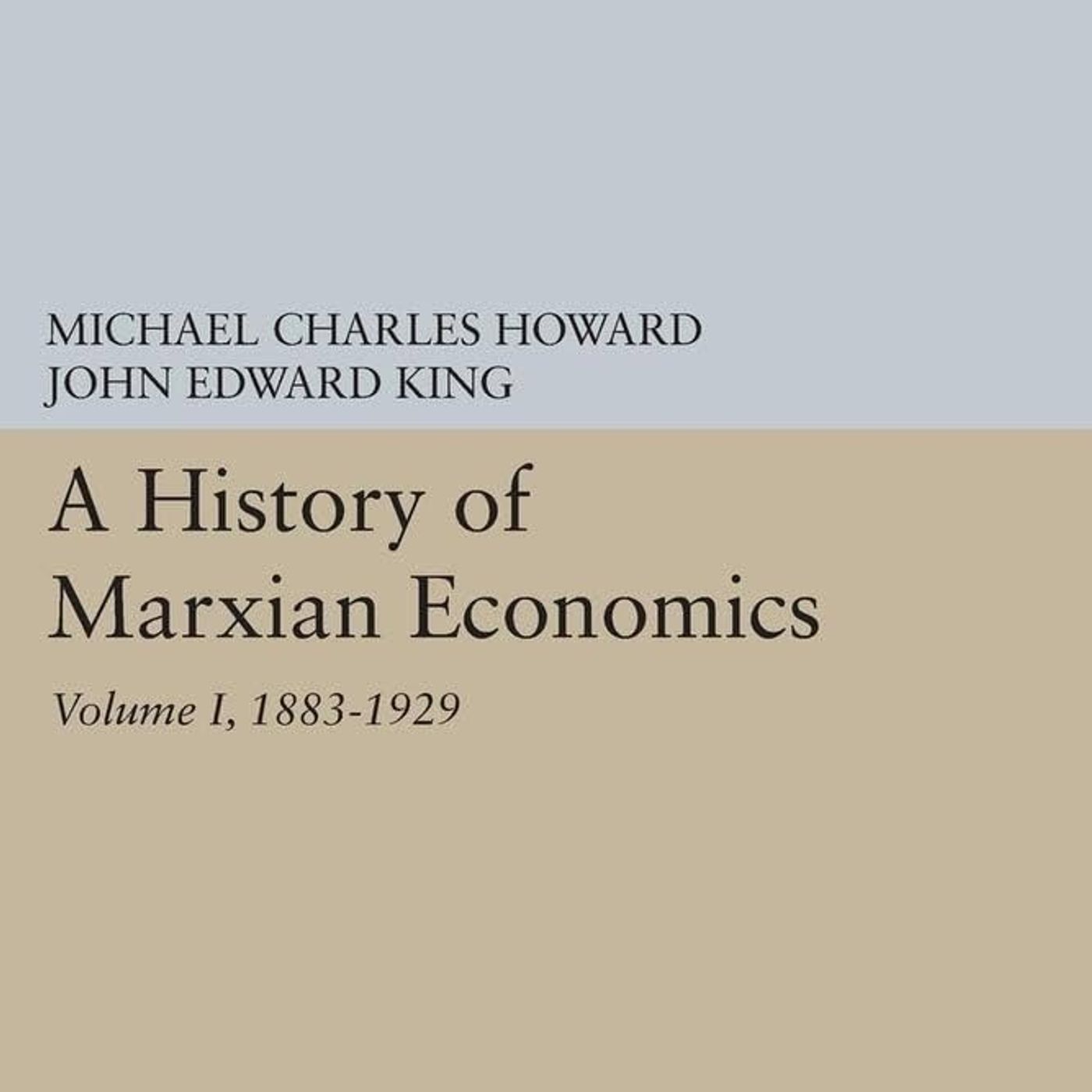
0:00 I want you to imagine, just for a second, that you have this brilliant friend. Like, a certified genius. Okay. 0:06 I'm picturing it. Right. 0:07 But this friend is also an absolute master of procrastination. 0:12 And they have notoriously awful handwriting. 0:15 Oh, no. Yeah. That's a bad combination. Yeah. 0:18 And then imagine this friend suddenly passes away. And you are left to inherit this massive, messy, completely disorganized pile of their notes. 0:26 That sounds like a literal nightmare. 0:29 It gets worse. Here is the kicker. A global political movement is waiting on those exact notes to guide their entire future. 0:37 Wow. No pressure, right? 0:39 Exactly. And that is exactly what happened in 1883. Karl Marx died and he left his closest collaborator, Friedrich Engels, to just, you know, pick up the pieces. 0:48 Which was a monumental task. 0:51 Oh, absolutely. So welcome to today's deep dive. We're doing a sweeping, incredibly detailed story about based on the book A History of Marxian Economic Thought, Volume 1, 1883 to 1929, by M.C. Howard and J.E. King. 1:07 It's a fantastic source. 1:08 It really is. And our mission today is to trace the chronological narrative of how a single, unfinished economic theory evolved, fractured, and adapted over 46 years. We're telling this completely as a historical story for you. 1:21 But before we jump into that timeline, I do need to step in and firmly clarify something for you, the listener. 1:27 Oh, right. Definitely. 1:28 Yeah. Because this deep dive covers politically charged historical content, specifically, you know, the evolution of Marxist and capitalist economic theories. 1:38 We are exploring these ideas strictly as impartial guides. Right. 1:42 No taking sides here. 1:43 Exactly. Our goal is absolutely not to endorse or take sides with any left wing or right wing viewpoints. We are simply here to report on and unpack the factual history, the math, and the theories exactly as they're presented in our source material. 1:57 Perfectly said. So we have a massive narrative arc to cover. 2:02 We're starting from Marx's death in 1883, moving through these bitter ideological rivalries in Germany, the unique economic struggles over in Russia, and finally, the absolute shock of the 1917 revolution. 2:16 That's quite a ride. 2:17 It is. So let's set the stage. It's the 1880s. 2:21 Marx is gone. Volume one of Capital is out in the world and it focuses on production and the exploitation of labor. But, I mean, it is glaringly incomplete. And Engels is now forced back into the role of chief economist. 2:36 And this was a position he really did not relish. 2:38 I mean, Marx and Engels had this sort of informal division of intellectual labor. 2:43 Right. 2:43 For decades, Engels had essentially given up economics. He focused on military and scientific affairs. He was completely out of practice. 2:51 But suddenly he's the guy. 2:52 Yeah. Suddenly he is the unchallenged intellectual leader of European social democracy. He just becomes this final court of appeal for all theoretical disputes. 3:02 And he's facing immense pressure from socialist political parties who are demanding theoretical guidance for this rapidly industrializing world. Plus, he's staring down a physical task that is just grueling. 3:15 Because Marx left no clear written testament. None. 3:18 The manuscripts were scattered, overlapping, and written in this scrawl that almost no one else could decipher. 3:25 It's amazing he got anything published at all. Right. 3:28 But Engels manages to push out Volume 2 of Capital, which is about the circulation of capital, relatively quickly in 1885. 3:36 But Volume 3? That took an exhausting 10 years. 3:40 Because the gaps in Volume 3 were enormous, Engels had to write entire sections himself. He was deciphering complex relationships like how the rate of turnover affects the rate of profit. 3:51 And didn't he have to update it too? 3:53 He did, yeah. He had to update the text to reflect new economic realities that barely existed when Marx first drafted the notes in the 1860s. We're talking about the rise of trusts, international cartels, the explosion of the stock exchange. 4:06 So while Engels is sweating over these manuscripts, the critics... 4:10 They smell blood in the water. Followers of a rival economist named Rodbertus start claiming that Marx actually plagiarized his core theory of surplus value. 4:20 Oh, yeah, the plagiarism accusations. Yeah. 4:22 So to defend Marx's legacy, and honestly, maybe to buy himself some much-needed time to edit, Engels launches a public challenge in the preface of Volume 2 in 1885. He essentially creates a prize essay competition. 4:36 It was such a brilliant tactical move. Engels basically dared any economist in the world to solve what was known as the transformation problem before Volume 3 was published. 4:46 OK, break that down for us. What was the challenge? 4:48 So the challenge was this. How do you reconcile Marx's labor theory of value, which is the idea that all new value comes exclusively from human labor, with the real world reality of an equal average rate of profit across different industries? 5:02 OK, wait, let me make sure I'm visualizing this correctly. 5:05 Let's say we have two businesses, right? 5:07 OK. 5:08 One is this massive textile plant filled with expensive, heavy machinery and only a few workers pulling levers. 5:14 Right. 5:15 Highly mechanized. 5:16 Exactly. And the other is a cigar rolling factory that is just hundreds of workers rolling by hand with almost no machinery. 5:24 A very labor intensive setup. 5:25 Right. So under Volume 1's logic, since human labor is the only thing that creates new surplus value, the cigar factory should be astronomically more profitable than the highly mechanized textile plant. 5:38 And that is the core of the problem right there. 5:40 If only living labor creates surplus value, industries with high labor and low machinery should generate massive profits. But, you know, in the real world, they just don't. 5:50 Right, because of competition. 5:51 Exactly. Competition forces capital to move around until profit rates tend to equalize across all industries, regardless of how much human labor they use. A million dollars invested in textiles yields roughly the same return as a million dollars invested in cigars. 6:06 So Engels throws down the gauntlet. He tells the world, look, Marx already solved this apparent contradiction in the upcoming volume three. 6:14 If you critics are so smart, let's see you figure out the math before I publish it. 6:19 And incredibly, people actually tried. Competitors lined up between 1885 and 1894. 6:25 Really? Like who? 6:27 Well, you had Wilhelm Lexis, a statistician who got quite close, actually. 6:32 He correctly intuited that everyday prices and hidden labor values systematically diverge. 6:38 Okay, so he was on the right track. He was. 6:41 Then there was Conrad Schmidt, a social democrat who tried to solve it but ended up confusing the abstract concept of socially necessary labor time with actual market prices. 6:51 Ah, gotcha. 6:52 There was also Achille Loria, this Italian academic who submitted a pretty bizarre theory involving interest payments to moneylenders, and P. 7:00 Fireman and J. Lair. 7:02 Okay, so did any of them get it right? 7:05 Fireman actually got close by distinguishing between different capital compositions. 7:10 And Lair kind of anticipated the mathematical formulas that would later dominate. But then you had people like George Stiebeling and Julius Wolf who submitted empirical census data but completely misunderstood the algebra. Oh, wow. Yeah. They just assumed prices 7:25 and values were the exact same thing, which abolishes the problem entirely rather than actually solving it. 7:31 So you have this entire generation of economists who scrambling to guess what is inside Marx's head. Engels basically freezes the development of Marxian economics for a decade. 7:42 By holding Volume 3 back, the entire theoretical development of the movement just stalls. 7:47 But then, Volume 3 finally drops in 1894, and it fundamentally reshapes everything. What was the big reveal? 7:55 So the long-awaited solution is revealed. Marx's own answer is that equilibrium prices, what he calls prices of production... do indeed diverge from labor values in individual industries. The cigar factory's prices might be lower than its actual labor values, 8:10 and the textile plant's prices might be higher. However, Marx argued that in aggregate, across the entire global economy, total profit exactly equals total surplus value. 8:22 Oh, I see. So think of total surplus value like a giant hidden reservoir of water created by all the workers in the world. 8:30 That's a perfect way to visualize it. 8:32 And individual capitalists, whether they own cigar factories or textile plants, they are just dipping different sized buckets into that same collective pool based on the size of their total investment. 8:43 Exactly. 8:44 The surface level of the economy, the prices we pay at the store, looks completely disconnected from labor time. But Marx insists that the total amount of profit sloshing around the system is strictly capped by the total amount of surplus labor extracted from workers globally. 8:59 Okay. I have to step in and advocate for the listener here. 9:03 Go for it. 9:04 If Marx openly admits that the prices we use to buy bread and pay rent don't match his theoretical labor values in everyday life, doesn't that make his entire Volume 1 theory seem like a massive, unnecessary detour? 9:19 It's a very fair question. Right. 9:22 Why should you or I care about an invisible reservoir of values if every single thing in the real world actually runs on prices? 9:28 Well, Eugene von Bohm-Bawerk asked that exact question. 9:31 Oh, really? Yes. 9:33 He was a brilliant Austrian economist, and he read Volume 3 and immediately attacked it in 1896. He published a scathing critique calling the whole theoretical framework a massive logical contradiction. 9:45 Ouch. 9:46 Yeah. He argued that Marx's Volume 1 and Volume 3 were fundamentally incompatible. If the real world operates on prices of production, Bomboverk argued, then the labor theory of value is just an abstract fiction that serves no analytical purpose. 10:01 He declared the entire Marxist economic system had logically collapsed. 10:06 I mean, if I'm a Marxist in 1896, I am panicking. 10:11 Bohm-Bawerk is basically calling the whole underlying philosophy a mathematical scam. 10:16 The defense has to either aggressively attack his math Or completely reframe his philosophy, right? 10:22 They actually did both. On the philosophical front, Rudolf Hilferding stepped up. He argued that Baum-Bauer fundamentally misunderstood Marx's entire method. 10:31 How so? 10:31 Hilferding said the method was historical, not just mathematical. He claimed Marx wasn't just building a static spreadsheet. He was showing how capitalism dynamically evolved out of simple commodity production. 10:42 Oh, I see. 10:43 Yeah, Hilferding argued that in pre-capitalist times, when independent artisans traded goods, those goods really did exchange based strictly on labor values. So the complex modern price system was a historical evolution of capitalism, not a logical contradiction. 10:57 Okay, so that handles the philosophy side of things. But the math in Volume 3 was still notoriously messy, right? 11:04 Marcus' own calculations for this transformation problem were incomplete. 11:08 They were, which brings in Ladislaus von Bortkiewicz in 1906 and 1907. 11:13 The mathematical savior. 11:14 Exactly. Borkovits was a brilliant mathematician who proved that Marx's own math in Volume 3 was flawed because of a sequencing error. 11:22 A sequencing error? 11:23 Yeah. Marx forgot to transform his inputs into prices. Marx calculated the final price of a commodity based on its new profit, but he left the raw materials and machinery used to make it in their original labor value form. 11:35 That is like trying to balance a corporate spreadsheet, where half the columns are recorded in dollars... and the other half are recorded in euros and pretending the final sum makes sense. 11:44 That's exactly what it's like. So Bortkiewicz fixed the spreadsheet. 11:48 He used complex linear equations to correct marks, proving that you could mathematically transform values into prices without a logical contradiction. 11:56 Oh, wow. 11:57 So he saved it. 11:59 Well, yes, but the salvation came at a steep theoretical cost. 12:03 There's always a catch. 12:05 Always. 12:06 Always. To make the algebra balance, Bortkiewicz had to abandon some of Marx's core aggregate equalities. You could no longer claim that total prices equaled total values and total profit equaled total surplus value simultaneously. The math forced a compromise. 12:21 Man, so while these theorists are locked in rooms arguing about algebra and aggregate equalities, the real world outside their windows is completely defying Marx's predictions. Oh, absolutely. We're moving into the late 1890s and early 1900s. Germany is rapidly industrializing. 12:39 But here's the problem for the revolutionary theorists. Real wages for everyday workers are actually rising. 12:46 Right, which wasn't supposed to happen. 12:48 Trade unions are gaining legitimate political power in parliament. And those apocalyptic system-ending economic crises Marx predicted, they just aren't happening. 12:58 The capitalist system seems to be stabilizing. 13:01 And this empirical reality creates a massive ideological fracture in the German movement. Enter Edward Bernstein, who becomes known as the revisionist. 13:09 The revisionists? 13:10 Yeah. Bernstein looks at the data and drops a bombshell. 13:14 He points out that the middle class isn't disappearing into poverty. 13:17 It's expanding. 13:18 The economic crises are getting milder. Capitalism is adapting. 13:22 So what's his solution? 13:24 Bernstein suggests they need to abandon the idea of an inevitable, violent economic collapse and instead work peacefully within the democratic system to achieve gradual reforms. 13:34 I can imagine that absolutely infuriates the Orthodox wing. 13:37 Oh, it did. 13:38 Karl Kautsky steps up as the great defender of orthodoxy. 13:42 Kautsky fiercely argues that capitalism's contradictions haven't vanished. They're just mutating into new, more dangerous forms. 13:49 Like what? 13:50 He points to massive credit bubbles, the monopolization of industries by cartels, and the terrifying growth of international rivalries between European nations. 13:58 Which directly sparks the effort to explain imperialism, right? Like, how does a Marxist framework Explain the new global reality where European powers are just violently carving up the globe. Exactly. 14:10 Rudolf Hilferding takes the first major swing at this in 1910 with his book Finance Capital. He argues that a monumental shift has occurred. Banking capital and industrial capital have fused together. 14:22 So the banks take over. 14:23 Basically, yes. Banks took over heavy industry. And this new finance capital requires the state to aggressively secure new global territories to protect its massive investments, leading inevitably to expansionist foreign policy. Wow. 14:38 And then in 1913, Rosa Luxemburg publishes The Accumulation of Capital, taking a completely different, heavily mathematical approach. 14:47 Her logic is fascinating. 14:49 It really is. She tries to prove that capitalism has a fatal structural flaw regarding consumer demand. If a capitalist pays his workers $ 10 in wages, but the factory produces goods worth $ 15, The workers can only ever afford to buy back $ 10 worth of stuff. Right. 15:07 So the question becomes... Because you. 15:08 Can't just keep selling it to other capitalists indefinitely. 15:11 Exactly. So Luxembourg mathematically argued that capitalism is not a self-sustaining system. It must constantly find non-capitalist markets like peasant economies or overseas colonies to absorb its surplus goods. 15:24 And once the whole world is conquered and modernized, there are no outside markets left. 15:29 The system runs out of places to dump its surplus. 15:32 And it mathematically implodes. For Luxembourg, imperialism and apocalyptic world wars aren't just policy choices. They are a mathematical inevitability to delay the end of the system. 15:43 But then Otto Bauer, another prominent theorist, tries to prove Luxembourg wrong. 15:48 This is the guy with the macroeconomic growth model. 15:50 Yes. Bauer creates a highly sophisticated model to show that capitalism could actually grow endlessly in a completely closed system without ever needing outside colonies, as long as population growth, 16:01 machinery investment, and consumer demand scale at perfectly proportional rates. 16:05 So Bauer tries to prove capitalism can stabilize itself. But, I mean, Bauer accidentally builds a mathematical trapdoor for his own ideology, doesn't he? 16:14 He absolutely does. It's kind of ironic. Years later, an economist named Henrik Grossman reexamined Bauer's complex equations. 16:22 And what did he find? 16:23 Grossman realized that if you ran Bauer's numbers far enough into the future, the math proved Bauer wrong. The system eventually required so much investment in machinery to keep growing that it ran out of surplus value to fund itself. 16:35 Wow. 16:36 Yeah, Bauer's math actually proved the inevitable breakdown of capitalism that he was trying to refute. 16:42 That is wild. Okay, so while the Germans are arguing about the mathematical end of capitalism, a completely different debate is boiling over in Russia about its beginning. 16:53 Russia was a different universe compared to Germany. 16:56 Overwhelmingly peasant-based, deeply underdeveloped, and suffering under czarist absolutism. The burning question here is, does Russia have to go through a brutal, prolonged capitalist phase with factories and robber barons, or can they skip it and go straight to socialism? 17:12 Well, the Russian populace believed they could skip it entirely. 17:15 Skip the factory phase completely. 17:16 Yeah. Their view was that Russian capitalism was an artificial import supported only by the Tsar. They looked at the traditional Russian peasant commune where land was shared and believed it was the true organic path to a uniquely Russian socialism. 17:30 Skip the misery of the factories and start building utopia from the rural commune. 17:35 It's like imagine a modern developing tech company. The populists are the idealistic founders who want to stay a small grassroots co-op forever, living on good vibes. 17:45 I love that analogy. 17:47 But then Georgy Plekhanov, the father of Russian Marxism, enters the boardroom like this aggressive venture capitalist. 17:54 Oh, entirely. 17:54 He tells the populists they are dreaming. He says you absolutely must take ruthless venture capital money and scale up into a massive corporation first. Yes, it will be painful. Yes, the factory system is miserable. But you cannot build a 18:08 global utopian platform without heavy infrastructure, server farms, and advanced technology. 18:14 And the next generation of Russian Marxists took Plekhanov's framework and proved exactly how this scaling up was already happening. 18:20 Mikhail Tugonbaranovsky used Marx's mathematical reproduction models to prove that capitalism didn't need outside markets like Luxembourg claimed. 18:29 Right. He called it proportionality. 18:31 Exactly. 18:31 He argued capitalism could create its own internal market just by building more machines to build more machines. As long as the heavy machinery sector was expanding, capitalism could grow in Russia even while the peasants remained poor. 18:44 And Vladimir Lenin backed this up with obsessive, data-heavy research. 18:48 I mean, long before 1917, Lenin was analyzing rural census data to prove that the quaint peasant commune the populace idealized was already dead. 18:57 The data showed it was rapidly dividing. 19:00 Yeah. into wealthy rural capitalists on one side and landless exploited wage laborers on the other. Capitalism was already violently birthing itself in the Russian countryside. 19:11 Then, in 1914, everything fractures. 19:14 World War I hits like a meteor. 19:16 It really did. The unified international Marxist movement completely shatters as socialist parties across Europe abandon their international solidarity and vote to fund their own nation's war efforts. 19:28 So, sitting in exile... watching the world burn, the Russian theorists scrambled to adapt the German theories to explain this unprecedented global carnage. 19:38 Nikolai Bukharin writes extensively on the imperialist state and state capitalism. 19:42 He also spends time ruthlessly critiquing the new marginalist economics coming out of the West. 19:47 Marginalism, right. The argued value was based on labor, but on subjective consumer demand and utility. 19:54 Right. And Bukharin dismissed this entire field of economics as the shallow psychological ideology of a parasitic leisure class of shareholders who just consume without producing. Wow. 20:05 Tell us how you really feel, Bukharin. 20:08 Seriously. And Lenin also writes his famous pamphlet on imperialism during this time. Drawing heavily on Hilferding, he defines imperialism by the export of capital, the rise of banking monopolies, and the violent territorial division of the world. 20:23 For Lenin, imperialism is the highest, final, and most decaying stage of capitalism. 20:29 But then, history turns completely upside down. It's 1917. 20:33 The Bolsheviks actually win state power. 20:37 Suddenly, economic theory isn't just people arguing over volume three in a cafe. It is government policy. 20:44 Which changes everything. 20:45 Which changes everything. 20:47 Completely. The Bolsheviks inherit a completely ruined, backward, war-torn economy, surrounded by hostile nations. They have to build an industrialized socialist state from scratch. Where do you even get the money to build the factories? 21:02 This sparks the great Soviet debate of the 1920s over how to fund this transition. On one side, you have Evgeny Preobrazhensky. 21:09 Okay, what's his plan? 21:11 He introduces the concept of primitive socialist accumulation. His theory is mathematically straightforward, but utterly brutal. The state has to economically squeeze the massive peasant agricultural sector. 21:24 Squeeze them how? 21:25 By forcing peasants to sell grain to the state at artificially low prices and buying industrial goods at artificially high prices, the state extracts the capital needed to forcibly fund rapid industrialization. 21:37 Wait, let me put myself in the shoes of a Russian peasant in 1924. I've just spent years fighting a revolution to get rid of the czar and the landlords. 21:48 And now the new socialist government is telling me they are going to systematically tax me into poverty and manipulate my grain prices just so they can afford to build a steel mill in a city I have never visited? 22:01 That is the exact tension that Bukharin pushes back against. 22:05 Bukharin realizes that squeezing the peasants will destroy the political alliance that won the revolution. 22:10 That makes sense. 22:11 He advocates for the smichka, or alliance, with the peasantry. 22:16 Bukharin argues that if you allow the peasants to grow wealthy through a regulated market economy, they will voluntarily buy industrial goods. The state can tax that wealth gently, and the whole country will organically and seamlessly grow into socialism 22:30 through agricultural cooperatives. 22:32 It's a massive debate about the soul and the survival of the new state. But while the Russians are debating grain prices and practical governance, back in the West, the theoretical story reaches its climax. 22:44 Yes, in 1929. 22:47 Henrik Grossman publishes a massive 622-page book that brings the entire 46-year theoretical narrative full circle. 22:56 Grossman looks back at everyone, Bauer, Luxembourg, Hilferding, and says they all miss the fundamental mechanism hidden inside Volume 3 of Capital. 23:04 The falling rate of profit, right? Exactly. 23:07 Grossman formulates a highly complex mathematical theory of the falling rate of profit to prove that capitalism has absolute, unsurpassable economic limits. 23:17 Okay. How does that mechanism actually work? Why does the profit rate have to fall? 23:24 It goes back to the very foundation. Only living human labor creates new surplus value. 23:29 Right. From volume one. 23:31 Yes. Machines do not create new value. They just slowly transfer their existing cost into the final product. But to stay competitive, a capitalist has to constantly invest in better, more expensive technology. 23:43 So the ratio of machines to humans changes. 23:46 Drastically. Over time, the ratio of dead machinery to living human labor gets astronomical because the the pool of human labor shrinks relative to the massive ballooning investment in technology, the overall rate of profit mathematically has to tick downward. 24:01 Oh, I see. 24:02 Grossman argued that eventually the system chokes on its own technological accumulation and breaks down from within the production process itself. 24:09 So we have traveled a massive road today. We started in 1883 with Friedrich Engels sitting in a room trying to organize a relatively narrow set of ideas about factory exploitation in Britain. 24:22 And by 1929... By 1929, over the course of 46 years, Marxism had morphed into a highly complex web of mathematical models, theories of finance capital, imperialism, and blueprints for managing a state-run economy. 24:38 But the historical irony of this timeline is profound. 24:42 Oh, deeply. 24:43 As Grossman is publishing his theories in 1929 on exactly how capitalism will mathematically end, the real world intervenes. 24:50 The Great Depression hits. 24:52 The West plunges into the catastrophic Great Depression, which seemingly validated the collapse theories. But simultaneously, the Soviet Union experiences Stalin's brutal revolution from above, forcing violent agricultural collectivization and rapid five-year plans. 25:07 Which violently rendered decades of nuanced theoretical debates about peaceful growth or peasant alliances completely moot. 25:14 The real world doesn't care about the math. 25:16 It really doesn't. Which leaves you with a final thought to ponder long after this deep dive ends. We started this journey talking about a messy, disorganized pile of notes left by a brilliant friend. 25:27 Right. 25:28 When an original creator leaves a theory unfinished, to what extent do the successors who fill in the blanks, people like Engels, Lenin, or Borkavich, actually create an entirely new philosophy in the original creator's name? 25:40 That's the big question. 25:42 Are the theories we attribute to history's great thinkers actually their own? Or are they just the compiled anxieties, political needs, and mathematical corrections of the generations that followed them? Something to think about next time you are trying to read 25:55 someone else's handwriting.









Community discussion