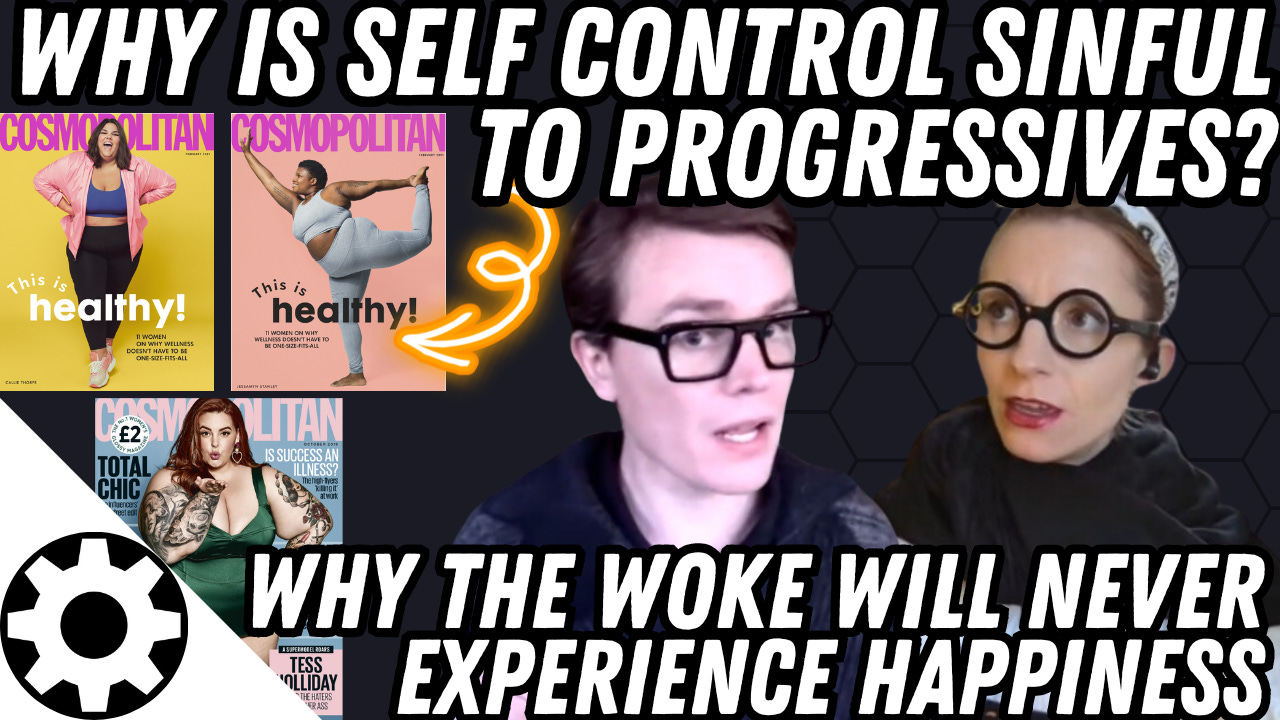
Why is Self Control Sinful to Progressives?
We discuss how modern progressive culture glorifies losing self-control, pursuing pleasure/happiness as the highest aim in life, and avoiding discomfort. We contrast this with historical and conservative values around self-mastery, overcoming fear/anxiety, and finding meaning by improving future generations. We argue the progressive view diminishes human potential and actual happiness.
Malcolm Collins: [00:00:00] humans don't actually feel that much happiness.
And so when you get out and you attempt to maximize your own personal pleasure, You have a deep realization of how trivial your life and existence is every single day. Yeah. Because you are experiencing everything good that you have brought to the world. And it's this
Simone Collins: fleeting, actually not terribly satisfying feeling.
Malcolm Collins: Life is about not cultivating positive emotional states, not the things that evolved into us, but intergenerational improvement, this expansion of human potentiality
in truth, doing whatever you want, whenever you feel like it does not cultivate human potential, it diminishes it.
It is sand on a fire. but what's really interesting is that an individual who lives for hedonism.
will always be less happy than an individual who lives for something else. the only real happiness you will ever experience is efficacious living your [00:01:00] values. Yeah. And if those values are happiness, then you'll never experience true happiness in your life.
And so many people was in this far progressive movement, never do.
Would you like to know more?
Malcolm Collins: This topic is an interesting one. Speaking of me losing self control right now, which is. Self control is seen in some ways as sinful within the urban monoculture in our society today, which some people identify with the progressive movement. I mean, that's largely what they're fighting for the urban monoculture.
To tell an individual you should not do that thing. When that thing that they are doing doesn't directly cause any negative impact on another person is seen as. A sinful thing to do. Now what's interesting is is it is even seen as sinful if that thing causes them negative consequences in the future So if I say something like do not eat that thing and and and because you'll get fat [00:02:00] and You will feel bad about that in the future that scene is a bad thing to to tell someone to notify them of that reality This is The haze movement and everything like that.
And I could go deep on the haze movement in an episode. It's really interesting for people aren't familiar as the healthy at every size movement. And it's the movement that's gotten really big around saying that
Simone Collins: no pun intended
Malcolm Collins: really big saying that being overweight is unhealthy. And one of the articles that, that was done on us when they were like researching us afterwards, they're like, oh, this whatever couple, well, you don't know this about them. . It was the best journalism ever done on us. They somehow found our Reddit history, which Oh, wasn't that
Simone Collins: a Vice article?
Malcolm Collins: And they were going through our internet history and they were like, these two, you would think like innocuous individuals.
Did you know he liked a post that was laughing at fat people having to go to the zoo to get an MRI? And I'm like, yeah, I did. I'd like, did you know that he follows like Kotaku in action [00:03:00] on Reddit? And I was like, wow. It's funny that they can't see. I used to follow Tumblr in action. Right. I mean,
Simone Collins: like if I.
If I had to, I mean, I feel like it's a beached whale right now because I'm so pregnant, like. I would laugh. I would laugh if I was obese and had to go to the zoo to get an MRI. Wouldn't you laugh? I would laugh.
Malcolm Collins: I think it's objectively funny. It's one of those things that when we talk about our model for what makes people laugh at something, it's when something is surprising, you didn't expect it, but it makes sense in context.
Yeah. Never something surprising. But make sense in context, that's what causes laughter and our hypothesis around laughter for people who aren't familiar with this theory, because we haven't done it in a few long time, I think we've only talked about in one of our early episodes is that it originally evolved in Children and it made the person that they were doing this to feel good about themselves.
And so the person would repeat the action. And the reason why the child was basically asking the parent to repeat the action That was surprising, but made [00:04:00] sense or some level of sense in context is they were trying to sort of make the mental connections around that until it was no longer funny, i. e.
until the thing that didn't kind of made sense in context, but was surprising was no longer surprising. They're like, Oh, okay, I understand this now. And this is why peekaboo is one of the longest things that makes kids laugh under around the age when they're learning object permanent and around the age where they are learning sort of theory of mind of other people.
Are, what? She's still there? I guess it kind of makes sense that she's still there when her hands are there, but it's a little surprising to me. And, and so that is, and that's an important concept for kids to get, so that's why they left. And then any of these concepts that were useful for kids. End up becoming something that the adult mind will hijack.
We say, this is what we think happened with the love reaction with the laughter reaction. It became sort of hijacked in courtship rituals when it hadn't turned off properly. You can read one of our books to go into our three on this more, but in this, what we wanna talk about is sit the, the [00:05:00] idea that self-control is sinful.
And like, where did this come from and why is it so critical and why does it cause so much damage? And where I really started to like. Wow, like I, I got how normalized it is within the progressive world and how not normalized it is within ours is I was following one of my friends on Facebook and they had this message in, in one of their private groups where they were like, I really want to sleep with this guy.
And they weren't sure whether they should or should not sleep with this guy. Like they didn't, sorry, they didn't really want to sleep with this guy. They had entertained the notion of sleeping with this guy, and this guy had said, I am open to sleeping with you. And so they were sort of stressing about the idea of, will I feel better?
Like, like, will it make me happier long term? To sleep with them, or is it better to just not deal with it because of the potential negative social ramifications and negative emotions that could create in me to sleep with them, right? [00:06:00] Now, this is really interesting for two reasons. I mean, what it's so far down this progressive monoculture that Whether or not you have sex with an individual is completely determinant on how it makes you feel about yourself.
Good feel in the moment. That's a very odd, I mean, that does show, like, that is complete dedication to the urban monoculture in terms of how you interpret things. Logically
Simone Collins: consistent, yeah.
Malcolm Collins: Yeah, it's logically consistent but then, too, I realize I haven't. In years ever ask myself, what will make me happier when I was trying to make a difficult decision like this has never been the thing I was optimizing around even when I had a more atheistic structures in my brain.
It was always well, what matters more f
You May Also Like

The Latest with Loren LoRosa
The Black Effect Podcast Network and iHeartPodcasts

Daily Inspiration: The Steve Harvey Morning Show
Peter Mutua

RADIO KULTURAEUROPA
RADIO KULTURAEUROPA

How Men Think
iHeartPodcasts

During the Break with Clint Powell
Clint Powell

Keeping It Real: Conversations with Jillian Michaels
Jillian Michaels

The Fred Show On Demand
The Fred Show

Coach Corey Wayne
Coach Corey Wayne

CAMINANDO POR EL MEDIO
Radio Trend Topic

Am I the Jerk?
youtube.com/amithejerk
The Latest with Loren LoRosa
The Black Effect Podcast Network and iHeartPodcasts
Daily Inspiration: The Steve Harvey Morning Show
Peter Mutua
RADIO KULTURAEUROPA
RADIO KULTURAEUROPA
How Men Think
iHeartPodcasts
During the Break with Clint Powell
Clint Powell
Keeping It Real: Conversations with Jillian Michaels
Jillian Michaels
The Fred Show On Demand
The Fred Show
Coach Corey Wayne
Coach Corey Wayne
CAMINANDO POR EL MEDIO
Radio Trend Topic
Am I the Jerk?
youtube.com/amithejerk
Community discussion