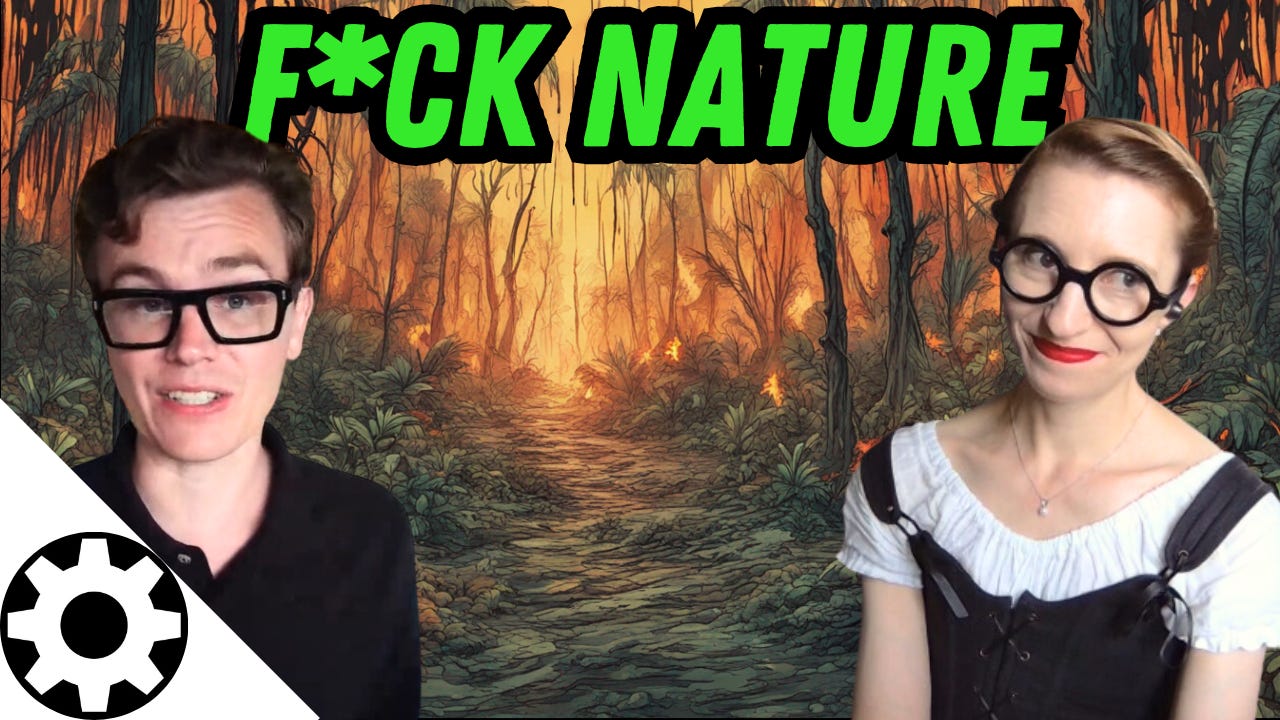
We're Done With Caring About the Environment
In this provocative and thought-provoking video, we dive deep into the controversial topic of climate change and environmental policies. We challenge mainstream narratives and explore alternative perspectives on global warming, environmental conservation, and the future of human civilization. This video covers:
* Critical analysis of climate change data and predictions
* The debate between environmental conservation and human progress
* Examination of proposed solutions like iron seeding and carbon capture
* Discussion on the politicization of environmental issues
* The relationship between environmentalism and population growth
* Critique of mainstream environmental movements and their motivations
* Exploration of technological solutions to environmental challenges
* The future of human civilization in the face of environmental changes
Note: This video presents controversial viewpoints and is intended to stimulate critical thinking and debate.
[00:00:00]
Malcolm Collins: Hello simone today We are going to be talking about how much I You hate the environment, burn it down, burn it down. I am so done with it. I am so done with dealing with environmentalists.
Speaker: Alright, that does it! I f ed it!
Oh, now she figures it out.
Malcolm Collins: When I came into all of this print natalist stuff, I started being like, well, maybe we can find common ground. You know, obviously the environment matters, but like, we should probably try to save humanity as well.
Speaker: Quick! Everybody help the children!
Hyaaah! Dude, bulldozers rule! Come on, let's get you back to civilization! Hooray! Hooray,
Malcolm Collins: Like I really, and you know, me, I tried to do a middle line, you, She got her undergraduate degree in [00:01:00] environmental business. Okay. It was one of these created degrees. Her first jobs were at companies like Earth Day Network and ACOR and other environmentalist stuff. Like we are not intrinsically antagonistic to environmentalism as a cause, but as time has gone on.
My relation to environmentalism has dramatically changed, and it's been changing more like I'd even say over this year, where I am getting further and further to a standpoint of just the environment, like, I'm done. We don't need to save it. We don't need it for humanity to survive.
Speaker 2: We're clearing out big sections of the rainforest for a lumberyard.
Really? That's great! You mean you don't mind? No! I hate the rainforest! You go right
Speaker: ahead and plow down this whole f*****g thing! That's swell!
Malcolm Collins: And a lot of the stuff that environmentalists are going on and on about these days.
Aren't even [00:02:00] necessarily like, an intrinsic negative. For biodiversity. If that's what they're trying to protect, and that's one of the areas that we're going to get into it just a second. But I want to hear your thoughts before I move further.
Simone Collins: Yeah, I struggle a lot with this. I think the big issue here is very similar to the bigger issues.
We constantly talk about with the urban monoculture, which is that we don't have anything inherently against the values that it. Proposes to a spouse. We are not against LGBTQ rights. We're not against personal liberty. We're not against freedom of choice. We're not against people choosing to live how they want to live, which is sort of what I, at least I grew up thinking progressivism and being left was the Marxism.
I didn't really know about, I guess this is the same issue with environmentalism where we are inherently in favor of sustainability. Of biodiversity, of, of flourishing of life. The reason we don't like environmentalism [00:03:00] is because it has been corrupted to the extent that it actively runs against the best interests of these causes.
Speaker: You only fight these causes cause caring cells All you activists can go f**k yourselves That was so inspiring! What a wonderful message!
Malcolm Collins: Yeah, well, and we did another episode that focused on like environmentalists are the biggest threat to the environment, but. I actually want to do more of a, a splitting here where I used to be like, look, I'm against environmentalism because I don't think it actually helps the environment. We're now, I've begun to move more and more into the perspective of, I might just not care about saving the environment at all.
Speaker: Do do do do do, da da do, wow!
Speaker 2: There's a place called the Rainforest that truly sucks ass.
Speaker: Let's knock it all down and get rid of it fast.
Malcolm Collins: You know, I,
Simone Collins: I don't. Just screw the earth. I'm going off the planet.
Malcolm Collins: Well, we're going to be doing that eventually anyway. So yeah, okay. I'll get into some specifics here. So [00:04:00] like, if you look at global warming, first of all, you know, what do plants need to grow?
Global climate change, global climate change, right?
Do we call it
warning now? We call it climate change. I don't
know. I don't know. I don't know. Like, I don't know if I'm allowed to say retarded now. It feels like we're doing the
Simone Collins: hard R, but it is no, you, you are not allowed to say it, but we say retarded. Because it's retarded to not say retarded.
Malcolm Collins: Yes. Yes.
And, and don't be gay about
Simone Collins: it. Okay.
Malcolm Collins: With climate change. Right. I don't know if I'm allowed to say gypped anymore, but I'm going to say, I'm going to say gypped. But so here's the thing, global climate change, global climate, whatever. Right. What's it do? It increases the amount of CO2 in the environment.
And it increases the amount of warmth and the, the, the, the reach of the earth. And what, what, what do plants need? What do rainforests need? They need CO2. You're just like hypercharging photosynthesis. The [00:05:00] very thing that counteracts this phenomenon is what is being hypercharged by this phenomenon.
So you're saying
Simone Collins: you're welcome, trees.
Malcolm Collins: Yeah, I've never seen more of an obvious negative feedback loop like in my life and yet environmentalists are like, Oh, no, this is where you're gonna get these positive feedback loops and everything like that and I'm like the Environment is a negative feedback loop on this but more than that, you know, you could even argue this is Good for the environment, broadly speaking, and we'll get into the specifics of that, but it's also good for humans.
You know, if you are looking at you're going to get improved travel time in Arctic regions, which really matters for stuff like using less fuel and stuff like that for the big tanker ships and stuff, you're going to be able to use resources in those regions. Which is good for humans. You're going to have less people dying from extreme cold exposure.
You're just in the United States. There's 1, 300 deaths per year from extreme cold exposure. That's from 2006 to [00:06:00] 2010. And we're talking about how much is growing going to be increased by this. If you, if you're looking at cereal production, if we're using that as a proxy in wealthier countries, global warming will increase it by four to 14%.
But it may decrease by 6 to 7 percent in poorer countries. Now when we also talk about global warming, and this is the thing that really gets me about all these convers
You May Also Like

Daily Inspiration: The Steve Harvey Morning Show
Peter Mutua

RADIO KULTURAEUROPA
RADIO KULTURAEUROPA

How Men Think
iHeartPodcasts

During the Break with Clint Powell
Clint Powell

Keeping It Real: Conversations with Jillian Michaels
Jillian Michaels

Coach Corey Wayne
Coach Corey Wayne

CAMINANDO POR EL MEDIO
Radio Trend Topic

Am I the Jerk?
youtube.com/amithejerk

Es Noticia
esRadio

Fulda Kultur - Der Podcast
Fulda Kultur / Shaggy Schwarz
Daily Inspiration: The Steve Harvey Morning Show
Peter Mutua
RADIO KULTURAEUROPA
RADIO KULTURAEUROPA
How Men Think
iHeartPodcasts
During the Break with Clint Powell
Clint Powell
Keeping It Real: Conversations with Jillian Michaels
Jillian Michaels
Coach Corey Wayne
Coach Corey Wayne
CAMINANDO POR EL MEDIO
Radio Trend Topic
Am I the Jerk?
youtube.com/amithejerk
Es Noticia
esRadio
Fulda Kultur - Der Podcast
Fulda Kultur / Shaggy Schwarz
Community discussion