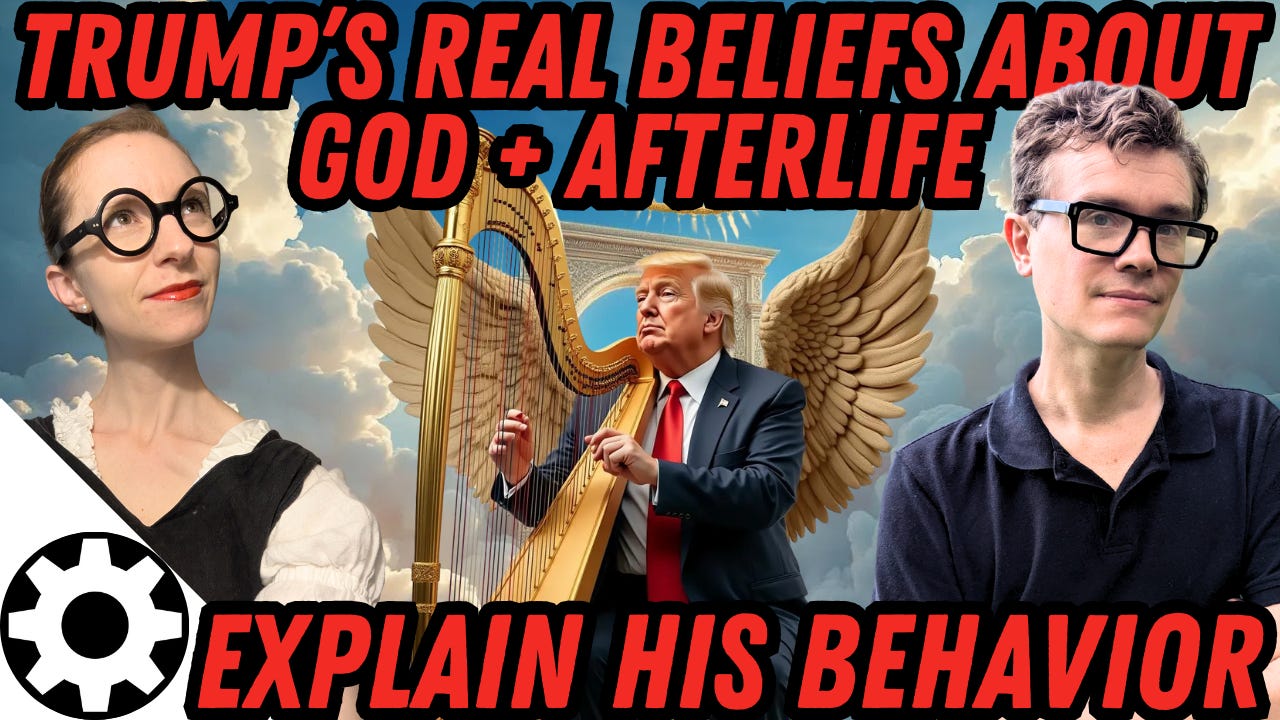
Trump's Unusual Beliefs About God & the Afterlife (An Investigation)
In this episode, Malcolm and Simone delve deep into understanding Donald Trump's theological beliefs, challenging the initial assumption that Trump lacks a specific theology. The discussion uncovers that Trump has a detailed personal theology heavily influenced by Norman Vincent Peale's teachings and 'The Power of Positive Thinking.' This self-help-centric Christianity shaped much of Trump's behavior and decision-making. Additionally, the episode explores Trump's recent efforts in international peace negotiations and how his contemplation of legacy and afterlife might be influencing his moves to end conflicts around the world.
Malcolm Collins: [00:00:00] Hello, Simone. Today was, it's one of these episodes that's just stunning for me because I come into it being like. You know what? I'm gonna try to untangle what Trump's true theological beliefs are. Okay? And my. Intuition going into this is he just didn't really have a theology. And he just had never thought deeply about this particular subject.
Right. Just Trump is
Simone Collins: great and everyone knows it.
Malcolm Collins: Yeah, he's the best. As I tied dug into it though, I learned that that is very much not true. Whoa. As a. Fairly detailed theology that he doesn't share with the public a lot. So just, you know, this is this, it says not what he signals to the public anymore.
But when you understand his theology, a lot of his behaviors that otherwise seem. Crazy or insane or don't make sense all of a sudden makes sense. In fact, I would argue that to understand and predict Trump's behavior, you need to understand his theology. And the other weird thing about this [00:01:00] theology is while it is not a traditional Christian theology, it came from a traditional Christian Church.
Oh, but just a unique one. Oh, wow. And, and we're gonna go further here because I also think that his theology has changed a lot recently, given that he thinks he's about to die or not about to die, but he's sort of like, it's the end of my life. You know? He's, he's contemplating his legacy. Yeah.
The, the quote recently from him that I absolutely love is if I can see, he's talking about ending the war in the Ukraine. He goes, if I can save 7,000 people a week from being killed, I wanna try and get to heaven if possible. Trump said, I'm hearing that I'm not doing well. I'm really at the bottom of the totem pole, but if I can get to heaven, this will be one of the reasons.
And I just love this idea of Trump beginning to get worried. Because, you know, he is cheated on spouses. He doesn't really go to church. He doesn't seem to understand much about the Bible. If we're, if we're gonna talk about, like, not understanding the, there's the famous quote [00:02:00] that I love. In the Bloomberg interview when asked what his favorite Bible verse is.
And you know, he just like, the Bible's my favorite book.
Speaker: Okay. You mentioned the Bible. You've been talking about how it's your favorite book. And you said, I think last night in Iowa, some people are surprised that you say that. I'm wondering what one or two of your most favored bible, uh, verses are and why? Well, I, I wouldn't want to get into it because to me that's very personal.
Trump: You know, when I talk about the Bible, it's very personal there. So I don't want to get into verses. I don't want to get into. There's verse, it means a lot to you that you think about or cite. The, the Bible means a lot to me, but I don't want to get into specifics, even to cite a verse that you like. No, I don't wanna do that.
I mean, you, an Old Testament guy or a New Testament guy. Uh, probably equal. I think it's just an incredible, the whole Bible is an incredible, I joke, uh, very much so. They always hold up the art of the deal. I say my second favorite book of all time, but, uh, I just think the Bible is just something very special.
Malcolm Collins: I don't, I don't know. I don't know. I can't name a book from, I can't name a quote from it, but it's my favorite book. And usually just
Simone Collins: a very personal thing. I'm not gonna talk about it.
Malcolm Collins: Yeah. And then, and then [00:03:00] during a Family Leadership summit interview, he said.
Why do I have to repent or ask for forgiveness if I'm not making any mistakes? Which is a very Trump thing to say. It's, it does not align with traditional Christian theology. Then once when he was giving a speech to a university campus, he called, and this is the type of thing I do because I don't go to church often.
He said two Corinthians instead of second Corinthians.
Speaker 4: And I, I asked Jerry and I asked some of the folks, because I hear this is a major theme right here, but two Corinthians right, two Corinthians three 17,
Malcolm Collins: oh. Which is exactly the type of thing I do. I'd say two Corinthians or something. Totally. Yeah. But I do, I do that because I don't go to church and I'm reading from a sheet of paper. Yeah. That,
Simone Collins: that's more like, yeah. Just spoken norms. Not, not necessarily a sinus.
Malcolm Collins: No, no, no, no. But , it indicates that he doesn't actually, and we know this from, you know, he, he goes like on holidays and stuff like that. So he is aware, you know, maybe not, not that high up, not that going to church more often in Christian beliefs gets you into heaven more easily.
I'm [00:04:00] just saying like he is aware that he has some vices. Right. And also the way he related to Christianity historically. So. He referred to the Christian Sacrament of communion as drinking, quote unquote, my little wine and eating, quote unquote, my little cracker, and that it made him feel, quote unquote, feel cleansed.
Little wine, my little cracker.
Simone Collins: Why does he say everything 10 times better than anyone else? I, I know. I love it.
Malcolm Collins: But so then in one Christian church setting, he said,
Speaker 5: I love you Christians. I'm not Christian. I love you.
Malcolm Collins: I love you Christians. I'm not Christian. Now a lot of people think he meant to say, I am a Christian. I love you Christians. I am a Christian.
Although that makes less sense. I think he might not have interpreted himself as a full Christian at this time, period. Hmm. So, . Chu born Presbyterian. His parents were Methodists before this. Hmm. But when he was young, the family shifted to a new church. This was in the 1970 seventies and it was called the Marble Collegiate Church in Manhattan. [00:05:00] A reform church run by a guy named Norman Vincent Peele.
Okay. Okay. Now you might be like, what's so special about a church run by a guy named Norman Vincent Peele?
Simone Collins: Yeah.
Malcolm Collins: Well, he invented a philosophy that you've probably heard about called The Power of Positive Thinking.
Simone Collins: No Blended Christianity
Malcolm Collins: with Motivational Self-Help.
Simone Collins: No.
Malcolm Collins: Oh no. Now you're beginning to see, oh.
So Trump grew up going to a church that taught self-help, principles of the eighties through the pulpit. Wow. Or not eighties, early seventies, when it was really beginning to pick up. So, so, and, and Trump really liked this guy called Peel. He calls him a, a, a mentor of his, he prays his preaching style.
We'll go into Trump's connection to him. But, he went to church and drank the Kool-Aid. I mean, [00:06:00] hello
Now I want you
You May Also Like

RADIO KULTURAEUROPA
RADIO KULTURAEUROPA

How Men Think
iHeartPodcasts

During the Break with Clint Powell
Clint Powell

CAMINANDO POR EL MEDIO
Radio Trend Topic

Am I the Jerk?
youtube.com/amithejerk

Es Noticia
esRadio

Con ánimo de lucro
esRadio

Estelle Midi
RMC

Madrid es noticia
esRadio

The Ranch Podcast
Matt Todd
RADIO KULTURAEUROPA
RADIO KULTURAEUROPA
How Men Think
iHeartPodcasts
During the Break with Clint Powell
Clint Powell
CAMINANDO POR EL MEDIO
Radio Trend Topic
Am I the Jerk?
youtube.com/amithejerk
Es Noticia
esRadio
Con ánimo de lucro
esRadio
Estelle Midi
RMC
Madrid es noticia
esRadio
The Ranch Podcast
Matt Todd
Community discussion