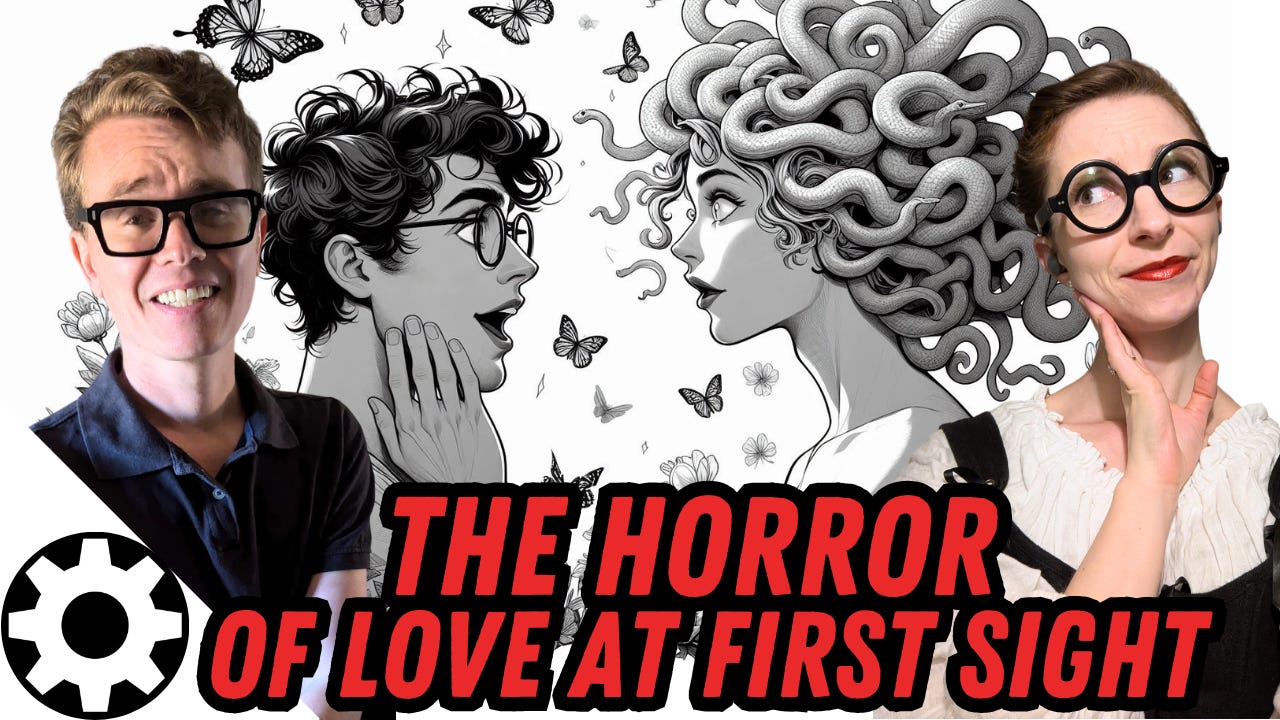
The Science and History of 'Love at First Sight'
The video explores whether 'love at first sight' truly exists, examining historical references and scientific studies. It touches on selective memory bias, medieval concepts of love, and modern research on oxytocin and dopamine. The hosts also discuss how physical attraction plays a vital role in these instant romantic connections, the role of cultural attractors, and how AI could predict romantic compatibility. The conversation digs into the biochemical pathways involved in love and lust, historical perspectives, and culminates with reflections on genetic predispositions and societal norms regarding relationships.
[00:00:00]
Malcolm Collins: Hello, Simone! I've got a question for you. Do you believe in love at first sight?
Simone Collins: I believe in lust at first sight.
Malcolm Collins: Well, around 52 to 66 percent of people in the U. S. claim to have experienced love at first sight. However, this belief may be bolstered by a selective memory bias where individuals romanticize their initial encounters over time.
Simone Collins: Hmm.
Malcolm Collins: However, what I would say is we have actually seen the concept of love at first sight discussed All the way back in history. We see it in Greek stories. Oh, so you see it in like Ovid metamorphosis, the story of Pygmalion depicts a sculptor falling in love with a statue he created at first light.
Site or the greek myth of narcissus who falls in love with his own reflection Also embodies a form of instant love And they even had a mechanism of action for it in the medieval period where The eyes of the lady [00:01:00] when encountered by those of her future lover thus generated And conveyed , a bright light from her eyes to his
Simone Collins: laser.
Malcolm Collins: So, yeah, no, they thought that, like, love was something that, like, woman generated inside of them and then, like, shot at men with their eyes. This is terrifying. This is just Captured his heart. But they might've been right about that. We'll get into in a little bit, but I want to hear, well, your lust at first sight comment is really astute when they look at the data.
And we'll get into this in a second, but what they found is yes. It appears that there does. appear to be this emotional thing that people call love at first sight. But it only occurs to people you find physically attractive. People aren't falling in love at first sight with their chubby whatever husband, they are falling in love at first sight with people who are generically [00:02:00] attractive.
And when people say they love someone at first sight who is not well, arousing to them or more generically attractive. They're typically lying in a supposed fact saying Or they were
Simone Collins: looking at their Bugatti instead. They just happened to be inside it.
Malcolm Collins: Yes. One of my favorite is that medieval texts also would, would compare the gaze of a beautiful woman to the sight of a basilisk.
Simone Collins: Yeah.
Malcolm Collins: You've got Medusa as well that turned men to stone with her beautiful gaze. Oh, they made
Simone Collins: them rock hard. Yes. This is what
Malcolm Collins: happens. Made them rock hard, right? Yeah. This is what
Simone Collins: really, there was just something was lost in translation and we thought, Oh, you mean they, they turned into a stone.
They're like, nah, kind of. So one thing I will say that I think is interesting is that even now When I have our podcast on or something and I, I freeze it and. [00:03:00] I walk by our computer screen and I see your figure, but I don't realize it's our podcast. It's on the screen. I'm like, Oh, who's that? And then also when we're in airports and you and I are separate or you're out walking by yourself and I'm just gazing across a crowd.
And I see you and I don't know it's you. I'm all like, who's this? Who's this? And I think that that's what people are describing as love at first sight is that you're just so much my type that even when I don't realize it's you, my body is just like, Yeah, we
Malcolm Collins: definitely had that reaction when we first met where you're like, and I still
Simone Collins: have it.
I still have it when I don't realize it to you. I have a different reaction when I know it's you because it's more like my person. But when I don't know, it's you. I definitely feel this like. Spark and I can totally understand what [00:04:00] these whatever medieval writers were talking about in terms of this, like, like lasers.
So, but again, I, I, I think that's entirely physical lust. And not well, and I mean, it would
Malcolm Collins: logically have to be so I'd also like to walk back here where people act like the concept of love at first sight is a romantic concept when really I see it as an anti romantic concept. Oh, yeah, because you don't know anything about the person yet.
You don't know anything about them.
Simone Collins: Yeah.
Malcolm Collins: Yeah. You would have to believe that In magic or the soul and that love is somehow capturing these systems Except we we understand love very well at like a psychological level. And it is not magic. It is not fairy dust uh Well, i'll read a quote here anthropologist Helen fisher who studied the brain activity of people madly in love with each other through mri scans says that romantic It says here through MRI scans, but it's wrong.[00:05:00]
It must have been through fMRI scans. But anyway says that romantic love takes a very quote unquote primitive pathway through the brain. The good feelings we experience when falling in love is driven by dopamine, the brain chemical behind our motivation to find food, water, and everything else we need for survival, and also some oxytocin, which we'll get into in a second.
It's just like the other survival mechanisms, like fear, for example, it can be triggered instantly. So, what we mean is, because we understand what love is, fundamentally, in the brain then the concept of, can it be triggered instantly, is just a concept of, Are some humans born abnormal? And yeah, of course, you know, even, even though we might be coded for like men to find women attractive and women to find men attractive, you're going to get some percentage of the population where that's not the case.
It's the same with a system like love. It was coded to only form after long periods of time. time it's going to accidentally fire sometimes when like the lust system is supposed to be firing or something like that. Well, and
Simone Collins: I think it's you're wrong to [00:06:00] use the word love when you say that yes, love at first sight exists because there are very different things that are happening hormonally between lust and love.
And also Let's say you see someone and you feel that spark and you're very attracted to them, but then you discover that they were war criminal and they have a habit of torturing people and you know that you're probably not going to love them. You know that they may be hot, but they're really bad. I disagree.
Do you know how many? Sorry, I should have. Okay. Okay. I need to use a better example for you. It turns out they're French. Okay. And then you're just like, Oh my God. Yeah. So nevermind. I'm just saying, The loving a person is very different. It involves knowing who they are, how they think. Although I will, I guess you have to add, there's this additional complication in Alexander cruel.
I think I sent you a link to this on what's up today.
You May Also Like

The Latest with Loren LoRosa
The Black Effect Podcast Network and iHeartPodcasts

Daily Inspiration: The Steve Harvey Morning Show
Peter Mutua

RADIO KULTURAEUROPA
RADIO KULTURAEUROPA

How Men Think
iHeartPodcasts

During the Break with Clint Powell
Clint Powell

Keeping It Real: Conversations with Jillian Michaels
Jillian Michaels

Coach Corey Wayne
Coach Corey Wayne

CAMINANDO POR EL MEDIO
Radio Trend Topic

Am I the Jerk?
youtube.com/amithejerk

Es Noticia
esRadio
The Latest with Loren LoRosa
The Black Effect Podcast Network and iHeartPodcasts
Daily Inspiration: The Steve Harvey Morning Show
Peter Mutua
RADIO KULTURAEUROPA
RADIO KULTURAEUROPA
How Men Think
iHeartPodcasts
During the Break with Clint Powell
Clint Powell
Keeping It Real: Conversations with Jillian Michaels
Jillian Michaels
Coach Corey Wayne
Coach Corey Wayne
CAMINANDO POR EL MEDIO
Radio Trend Topic
Am I the Jerk?
youtube.com/amithejerk
Es Noticia
esRadio
Community discussion