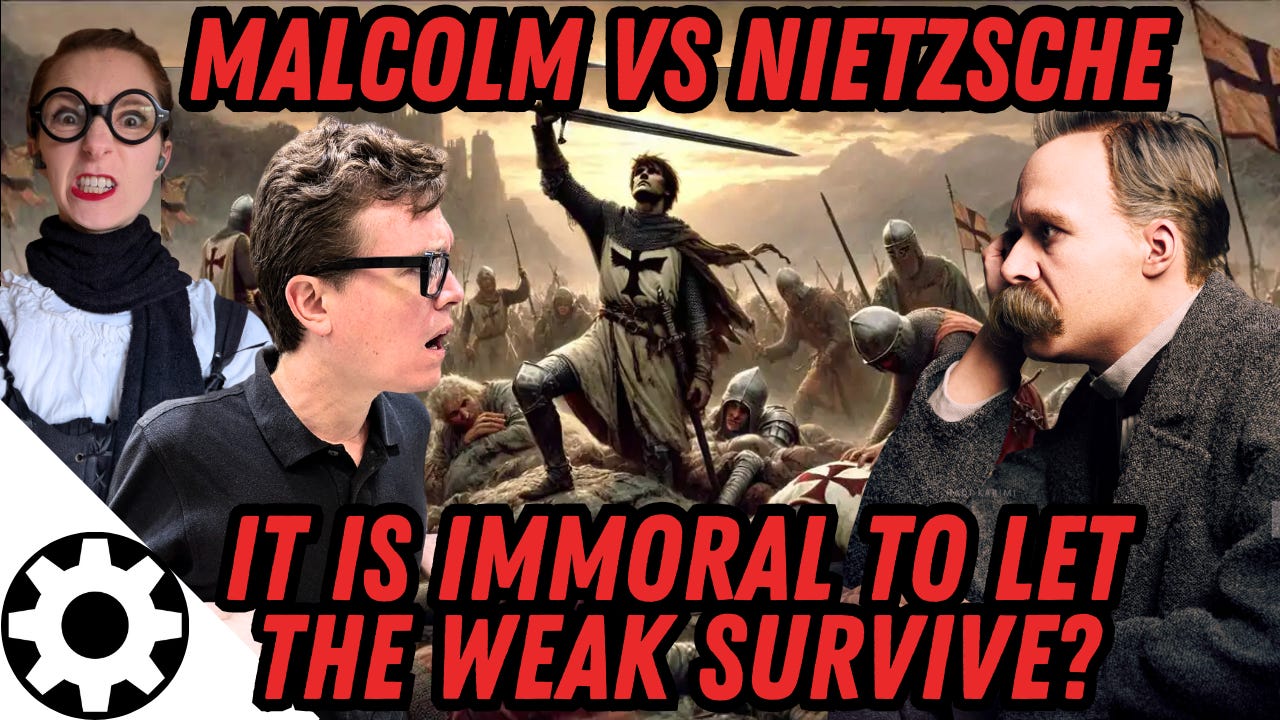
The Immorality of Weakness: Nietzschean vs. Collinsian Philosophy
In this thought-provoking episode, we dive deep into the often misunderstood philosophy of Friedrich Nietzsche, exploring his ideas on the immorality of weakness, the concept of the Ubermensch, and how they relate to modern issues like woke culture and tribal morality. We differentiate our views from Nietzsche's, discuss the relevance of his ideas in today's world, and address the broader implications for cultural and societal development. Join us as we unravel complex philosophical concepts and their impact on contemporary thought.
[00:00:00]
Malcolm Collins: Hello, Simone. Today we are going to be talking. About the immorality of weakness, and I would note here that we are not going to be talking about this from the perspective of niche, but we will be talking a lot about Frederick Nietzsche throughout, especially at the end of this episode to differentiate our views on why weakness should be scorned versus Nietzsche's views on weakness leading fundamentally to immorality.
Because they're actually distinct, but not as distinct as I thought when I went into this subject. And I would say that me studying Nietzsche, very sad. It's just a bunch of instances of me being like, I don't want to be basic, but he actually makes a lot of good points. Very prescient about woke people, but we'll get to that in a second.
Okay. Well, that people will use the sympathy of others to try to exert power over them and that people will manipulate others by acting sympathetic to them [00:01:00] to keep them in a permanently infantilized state that glorifies themselves i. e. the person doing the infantilization. But before we get to all of that, where this was highlighted for me.
Was two things. One is a recent evolution in my understanding of our wider world perspective, which has become a lot more clear to me and sort of how I view clan based structures and how I view morality at the wider societal level than at the individual level, but also a clip that we ran in a recent episode that's a famous scene from Trigon or I don't know if it's a famous scene, but it's a scene that always hit me hard as a kid.
Because in it, there are two characters arguing and the character who is the villain says you have to kill the one character is trying to save a butterfly, the good guy. And then the villain says, well, you just need to kill the spider then basically.
Simone Collins: Because it's a butterfly caught in a web for those.
Because [00:02:00]
Malcolm Collins: if you free the butterfly. Then the spider will eventually starve. You can't, you're not doing a good thing by freeing the butterfly. You're just consigning the spider to a slow death. And the good guy character says no, there's always a way.
Speaker 6: That was the easiest way to stop him. I didn't want to kill the spider unless the spider caught the butterfly, it would die of starvation . You can't save both,
Speaker 5: it's not right to make that choice so easily. . BUt
Speaker 6: I'm not wrong about this, Rem. Wanting to save both is just a naive contradiction. And what would you have rather had us do, just think about it? In the meantime, while we do that, the spider eats the butterfly
Speaker 7: I wanted to save both of them, you idiot!
Malcolm Collins: And the entire Trigun series is based around this philosophy of No matter how bad things are, there is always a way to save the bad guy.
There is always a way to make things right. When in reality, by [00:03:00] attempting to save the bad guy, you often cause much more harm in the longterm. You are masturbating your own sense of justice. Like you being a good person, usually because you don't have to deal with the risk that that bad guy poses to society.
The famous example here, of course, I'm thinking of is the woman who had a person murder her mother. And everyone was like, this is a really bad dude. She petitioned to get them released from prison early, hired them, and then they murdered her when she fired them for stealing from her. Which is to say that a lot of people, when they take this benevolent and magnanimous looking position, they're doing it just to heighten their own sense of I'm a good person without really thinking about the other harm that this person is going to cause, which is what often happens.
If you look at statistics and I'll add some in post here, The vast majority, for example, of thefts are caused by a very, very small majority of thieves who just do it over and over and over again, right? It's the same as just about any crime, right? Very small number of people actually do it, which I think
Simone Collins: Also, [00:04:00] just to be fair, explains the behavior of people who want to give people the benefit of the doubt because the vast majority of humans deserve the benefit of the doubt.
It's a very, very small percentage that really just needs to be distrusted and removed from mainstream society.
Malcolm Collins: The, the, the problem here is I think that we as a society have been conditioned to not believe this by media.
And I'm going to call this the Thai hot Maru problem.
Speaker 2: What's on your mind, Lieutenant? The Kobayashi Maru, sir.
Lieutenant, yOu are looking at the only Starfleet cadet who ever beat the no win scenario.
Speaker: How?
Speaker 2: I reprogrammed the simulation so it was possible to rescue the ship. What? He cheated. I changed the conditions of the test.
I don't believe in the no win scenario.
Malcolm Collins: Now, for people who don't know what the Tai Hot Maru is, the Tai Hot Maru is a famous test from the Star Trek universe that [00:05:00] you are supposed to be unable to pass.
And it's supposed to show what do you do in an unwinnable scenario. And yet our society and media constantly says, when the hero is given an unwinnable scenario, save this person or this person. Save your love or like this group of citizens. The answer is always supposed to be, there is a way to save both.
Simone Collins: And
Malcolm Collins: that is not true. Fundamentally,
Simone Collins: right?
Malcolm Collins: There is not always a way to solve those. And it creates a really toxic mindset around morality for a lot of people because they believe that any decision that leads to harm for some group of people is fundamentally an immoral decision, regardless of the necessity or longterm good of that decision.
And so here, what I wanted to dig into was your response to the try again video because I think it's accurate and it encapsulates our view of morality that [00:06:00] we will go into and why this view of morality leads downstream to some very perplexing beliefs that we have, for example, a lot of people can be like, wait you guys think that there's differences between cultural groups.
So if you think that there's differences between cultural like groups Then why don't you think that like the europeans are the good guys and like, the the jews and like the the blacks are the bad guys when it seems that you actually have a great deal of derision for northern europeans and even more derision for anti semites And yet you hold very pretty neutral views to groups like the hispanics.
And Really really confuses And it's like, well, there's actually a logically consistent reason for all of these beliefs, but you just assume that the reason is that we're capitulating to the urban monoculture without realizing that the position that we're taking is actually even harder to hold than the just generic, you know, Sort of racist person pos
You May Also Like

The Latest with Loren LoRosa
The Black Effect Podcast Network and iHeartPodcasts

Daily Inspiration: The Steve Harvey Morning Show
Peter Mutua

RADIO KULTURAEUROPA
RADIO KULTURAEUROPA

How Men Think
iHeartPodcasts

During the Break with Clint Powell
Clint Powell

Keeping It Real: Conversations with Jillian Michaels
Jillian Michaels

Coach Corey Wayne
Coach Corey Wayne

CAMINANDO POR EL MEDIO
Radio Trend Topic

Am I the Jerk?
youtube.com/amithejerk

Es Noticia
esRadio
The Latest with Loren LoRosa
The Black Effect Podcast Network and iHeartPodcasts
Daily Inspiration: The Steve Harvey Morning Show
Peter Mutua
RADIO KULTURAEUROPA
RADIO KULTURAEUROPA
How Men Think
iHeartPodcasts
During the Break with Clint Powell
Clint Powell
Keeping It Real: Conversations with Jillian Michaels
Jillian Michaels
Coach Corey Wayne
Coach Corey Wayne
CAMINANDO POR EL MEDIO
Radio Trend Topic
Am I the Jerk?
youtube.com/amithejerk
Es Noticia
esRadio
Community discussion