Peacocking: The History, Science, & Anthropology
Dive into the fascinating world of “peacocking” with Malcolm and Simone Collins on this episode of Based Camp! From evolutionary biology to modern dating signals, we explore how men and women use costly displays—like flashy cars, makeup, or even leg-lengthening surgery—to attract partners. Discover why choosing a spouse based on looks is a hidden commitment, the history of male fashion from codpieces to high heels, and why both sexes peacock in unique ways today. We break down honest vs. dishonest signaling, why males are becoming more selective in long-term relationships, and real-world examples from seahorses to Genghis Khan. If you’re into red pill insights, cultural trends, or just want to understand the hidden dynamics of attraction, this is a must-watch!
Episode Notes
* Both men and women who choose spouses based on looks are both telling on themselves and implicitly committing to something without realizing it
* Basically, when you’re being choosy about partners, it’s because you implicitly understand (and may be signalling) that you’ll do most of the work and/or take on most of the risk
* To understand why this is the case, we need to look to peacocking and WHY animals (plus humans) do it
* We also need to understand how peacocking has evolved in the face of modernity and how we may need to disregard certain instincts because they were evolved for an old game and these days, many of the rules are TOTALLY different
Why Peacock?
Peacocking is required when the target market is selective (it’s obvious and universal—products only need branding and marketing in competitive markets with choices).
Female peacocking is necessary only when men get sexually selective.
There are three reasons why males get sexually selective:
* Males invest heavily in parental care (time, energy, or risk), so they can only mate with a limited number of females.
* For example, male seahorses, which carry and nourish the eggs in a brood pouch (a form of male pregnancy), are notably choosy about mates.
* Married fathers’ childcare time rose from about 2.6 hours per week in 1965 to about 7.2 hours per week in 2011 and 7.8-8 hours/week in 2020/2021 (with married fathers around 8 hours and college‑educated fathers about 10 hours per week.)
* In case comparison is desired: Married mothers’ time went from about 10.6 hours per week in 1965 to roughly 14.3 hours per week in 2011, and around 13.5–14 hours remains a standard estimate in the 2000s.
* There is large variation in female quality (for example, in fecundity, size, or health), making some females much more valuable mates than others.
* Male seahorses preferentially select larger females, as these tend to produce more or higher-quality eggs, leading to better offspring survival. Males have been observed rejecting smaller or less suitable females by breaking off courtship dances or swimming away, even when the females are receptive. This selectivity stems from the males’ limited brood pouch capacity and the high energy investment in pregnancy, making indiscriminate mating costly
* The St. Andrews experience
* The marriage-and-then-kids bait-and-switch
* In many fish and bird species with biparental care (for example, certain cichlid fishes and shorebirds), males court and mate preferentially with larger or more fecund females and may ignore smaller or otherwise low-quality females.
* Will men eventually look for signals of actual COMMITMENT to larger families?
* Mating itself is costly (risk of predation, energy loss, disease, increased risk from male-on-male competition), so mating “indiscriminately” reduces a male’s total lifetime reproductive success.
* Legal risk
* One major form of “predation” in the modern civilized world
* Financial risk
* A major form of energy loss
* Pair bonding?
* In monogamous mammals like prairie voles, males form strong pair bonds and show selective affiliation and aggression toward intruding conspecifics, effectively refusing to mate with other available females once bonded
* Do men pair bond more???
* I recall in red pill forums men expressing some level of disdain for women who just aen’t really capable of love, which implied that men *were*—so is it that men really feel pair bonded to female partners beyond just mercenary calculations?
* And we discussed women potentially being into male-male romance because of pair bonding
The TL:DR here:
* So long as men have choices and are either made vulnerable by partnering with women or involved in childcare, they’ll be selective.
* BUT: So long as women are also subject to these risks and obligations, they’ll also be choosy
* So both sexes peacock, but in different ways depending on trends and the economy
The History of Peacocking
Neither men nor women stopped peacocking; the means of peacocking for each sex just evolved over time
* When you see restrained male dress, it is typically attributed peacocking through cultural signaling, not through a lack of peacocking
* Globally speaking
* Many Asian and African traditions start from a baseline where both genders can be richly dressed, especially in ritual or elite contexts, rather than a strong male/female distinction in ornament.
* Confucian, samurai, colonial, and capitalist influences all tended over time to align male public dress with restraint and practicality, especially where Western business and bureaucratic models were adopted.
* LOOKING JUST AT EUROPE: Before the 1800s, both men and women who had means to peacock did so in very ornate ways:
* Notable examples of male ornamentation:
* The Renaissance & Tudor England (1500s): Think Henry VIII. Men wore massive “codpieces,” heavy furs, and slashed sleeves to show off expensive under-layers. Leg shape was emphasized with tight hose, and jewelry was a masculine staple.
* Note that this is an extreme emphasis on masculinity
* The Baroque & Rococo Periods (1600s–1700s): This was the peak of male ornamentation. Under Louis XIV of France (the “Sun King”), men wore:
* High heels: Red-soled heels were a symbol of aristocratic status.
* Side note:
* for roughly the first 700 years of their existence, high heels were an exclusively masculine piece of gear.
* They weren’t invented for height or aesthetics, but for warfare.
* The high heel was born in Persia (modern-day Iran). It was a functional tool for the Persian cavalry, who were famous for their skills as horse-mounted archers.
* The Purpose: When a soldier stood up in his stirrups to shoot a bow and arrow, the heel “locked” his foot into place, providing the stability needed to aim a deadly shot while galloping.
* The Symbolism: Because horses were expensive to own and maintain, wearing heeled riding boots became an immediate signal that you were a man of wealth and military prowess.
* In 1599, the Persian Shah sent a diplomatic mission to Europe. The high-heeled boots worn by the Persian soldiers sparked a massive fashion craze among European aristocrats.
* Masculinity & Height: European men adopted the heel to look taller and more “virile.”
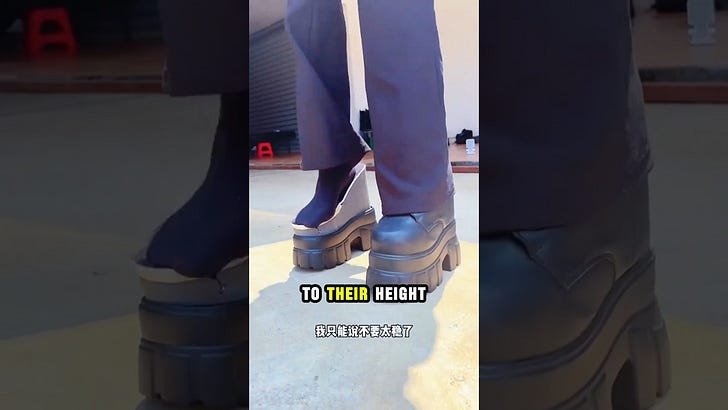
* Like pro leg lengthening surgery
* Men still totally do this:
* //
* Impracticality as Status: As the trend moved from the battlefield to the ballroom, heels became higher and thinner. This was intentional: a very high heel made it nearly impossible to walk on cobbles or work in fields, proving you were so rich you didn’t have to do either.
* The Red Heel: King Louis XIV of France took this to the extreme. He famously wore 4-inch heels and decreed that only nobility could wear heels colored with expensive red dye (talons rouges).
* Powdered wigs: The bi
You May Also Like

Am I the Jerk?
youtube.com/amithejerk

Con ánimo de lucro
esRadio

Estelle Midi
RMC

Madrid es noticia
esRadio
The Unmistakable Creative Podcast
Srinivas Rao

Money Making Conversations Master Class
Rushion McDonald
Podcasts | The Survival Podcast
The Survival Podcast
Woman's Hour
BBC Radio 4

綠豆搞Bean科
綠豆 Green Bean Media

How Men Think
iHeartPodcasts
Am I the Jerk?
youtube.com/amithejerk
Con ánimo de lucro
esRadio
Estelle Midi
RMC
Madrid es noticia
esRadio
The Unmistakable Creative Podcast
Srinivas Rao
Money Making Conversations Master Class
Rushion McDonald
Podcasts | The Survival Podcast
The Survival Podcast
Woman's Hour
BBC Radio 4
綠豆搞Bean科
綠豆 Green Bean Media
How Men Think
iHeartPodcasts
Community discussion