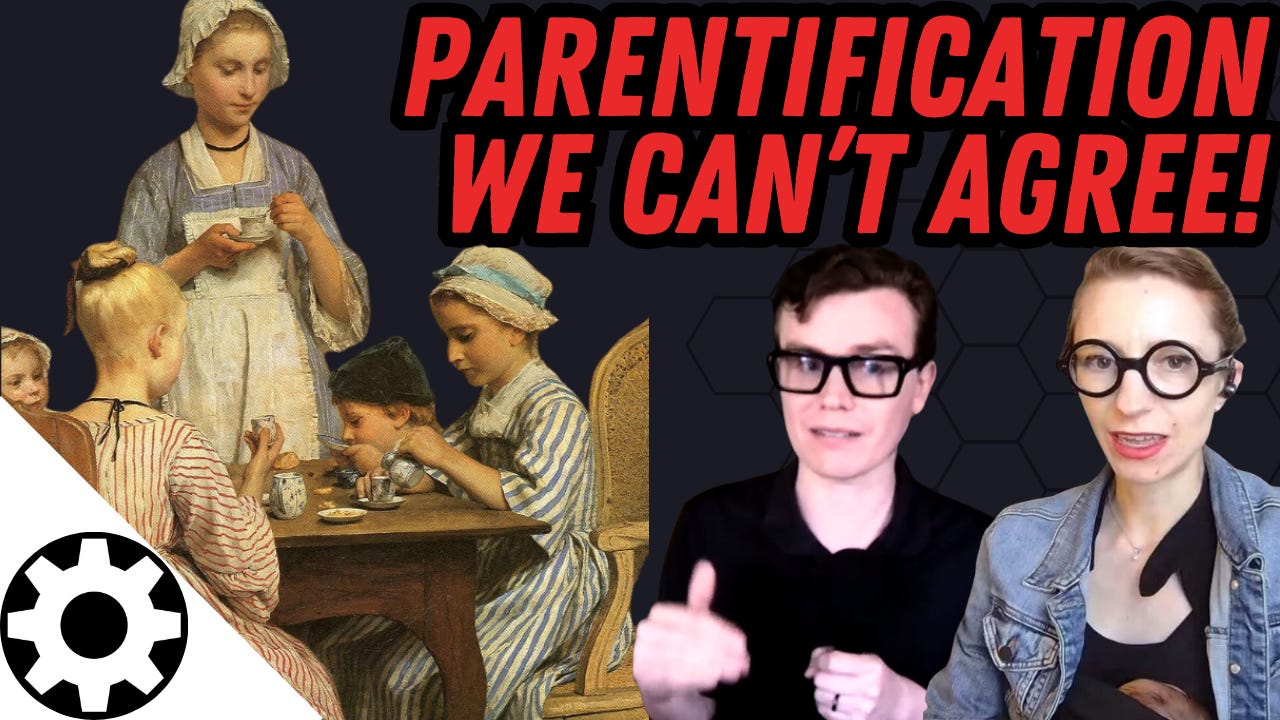
Parentification: Malcolm and Simone Debate How Much Responsibility Kids Should Have for Siblings
In this thought-provoking episode, Malcolm and Simone delve into the controversial topic of parentification, exploring its various definitions and implications for raising children in large families. They discuss how the concept is often misused by YouTube commenters and contrast it with the medical industry's understanding of emotional and instrumental parentification. Malcolm argues that historically, children taking on parental roles was seen as a moral responsibility and necessity for maintaining high fertility rates. Simone adds nuance to the discussion, highlighting the importance of consent, aptitude, and ensuring children's safety when assigning responsibilities. The couple also touches on the psychological benefits of giving children age-appropriate tasks and the dangers of creating a culture where kids believe they can shirk responsibilities they dislike. Join Malcolm and Simone as they navigate this complex issue and offer insights on fostering a sense of moral responsibility in children.
[00:00:00]
Malcolm Collins: Hello, Simone. Hello, gorgeous husband. Today, we are going to do an episode on the topic of parentification. , so what I've learned, cause I wanted to do some more research on this before going live with this episode. Is like the actual definition of parentification is not the way it is used by YouTube commenters.
Oh. And so we'll be talking about parentification as three different concepts throughout this show. So first is the way that it is most often used because where I see this is when we're watching like Ultra progressive reaction videos to prenatalist families, IE video families with a lot of kids,
Industry Collins: or
Malcolm Collins: when we see fam kids who grew up in large environments with a lot of other kids, their complaint is parentification.
And when this is,
Simone Collins: we should say kids who grew up in large families who subsequently deconverted from that, their birth culture, essentially.
Malcolm Collins: Yeah. So they will say that they were forced to undertake the [00:01:00] role of the parent to In some of like in helping raise their siblings that they were in part responsible for raising their siblings.
This is the way it is used within pop culture.
Then within the medical industry or the way it was originally intended to be used is actually there is emotional parentification, which means that the parent relies on their child for emotional support that should be coming from their partner, i.
e. they are treating their child more like a friend and less like a child. The other category of parentification here is , when a child feels the need to take on responsibility because their parent isn't fully responsible.
Industry Collins: Okay.
Malcolm Collins: Example here would be like their dad ran away, their mom's addicted to crack and they had to raise their sibling.
Simone Collins: Okay.
Malcolm Collins: This is very different than the way [00:02:00] YouTubers mean it, which is, I grew up in a family with seven kids, and I was responsible for sometimes watching after my siblings, or feeding my siblings, or, etc.
And it's a very important topic to dive into because so long as parentification as it is talked about within the YouTube community is something that is shamed, culturally we will never be able to get above replacement rate again. Because taking responsibility for one's family members historically was just seen as an obvious moral good and responsibility of every individual, right?
You cannot raise a large family. Especially in a historic context without the children taking on some of the parental roles. And to understand what I mean when I say this, in the 1800s in the United States, your average American had seven [00:03:00] kids. Average. So that means for every American who didn't get married or had zero kids, there was another American having over 14 kids.
Okay? That means for every American who had four kids, The measly, tiny number of four kids, oh shame to that barren spinstress, which we only recently got to a few days ago That meant that there was another family that was having 10 kids.
These were families, the average American family, where the kids were relied upon in part to help with child rearing. And we should note how much this was stalled in a cultural context. So I read the diary from one of my ancestors in a previous episode. It's the episode titled something like kids used to like their parents.
And it was, it's a great episode, by the [00:04:00] way, I strongly suggest you check it out. It's one of those episodes where it ended up getting rev shared and I was like, I don't even care. Too good. But great episode. But this previous episode in the diaries, something that was very interesting, is it was seen as totally normal and admirable for the older siblings in a family.
To give up their potentiality in life to expand the potentiality of the younger siblings. So in this family, what happened is the, you could go work in the local lumber mill and make good money, but you didn't have any chance of upward social mobility. So the older siblings in the family the two oldest brothers went to work in the lumber mill and then use the money that they made in the lumber bill to make sure that their younger siblings could get a good education.
And today, this would be seen of as horrifying. How could that happen? In the frontier times, it's not like the parents had any money. They were barely scraping by as They had a in the [00:05:00] story, they had some pigs, and they had a spin wheel for making dresses. And that was it.
Like a one room house and an outhouse. That was what they owned, right? You didn't have anything else. And I think that in a historic context, we just forget that because we compare ourselves only to our parents generation, how hard things were, we also need to talk about the psychological benefits of parentification.
But before we do that, Simone, I'd love it if you had any thoughts on what I've gone over so far.
Simone Collins: Yeah. You're basically just saying this is a practical reality in a high fertility culture, which I think is a really important foundation for this. Because most people, when they're looking at parenatalism going forward, would never think parentification would or could be a part of that.
And a lot of their priors are based on, okay how do we raise a kid the way that we raise kids now, which is unsustainable, inherently. There has to be parentification.
Malcolm Collins: Yeah. It's interesting. We have a friend who's [00:06:00] from a very high fertility Mormon family and who has deconverted and who's actually incredibly successful.
It's remarkable to me that she has any complaints about her child. I always am like people are like we're your parents. Good. And I go, I don't know, I'm successful and happy with my life. So they must've been they're like what about all the horrible things? I was like it turns out that those must've been in my best interest.
Or, I judge the quality of a parent, not by a child's self description of them, but by how well the child did as an adult. I'm like then your childhood clearly provided you with some utility. Which is, I'm very much a functionalist. People always make fun of us for that.
But. She complained. She's look at my family had a, I had eight siblings and I was the oldest and I always ended up having to take care of them. And it really robbed me of my childhood. And I was like, okay, so which of your siblings would you prefer not to? And she's that's like apple and oranges and it's no it's not the you not getting to do whatever you want
You May Also Like

The Latest with Loren LoRosa
The Black Effect Podcast Network and iHeartPodcasts

Daily Inspiration: The Steve Harvey Morning Show
Peter Mutua

RADIO KULTURAEUROPA
RADIO KULTURAEUROPA

How Men Think
iHeartPodcasts

During the Break with Clint Powell
Clint Powell

Keeping It Real: Conversations with Jillian Michaels
Jillian Michaels

Coach Corey Wayne
Coach Corey Wayne

CAMINANDO POR EL MEDIO
Radio Trend Topic

Am I the Jerk?
youtube.com/amithejerk

Es Noticia
esRadio
The Latest with Loren LoRosa
The Black Effect Podcast Network and iHeartPodcasts
Daily Inspiration: The Steve Harvey Morning Show
Peter Mutua
RADIO KULTURAEUROPA
RADIO KULTURAEUROPA
How Men Think
iHeartPodcasts
During the Break with Clint Powell
Clint Powell
Keeping It Real: Conversations with Jillian Michaels
Jillian Michaels
Coach Corey Wayne
Coach Corey Wayne
CAMINANDO POR EL MEDIO
Radio Trend Topic
Am I the Jerk?
youtube.com/amithejerk
Es Noticia
esRadio
Community discussion