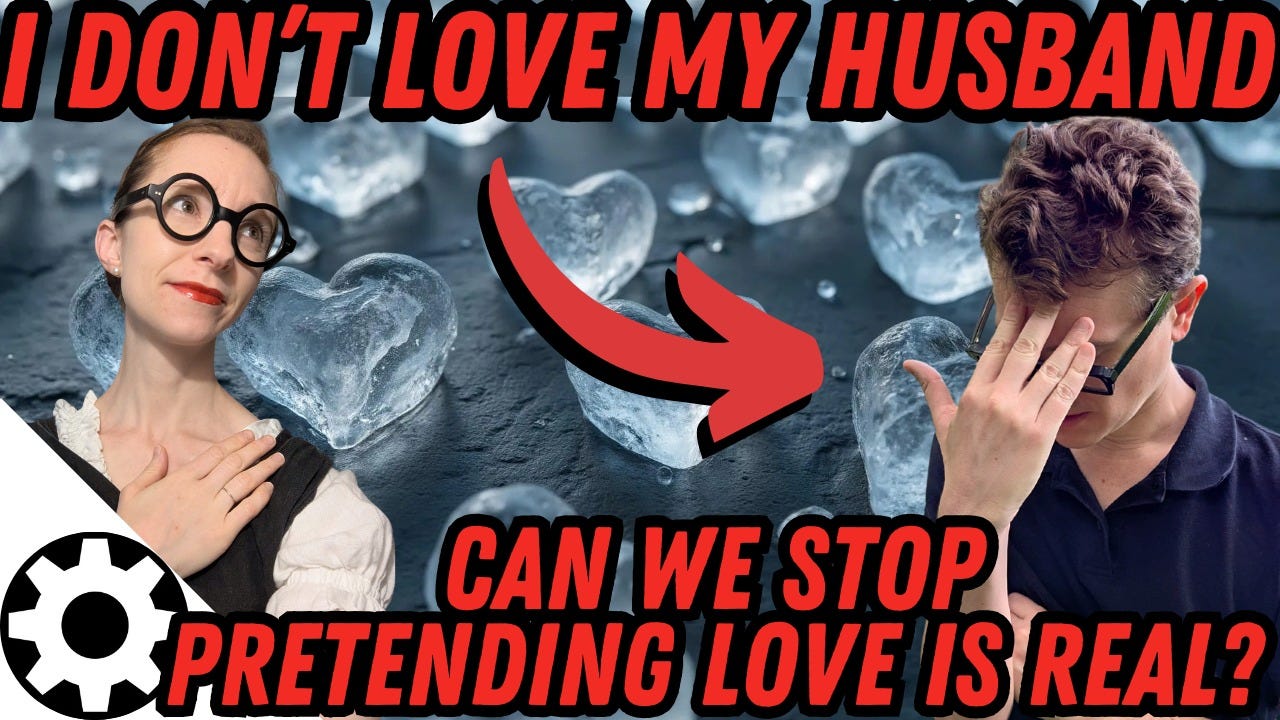
Love Is Not A Real Emotion (Inside Our Loveless Marriage)
In this episode, we delve deep into the concept of love, challenging the traditional and culturally popularized ideas surrounding romantic love. We argue that what is often labeled as 'love' is actually a bundle of separate emotions such as admiration, attachment, arousal, and fondness, and not a single profound, unique emotion. By exploring various scientific, genetic, historical, and cross-cultural perspectives, we aim to demystify and deconstruct the concept of love. We discuss the biological markers and chemical reactions associated with love, the societal constructs that influence our understanding of it, and how different cultures historically viewed relationships and love. Join us as we debunk long-held beliefs and provide a fresh, rational take on love and marriage.
[00:00:00]
Malcolm Collins: Hello, I'm excited to be here with you today. If you read this title and you're familiar with the way we do title cards, you probably think that this is some sort of bait and switch.
It is not a bait and switch.
Simone Collins: No.
Malcolm Collins: This is, this is with the, the, the core point I'm gonna be arguing in this episode. Is that some groups may feel love, but I suspect for the vast majority of humans at, at least given myself and with my wife, you know, I, I came to her the other day and I was like, I wasn't sure if you were gonna be mad at me.
'cause I, we always end this show. I was like, I love you and everything like that. And I was like, Simone, I'm gonna be honest. I don't feel some separate distinct emotion that I can categorize as love like, and, and I think that what's really cool is if love is a myth. Yeah. Most people don't feel that they can say that.
They can go out and say, Hey, this is a myth. Yeah. 'cause either they're not in a deep, you know, satisfying relationship. Mm-hmm. So they're in this position where people will just be like, oh, well you haven't found love yet.
Mm-hmm.
Right. Or they are in [00:01:00] a deep, satisfying relationship and people will say.
Wait, does that mean that you don't really care about your wife? Does that mean you don't, you know, it, it disconfirms being the person, the whistleblower on love to, to beat all these people. Like, Hey, I'm not sure this is a real thing and we're gonna be going through the receipts on it. Yeah. Is quite a costly thing to do unless you're in an incredibly secure position with your relationship.
And so people know us, they know that. I literally have no negative thoughts about my wife anymore. Like there are times in a relationship where like, I had like minor beast with you about this or that. I drive you a
Simone Collins: little nuts on some fronts. I don't
Malcolm Collins: even have minor beasts. The, the, the primary emotion that I feel towards you, like if I was going to categorize the primary emotions that I feel towards you is admiration.
And a sense of debt for everything that you've invested in our family and aligned future.
Simone Collins: Oh, same dude.
Malcolm Collins: And I have other feelings. I have a [00:02:00] feeling of attachment. I have a feeling of fondness. I have a feeling of sadness when you're not around or like a desire to be with you again. That's sort of like an addiction.
I have arousal from you. I think that you're a very attractive woman. But dude, I can name all of those things. Yeah. These are all separate and
Simone Collins: distinct things
Malcolm Collins: and, and, and I don't feel something other than these things that have a very commonly known name. And so I think that me coming out here and saying this is saying something that is sort of like.
And I, I will note, I do think that quote unquote love is a real thing. But what I mean by that is I think that what we are calling love is a bundle of other emotions that have easily nameable names. Yeah. It's either new relationship energy is often mistaken for love when you're starting to date.
For people who don't know, this is common in like the polyamory community. Mm-hmm. In it sets. Special feeling you get when you're dating someone you're excited about. Yeah. That [00:03:00] dies down your chest
Simone Collins: in your belly. The tingly.
Malcolm Collins: Yes, the tingly. But, but new relationship energy is obviously not love.
Simone Collins: No.
Malcolm Collins: People call it love early when, when somebody says like, do you love me or do you not love me? They're typically asking like, how much new relationship energy do you have for me?
Simone Collins: Yeah.
Malcolm Collins: The second thing that has often caused a love, and this is in relation to children, right? Is and by the way, when I say like.
This is what people are calling love, like this bundle of emotions. This is why when I tell my wife I love her at the end of every episode, I'm not lying to her. I am, I am telling her I have this emotional set that other people are calling love. But with children, I think what is often called love is a bundle of emotions, but predominantly the emotion.
The psychologists call attachment. And in psychology especially child development attachment is treated as a unique emotional state. A child does not just like their caregiver, they feel a deep existential distress when separated, insecurity when near except for our kids. And that defines attachment distress when separated.
[00:04:00] Security went near. But that's not love that nobody would say, oh, but it means our children
Simone Collins: don't love us, Malcolm, I swear to you.
Malcolm Collins: No, no. I, I mean, I don't think they do.
But I think a lot of people, they may hear this. And they'll think this is really a semantic argument, right? You're being like, well, you have these emotional states, but they're not. And I'm like, actually, not only is it not a semantic argument, it's a very big deal that this misconception has had.
And it's a very big deal because a lot of people, like if you look in at the, the sort of normal western relationship development, there is the moment when the partner says, I love you. Right? And so somebody could be like, well, you know. You're saying that, you know, loveness loving is really just , a word that means fondness and attachment and arousal maybe, right?
Mm-hmm. And it's like, well, if that is actually what everyone else means when they're saying the word love, then why do we have this ritual in relationships where people who otherwise like each other in all other formats like two [00:05:00] people will be dating for a long time, like years sometimes, and one of them won't say, I love you to the other one.
And it's supposed to be this like big step in the relationship when they say, I love you to them.
Simone Collins: Yeah. And the other partner says.
Malcolm Collins: Thanks. Yeah. Or, or I love you too, or whatever, right? But, but suppose they say this and, and what love really means in our society is just fondness, arousal, and attachment.
Right. And maybe respect in, in most of the instances in which I've seen, a person doesn't say, I love you in a relationship, and it's like a big deal within our media or something like that. They have all of those emotions.
So clearly it's explicitly sort of demonstrated to people that this word means something in addition to those things. Well, and I think it causes
Simone Collins: conflict. Like I think one of the reasons why people don't immediately say I love
You May Also Like

RADIO KULTURAEUROPA
RADIO KULTURAEUROPA

How Men Think
iHeartPodcasts

During the Break with Clint Powell
Clint Powell

CAMINANDO POR EL MEDIO
Radio Trend Topic

Am I the Jerk?
youtube.com/amithejerk

Es Noticia
esRadio

Con ánimo de lucro
esRadio

Estelle Midi
RMC

Madrid es noticia
esRadio

The Ranch Podcast
Matt Todd
RADIO KULTURAEUROPA
RADIO KULTURAEUROPA
How Men Think
iHeartPodcasts
During the Break with Clint Powell
Clint Powell
CAMINANDO POR EL MEDIO
Radio Trend Topic
Am I the Jerk?
youtube.com/amithejerk
Es Noticia
esRadio
Con ánimo de lucro
esRadio
Estelle Midi
RMC
Madrid es noticia
esRadio
The Ranch Podcast
Matt Todd
Community discussion