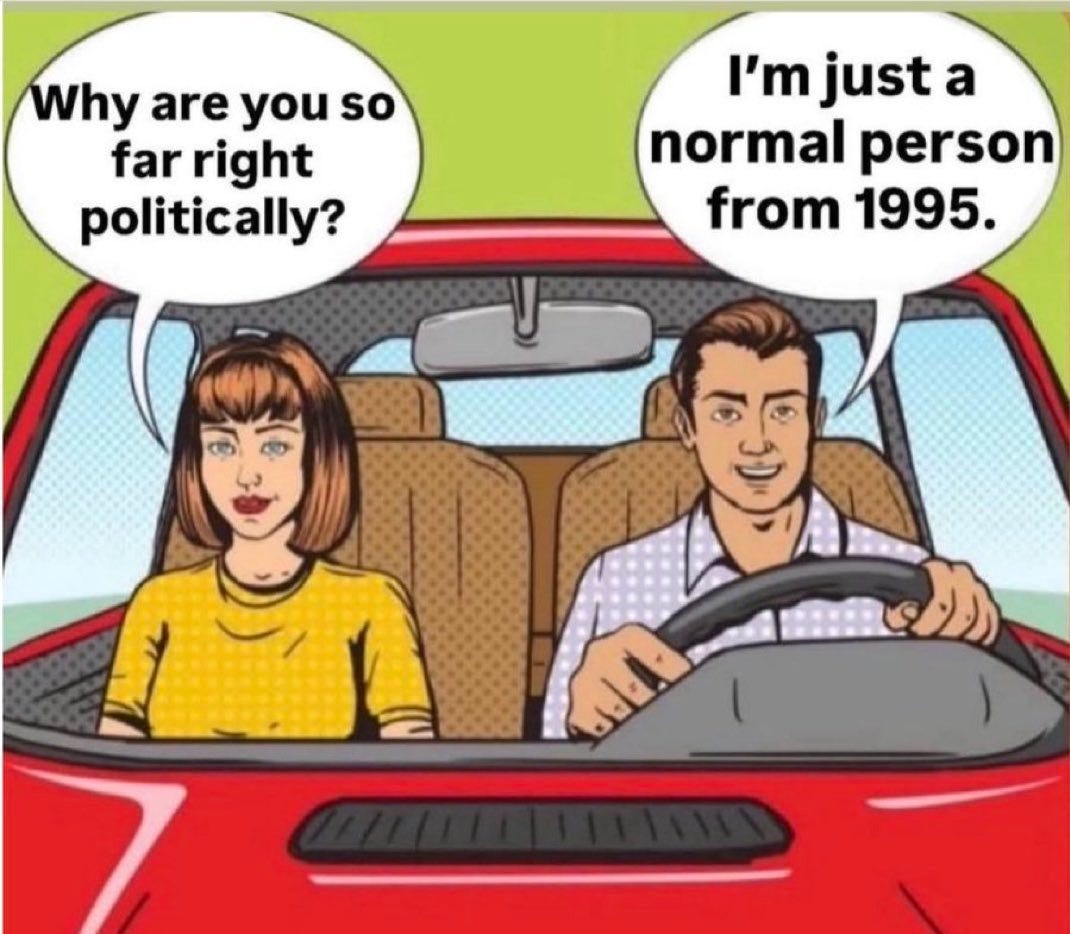
Is The Far Right Just Normal Men From the 90s? (The Stats)
In this episode of Based Camp, Simone and Malcolm Collins dive into the viral meme: “I’m just a normal person from 1995.” They explore how mainstream 1990s views — including those from Bill and Hillary Clinton on immigration, welfare reform, and borders — are now branded as “far-right extremism.”
Using data from Cremieux’s Substack analysis of the General Social Survey, Pew Research polarization graphs, and cultural shifts, they discuss the leftward drift on race, gender, sexuality, institutions, and more. They argue that what was once normal (family values, personal responsibility, evidence-based thinking) is now demonized, while the modern Right has become the side of data, science, realism, and genuine societal progress.
Topics include: the Overton window shift, trans issues and science, immigration realities, political tolerance, why many 1990s Democrats would be “MAGA” today, and the divorce between “progressivism” and actual improvement. Plus lighter moments on Hunter Biden, AI waifus, and mashed potatoes.
Show Notes
To set the scene, here are some quotes:
* From our xenophobic, far-right president, saying: “I want to talk with you about the problem of illegal immigration. It’s a problem our administration inherited, and it’s a very serious one. It costs the taxpayers of the United States a lot of money, and it’s unfair to Americans who are working every day to pay their own bills... Our immigration policy is focused in four areas: first, strengthening border control; second, protecting American jobs by enforcing laws against illegal immigrants at the workplace; third, deporting criminal and deportable aliens; fourth, giving assistance to States who need it and denying illegal aliens benefits for public services or welfare.”
* Or this from our capitalistic first lady, advocating for a “welfare reform plan that will dramatically change the nation’s welfare system into one that requires work in exchange for time-limited assistance.”
What do they all have in common? They come from left-leaning public figures in the 1990s.
The Rabbit Hole on X posted “Far right is often just a propaganda term for normal person” alongside a cartoon of a woman and man in a car, with the woman saying: “Why are you so far right politically” and the man saying “I’m just a normal person from 1995.”
Andy Hatfield posted another meme that reads: “Recognize the warning signs of a far-right extremist:
* Full time employment
* Literacy
* Loves his family and country
* Common sense
* Obeys the law”
Inspired by the meme, Cremieux wrote A Normal Person 30 Years Ago A normal guy in 1995 probably believes a lot of things that are unacceptable now on Substack and his post about it—plus the resulting discourse—became a trending topic du jour on X.
Cremieux’s Observations
In his Substack article, Cremieux broke from the sentiment-based memes and looked at the data.
“I opened up the General Social Survey and had a look around. To get started, I defined a few sets of political views: Institutional Confidence, Criminal Justice & Guns, Political Tolerance, Economic/Pro-Government, Racial Liberalism/Civil Rights, Gender-Role Egalitarianism, and Sexual & Moral Liberalism, and then I outlined a set of important social views.”
The data shows that:
* “People have become less confident in America’s institutions over time.”
* “When it comes to criminal justice and firearms, more people think courts are too harsh on criminals, more people oppose the death penalty, and fewer people think we ought to requires permits to buy guns. The last of these didn’t change that much.”
* “Political tolerance has somewhat increased since the 1970s, but it’s somewhat down since the 1990s. This general trend masks something interesting: more acceptance of gays and atheists, less acceptance of racists and militarists.”
* “Movement on economically left-wing views has been generally pretty flat, which is roughly what we also see for economically right-wing views.”
* “When it comes to racial liberalism, people have shifted far to the left. People have become more likely to ascribe Black-White gaps to discrimination and less to a lack of effort, among other things.”
* “When it comes to gender roles, egalitarianism has greatly increased.”
* Diana Fleischman recently made an interesting observation on that front vis a vis male postpartum depression
* “Finally, when it comes to sexual and moral liberalism, views on sex education, divorce, marijuana legality, and so on have, in some cases, quite radically shifted towards left-ward positions. Abortion legality for serious defects is the only exception among the bunch.”
He concludes that “the nation has moved considerably, but not overwhelmingly, to the left.”
His editorialization is thoughtful: “What can we say about the normal person from 1995? In many ways, he was much like us. In other ways, he was what most people would now regard as kind of a dick. He didn’t like interracial marriage and he wasn’t too keen on gays either. These social views aren’t alone: plenty of things now considered taboo were, at the time, wholly acceptable, even in polite society, and sometimes these were the majority view.
Right or wrong, I don’t think appealing to normal people in the world 30 years ago is likely to make many friends after realizing the sorts of things people used to believe.”
I largely agree but also think he is not extrapolating sufficiently from the data. “Let a racist speak” has gone down in the General Social Survey, but also the definition of “racist” has changed significantly, from something that is, we would argue, blatantly racist, to someone who, for example, believes genes dictate skin color and other traits.
In short, I think he was looking at the wrong thing to measure change.
Additional Observations Shared on X
NC Phycicist observed that “Pew Research illustrates this nicely. What the left calls the “far right” is just the left moving further left.” sharing a pretty illustrative graph showing diverging median democrats and median republicans in 1994 vs 2017:
HF responded that: “Society always changes and moves on. By definition, a progressive (someone on the left) is either ahead of, or keeping up with those changes. A conservative (someone on the right) wants things to stay the same and not change.
Society always changes and moves on. By definition, a progressive (someone on the left) is either ahead of, or keeping up with those changes. A conservative (someone on the right) wants things to stay the same and not change.”
But Charles Pontificates pointed out that “It’s mostly leftists who want deindustrialization and the stagnation of energy production, and that’s hardly progress.” sharing a graph of electricity and income per capita that makes it clear there’s no such thing as a low-energy rich c
You May Also Like

Estelle Midi
RMC

Madrid es noticia
esRadio

The Unmistakable Creative Podcast
Srinivas Rao

Money Making Conversations Master Class
Rushion McDonald
Podcasts | The Survival Podcast
The Survival Podcast
Woman's Hour
BBC Radio 4

綠豆搞Bean科
綠豆 Green Bean Media

How Men Think
iHeartPodcasts

Stuff They Don't Want You To Know
iHeartPodcasts

Rogue Energy
iHeartPodcasts
Estelle Midi
RMC
Madrid es noticia
esRadio
The Unmistakable Creative Podcast
Srinivas Rao
Money Making Conversations Master Class
Rushion McDonald
Podcasts | The Survival Podcast
The Survival Podcast
Woman's Hour
BBC Radio 4
綠豆搞Bean科
綠豆 Green Bean Media
How Men Think
iHeartPodcasts
Stuff They Don't Want You To Know
iHeartPodcasts
Rogue Energy
iHeartPodcasts
Community discussion