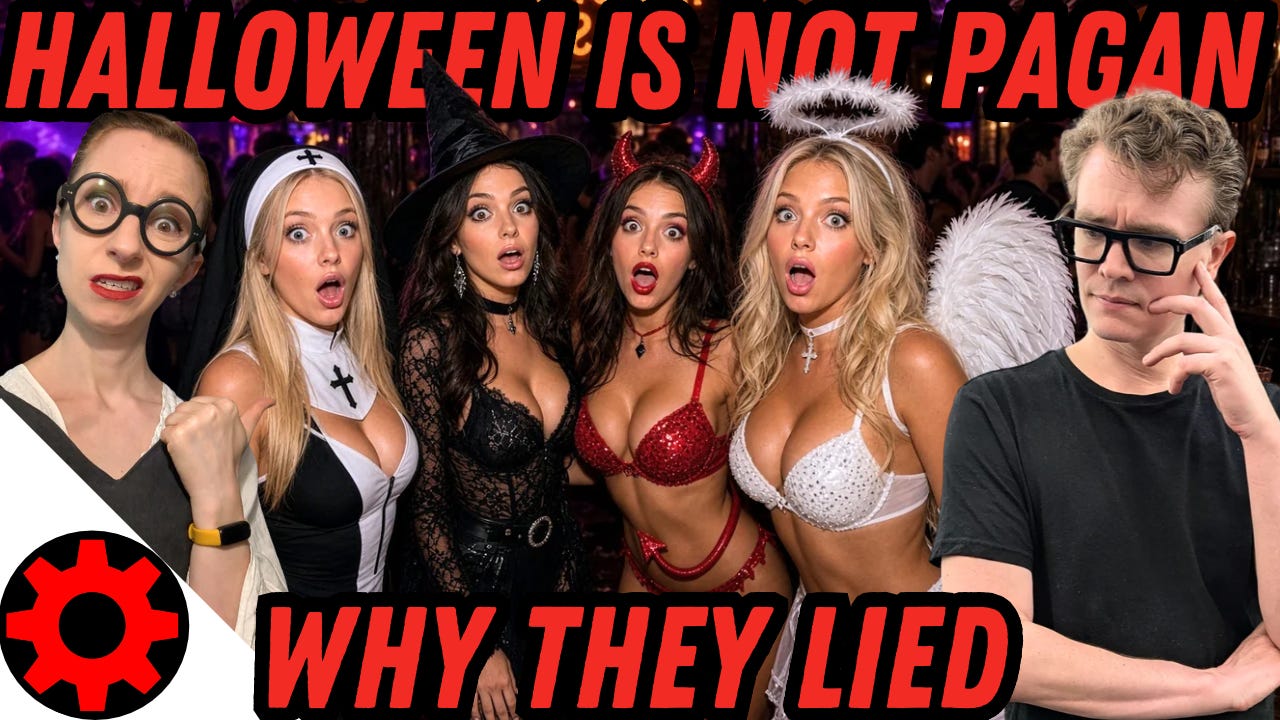
Halloween & The Colonization of Christian Holidays
We examine the origins of Halloween traditions and show that none trace back to pagan practices. From trick-or-treating evolving out of pre-holiday door-to-door visits and caroling-style customs, to jack-o’-lanterns starting as practical turnip lanterns, every element developed within Christian communities.
The video covers the history of All Saints Day, the role of Scottish and Irish folk customs, the commercialization through postcards and party goods in the early 1900s, and why modern associations with ghosts and the occult appeared centuries later. It also addresses common claims about Samhain and explains how the date and practices remained distinct from any earlier pagan observances.
Episode Transcript
Simone Collins:Hello,
Malcolm Collins:Simone. I’m excited to be here with you today. Today, we are going to be busting the myth that the modern practice of Halloween has any meaningful pagan roots at all.
Simone Collins:But I don’t know the the the pumpkins and the gourds and the lights and the the... You gotta scare away that?
Malcolm Collins:Nothing traces back to anything pagan, and we will go through each thing with receipts. And it is going to shock, I think, a lot of people who have bought into this myth because it is a persistent myth, and it feels cool. Like, oh, I bet the pagans did something around that time,
Speaker 4:My life has been a lie. God is dead. The government’s lame. Thanksgiving is about killing Indians. Jesus wasn’t born on Christmas. They moved the date. It was a pagan holiday.
Simone Collins:and they’re in like, don’t Christian families say, well, we don’t celebrate Halloween because that’s a demonic holiday, etcetera.
Malcolm Collins:They also say that about Christmas, and they say that about a a lot of things. So, it’s actually really fascinating as you get into it, where the various Halloween traditions come from. so for example, can you guess, the practice of trick or treating Is actually an evolution of another practice that was just something you did before any holiday, and there is another
Simone Collins:evolution of
Malcolm Collins:What? Okay. And what what was it? Describe it.
Simone Collins:You, you get kinda drunk and you go from house to house and you ask for more, like, food and drink.
Malcolm Collins:Okay. So you’re familiar with it. Yeah. So what would... Did there... The, the the practice that today we know is trick or treating is actually the exact same practice that we today know as caroling just evolved in two different directions, both practiced before two important Christian holidays.
Simone Collins:Oh. Just, like, raid people’s house. It it just seems it seems like a very disturbing thing to have happened. Like, oh gosh.
Malcolm Collins:They’re gonna So so what Simone’s... Oh, well, specifically, the iteration that you’re familiar with, the more aggressive one, is not a general British tradition. It came from the the... You can guess who, the backwards people, the lower Scottish reavers. In in in the in the normal version of this tradition, what you would do is before All Hallows’ Eve or All Saints Day, you would go door to door, and you would say, if you give me a treat, I will pray for your dead people. Oh. Right. I’ll I’ll pray for dead people in your family. A very Christian tradition, by the way. This is like a a thoroughly Christian tradition. But then the the backwards people who ended up becoming one of the dominant cultural groups in The United States that now form the the core of what we call Americana, they had a separate tradition where they would go and basically come to your house and be like, give us something or we’ll f up your property. And you see this captured in the, even even some traditional carols. Like, give us some figgy pudding. We won’t go until we get some.
Simone Collins:Yeah.
Malcolm Collins:so bring it right here. It’s it’s quite a forceful song if you if you listen to the lyrics.
Simone Collins:Yeah. Yeah. It’s basically, yeah, give us, food and drink or you’re gonna regret it.
Malcolm Collins:Yeah. Give us food and drink or you’re gonna regret it, which is exactly what the initial version of what we today think of as trick or treating was. and the other the other fun part of it is its association with ghosts and goblins and everything like that. That was created from the nineteen hundreds to, like, nineteen twenties primarily by, holiday card companies. And so you’d say, well, how did... Wait. Why were holiday card companies... Why did they associate those things with the holiday in the first place? Yeah. and there were two reasons. reason number one is... So if we look at the early Christian iteration of this holiday, you can see because it doesn’t begin to look more and more like a ghost and ghouls and go out and dress up day until very, very, very modern iterations of it. and and those iterations bear some resemblance to stuff that was practiced around this period, hundreds of years before the first Halloween was. The problem is is that the first Halloween didn’t include all of those elements that looked vaguely pagan. And because of that, you you can’t draw a connection between the pagan tradition and the first Halloween. But you could say, okay. Well, so how did it how did it get associated with the dead to begin with? Right. So it was originally a holiday for all saints. This is where it got the name All Saints Day.
Simone Collins:Wait. Hold on, though. No. You can’t have it both ways. You can’t be the Catholic church and say, okay. Let’s just celebrate all the saints on one... Like, present’s day, and then be like, but then we also need a holiday for all the best saints.
Malcolm Collins:Well... So it changed over time. But what is also have a president’s day. Come on. It was like the president’s day of saints because many saints didn’t have individual holidays.
Simone Collins:Oh, so it was for all the other... It’s all other saints.
Malcolm Collins:Well, including those saints. But then it evolved, and it became for all martyrs.
Simone Collins:And then Oh, is that where some of the spookiness comes in?
Malcolm Collins:For... No. It was for everyone who had martyred themselves on behalf of the church. Then much, much, much later, it became the holiday for all Christian dead people. Okay. Because they they basically... It was just sort of a cultural phenomenon that you can see. You sort of loosen it. Well, can we pray for this person to this day? Sure. Yeah. Why not?
Simone Collins:Have a blast.
Malcolm Collins:Looser and looser and looser and became a holiday for all dead people. and that’s where it got the death connection. But that death connection comes directly downstream of saints and then martyrs, which are very, very, very Christian ideas. Then you have the, well, then what about... What... Where did it get this occult connection? Where did it get this magic mysticism connection? This is actually one of its oldest traditions, still only dating to around the eighteen hundreds.
Simone Collins:What?
Malcolm Collins:But as a tradition, so long after anyone remembered anything pagan, it was actually, again, from the reavers or the Scottish people that this tradition was entered. And it was based around a number of ceremonies, I guess you could say, that people did as part of courtship rituals.
Simone Collins:Wai
You May Also Like

Estelle Midi
RMC

Madrid es noticia
esRadio
Money Making Conversations Master Class
Rushion McDonald
Podcasts | The Survival Podcast
The Survival Podcast
Woman's Hour
BBC Radio 4

綠豆搞Bean科
綠豆 Green Bean Media

How Men Think
iHeartPodcasts
Stuff They Don't Want You To Know
iHeartPodcasts

Rogue Energy
iHeartPodcasts
Aloula Radio
Aloula Radio
Estelle Midi
RMC
Madrid es noticia
esRadio
Money Making Conversations Master Class
Rushion McDonald
Podcasts | The Survival Podcast
The Survival Podcast
Woman's Hour
BBC Radio 4
綠豆搞Bean科
綠豆 Green Bean Media
How Men Think
iHeartPodcasts
Stuff They Don't Want You To Know
iHeartPodcasts
Rogue Energy
iHeartPodcasts
Aloula Radio
Aloula Radio
Community discussion