Could All Debt Actually Just Be Canceled?
Could a “debt jubilee” happen in the US? Malcolm and Simone dive deep into skyrocketing consumer debt, unsustainable government obligations (like Social Security insolvency by 2032-2034), and historical debt cancellations—from ancient Mesopotamia and Biblical jubilees to Japan’s post-WWII wealth confiscation and modern “Abenomics.”
They debate whether America’s record-high credit card debt, buy-now-pay-later defaults, and cultural attitudes toward money could trigger a crisis, hyperinflation, or forced wealth redistribution. Is bankruptcy already America’s soft debt jubilee? What should you invest in (or avoid) if things get weird in the 2030s?
Hilarious tangents include check fraud “hacks,” Caleb Hammer roasts, ramen lifehacks, and why Japan pulled off drastic reforms while Venezuela and Zimbabwe collapsed.
As Simone outlined this episode, the outline (and links) follows! The transcript is at the end of the post. Merry Christmas, you filthy animals!
Episode Outline
* US consumer debt levels are currently at record highs in 2025, both in nominal and inflation-adjusted terms
* Average credit card debt among cardholders with unpaid balances rose to about $7,321 in Q1 2025, up 5.8% from a year earlier
* People are using buy now pay later services like Klarna and Afterpay at record levels and increasingly paying late
* A LendingTree survey found that 41% of BNPL users made a late payment in 2025, up from 34% the prior year
* April 2025, 31% of federal student loan borrowers were 90+ days delinquent on payments,
* This comes at a time when…
* People are beginning to view debt payoff, the concept of capitalism, and even faith in fiat currency with increasing skepticism
* Loan defaults and late payments are on the rise
* democratic socialist political figures like Zohran Mamdani are gaining serious traction and public attention
* Even our governments are spending like someone with zero expectation of paying off their debt
* US social security likely to falter in 2032-2034
* The UK is set to experience a social security crisis in the early 2030s
* And this matters, because something’s gotta give, and in the past, this has involved various forms of debt jubilees
* So we’re going to discuss:
* The situation with consumer debt today
* The situation with government debt today
* How unsustainable debt has been dealt with historically
* How this could go poorly
* How this could go well and how we as individuals might prepare
Banks and Fractional Reserves
* The post:
* Oct 21 trending discussion: https://x.com/i/trending/1980520651816341983
US Consumer Debt
* Credit card balances hit another all-time high, reaching around $1.21 trillion in Q2 2025—matching last year’s record with annualized growth rates of over 9% in mid-2025.
* Credit card interest rates are commonly averaging 22–24% in 2025, compared to around 15% just a few years ago.
* Delinquency rates for credit cards and other non-housing debts have increased to levels well above pre-pandemic norms. In Q2 2025, about 4.4% of all debt was in some phase of delinquency.
* Klarna reported a 17% increase in consumer credit losses in Q1 2025, totaling $136 million, with repayment defaults rising among users.
* Student loan delinquencies are also rising, especially following the resumption of payments after long pandemic-era forbearance, adding further strain to household finances
* In March 2025, just 35% of federal student-loan borrowers had made their most recent payment on time. The rest were at risk of (or already in) serious delinquency or default.
It has actually been worse recently, though:
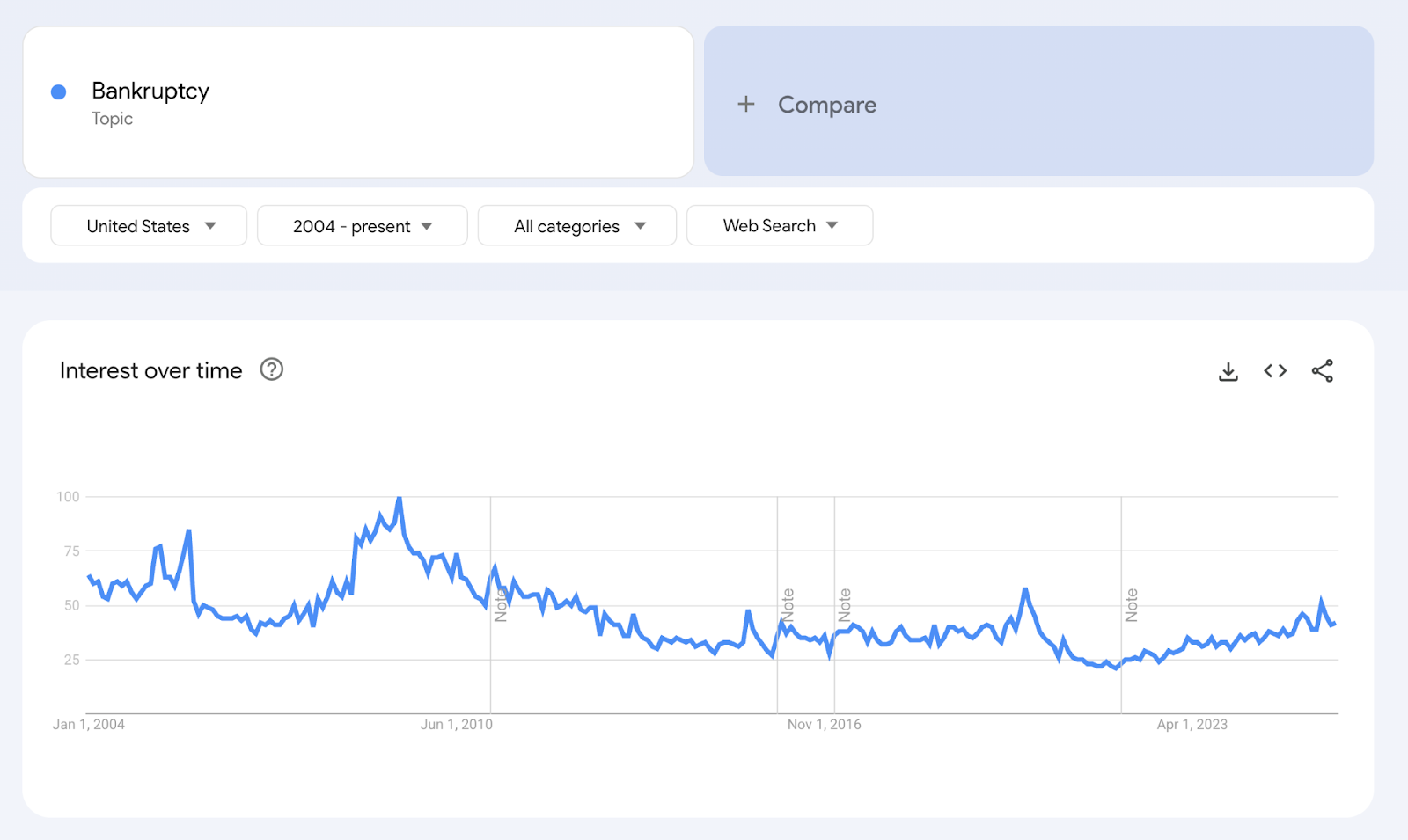
* US consumer (household) debt has reached nominal record highs in 2025, but when adjusted for economic growth (e.g., as a percentage of GDP), it remains below pre-2008 financial crisis peaks and has even declined slightly in recent quarters.
* This tracks with bankruptcy search trends (https://trends.google.com/trends/explore?date=all&geo=US&q=%2Fm%2F01hhz&hl=en)
* After adjusting for inflation, average household debt in 2025 is about 2.9% ($1,800) higher than in 2013 but 17.2% ($13,100) lower than the 2008 peak.
* Also, bankruptcy is pretty soft on people
* Basically bad credit for 10 years and non-essential assets can be frozen, but many don’t have much to lose in the face of that.
* What has me worried more is the mindset
* The surging skepticism around communism
* The employment threat of rising AI
* The increasingly absurdist interpretation of money and normalization of putting off money problems
* E.g. BNPL usage is surging, with monthly spending up 21% year-over-year to $243.90 per user in June 2025.
* 41% of users paid late in the past year (up from 34%), 24% faced late payments in 2025, and nearly 40% regret usage due to hidden costs.
The gist:
* Consumer debt is a problem
* Government debt is a bigger problem
Government Inability to Pay Obligations
Social Security Set to Falter
* The U.S. Social Security retirement trust fund is now projected to be insolvent by late 2032; if the disability fund is combined, around 2034. Benefits would be cut about 24% automatically if nothing is done
* UK state pension is pay-as-you-go and generally funded from current taxes, but there are major concerns about the sustainability of defined benefit (private and public) pension plans and the adequacy of future benefits. A liquidity and solvency crisis in 2022 exposed the vulnerability of the system, and ongoing warnings suggest potential crisis if reforms aren’t enacted as liabilities grow
* Other Western nations face sustainability crises from the 2030s, mostly driven by aging populations and shrinking worker/retiree ratios.
* Canada is currently better positioned due to earlier reforms, but is still monitoring demographic risks.
* All systems will require some combination of benefit reduction, tax increases, or later retirement ages to remain sustainable.
Historical Jubilees
TL:DR: Rules repeatedly cancelled debts (without consent from creditors) to end, evade, or calm rebellion, turmoil, class conflict, revolution, or societal breakdown.
Misc
* Ancient Mesopotamia: Kings of Sumer, Babylon, and neighboring regions periodically canceled debts for peasants and small landholders, often at the start of their reigns or during crises.
* Athens, Greece – Solon’s Seisachtheia “sigh-SAK-thee-uh” (594 BCE): Solon forgave personal debts, banned debt slavery, and wiped out mortgage debts in Athens.
* Initially controversial but eventually credited with preventing revolution and laying foundations for Athenian democracy. Credit eventually resumed as societal structures stabilized.
Medieval Japan
In medieval Japan, particularly during the Kamakura (1185–1333) and Muromachi (1336–1573) periods, the shogunate issued edicts known as tokusei (literally “virtuous government” or “benevolent rule”), which effectively functioned as debt jubilees. These were decrees that canceled debts, often in response to peasant uprisings (tokusei ikki) driven by famines, high taxes, epidemics, or exploitative lending practices. The concept dated back even earlier, with roots in the Nara and Heian periods (710–1185), but became prominent in the 13th–15th centuries.
* The most famous early example is the Einin Tokuseirei of 1297, issued by the Kamakura shogunate. It annulled all debts contracted before that year, allowed vassals (gokenin, or samu
You May Also Like

How Men Think
iHeartPodcasts

Am I the Jerk?
youtube.com/amithejerk

Con ánimo de lucro
esRadio

Estelle Midi
RMC

Madrid es noticia
esRadio

The Ranch Podcast
Matt Todd
The Unmistakable Creative Podcast
Srinivas Rao

Money Making Conversations Master Class
Rushion McDonald
Podcasts | The Survival Podcast
The Survival Podcast
Woman's Hour
BBC Radio 4
How Men Think
iHeartPodcasts
Am I the Jerk?
youtube.com/amithejerk
Con ánimo de lucro
esRadio
Estelle Midi
RMC
Madrid es noticia
esRadio
The Ranch Podcast
Matt Todd
The Unmistakable Creative Podcast
Srinivas Rao
Money Making Conversations Master Class
Rushion McDonald
Podcasts | The Survival Podcast
The Survival Podcast
Woman's Hour
BBC Radio 4
Community discussion