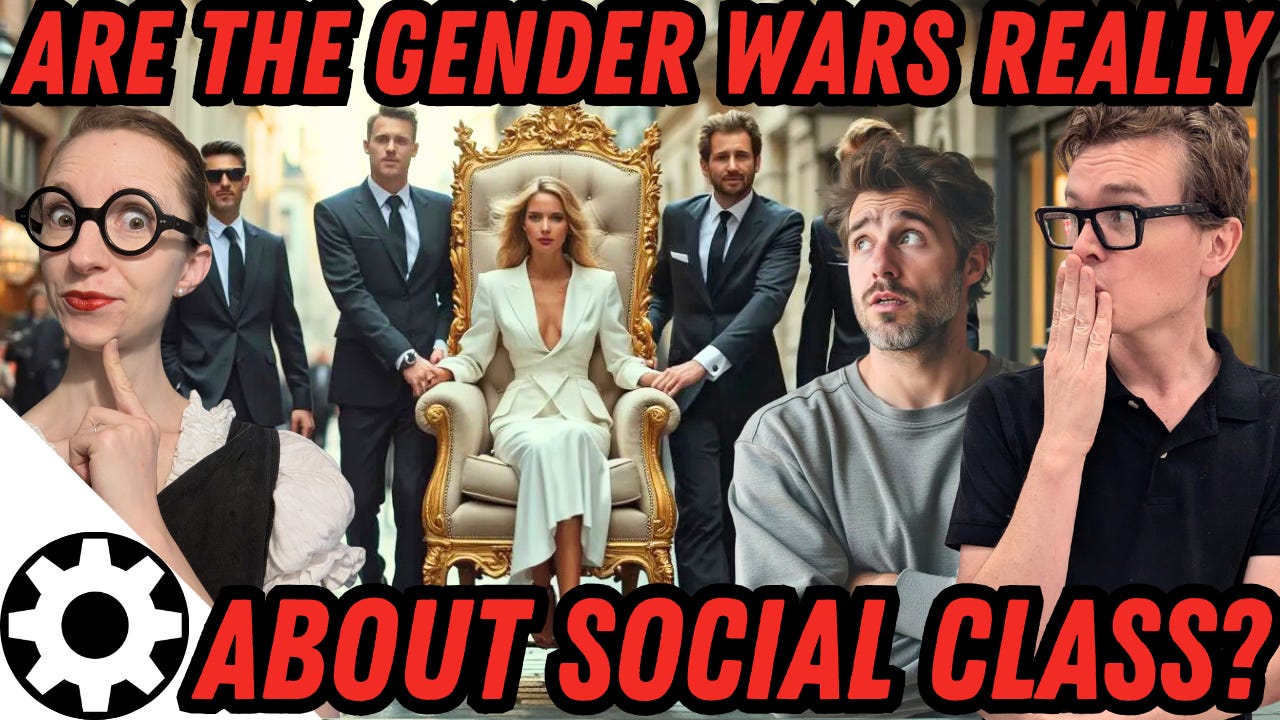
Are the Gender Wars Really About Class?
In this engaging discussion, Malcolm and Simone explore the intriguing theory that the so-called gender wars are essentially a front for class conflicts, specifically between upper middle-class women and lower middle-class men. The conversation is inspired by an argument from a Substack article and dives into how these conflicts might actually reflect deeper socioeconomic issues. They touch on various examples, such as racial and ethnic tensions, rural-urban divides, and generational conflicts, to argue that perceived cultural differences often mask underlying class grievances. They also discuss how different groups signal status in contemporary society and how these dynamics inform the current landscape of gender and class relations.
Simone Collins: [00:00:00] Hello, Malcolm. I'm so excited to be with you here today because we're going to talk about the gender wars, which we don't talk about nearly enough. We never talk about gender on this channel. No. Never men or women, but no,
Malcolm Collins: you heard it in a crazy theory. That really clicked for me in a lot of ways.
Yeah, yeah. I came across this
Simone Collins: argument. That gender wars are not really about gender, but rather about class differences and specifically between upper middle class women and lower middle class men. And this came from cartoons hate her on Substack who made this argument. And she largely implies that that basically gender wars participants aren't aware of this, but I'm gonna argue that they are.
And then I'm also gonna argue that it could very well be that all conflicts are class conflicts, and there are some really telling examples. And I think ultimately if we acknowledge. This class resource distribution issue is the underlying cause of. Most, if not possibly all intergroup conflicts.
Maybe we can navigate them more smartly, but like [00:01:00] Let's get into it. You ready?
Malcolm Collins: I'm actually gonna push back on one area here. Okay. Yeah. I'm gonna argue something else. Okay. Which is that what creates this class divide is that male communities. Will be drawn due to their sort of tribal, centralized nature to the class norms that are normative to the community broadly, whereas female communities are drawn to a class identity.
To the class identity that is shared by the most elites within the community.
Simone Collins: Hmm.
Malcolm Collins: And so even
Simone Collins: if, oh, come on. I mean, like the, the male influencers who set tones are, are more elite
Malcolm Collins: male influencers who set tones intentionally, code themselves as lower middle class. Oh God. You're right though. No,
Simone Collins: it's true.
Even though like the really wealthy ones come across as so trashy, it's so bad. Yes.
Malcolm Collins: Whereas the female elites code themselves as middle, upper class manhattanites.
Simone Collins: It's like old money versus new money gender edition [00:02:00]
Malcolm Collins: like Tim Pool or something. And like the way he dresses on his show or like, oh, or like
Simone Collins: Andrew Tate or like the guy who wakes up at four M and shoves his face in ice buckets of water.
They all give off a very new money aesthetic. Whereas literally. Like women are constantly, like right now a a sort of trending thing on Instagram and TikTok is sort of this old money summer aesthetic that like people like Hailey Bieber are, are pi like not pioneering, but popularizing. So it is, it is actually, that's really interesting that also when, when each class is trying to show off wealth, there is men go to new money and women go to old money right now, that's
Malcolm Collins: not what I said at all.
Simone Collins: Okay, well then I'm a separate, didn't money
Malcolm Collins: consider who is actually rising, was in the male spaces or who Wouldn when they were, so when Andrew Tate was rising in fame. Okay. He didn't go to new money coding. What he went to was traditional masculine things like boxing, kick fighting, stuff like that. If you [00:03:00] look at the male.
Influencers who have risen was in conservative spaces recently. You have individuals like Asma Gold who intentionally codes as lower middle class, even though he could very easily got a lot more money if he wanted to. Oh, that's
Simone Collins: interesting.
Malcolm Collins: Whereas or or considered bronzes age pervert very intentionally codes as lower middle class.
Even though he went to Yale, you are almost, almost a
Simone Collins: stoic aesthetic. They're like taking the Socrates approach.
Malcolm Collins: Bronze Age RA Nationalist does this with a lot of his stuff. He doesn't, you, you wouldn't have known. Yeah, yeah. No.
Simone Collins: His stuff's not about money at all. It's about like anything. A lot of these
Malcolm Collins: people too is alternate personas hide that they are not in real life lower middle class individuals.
Oh, that's
Simone Collins: true. Oh, that, oh, but also, yeah, there seems to be a correlation between like the, actually. Upper class men are pretending to be lower class than they are, but then like the, the men who actually come from more middling backgrounds, pretend. Act like new money that, that Well, and,
Malcolm Collins: and think about the [00:04:00] way that the men who are trying to gain social status today, who even have like all the wealth you could want are doing it.
So consider somebody like Elon, right? Like what does Elon do to try to raise his own social status when he has all the money you could ever have? He doesn't like dress in fancy clothes or anything like that. What he does is he posts. Controversial memes and he, he creates a fake account to try to make it look like he's playing a lot, a lot higher level in video games.
The spans of
Simone Collins: our time,
Malcolm Collins: hold on, that's a lower, he's making the wealthiest man on earth make sure a, a huge amount of effort and ended up with a huge amount of social egg on his face to make it look like he was good at a lower middle class hobby.
Simone Collins: That's a, that's a really, that's a really interesting point.
I wonder if they're just evolutionarily divergent, but equally valid approaches to [00:05:00] a kind of realization on behalf of the collective online male aid that they are in general lower middle class. And so either you can, as an a male influencer be like, money, money, money, money, money signaling. Like, I have tons of money.
Look at all my money or be like, Hmm, I mess it. I don't need money. I'm above money. I'm better than money. I live else. No, I'm, Amanda is
Malcolm Collins: gonna argue that what we're actually seeing here is a few things. Okay? It's the way that, that men build comradery and culture, okay? Is. Part of the reason why they have normalized to the lower middle class aesthetic.
Ooh. But the other reason is the influence of the MAGA movement and the MAGA movement. As I've noted in a number of my earlier episodes, low culture, a huge amount of cultural influence that comes downstream from the Appian or backwards cultural group, which is known as like the redneck or hillbilly group, and like popular parlance.
Yeah. Which specifically has always really shunned the, the trappings of the upper classes. Mm-hmm. And, and intentionally wo
You May Also Like

RADIO KULTURAEUROPA
RADIO KULTURAEUROPA

How Men Think
iHeartPodcasts

During the Break with Clint Powell
Clint Powell

CAMINANDO POR EL MEDIO
Radio Trend Topic

Am I the Jerk?
youtube.com/amithejerk

Es Noticia
esRadio

Con ánimo de lucro
esRadio

Estelle Midi
RMC

Madrid es noticia
esRadio

The Ranch Podcast
Matt Todd
RADIO KULTURAEUROPA
RADIO KULTURAEUROPA
How Men Think
iHeartPodcasts
During the Break with Clint Powell
Clint Powell
CAMINANDO POR EL MEDIO
Radio Trend Topic
Am I the Jerk?
youtube.com/amithejerk
Es Noticia
esRadio
Con ánimo de lucro
esRadio
Estelle Midi
RMC
Madrid es noticia
esRadio
The Ranch Podcast
Matt Todd
Community discussion