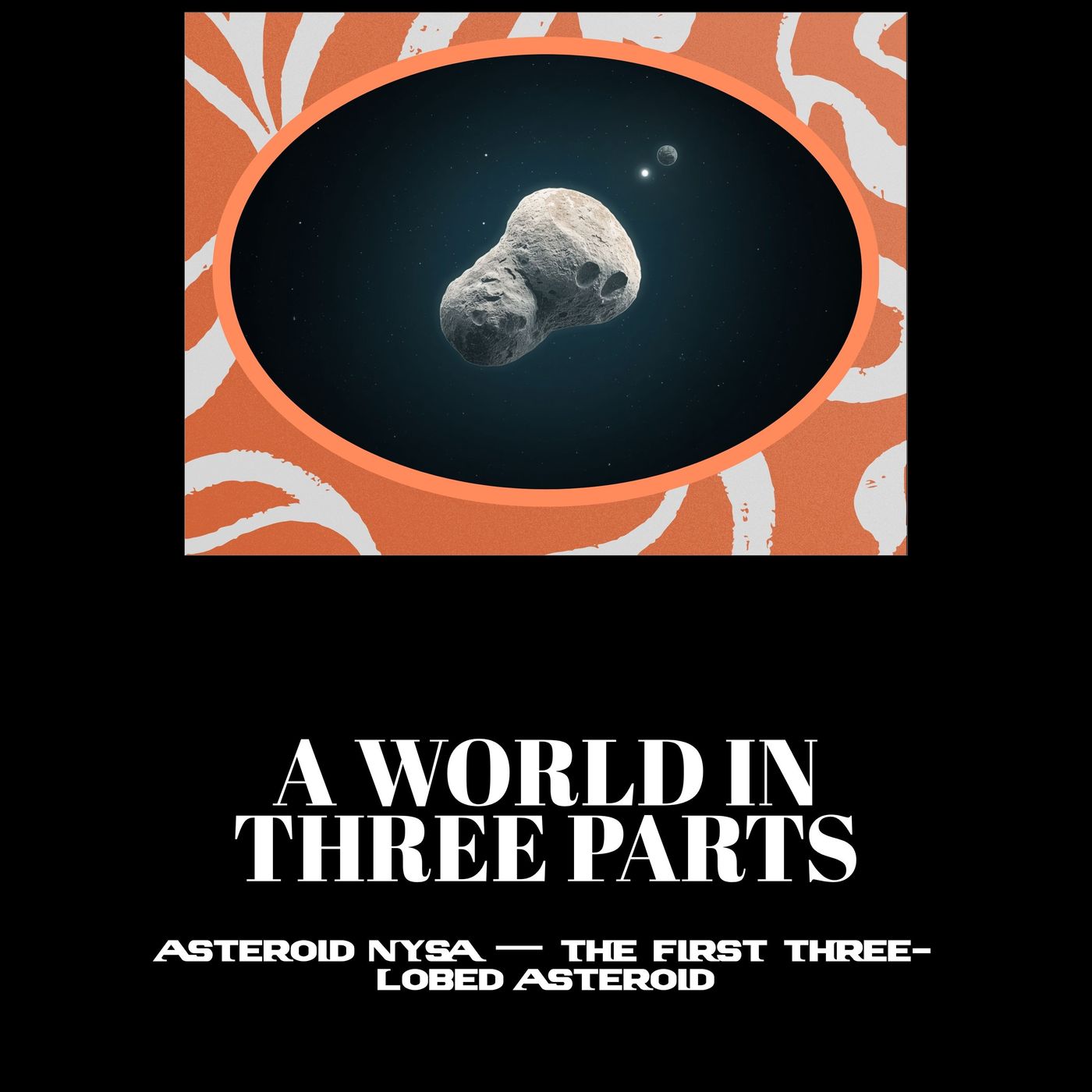
S05E155 · Friday 31 July 2026 · Astronomy Daily with Anna & Avery. Four stories and a both-hemispheres skywatch. Australian English. ① Asteroid (44) Nysa — the first three-lobed world, and its hidden moon ● trilobate body — three lobes joined by two narrow necks; a candidate “first” of its kind. ● A new ~1 km moon, S/2026 (44) 1, was found orbiting ≥170 km out — spotted using high-contrast imaging borrowed from exoplanet work, and confirmed moving across two observing runs. ● The moon lets astronomers weigh Nysa (mass → density), which should help decide between a genuine contact-trinary and a single, deeply indented body. ● Nysa is a bright, main-belt E-type (enstatite-rich) asteroid, ~75 km across, known since 1857. ● Source: Lowell Observatory / University of Arizona press release, 29 Jul 2026; study “Unmasking (44) Nysa: Evidence for a Trilobate Structure” (Minker et al.). Coverage: Space.com, Gizmodo, 29–30 Jul 2026. ② Mapping Alien Continents — a NASA concept to image an exoplanet’s surface ● NASA’s 2026 NIAC round funds 18 early-stage “visionary” concepts (~$175k each, 9 months). These are seed studies, not missions. ● Paul Stankus (Brookhaven) proposes “Mapping Alien Continents”: resolve the surface of an Earth-like exoplanet — continents, oceans — in visible light. ● Method: a novel “dynamic hierarchical nulling” interferometer to suppress starlight at 10¹⁰-to-1 contrast, then combine beams from two spacecraft ~100 km apart (optical VLBI-style imaging). ● Source: NASA “2026 Innovative Technology Concepts” release and NIAC selections (posted 21 Jul; consolidated release ~29 Jul 2026); Universe Today feature, 30 Jul 2026. ③ Solar-storm watch — CMEs inbound, minor-storm and aurora potential ● Two faint coronal mass ejections, plus coronal-hole solar wind, are set to give Earth glancing blows; forecasters flag possible G1 (minor) geomagnetic storms and auroras over the coming days. ● G1 means little grid impact but aurora visible at somewhat lower latitudes than usual — see the skywatch for where to look, both hemispheres. ● Source: NOAA SWPC (WSA-ENLIL model); EarthSky / The Sun Today, 30 Jul 2026. ④ ESCAPADE’s family portrait of Earth and the Moon ● NASA’s twin Mars orbiters (“Blue” and “Gold,” built by Rocket Lab) imaged Earth and the Moon as thin crescents in visible and thermal-infrared light from a loiter orbit near Sun–Earth L2. ● In infrared, Earth’s night side glows with its own heat; the Moon’s shadowed half is far colder — a calibration check before Mars. ● ESCAPADE’s science goal (arrival Sept 2027): measure how the solar wind strips Mars’s unshielded atmosphere — the payoff of today’s solar-wind thread. ● Source: NASA (Goddard) image feature, ~25 Jul 2026 (images captured 3 Jul); NAU / phys.org; Universe Today, 29 Jul 2026. Skywatch — both hemispheres ● Bright waning-gibbous Moon (post-Buck-Moon, 29 Jul) washes out faint targets. ● Southern Delta Aquariids + Alpha Capricornids just past peak (SH-favoured; Moon-hampered). Perseids build to a near-moonless peak on the night of 12–13 Aug — prime for North America, low in the north for the SH. ● 12 Aug total solar eclipse: totality across Greenland / Iceland / Spain; partial for parts of northern North America and Europe. ISO 12312-2 eye protection required for any partial phase. ● Pre-dawn planets low in the east (Sydney and North American framing). Aurora watch for high latitudes both hemispheres if the storms land. ● Diary: a spent Falcon 9 upper stage (2025-010D) is predicted to hit the Moon near Einstein Crater on 5 Aug 2026, ~06:35 UTC (~2:34 a.m. ET). North America best-timed; telescope needed, Moon ~56% lit, target the limb dust plume. From Sydney the Moon is down at impact — rely on LRO after-images. Callback to E125/E147. Source: Fernando et al., arXiv...