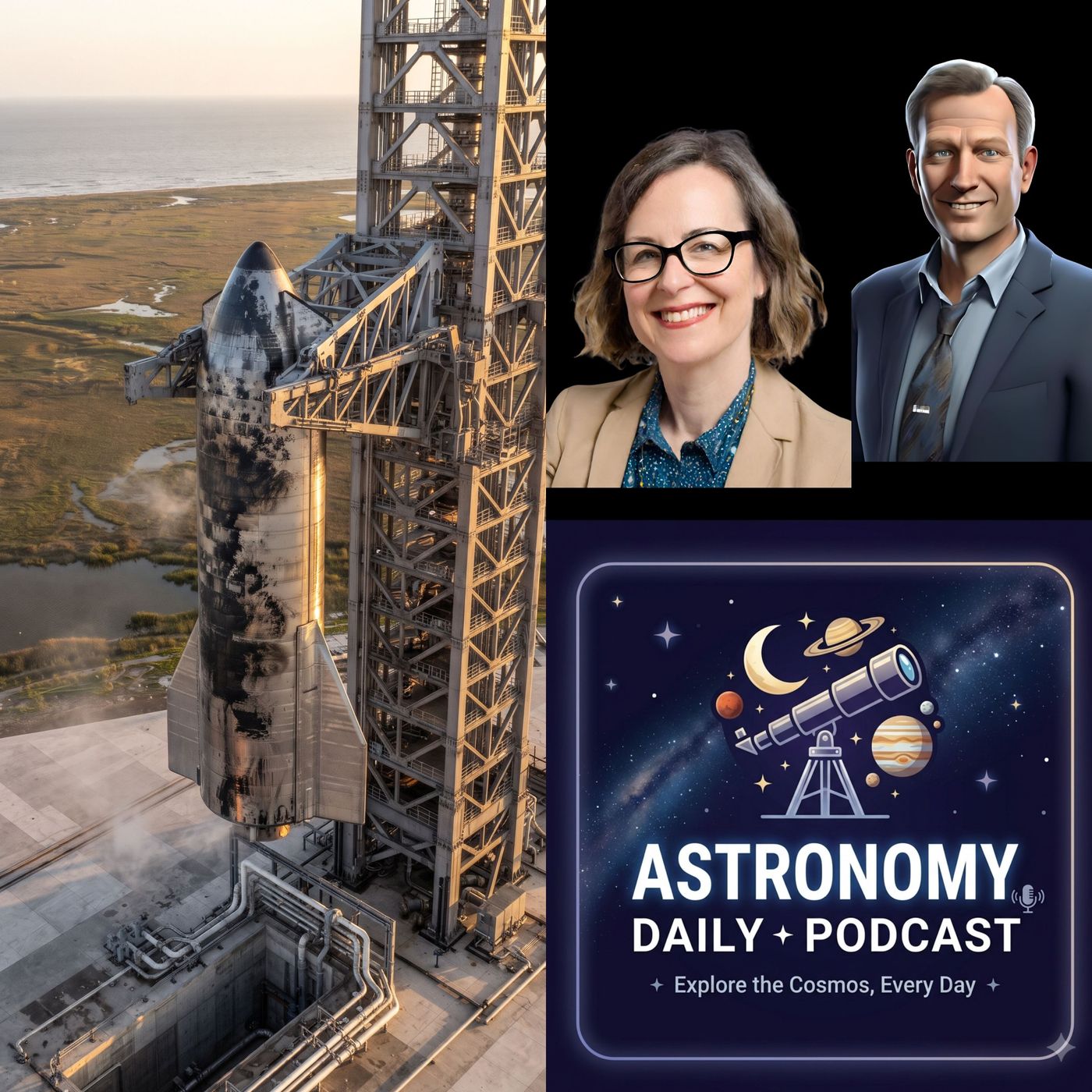
0:00 Anna: Hello, everybody, and welcome to another week of Astronomy AstroDailyPod. For the first time, a spacecraft has come back from orbit and been plucked out of the air by the tower it launched from. It happened on Sunday morning, Australian time. And today we have 0:15 the full story of Starship Flight 15, including the half of the plan that did not work. 0:21 Avery: Also today, four researchers in Perth have checked one of the most famous pictures in science. The black hole in M M87, and it holds up. A white dwarf has blown itself apart in a southern galaxy and it's still getting brighter. And gravitational 0:35 waves are hinting at a whole population of stars that died without exploding at all. 0:40 Anna: Plus Hera at its asteroids, Voyager, one Day From Home and the Leonids. 0:47 I'm Anna. 0:48 Avery: And I'm, um, Avery. This is Astronomy daily for Monday 16th November 2026. 0:54 Anna: When we recorded Saturday's weekend wrap, Starship Flight 15 was only half finished. The rocket had launched, the booster catch had been called off, the ship was in orbit, and the attempt to catch it was, as we said then, still to come. 1:10 So let's finish the story properly. 1:13 Avery: Start with the clock. Liftoff was at uh 4:47 on Friday afternoon, Texas time from Pad 2 at uh Starbase. That's 22.47 universal time on the 13th, or 947 on Saturday morning in Eastern Australia. 1:28 On the pad were Booster 22 and Ship 42. Both of them. The newer Block 3 design Anna: and the plan was the most ambitious SpaceX has ever flown. Catch the booster at the tower about seven minutes after launch, leave the ship in orbit for most of a day, then bring the 1:47 ship back over land and catch that too at the same pad. Nobody has ever recovered both stages of an orbital rocket this way. 1:56 Avery: The booster is where it went wrong and the explanation changed over the weekend. So this is worth telling carefully. According to SpaceX's own commentary, as reported by Space.com, all 33 Raptor engines fired on the way up. One dropped out after 2:10 the stages separated. So the boostback burn, the burn that turns the booster around and sends it home, ran on 32 Anna: and that burn ended early. The booster then worked out for itself that it was not going to be in the right place for a catch, 2:23 and it did what it is programmed to do. It diverted offshore, lit 13 engines for a landing burn, hovered above the Gulf and shut down. Its flight termination system fired, and it was destroyed just above the water about six and a half minutes after liftoff 2:41 Avery: on Friday night, SpaceX's Dan Huott said the abort came from a, uh, guidance navigation and control issue. On Saturday, the company corrected that Guidance was not the fault. 2:53 Guidance was a system that noticed a problem and protected the launch pad. 2:57 Anna: The current account from SpaceX's Kate Tice is that early indications point to a low fuel mass alarm that cut the boostback burn short. Why that alarm tripped is not yet known. SpaceX says it is still digging into the root cause and that is where the record stands today. 3:16 Avery: There are reports of a post from Elon Musk saying the booster was slightly low on fuel because the engines on the performed a little. We treat that as a comment rather than a finding, um, until the investigation says so. 3:28 Anna: Now the half that work. 3:30 JP42 reached an orbit roughly 275 kilometres up and by an hour and 17 minutes into the flight, it had released all 26 of its Starlink V3 satellites. 3:44 Avery: A few of those satellites carried cameras and their first job was to look back at the ship. 3:48 SpaceX said those views, together with tracking from the ground, showed the heat shield was in good shape for reentry. That inspection mattered because this ship was coming home over land. 3:59 Anna: It then circled the Earth 14 times. 4:02 About 20 hours and 40 minutes in, controllers reached the last decision. Bring it back to Texas or put it down in the ocean. Instead, they chose Texas. 4:14 Avery: The deorbit burn was tiny. One engine, 10 seconds at uh, 2023 Universal Time on Saturday, then reentry. 4:23 The belly first fall through the atmosphere, the flip to vertical above the tower and the arms closed around it at about 21:20 universal time. That's 3:20 in the afternoon at Starbase and 8:20 on Sunday morning in Sydney. 4:37 Anna: 22 hours and 33 minutes from liftoff to catch. 4:42 Avery: So how big is this? The first booster catch was Flight 5 back in October 2024. 4:48 But a booster comes back from the edge of space at a few thousand kilometres an hour. A ship comes back from orbit at more than seven kilometres a second through heating the booster never sees. Bringing that back to within arm's reach of a tower is a much 5:03 harder problem. And on Saturday it was solved. Once. 5:07 Anna: Once is the important word. The point of all this is a rocket where both halves fly again quickly. Flight 15 did not recover both halves and no caught ship has yet been inspected, refuelled and reflown. Those are the next tests and as we record, there is no date for Flight 5:26 16. 5:27 Avery: It also matters beyond SpaceX. As we reported in October, NASA's plan for Artemis 3 in 2027 has Orion docking with a starship in Earth orbit and the Moon landings after that depend on starships flying often enough to refuel each other. That only works 5:44 if the ships come back. 5:46 Anna: And an honest note from this side of the world, there is no Australian thread to this one. It's a Texas story. 5:55 What we can say is that the catch came at twenty past eight on a Sunday morning in Eastern Australia. A, uh, kinder hour for watching live than these flights usually give us. 6:07 Avery: Booster lost cause still open. 6:10 Chip caught for the first time ever will follow the investigation Anna: in April 2019, the event horizon Telescope released a picture almost everyone has now seen a lopsided orange ring around a dark centre. It was the black hole at the heart of the galaxy M UM87, about 6:28 55 million light years away. And it was the work of hundreds of scientists. 6:34 Avery: It also came with a quiet question attached. 6:37 The Event Horizon Telescope is a handful of radio dishes scattered across the planet, pretending to be one dish the size of the Earth that leaves enormous gaps in the data. 6:47 Filling those gaps takes software, and software means choices. So how much of the ring is the black hole and how much is the method? 6:55 Anna: A team of four from csiro, Australia's national science agency, has now answered that in the journal Nature, published last week. The lead author is Samuel Y. Working with Nithyanandan Thai Guarajan, Ivy Wong and Foivos Diakogenis, and their technique is called Gendire. 7:14 Avery: Two ideas make it work. The first is old. 7:18 Each telescope adds its own errors to the signal, mostly from the atmosphere above it. 7:22 But if you combine measurements around a closed triangle of three telescopes, those station errors cancel out. Radio astronomers have used that trick since the 1950s. The CSIRO team builds images from those error proof combinations alone. 7:36 Anna: The second idea is new. They trained a machine learning model to turn those combinations back into a picture, and they trained it on ordinary non astronomical images. It was never shown a black hole, as Dr. Lai put it. The model had no idea what a black hole looked like, 7:55 Avery: and when they pointed it at the original 2017 data, out came a ring almost identical in size and shape to the famous one. The Event Horizon Telescope's own director, Laurent Leunard, called it excellent agreement. 8:08 Anna: One caution and it's ours rather than the press releases. This is an independent method applied to the same observations. It is not a second telescope taking a second look. 8:22 What it rules out is the worry that the ring was manufactured by the processing, Avery: which is exactly how science is meant to work. A big claim. Then someone else with different tools and no stake in the answer checks it here. That someone was Four people in Perth. 8:41 Anna: Tsiro says the same technique could help in medical imaging and in mapping earthquakes anywhere. A picture has to be rebuilt from patchy measurements Avery: now to something happening right now. And for once, the best seats are in the south. 8:57 On 2 November, the Atlas survey spotted a new point of light in the Galaxy NGC 1433. It was first logged as a transient, then confirmed by its spectrum as a young type 1A supernova. And it now carries the name SN2026AHVU. 9:14 Anna: A type 1A is the thermonuclear destruction of a white dwarf, the dense ember left behind by a star like the sun. 9:22 Moore Lab, which runs the big American telescopes in Chile, put out images last week from the Dark Energy Camera on the Blanco telescope at Cerro Tololo and from Gemini south. 9:33 Avery: Two things make this one special. It's close. 9:36 Noir Lab gives the distance as about 50 million light years and calls it one of the nearest type 1a supernova since SN2011FE 15 years ago. And it was caught early. Within days of discovery, it had climbed from magnitude 17 to magnitude 13.5. And it was still brightening when the 9:54 release went out. 9:55 Anna: Catching one on the way up matters because the first days carried the clues about what actually set the white dwarf off. And that is still argued over. The Dark Energy Camera had also imaged this same galaxy years ago, so astronomers have clean before and after 10:11 pictures of the exact spot. 10:13 Avery: There's a neat circle in that. Type 1A supernovae are the standard candles that reveal dark energy in the first place. And here is a dark energy camera watching one go off in its own backyard. Noir Lab is coordinating followed up with Blanco Gemini and the Soar Telescope. 10:30 Anna: And where is it? NGC 1433 sits in Horologium, the pendulum clock. At a declination of -47 degrees from Sydney, it passes almost overhead. From Los angeles, it scrapes 9 degrees above the southern horizon. From New York, 2 degrees from London, it never rises at all. 10:52 Avery: It's a telescope target, not a naked eye one. 10:56 And reports suggest the peak falls over the coming week. We'll tell southern observers exactly when to look in the skywatch. 11:03 Anna: From a star that exploded to stars that may not have. When a really massive star runs out of fuel, the textbook ending is a supernova. But theorists have long suspected that some of them skip the fireworks. The core collapses, the explosion never gets going, and the star 11:21 quietly folds in on itself to make a black hole A, uh, failed supernova. 11:26 Avery: The trouble is that a star that simply Vanishes is hard to catch. There's one well known candidate giant star in the galaxy NGC 6946 that disappeared from Hubble images but it has never been confirmed. 11:42 Anna: So a Caltech led team came at it from the other end. In a paper published this month in Physical Review, D. Isaac Legred, Jacob Gollum and Caterina Cianzioni looked at the black holes themselves. 11:55 257 mergers picked up by the Ligo, Virgo and Kagra detectors over the past 10 years Avery: and the masses are not smoothly spread. 12:05 About three quarters of the sample piles up near 10 times the mass of the sun. Just above that between 12 and 16 solar masses. There's a marked shortage and the black holes in that 10 solar mass peak spin within a narrower range than the rest. 12:19 Anna: A pileup, a gap and a family resemblance in the spins. That is what you would expect if those black holes share an origin. And it matches what theorists predicted for stars that collapsed directly. Professor Chatianu says they may be a distinct subpopulation that 12:37 failed to go supernova. 12:39 Avery: May is doing real work in that sentence. The team is clear that this is not direct evidence of a failed supernova. Nobody watched a star implode. It's a pattern in the data that fits the idea and the gap itself is not yet explained. 12:53 Anna: A disclosure from us as well. A preprint of this paper has been public since April so it's the peer reviewed version that is new and regular listeners may remember our September story on neutrinos raising the number of stars that first fail 13:08 to explode. This is the same question asked with gravitational waves instead of simulations. 13:14 Avery: Quick hits and three spacecraft with dates attached. First HERA has arrived. 13:20 The European Space Agency confirmed last Wednesday that its planetary defence mission is now holding station 25 to 30 kilometres from the asteroids Didymos and Dimorphos. 13:30 Anna: And it isn't orbiting in any normal sense. 13:33 Didymos is 780 metres across and its gravity is about 40,000 times weaker than Earth's. So HERA drifts along straight lines at about 12 centimetres a second and fires its thrusters to turn 90 degrees at each corner. ESSA calls the result of 13:50 rectangular orbit. If a thruster ever fails, the spacecraft simply drifts away. 13:55 Avery: The pictures everyone is waiting for of uh, what NASA's DART impact did to Dimorphos in 2022 are are due on the 25th of November Anna: 2nd. Voyager 1, NASA's figure for the moment it reaches one light day from Earth is 0616 Universal Time on 14:12 Wednesday. The 18th. That's 5:16 in the afternoon in Sydney and just after 1 in the morning in New York. From then on, a radio signal takes more than 24 hours each way. 14:25 Avery: 49 years to travel the distance light covers in a day. We'll mark it properly when it happens. 14:31 Anna: And third, Bepi Colombo, the European and Japanese mission is due to fire itself into orbit around Mercury this Saturday, the 21st, after eight years in flight. More on that later in the week. 14:45 Avery: Skywatch. And we've run our own numbers again for Sydney, Los Angeles, New York and London. 14:51 Three things this a meteor shower, two planets, and that supernova. 14:57 Anna: The Leonids peak at about 23:40 Universal Time tonight, Tuesday the 17th. 15:03 That falls in daylight for most of us, so the mornings either side are the ones to use. 15:08 And Wednesday the 18th is the better of the two. Expect 10 to 15 meteors an hour under a dark sky at best. 15:17 Avery: You'll read that the Moon spoils it. It doesn't. The Moon reaches first quarter today, and it has set by around midnight in the northern cities and by half past one in Sydney. The hours before dawn are dark everywhere. 15:29 Anna: This is a northern shower, though, and we should say so as twilight begins. The radiant in Leo, uh, stands 68 degrees up from M. Los Angeles, 65 from New York and 57 from London. 15:43 From Sydney, it's only 17 degrees up, so southern observers will see a, uh, handful an hour low in the northeast from about 3 in the morning. 15:53 Avery: Right beside that radiant, Mars and Jupiter are still a close pair. They were nearest on Monday at, uh, 1.2 degrees. On Wednesday morning, they're a degree and a half apart, and by Friday, 2 degrees. Jupiter is the brilliant one. Mars is the fainter orange one. Beside it, 16:11 Anna: height is the difference. Again, before dawn, the pair stand 66 degrees up from Los Angeles, 61 from New York and 52 from London, but 26 degrees up in the northeast from Sydney. Still easy. Just lower, Avery: lower down in the dawn, Venus is back as a 16:29 morning star at magnitude -4.4. 16:32 And northern listeners get Mercury, too, at his greatest distance from the sun on Friday and Saturday, 5 to 7 degrees up in the east southeast, about 50 minutes before sunrise from Sydney. Mercury doesn't clear the horizon in time. 16:46 Anna: One safety line. As always, when we send you looking near the sunrise, stop sweeping with binoculars or a telescope well before the sun comes up. And never look at the sun itself without a filter certified to the ISO 123122 standard. 17:03 Avery: And, um, for the south, the Supernova NGC 1433 is 48 degrees up in the southeast from Sydney, when the sky gets fully dark at about a quarter past nine, it crosses the meridian around a quarter to one in the morning, 77 degrees high nearly overhead. 17:20 Anna: The Moon is in the evening sky this week, so the best window is after moonset from about half past one on Wednesday morning, when the galaxy is still very high. 17:31 You'll need a telescope, 20 centimetres or more to be comfortable, and a finder chart. 17:37 The galaxy's 10th magnitude. Look for a star that isn't on the chart. 17:42 Avery: Some weeks, the north gets the deep sky. This week, it's ours. 17:46 Anna: That's the episode a ship caught and a booster lost. A, uh, famous picture checked and confirmed a supernova on the rise in the southern sky and a hint of stars that died quietly. 18:01 Avery: Later this week, Voyager 1 crosses one light day and BepiColombo arrives at Mercury. And we'll have both. You'll find show notes, sources and our full back catalogue at astronomydaily.IO Anna: if you see a Leonid or better still, that supernova, tell us through the contact 18:18 form on the site. We do read them. You can also find us as AstroDaily Pod on the usual platforms. 18:26 Avery: Astronomy AstroDailyPod is part of the bytes.com podcast network. I'm Avery. 18:31 Anna: And I'm Anna. Clear skies and we'll see you tomorrow. 18:35 : Astronomy Day. 18:38 The stories we told. 18:46 Stories. 18:54 We told 18:58 m.










Community discussion