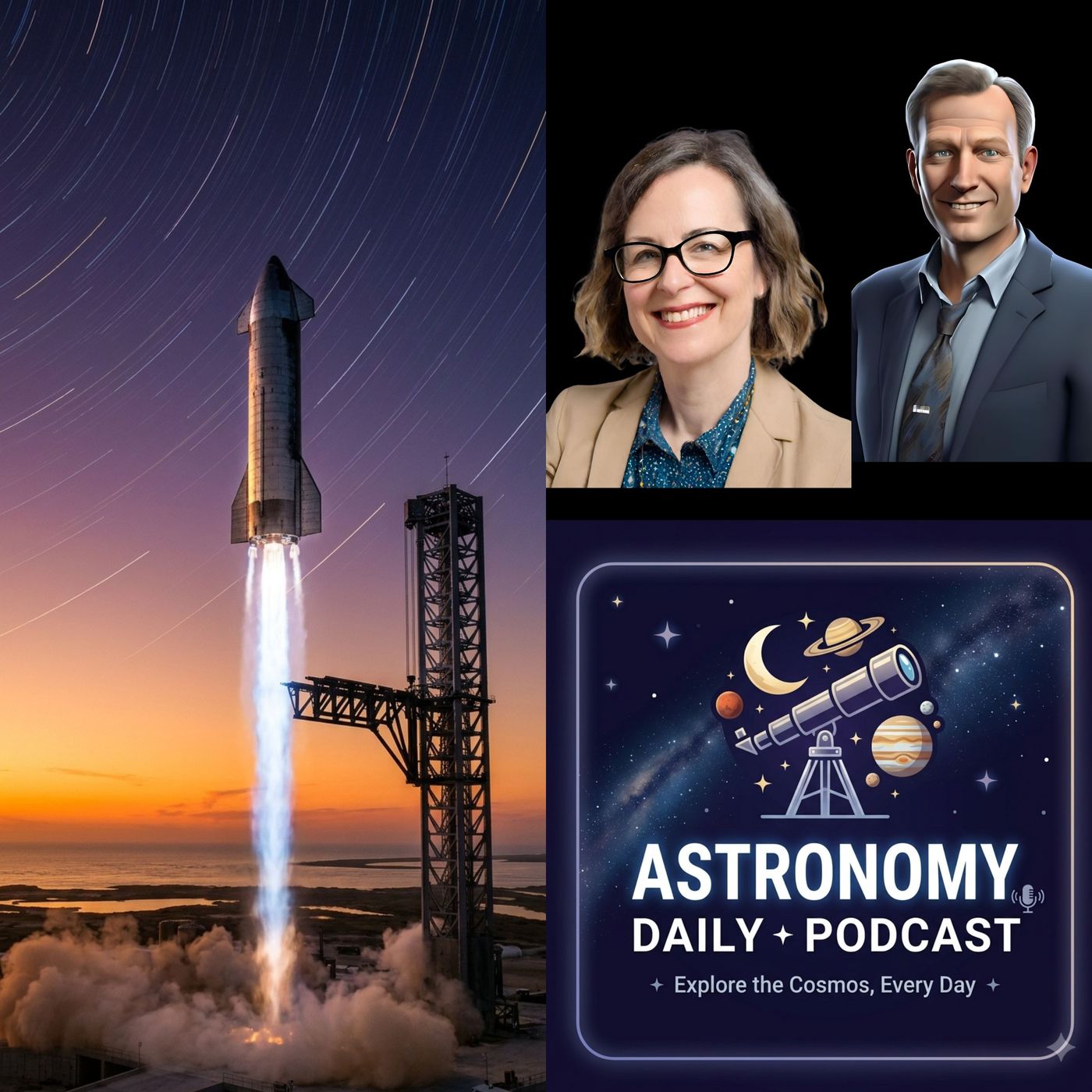
0:00 Anna: Welcome to Astronomy AstroDailyPod, your daily dose of space and astronomy news for Friday the uh, 13th of November 2026. I'm Anna. 0:11 Avery: And I'm Avery. Friday the 13th and SpaceX has chosen it to try something nobody has ever done fly a rocket to orbit, then catch both halves of it back at the launch tower. 0:22 Anna: Also today, Europe's Euclid telescope has opened the first big slice of its sky survey to everyone on Earth. And a robot about a cubic metre in size has assembled a piece of structure in orbit with no astronaut anywhere near it. 0:37 Avery: Plus, Voyager 1 is days away from being a full light day from home. And um, the weekend's sky has Mars and Jupiter closing to just over 1 degree apart. 0:48 Let's get into it. 0:49 Anna: Our lead today is a launch eve story and we want to be careful with one word from the start. Starship Flight 15 is targeted for today, Friday 13th November. Targeted not scheduled. Regular listeners will remember we had to correct ourselves on a starship date 1:08 back in September. So that's the word we use. 1:11 Now Avery: here's the a, ah, 75 minute window opens at 4:45 in the afternoon Central time at Starbase in Texas. That's 5:45pm Eastern, 2:45pm Pacific and 22:45 universal time. For those of us in eastern Australia, it's 9:45 on Saturday morning daylight time. 1:32 Anna: The vehicles are Booster 22 and Ship 42. Both are the larger Block 3 design. This is the fourth flight of that version and it goes from Starbase's second launch pad. 1:45 Avery: And um, the headline is what happens to them afterwards. SpaceX says it will try to catch both. The super heavy booster comes back first to the tower's mechanical arms roughly six and a half minutes after liftoff. 1:59 Anna: A booster catch is not new in itself. 2:02 SpaceX first did that in October 2024. 2:05 But this would be the first catch of a Block three booster and the first catch of anything at Pad two. 2:12 Avery: The ship is the part with no precedent at all. No starship upper stage has ever been caught. Everyone that has survived re entry has come down in the ocean. 2:23 Anna: So let's walk through the ship's day because it is a full day. Ship 42 is planned to reach an orbit about 275 kilometres up and release 26 of the newer Starlink V3 satellites. The same payload count Flight 14 carried in September. 2:42 Avery: Then it stays up. The published profile has it completing about 14 orbits over more than 22 hours. 2:50 Anna: Why so long? Because of geometry. The Earth turns underneath the orbit and the ship has to Wait until its path lines up again with the corridor that leads back to Starbase. You can't come home to a tower on any orbit you like. You come home on the one that passes over it. 3:08 Avery: When that lines up, the sequence is a deorbit burn, re entry, the flip from belly first to tail first, a landing burn and then the arms. The plant catch time is about 22 hours and 32 minutes after liftoff. 3:24 Anna: We did the arithmetic. If it lifts off right at the opening of the window, that puts the catch attempt at about 3:17 on Saturday afternoon, Central Time, 21:17 Universal Time and 8:17 on Sunday morning in Sydney. Any delay inside the window slides that along with it. 3:43 Avery: And think about what the ship is being asked to do compared with a booster. The booster turns around a few minutes into flight. The ship comes back from orbital speed something like 27,000 kilometres an hour through the full heat of reentry, and then 3:59 has to arrive at a point in space a few metres wide Anna: with a heat shield of thousands of tiles that has to work well enough for the vehicle to still be steerable at the end. 4:11 Avery: Now, the caveats, and there are three, and, um, we'd ask you to hold on to all of them. 4:17 Anna: First, the licence. The ship's path back to the tower takes it over populated areas, which a, uh, splashdown at sea never did. 4:25 That needs a modification to SpaceX's launch licence from the US Federal Aviation Administration. SpaceX's own announcement says the date is pending regulatory approval and in the reporting we could check. That approval have not yet been confirmed. It may well have landed by the 4:43 time you hear this. 4:44 Avery: Second, the ship catch is conditional. 4:48 SpaceX describes it as, uh, dependent on health checks before reentry. If the vehicle isn't healthy, the catch doesn't happen. That is a sensible rule when the alternative is flying a damaged vehicle at your only block three line launch tower. 5:04 Anna: And third, this is a test flight. 5:07 Flight 14 reached orbit in September and deployed its satellites. But the mission was cut short at about three hours. A day in orbit is new for this vehicle on its own before anyone catches anything. 5:20 Avery: So a realistic list of outcomes is long. Both caught, booster caught, and the ship waved off. A scrub and another try. All of those would be ordinary results for a programme at this stage. 5:34 Anna: Why does it matter if they do pull it off? 5:37 Because it would be the first time both stages of an orbital rocket have come back to the launch site intact. The space shuttle brought its orbiter and its boosters home, but threw away the big tank every time. 5:50 Falcon 9 lands its first stage and discards the second. 5:54 Avery: And the whole economic argument for starship, including the lunar lander version NASA is counting on for Artemis, rests on doing this. 6:01 Routinely refuelling a moon lander in orbit takes many tanker flights. That only makes sense if the tankers come back Anna: for timing. Australia gets the friendly end of this one launch at breakfast on Saturday. 6:15 And if all goes to plan, a uh, catch attempt at breakfast on Sunday, Avery: we'll have whatever happens in tomorrow's weekend wrap for today targeted pending approval. 6:26 And watch that word Conditional Anna: Story two and it closes a thread from yesterday's episode the European Space Agency's Euclid Space Telescope had its first major public data release pencilled in for Thursday 12th November. The archive that serves Euclid data in the United 6:45 States at UH Caltech's IPAC now lists that release as out Avery: the name is a mouthful. Data release one foundation let's unpack what's in it about 1,900 square degrees of Euclid's main wide survey. That's roughly 1/7 of the sky area the mission is planning to cover in total 7:06 Anna: and in volume, about 1.8 petabytes. Raw data, calibrated images, catalogues and spectra plus Euclid's deep field Avery: for scale. The previous public Release back in March 2025 covered 63 square degrees and about 26 million galaxies. This is around 30 7:28 times the area it replaces that earlier release outright. 7:32 Anna: Now, an honest note on what this is not the word foundation is doing real work. 7:38 ESA split this release in two back in June. 7:41 What's out now is the images, the catalogues and the spectra. The higher level products built for Euclid's actual purpose, measuring how galaxies cluster and how their shapes are subtly distorted by dark matter, follow in the complete release in the middle of 2027. 7:58 Avery: So there are no dark energy results today, and nobody should expect headlines about the fate of the universe this week. Euclid was built to test whether dark energy changes over time. The question we followed all year through the supernova results. That answer is 8:15 still at least months away. 8:17 Anna: It also arrived three weeks later than first planned. The original date was 21 October. 8:24 Avery: What it does do is hand the raw material to everyone. Any astronomer, any student, anywhere can now go looking. 8:33 And at this scale, the rare things start to turn up. Strong gravitational lenses, ring galaxies made by collisions, discs around young stars seen edge on. 8:44 Anna: ESA is leaning into that. There's a hackathon from the 23rd to the 26th of November, where teams compete to find the strangest objects in the data with the finds going into a published catalogue. 9:00 Avery: When we prepared this episode, ESA's own public announcement and images had not appeared. Ah, as it was still early morning in Europe. If they have by the time you listen, the pictures will be worth your time and will pick up anything notable tomorrow. 9:15 Anna: And uh, a reminder that Euclid's sky is very much a southern sky too. One of its three deep fields sits far in the south and the ground based surveys that supply colours for Euclid's southern galaxies are run from Chile. 9:28 Avery: A catalogue, as we like to say on this show, is a detection limit, not a census. This one just moved the limit a long way. 9:37 Anna: Story three is a small piece of hardware with a large idea behind it. 9:43 A robotic builder designed at Caltech has assembled part of a structure in orbit and the team says that is a uh, first. 9:51 Avery: The project is called astra, the autonomous in space tensioned reflector assembly. 9:57 It's funded by darpa, the US Defence Research Agency under a programme on building large structures in space. DARPA and Caltech announced the result last week. 10:07 Anna: The reason anyone wants this is a hard limit in spaceflight. Everything we've ever put in orbit either fit inside a rocket fairing or was folded up to fit like the James Webb Space Telescope's mirror and sunshield. Folding gets you a long way. 10:24 It doesn't get you a uh, hundred metre antenna. 10:27 Avery: The third option is to launch a box of parts and build the thing where it will be used. DARPA's programme manager compared the Caltech approach to construction toys. Drutz joined at nodes one section at a time. 10:42 Anna: Astra is about a cubic metre. It rode to orbit on the 30th of March aboard uh, a SpaceX rideshare flight hosted on a momentous space tug. Inside were two truss sections called bays already built on the ground, plus a robotic arm and dispensers full of struts and joints. 11:01 Avery: In orbit it pushed out the two pre built bays and then the arm picked up loose parts and assembled a third. That third bay is the milestone project lead Sergio Pellegrino put it this. This is the first time that a structure has been autonomously constructed in space. 11:19 Anna: Now the caveats, because the headline is bigger than the hardware, the goal was a reflector antenna 1.4 metres across, needing 11 bays. They have built one in space. The mission ends in December and the team says finishing the whole truss is unlikely 11:37 Avery: and autonomous has a specific meaning here. No astronaut touched it, but engineers on the ground sent the commands and checked the results in photographs. When something went wrong, they reproduce the fault on a twin of the robot kept in the lab 11:52 at Caltech before sending a fix. 11:55 Anna: Which is rather how you'd expect a first attempt to go. Astronauts have assembled structures by hand in orbit since the 1980s and the space station was put together with a great deal of human help. This is the robot doing the joining itself. 12:11 Avery: The reason astronomers should care is at the far end of this road. The size of a space telescope's mirror or a radio dish is set by what you can fold. 12:23 If you can build in place, that limit goes away, Anna: one bay out of 11. But it's the first one. 12:31 Avery: Quick hits and we start with a number. 12:35 On Wednesday 18 November at 10:16 in the morning Universal Time, NASA's Voyager 1 is expected to reach one light day from Earth. That's 9:16 that evening in Sydney and 2:16 in the morning Pacific Time. 12:49 Anna: One light day is about 25.9 billion kilometres. 12:55 A radio signal will take 24 hours to get there and a reply, another 24 to come back. It has taken Voyager just over 49 years to travel what light covers in a day. 13:08 Avery: No other human made object has has been that far. And nothing changes at the spacecraft when it crosses. 13:16 It's a milestone for us, not for Voyager. 13:20 Anna: Second, a date for next week. The European and Japanese BepiColombo mission is due to be captured into orbit around Mercury on Saturday 21st November, eight years after launch. We'll have a proper preview before then. 13:35 Avery: And third, ESA's HERA spacecraft, now with the asteroid pair Didymos. And Dimorphos, has its first detailed images of Dimorphos due on the 25th. 13:46 That's the little moon NASA's DART spacecraft struck in 2022. So those pictures are the first close look at the scar Anna: time for Skywatch. 13:55 And as always, we've run these numbers ourselves. For Sydney, Los Angeles, New York and London, Avery: the main event is before dawn. 14:05 Mars and Jupiter have been closing on each other all spring or all autumn if you're in the north. And this weekend they're nearly there Anna: on Saturday morning they're about 1.4 degrees apart. They're closest on Monday morning the 16th at 1.2 14:22 degrees. That's a little more than two full moons side by side. Jupiter is the brilliant 1 at magnitude -2. 14:31 Mars is the fainter, distinctly orange point right beside it. 14:36 Avery: By the way, you may see listings saying less than 1 degree. Our calculation gives a minimum of 1.19 degrees, and NASA's own skywatching guide for the month says 1.2, so we're comfortable with that figure. 14:50 Anna: Where to look depends very Anna: much on where you are. An hour before sunrise from Los Angeles, the pair is 69 degrees up, almost overhead in the south southeast from New York, 63 degrees from London, 53 degrees due south Avery: from Sydney. They're lower, about 30 degrees 15:11 up in the north northeast, an hour before sunrise. And sunrise is early 5:43, so you're looking at about a quarter to five, still an easy naked eyesight. Binoculars will hold both planets in one view everywhere. 15:25 Anna: Now, Venus, it's back as a morning object after passing between us and the sun last month. And it's dazzling, magnitude -4.3 in a small telescope, it's a big, thin Crescent, about 14% lit and 50 arcseconds across, with the star Spica, uh, a degree and a half away. 15:46 Avery: The north gets the better of this one. An hour before sunrise, Venus is 15 to 17 degrees up from Los Angeles and New York and about 14 from London. 15:58 From Sydney, it's only 6 degrees above the eastern horizon, so you need a clear, flat view. 16:05 Anna: And Mercury is strictly a northern target this week. Low in the east southeast beneath Venus. That gives Northern observers 4 planets in a line before dawn from Sydney. Mercury is still below the horizon at that hour, so we get three. 16:22 Avery: A, uh, safety note, and we say it every episode. Venus and Mercury are close to where the sun is about to rise. Stop sweeping with binoculars or a telescope well before sunrise, and never look at the sun without certified solar filters that meet the ISO 16:37 123122 international standard. 16:40 Anna: The evening sky is the south's turn an hour after sunset. Saturn is 50 degrees up in the north from Sydney against 36 from Los Angeles, 30 from New York and about 20 from London. 16:55 The Moon is a waxing crescent in the west tonight and Saturday, reaching first quarter on Tuesday the 17th, Avery: which is good news for the Leonid meteor shower. Peaking on the mornings of the 17th and 18th. A first quarter moon has set by 17:10 the small hours, so the sky is dark when it counts. 17:14 Anna: Expectations, though, this is Anna: a modest year, perhaps 15 meteors an hour under a dark sky. 17:23 And it favours the north again two hours before sunrise. The radiant is about 60 degrees up from the northern cities and only 12 degrees from Sydney, Avery: so southern listeners will see a handful of long ones skimming up from the northeastern horizon. Honestly, this is a 17:41 northern week before dawn and a southern week after dusk. 17:46 Some weeks it runs the other way, Anna: and that's Astronomy daily for Friday 13th November. A rocket that may be caught twice, a telescope that has opened its books, and a robot that has put together the first piece of something much bigger. 18:04 Avery: If Starship flies, we'll have the outcome in tomorrow's weekend wrap, along with anything Euclid has shown us overnight. 18:11 Anna: You can find every episode, our news feed and the newsletter at astronomydaily IO and we're @astrodaily pod on social media. If you have a question, the contact form on the site comes straight to the team. 18:25 Avery: Astronomy AstroDailyPod is part of the bytes.com podcast network. I'm Avery. 18:30 Anna: And I'm Anna. Clear skies and keep looking up.










Community discussion