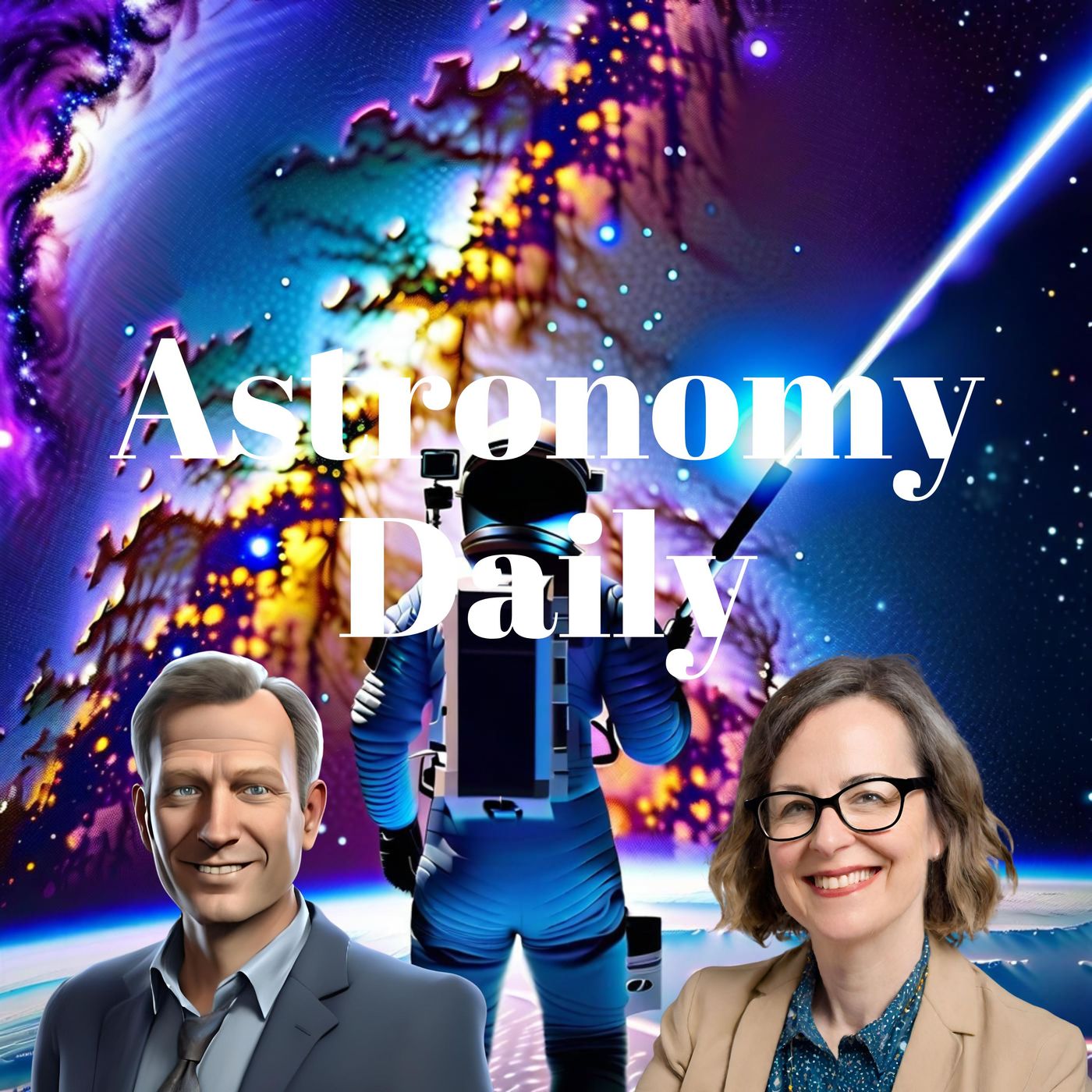
Aussie Satellite Snapshots, Space Command's Close Encounter, and the Truth About Water Worlds
- Australia's Spirit Satellite Takes Selfies in Orbit: The Spirit nanosatellite has successfully completed its first mission phase, orbiting Earth for over 600 days and taking selfies to confirm its systems are operational. Equipped with an Italian Space Agency instrument to detect gamma ray bursts, Spirit features an autonomous repointing system that allows it to respond immediately to cosmic events, showcasing the potential of AI in space exploration.
- US and UK Military Satellites Conduct Historic Operation: In a first-of-its-kind event, the US Space Command performed a rendezvous proximity operation with the UK's Skynet 5A satellite in geostationary orbit. This peaceful inspection underscores military cooperation between allies while sending a clear message about capabilities in contested space environments.
- NASA Introduces New Class of Astronauts: NASA has welcomed its 24th class of astronauts, including a former SpaceX crew member from the all-civilian Inspiration4 mission, highlighting the growing pipeline from commercial spaceflight to NASA.
- Rocket Launch Roundup: It's been a busy week for launches, featuring SpaceX's deployment of 22 Starlink satellites with a record-setting reusable booster, Rocket Lab's upcoming Electron launch for the US Space Force, and China's successful launch of the Yao' Gon 44 reconnaissance satellite.
- Exotic Theories on Gravitational Waves: A new paper suggests that the peculiar gravitational wave signal GW 190521 may not be a standard black hole merger but could instead be an echo of a collision from another universe, traveling through a wormhole. While the standard explanation remains the most likely, the hypothesis opens up intriguing possibilities.
- New Research Challenges Water World Theories: Recent studies on Hycean worlds, previously thought to be covered in vast oceans, indicate that immense pressure and heat may trap water deep within these planets, making them less likely to exist as envisioned. However, this could lead to more Earth-like planets forming with moderate surface water.
- New Comet C2025R2 Swan Discovered: A newly discovered comet, C2025R2 Swan, is brightening and may become visible to the naked eye by October. Stargazers are encouraged to keep an eye on the sky, especially around its closest approach to Earth on October 21st.
- For more cosmic updates, visit our website at astronomydaily.io. Join our community on social media by searching for #AstroDailyPod on Facebook, X, YouTubeMusic Music, TikTok, and our new Instagram account! Don’t forget to subscribe to the podcast on Apple Podcasts, Spotify, iHeartRadio, or wherever you get your podcasts.
- Thank you for tuning in. This is Anna and Avery signing off. Until next time, keep looking up and exploring the wonders of our universe.
Spirit Satellite Update
[Australian Space Agency](https://www.astronauts.gov.au/)
US-UK Military Operation
[US Space Command](https://www.spacecom.mil/)
NASA Astronaut Class Announcement
[NASA](https://www.nasa.gov/)
Launch Updates
[SpaceX](https://www.spacex.com/)
Gravitational Waves Research
[Nature](https://www.nature.com/)
Hycean Worlds Study
[Journal of Astrobiology](
You May Also Like
Life, Death, and Taxonomy
Life, Death, and Taxonomy

Podcast de Juan Ramón Rallo
Juan Ramón Rallo

The Grave Talks | Haunted, Paranormal & Supernatural
Ghost Stores, Haunted, Paranormal & Supernatural Stories

The Best of Coast to Coast AM
iHeartPodcasts and Coast to Coast AM
Let's Science
SQPN, Inc.
Accès au Marché Mondial des Dispositifs Médicaux
Pure Global
Human Factors Minute
Human Factors Cast
Dr. Chapa’s OBGYN Clinical Pearls
Dr. Chapa’s Clinical Pearls
Eye On The Sky
Vermont Public

Farm Small Farm Smart Daily
The Modern Grower Podcast Network
Life, Death, and Taxonomy
Life, Death, and Taxonomy
Podcast de Juan Ramón Rallo
Juan Ramón Rallo
The Grave Talks | Haunted, Paranormal & Supernatural
Ghost Stores, Haunted, Paranormal & Supernatural Stories
The Best of Coast to Coast AM
iHeartPodcasts and Coast to Coast AM
Let's Science
SQPN, Inc.
Accès au Marché Mondial des Dispositifs Médicaux
Pure Global
Human Factors Minute
Human Factors Cast
Dr. Chapa’s OBGYN Clinical Pearls
Dr. Chapa’s Clinical Pearls
Eye On The Sky
Vermont Public
Farm Small Farm Smart Daily
The Modern Grower Podcast Network
Community discussion