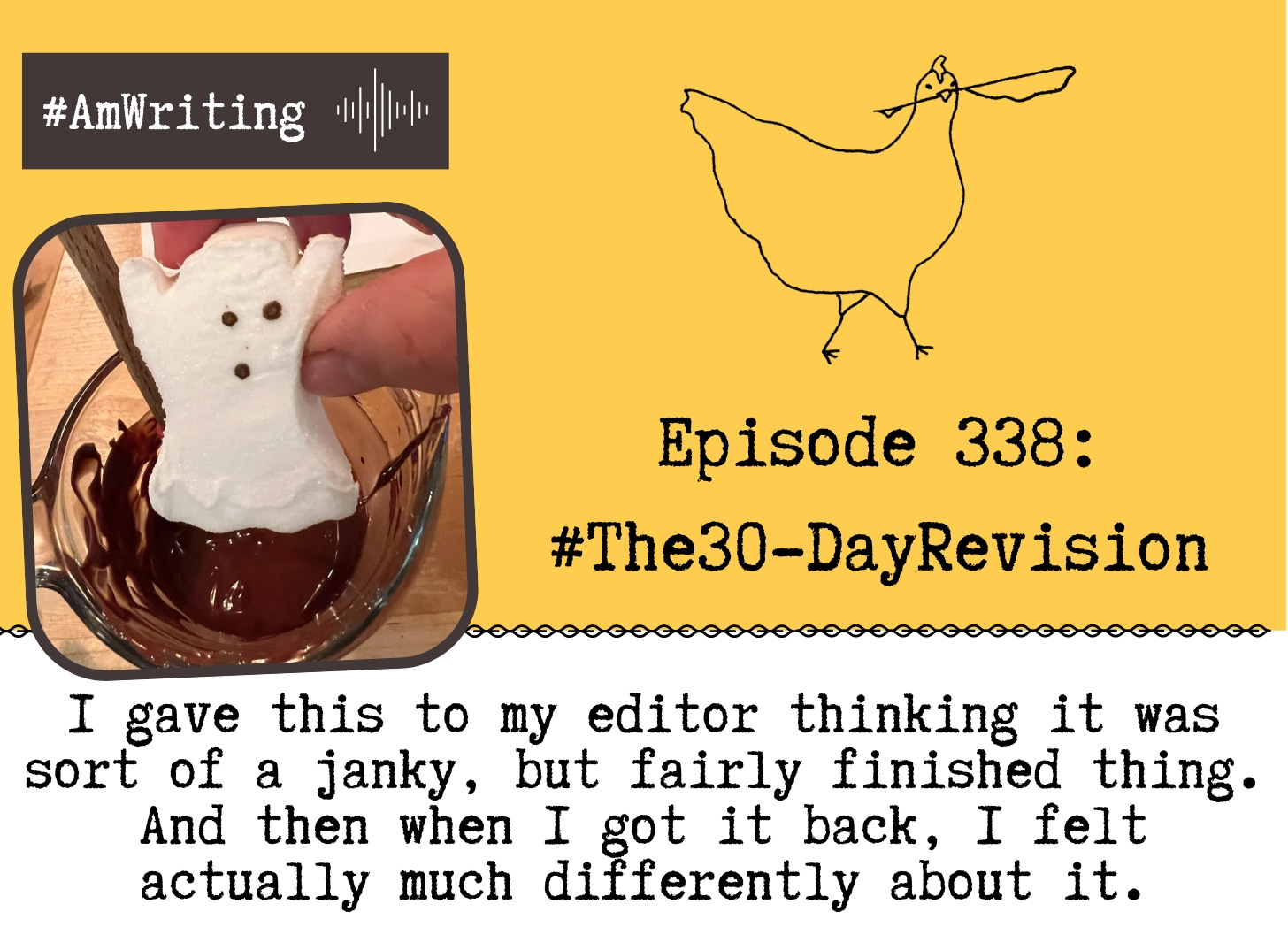
The 30-Day Revision: Episode 338 How KJ Revised a Novel in 30 Days/189 Hours and approximately 72 Chocolate-Covered Peeps
Many of you have heard me (this is obviously KJ) whine about my revision in process. Well, I’m here to report that it’s done, and successfully. Below is a full description of the process, and in the episode you’ll hear me talking about it with Jennie Nash. I detail everything except the Peeps that fueled me, and I decided it was wrong to leave them out.
So, in addition to a lot of butt-in-chair time and a surprising number of hours spend really just staring the at screen, I should own that I also ate a lot of Halloween peeps and most of a bag of fun-sized $100,000 bars. And I would have eaten the whole bag but someone else beat me too it, and they owe me big.
Here it is in writing, THE LONG VERSION: How to do a substantial novel revision in 30 days
The Overview
I had a long, rambling, completed draft of a book with a solid plot and decent thematic/internal story. The magic system was unclear and the romance undeveloped, and I had too many side-characters and too many scenes that weren’t doing more than one job. Because it’s a seasonal book, I couldn’t take my time with a revision without getting pushed another full year out. So we were shooting for publication in less than a year—and we needed to leave some time, tbh, for me to get this wrong and have to fix it again. Thus: 30 days to a revision that involved nearly a full rewrite, even though the characters, story and in particular the plot excitement of the ending would stay the same.
What the hell did I sell?
At the time, I thought I sold a solid, almost-ready 102K draft. Looking back, I see I sold an idea (Grown-up Gilmore Girls meets Practical Magic with a stolen set of family Tarot cards with powers and a mission of their own) and a rambling, creaky proof-of-concept draft with a solid plot at its core and characters my editor liked and wanted to spend time with.
What this was: Same basic plot, both inside and out. I’ve done revisions that required altering a major plot point or removing characters. This did not.
Same characters.
Same themes, but narrowed and clarified.
A few thoughts on that—the draft I sold was, in my mind, intentionally “edit-able”. There comes a point in a draft when editing it is hard. When what you have is both very polished and tightly wound, the editor may be able to see what’s wrong, but pulling it out will be more painful for the writer, because you’ve locked down all the story elements to intertwine and all the language, etc. This wasn’t that—when I yanked out scenes, they were at least flabby or tangential. I didn’t have to feel too bad about it. And the story wasn’t quite locked in as well. So none of this was unexpected. I know this editor likes to edit and is really good at it.
That said, it WAS a … third or fourth draft or fifth, I can’t remember. I’d done a lot of work on it. When I let go of it I thought it was pretty darn good. When I got it back I was like, OMG I can’t BELIEVE I gave this to anyone, it’s so long and there are scenes that don’t go anywhere and it takes forever to get to the point. And in many ways I had done too much writing work on a story that wasn’t ready to be written (although some of that is necessary for me to find the story).
So a) I thought this was a lot better than it was and b) even after you sell a book, sometimes there is substantial work still to be done and that is fine, it doesn’t mean you’re terrible and the story is crap and the editor is staring at it and thinking, I cannot believe I bought this horrible piece of junk. (Or so I kept telling myself, over and over and over.) And c) apparently what you go out with can be (and will be) far, far from perfect. Even if you think it is.
All that said, some editors don’t edit. I was talking with another writer at a party recently, a NYT best-seller who broke out on her seventh novel, and has written 2 more since, told me that she doesn’t get edited any more. That may be because of her skill and experience (and if so, I am so not there and can go back to feeling terrible about this draft) but I’ve heard the same from newer novelists. And debut novelists, although that situation is a little different, as our debuts are usually the product of a longer period of work and often working with paid editors or readers.
I knew this editor and knew what to expect. If I was submitting to an unknown editor, I would submit something that—to me—was ready to go. Which, I should say, does not mean that it won’t get the same big editorial treatment, so it’s important to be ready for that and accept it. It also doesn’t mean it wouldn’t need it.
The goal for this go-round.
Major notes from my editor: it’s too long, and it drags. The magic system is unclear. The motivations of several major secondary characters who move the plot are unclear. The love story is an afterthought. There’s too much of one secondary character and not enough of 2 others. Too much internal monologue, too many conversations in parts that should be action. The deep backstory (i.e where the magic comes from) should be super-clear to me but mostly unseen by the reader.
Minor notes: Some scenes don’t work hard enough. Magic should be more magical. The stakes are high, but make it more clear what they are. More descriptions of the cute town and shop.
My editor suggested a fresh structure of the first half of the book that moved it more quickly, which was very helpful. There are two inciting incidents, and we moved things so one of them happens very very quickly (the return of the magic) and the other later, after the first had more time to develop (the magic goes badly).
I had two calls with my editor, the first before she wrote her (10 page!) editorial letter and the second after I’d read it. I didn’t do any revision in between—I re-wrote the flap copy and worked on their author questionnaire (and if you’ve never done one of those, they’re quite long). We also wrote the tagline. Both of those—the flap copy and the tagline—were really helpful in reminding me what it was I was doing here, especially the tagline, which ended up on a post-it on my desktop: Flair is done with magic. But magic isn’t done with her.
I needed to cut at least 10K words, make the magic, the plot and the motivations of the characters around it clear, bring the romance forward and take out a lot of action (and a few tertiary characters and events) that were obscuring the main story.
An aside: I think we’re either writers who stuff too much into the story (and write long) or writers who get right to the point (and write short). Whichever you are, outlining a favorite book in your genre or one that really did whatever your goal is (page-turner, thought-provoking, slow burn) successfully for you can really help. How many additional characters and plotlines were there? Which did you remember at the end of the book? How many did you really love, or really contributed to the book’s success with you? Did they move the plot and the inner story or just one or the other?
I did this during my revision and found it really helpful. Again. For me, outlining—or at least thinking about specific elements—of books I hope to be like on some level is always a good move.
The numbers
Original: 102K/330 pp 36 chapters
Revision: 83K/298 pp 30 chapters
30 days/189.5 hours of butt-in-chair. This does not count anxiety dreams, walks to think through problems or time spent staring at other people and nodding while thinking about book.
Longest day: 11 hours (I had 2 11 hour days and 5 10 hour days)
What did that look like? 7-8 hours before dinner, with a substantial dinner stop that often included a walk or short bike ride, then back at it until 11 pm or so. I’m a natural night owl, so that’s not that hard for me.
Shortest: 1.5 (I traveled 3x during the 30 days, so
You May Also Like

Le Cours de l'histoire
France Culture

La voce del poeta
Lorenzo Pieri
Podcast Patapoe
0d0a
Daily Short Stories - Mystery & Suspense
Sol Good Network

Daily Short Stories - Ghost and Horror Stories
Sol Good Network

New Books in Literature
Marshall Poe

Daily Rosary Meditations | Catholic Prayers
Dr. Mike Scherschligt
The Great Detectives of Old Time Radio| Daily Mystery Dramas
Adam Graham|Old Time Radio Detective Host

CyberSecurity Summary
CyberSecurity Summary

Book Shelter
Book Shelter
Le Cours de l'histoire
France Culture
La voce del poeta
Lorenzo Pieri
Podcast Patapoe
0d0a
Daily Short Stories - Mystery & Suspense
Sol Good Network
Daily Short Stories - Ghost and Horror Stories
Sol Good Network
New Books in Literature
Marshall Poe
Daily Rosary Meditations | Catholic Prayers
Dr. Mike Scherschligt
The Great Detectives of Old Time Radio| Daily Mystery Dramas
Adam Graham|Old Time Radio Detective Host
CyberSecurity Summary
CyberSecurity Summary
Book Shelter
Book Shelter
Community discussion