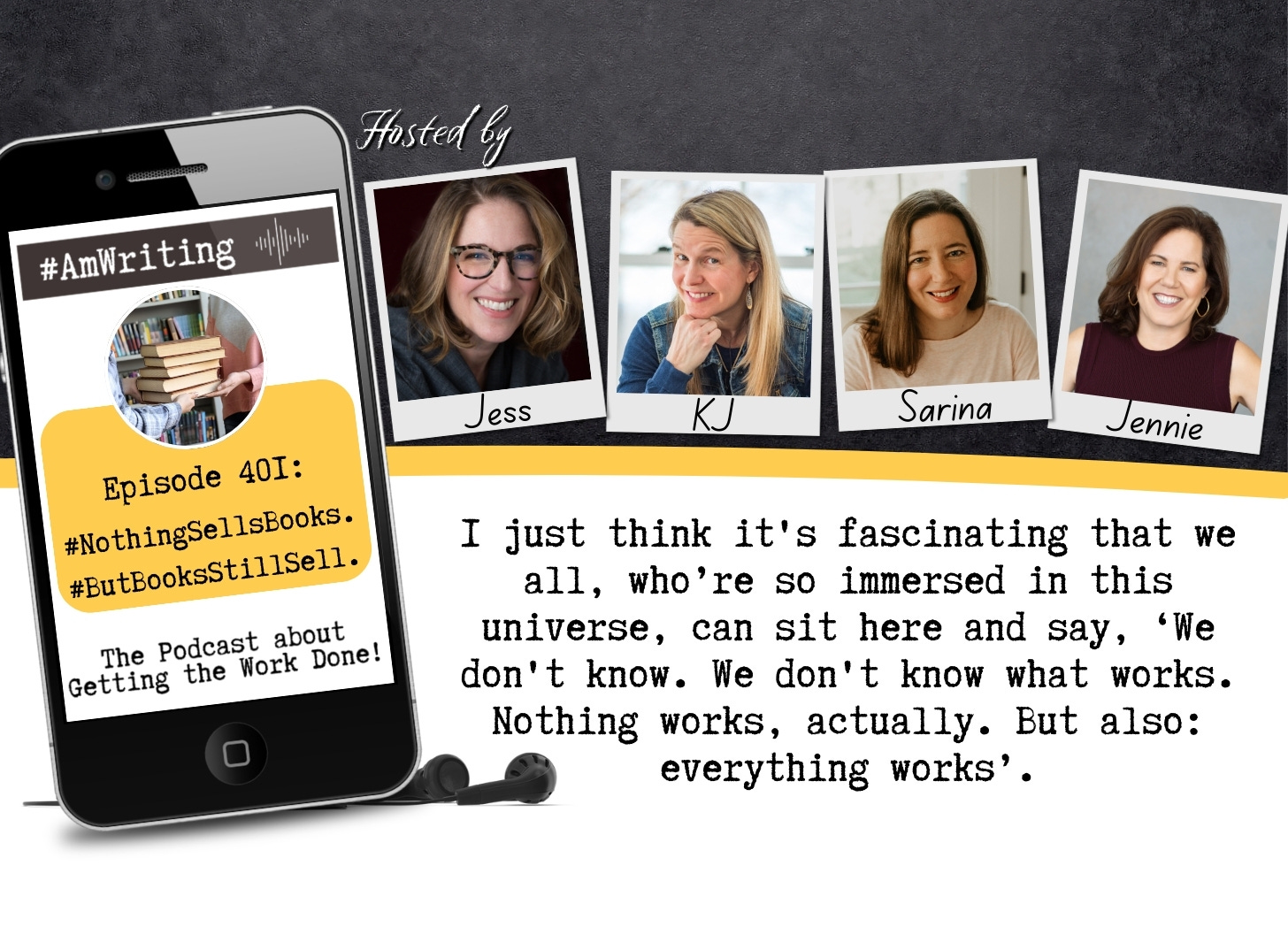
Nothing Sells Books. But Books Still Sell.
It’s EPISODE 401! That’s a lot of episodes. We’re proud. We’re also not done—and a couple weeks ago, a fellow writer decreed, in an email post that went rather viral, that No One Buys Books.
We disagree. Instead, we offer the following less bleak but not entirely rosy corollary: Nothing Sells Books. But Books Still Sell.
Coming at you in this episode are four somewhat cynical authors, one who spends her time now working with writers rather than writing herself. We’ve all had books hit various lists… and we’ve all had books that have not, have neither hit any lists or reached target numbers or earned out or anything of the sort. And we have thoughts. Listen for them… but meanwhile, here I am, KJ, with my very own soapbox bc I said “I’ll write the shownotes” and the others, spotting an opportunity to let someone else do a thing, semi-wisely agreed because now I get to tell you what I think.
I mostly think that we authors have bought into a story in which we have more control over our sales than we do. We believe—or want to—that we can TikTok hustle up readers, tweet our way to success, muster our many Facebook friends to buy three copies each (it’s not that much!), put some links in our Substacks and call on our Notes, Threads and Insta buds to click those links. And traditional publishers want so badly to believe that too—because if it’s not true, then we don’t know what is. Reviews MIGHT sell books. Ads sometimes work. Even celebrity book clubs, the last magic best-seller wand, only work when there is a match-up between readers and the book—some Reese, GMA and Jenna picks sell big while others don’t, and there is absolutely no way to beg, buy, or steal your way onto them anyway. (Maybe? Story idea, yours for the taking: author blackmails way onto celeb book list, things go terribly wrong.)
And I want to tell you that this is not true, because I don’t entirely want it to be true. It arguably hasn’t been true for me, and I’ve seen it not work for many if not most of other authors. To get more specific, I’ve had not one but TWO excerpts of a book in the NYT and had it not move the needle. I’ve had an essay in LitHub, ditto. I’ve been on many, many podcasts, I’ve sent emails, I’ve made TikToks and reels, and I’ve watched friends push these buttons hard and less hard to mixed results—but not NO results, and that’s an important distinction. Below, I’m offering a few success stories, all with massive caveats, the most important of which is this: I probably only see the successes.
The TL;DR is this: nothing easy sells books. There is no short cut or even a long cut. For most of us, nothing we ourselves are willing to do or are capable of doing in the short term is going to move enough titles to make a significant impact on our success. The second half of our koan is also true, though. Books still sell. But most book sales, especially those that lead to wild success, come from forces beyond our control. Word of mouth, a lucky media hit, a celebrity boost. A hit TV show that comes out of the blue years after a series is published (Bridgerton), or maybe after the author has died (The Queen’s Gambit). Or they come from enough people picking up the book and sharing it with enough others in ways that cannot be planned or gamed. You can’t count on those things, although one thing remains true: lightning can’t strike a book that hasn’t been written.
The most important thing to do is to write the books.
Sarina notes in the podcast that nothing sells (your) books like more books (by you)—witness, for example, Taylor Jenkins Reid. Daisy Jones and the Six was not her first book by any means—but its success brought her backlist roaring into prominence. I think about TJR a LOT, because she stuck to the thing I want to stick to—writing the books, not recording video confessionals about the writing process and setting them to the music du jour. But… that’s a thing. That people like. That honestly can (maybe, kinda, and I’m not at all sure how much you control this) sell books.
The depressing (to me) truth is that if you really throw your whole heart and soul into marketing your title, you might be able to get somewhere, but the thing is I am talking ALL IN. I’m talking hours of content creation one way or another. It might be hard-hitting researched work in an area that fascinates people. It might be hot takes on a world that really is your wheelhouse. It might be soul-baring, emotional videos about the process. It might be really digging into Facebook ads and Amazon algorithms, SEO and tagging. Either way it’s a lot of non-writing work to create podcasts, ads, videos and well-produced reels. It takes time, much of it spent on details like lining up the right music and analyzing results and repeating again and again and none of that is easy or fast.
Let me offer some case studies. First, Breanne Randall. This one is painful for me because we had similar books coming out at a similar time (Playing the Witch Card and The Unfortunate Side Effects of Heartbreak and Magic), and hers hit the NYT list and mine did not. Is it possible that she wrote a better book? Sure. But she hit the list for one week only (NO SHADE that’s amazing), her first week after going on sale, which means that the vast majority of those sales were pre-orders and most almost certainly didn’t result from WOM from happy readers. So at that moment, it probably didn’t matter whose book was better. What mattered was something else, and it’s quite possible, even likely, that that “something else” was her impressive hustle, especially on TikTok but also on Instagram. I did some. She did more. A LOT more.
For all the details on her hard work and results, read Dan Blank’s description here—but suffice it to say we’re talking hours and hours of video and posts, an excellent eye for what was resonating with viewers and readers and a willingness (up to a point) to really share the journey. She’s also attractive and closer to the TikTok demographic and probably herself loves the format—all things that go a long way to success in any genre. It’s really hard to put that kind of time and effort into a creative act that you aren’t enjoying (and unlikely to succeed). And the book itself fits the TT demo as well—but that’s not enough on its own. She did the work, and she reaped the reward, and I both admire and hate her for it.
Here’s another approach: become the go-to expert in an area you’re passionate about and develop a fan base around it, then write a book in that area that is absolutely for your fans. My example here is Virginia Sole-Smith, who we’ve had on as a guest (Episode 362: Talking Fat Talk and Substack Success, and Episode 128: #PlanItOut). Virginia has shifted around somewhat, from a more parent-oriented place to one centered on diet culture, anti-fat bias, feminism and health. You’ll find her—and her podcast, email and many many media hits and her best-selling book—
You May Also Like

Le Cours de l'histoire
France Culture
Choice Classic Radio Detectives | Old Time Radio
Choice Classic Radio

dodo on air
百々千晴
Classic Humorous Short Stories from America
The Podcast Network
Classic Children’s Stories Library
The Podcast Network

Le Book Club
France Culture
Daily Short Stories - Ghost and Horror Stories
Sol Good Network
Daily Short Stories - Mystery & Suspense
Sol Good Network

Gunsmoke | OTRWesterns.com
Andrew Rhynes

Fakeologist Network
Fakeologist
Le Cours de l'histoire
France Culture
Choice Classic Radio Detectives | Old Time Radio
Choice Classic Radio
dodo on air
百々千晴
Classic Humorous Short Stories from America
The Podcast Network
Classic Children’s Stories Library
The Podcast Network
Le Book Club
France Culture
Daily Short Stories - Ghost and Horror Stories
Sol Good Network
Daily Short Stories - Mystery & Suspense
Sol Good Network
Gunsmoke | OTRWesterns.com
Andrew Rhynes
Fakeologist Network
Fakeologist
Community discussion