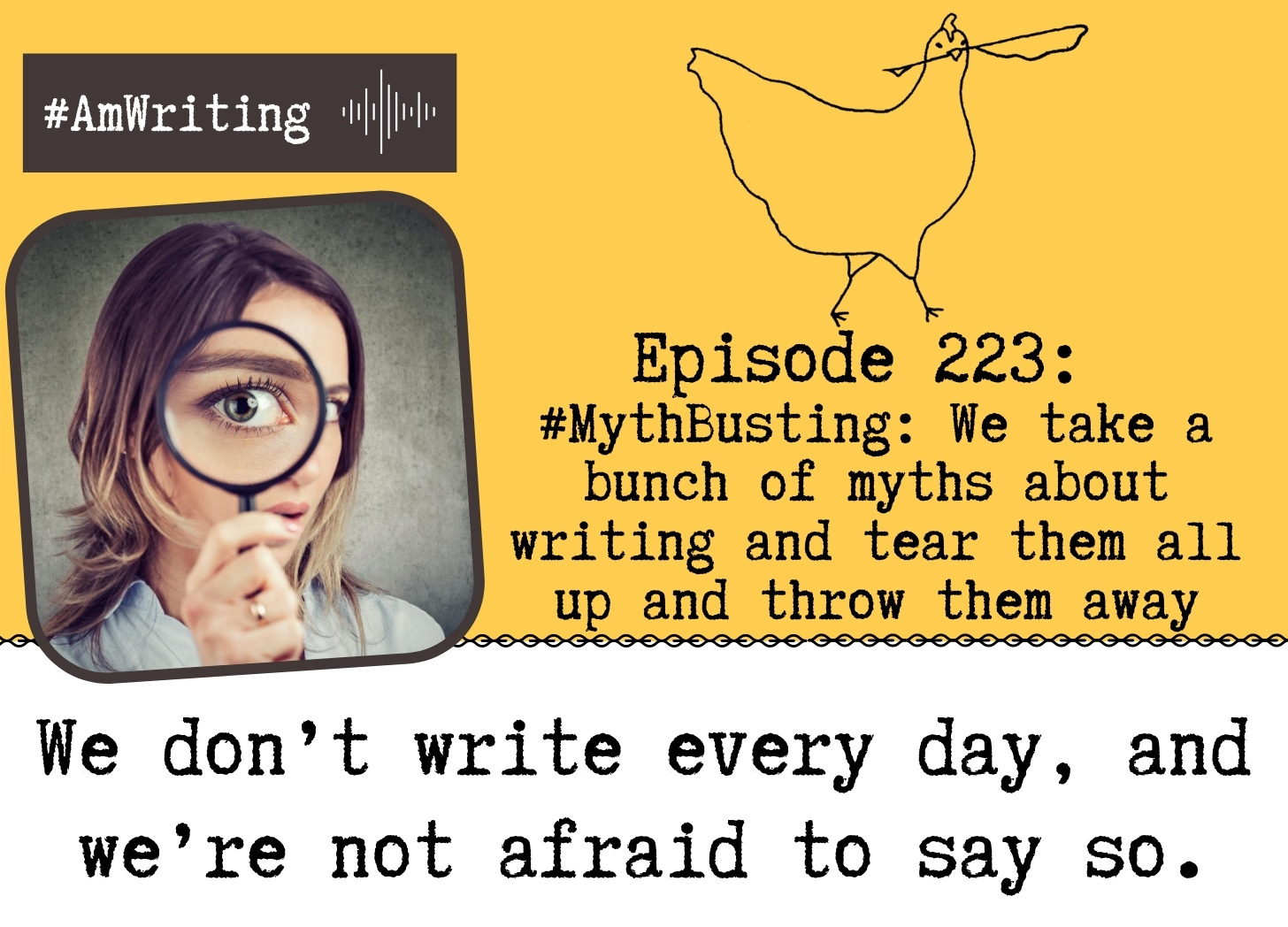
Episode 223: #MythBusting: We take a bunch of myths about writing and tear them all up and throw them away
Write every day. Don’t read fiction while you’re writing fiction. My way or the highway. In a burst of frustration, we’re reminding ourselves—and you—that there’s no one way to get this job done, and if your way is counter to what some of the greats might tell you (we’re looking at you, Stephen King, even though we love you), that doesn’t mean it won’t work.
A few links from the episode:
Minisode: #AmQuerying: How to write a fiction query letter that makes an agent ask for more
Becca Syme: https://betterfasteracademy.com/beccasyme/
#AmReading
Sarina: Notes of Silencing by Lacy Crawford
Jess: Unacceptable by Melissa Korn & Jennifer Levitz
Unspeakable Acts by Sarah Weinman
KJ: Big Summer by Jennifer Weiner
The Vanishing Half by Brit Bennett
Our amazing sponsors: Dabble Writing Software, which I can’t wait to use to line up all my scenes and plot points AS SOON AS I START FIGURING OUT WHAT THEY ARE and which you should absolutely try.
And Author Accelerator. Jennie Nash is doing a Facebook Live coaching of a memoir outline on August 14, 2020—that’s next week. I can’t wait, I love watching her do these. Sign up here, or just go learn more!
KJ Dell'Antonia 0:00
Writers, KJ here. Have you heard me talk about Dabble yet? I mean really listened. Dabble writing software is our new sponsor, and we love them. Sarina and I can't stop playing with the outline piece of it, which is every bit as flexible as a bunch of post it notes on your desk and a whole lot more portable. You can track everything that belongs within a scene, how that scene fits into multiple plot lines, and where that scene belongs in the book. And you can move it with the flick of a mouse. It's honestly a little too much fun. We don't want to encourage you to procrastinate, but getting your storyline right isn't procrastination. It's part of the work. So try out Dabble and let us know if it helps you get your work done by downloading a free trial at dabblewriter.com. Is it recording?
Jess Lahey 0:50
Now it's recording.
KJ Dell'Antonia 0:52
This is the part where I stare blankly at the microphone and try to remember what I'm supposed to be doing.
Jess Lahey 0:56
Alright, let's start over.
KJ Dell'Antonia 0:58
Awkward pause. I'm going to rustle some papers. Okay. Now one, two, three. Hey, I'm KJ Dell'Antonia and this is #AmWriting. The podcast about writing all the things, fiction, nonfiction, short pieces, long pieces, entire books, be they small or long, pitches, proposals, and as I say every week, this is the podcast about sitting down and getting your work done or not, but trying. I am, as I've previously stated, KJ Dell'Antonia. I am the author of the novel The Chicken Sisters, which will be out in December of this year, which is 2020. I'm the former editor of the Motherlode blog at the New York Times where I still sometimes contribute and the author of How to Be a Happier Parent, which is out in paperback and available everywhere now.
And I'm Jess Lahey, the author of The Gift of Failure. And I have a new book coming out in April. I just finished the galley edits so it feels real, called The Addiction Inoculation. And you can find my work right about now when this thing comes out in the Washington Post, but I write for lots of different places.
Sarina Bowen 2:19
And I'm Sarina Bowen. I'm the author of 35 romance novels. And you can always find more of me at Amazon Apple books and everywhere romances are sold.
So today's topic is kind of about keeping your head in the game.
Jess Lahey 3:06
It absolutely is. I'm optimistic. I'm going to go with the it is about keeping your head in the game. What is our topic for today, Sarina?
Sarina Bowen 3:14
It's myths about writing. All the things that we have absorbed over the years that may or may not be true. And myths come from a place of cultural reference. So these myths aren't out of left field, but we still want to examine them just to make sure we're taking the right advice.
Jess Lahey 3:36
Well, I think it's important to do that because some of these myths come from people. I mean, heck, if we took our oft cited David Sedaris advice about never, ever asking for anything, and that became sort of the way that writers were supposed to do things, then not a lot of writers would get stuff done. It happens to have worked beautifully for him. There are a couple of other authors that I'm going to cite while we're talking about some of these, and it can become the word of the writers. And it's not necessarily so because writing is different for different people.
Well, I think in particular, there is one myth that we really want to blow up today for all of our sakes. And that myth is the 'you must write every day'. Am I right?
It can be a goal.
And you know, I think we often make it sound like we do write every day. And we often do write every day. But I think what we don't talk about is that it is seasonal and cyclical. And that writing can sometimes mean other things.
Sarina Bowen 4:45
So I came up with the idea of myths, I mean, it entered my brain this weekend when I was listening to a talk by a writing coach named Becca Syme. And she was speaking at an event called Inkers Con that I was enjoying listening to. And she does some myth busting in hers but what she got to was that you have to examine the premise of these myths, like what premise are we accepting if we go along with it and KJ just said writers write every day and I would say that there's an even deeper premise to that one which is writers right because they must, and this one always makes me roll my eyes. Because I am definitely a writer. You know, my whole career is set up around this, but I have never once looked in the mirror and said, I'm a writer because I must, it's a compulsion for me. It's not it's actually my job and some days I just don't feel like doing it.
Jess Lahey 5:55
I think that for me, it's how I best express myself. I mean, I always would rather express myself in the written word than trying to explain something to someone orally. And that's just my preference for how I tend to make the best contribution. Do I have to write? In fact, if someone said I couldn't write for the rest of my life, I think I could be okay. I think I'd be fine. I may not be as well understood, but I think I would be fine. I'd have to make more phone calls. Oh my gosh, that would be the worst.
Sarina Bowen 6:33
You know, Jess, you just reminded me of that thing that happens at the very end of Spinal Tap the rockumentary. At the very end, when the credits are rolling, they asked each band member in turn, like, 'If you couldn't have rock and roll, how would you go on?' And the first one says something like, 'Well, but I'd still have the sex and drugs.' And then the last one is like, "Well, I could work in a shop.'
Jess Lahey 7:19
But yeah, I think that the whole I have to write or I will perish is along the lines of I couldn't live without you because I just don't think those are healthy ways to think about the world, but that's just me.<
You May Also Like
Daily Short Stories - Mystery & Suspense
Sol Good Network
Daily Short Stories - Ghost and Horror Stories
Sol Good Network
New Books in Literature
Marshall Poe
The Great Detectives of Old Time Radio| Daily Mystery Dramas
Adam Graham|Old Time Radio Detective Host

ジェーン・スー 生活は踊る
TBS RADIO
CyberSecurity Summary
CyberSecurity Summary
Book Shelter
Book Shelter

The Literary Life Podcast
Angelina Stanford Thomas Banks

ALEX
SUNNY

Daily Mass Readings
Augustine Institute
Daily Short Stories - Mystery & Suspense
Sol Good Network
Daily Short Stories - Ghost and Horror Stories
Sol Good Network
New Books in Literature
Marshall Poe
The Great Detectives of Old Time Radio| Daily Mystery Dramas
Adam Graham|Old Time Radio Detective Host
ジェーン・スー 生活は踊る
TBS RADIO
CyberSecurity Summary
CyberSecurity Summary
Book Shelter
Book Shelter
The Literary Life Podcast
Angelina Stanford Thomas Banks
ALEX
SUNNY
Daily Mass Readings
Augustine Institute
Community discussion