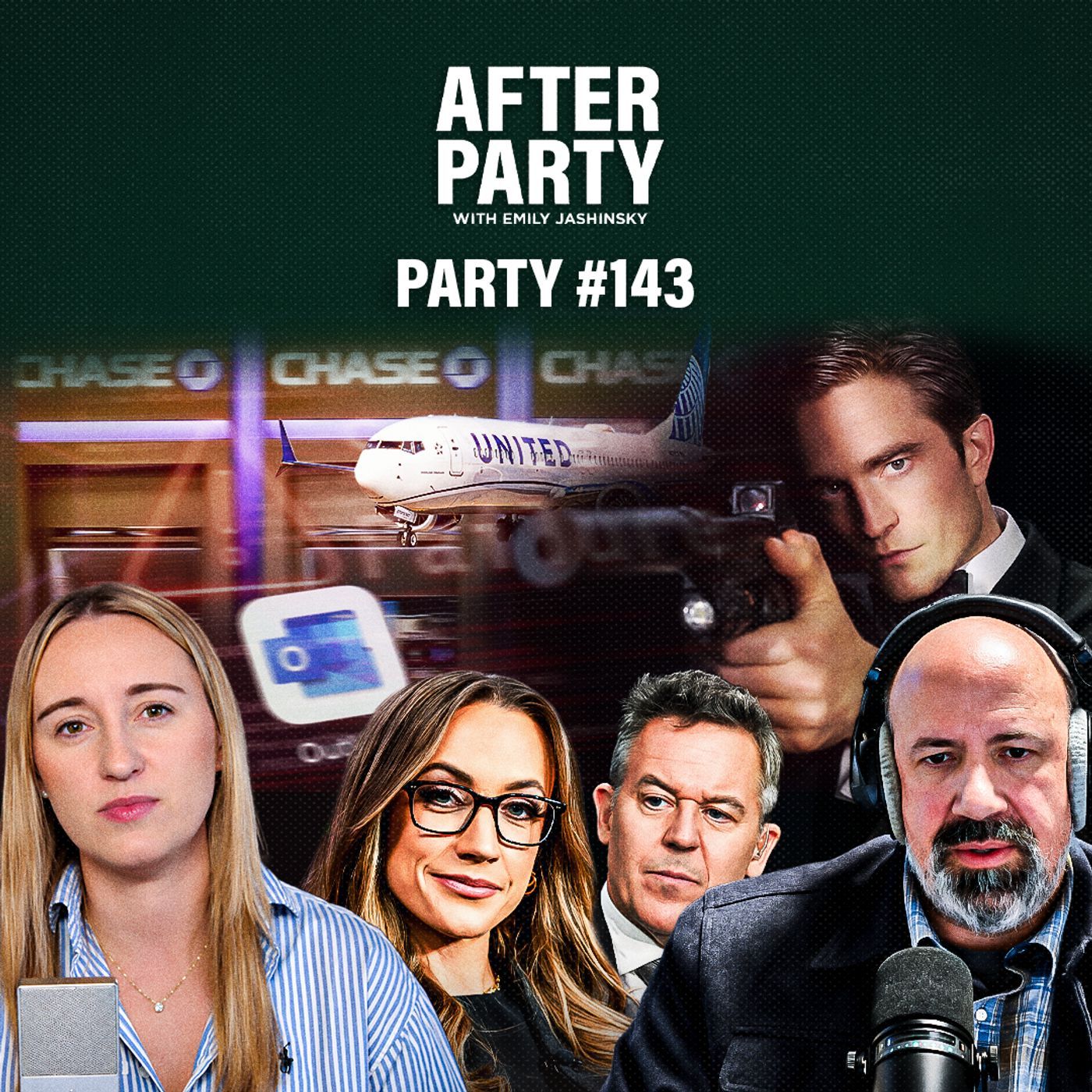
0:02 Hey, everyone. 0:05 Welcome back to After Party. Please do subscribe if you haven't yet. It helps us so much. 0:08 You can email me at emily at WKMedia.com. 0:10 I answer just about all your emails on every Friday's podcast. 0:14 You can find that on Apple and Spotify. 0:16 We are joined today by Mark Hemingway, friend of the show. 0:21 Mark is, of course, a senior writer at Real Clear Investigations and finds himself in the middle of An incredible battle royale for the future of the conservative movement right now, which we are going to get into. 0:33 Fear not. We're going to get into that. 0:35 We're going to get into the bulwark folks, many of whom Mark has known for a long time. We're going to get into that big fight between Kat Timpf and Greg Gutfeld that actually became an even bigger fight online 0:46 about boomer conservatives versus younger conservatives and whether or not that's even a useful dichotomy. But let's start with Doomsday because yesterday, where else would we start, Mark? Yesterday, let's toss this post up on the screen. Morning Brew noted 1:01 yesterday as the NSA's internal communications portal went down. 1:06 Thursday, it was Microsoft. Friday, it was the FAA. Monday, it was big banks. Tuesday, the NSA. 1:11 We should also add Apple had some, I think, difficulties yesterday. 1:16 The anthropic IPO, perhaps the largest in human financial history is dropping tomorrow, which I think is rather interesting timing for all of this sudden, uh, glitching. 1:26 Um, Mark, there's a lot to, there are a lot of different. 1:29 Ways we could take this. I'm curious, you know, are you, are you hunkered down? Are you prepping right now? 1:34 Uh, so, um, I was raised a Mormon. Uh, so, um, my God bless my, um, still practicing Mormon parents, um, I have a couple of months worth of freeze-dried food in my basement because that's what Mormons do. I actually think this is generally a good habit. Any number of 1:55 things can happen where you might need to take care of you and your family for a week or. 2:00 Two or possibly longer. I don't know. 2:03 I am not a total doomsday prepper though. Complicated systems, it's very hard for everything to go down permanently basically. 2:13 Having enough food and stuff on hand to get by for a week or two seems practical to having an entire bunker in your basement seems maybe a bit excessive. 2:24 Well, you know, you've been around Washington for a very long time, and I don't remember. I mean, you were here. 2:31 I wasn't here, of course, during 9-11. 2:33 But I don't actually really remember the city itself being this on edge. And what that tells me is that it's not just normal people who are on edge. 2:42 I'm curious if you have had a similar experience. 2:44 To me, it feels like even the people who normally project some calm and confidence are on edge here. 2:51 In D.C., Well, I think the big difference here, though, you mentioned 9-11, the big difference between, you know, 25 years ago and now is that when 9-11 happened, people still had a lot of confidence in our institutions and our systems to handle things like that. And I think 3:06 that subsequently in the last 10 years or so, we've realized that we shouldn't have as much confidence in those, you know, systems and institutions, you know, post-COVID, you Um, and post, you know, Trump, especially, and not because of 3:19 anything Trump did, but, you know, we saw all of a sudden that a lot of institutions in the pro-Trump era were acting not in the interest of the American people, but acting in their own sort of, you know, selfish political interests. And people assume that if, you know, the 3:31 crap hits the fan, that that's what's going to happen. 3:34 You know, um, all of these institutions that are supposed to protect us are probably going to start acting in very political and very self-interested ways, though, just the way that they did during COVID. 3:44 Well, and maybe because of a couple of things Trump did, just thinking about the bear hug of the AI industry, which I think allowed them to accelerate in a way we don't know yet, but we may find out, we may learn that that was a dangerous pace of acceleration. 3:58 And I guess that point about institutional trust, I think of big business and big government and big media, as Andrew Breitbart would have said, and Nobody has any trust in any of these institutions. Nobody has any trust in 4:10 the government to regulate the industry to tell you what's accurately happening behind the closed doors at the NSA. Because there was that weird leak yesterday with a Natasha Bertrand byline, of course. Right after the Dirty Bomb story, we learned 4:22 from Natasha Bertrand that six sources say the NSA's internal servers are down. Then someone tells the Wall Street Journal about an hour later that it was just a normal software patch. And then you're supposed to say, like, all right, 4:34 what is the government telling the truth? Is the CNN story anywhere near accurate? Like, we're just left looking around thinking, is my banking at risk? Is my national security at risk? 4:45 Right. 4:46 Well, you know, it's interesting. It's hard to tell what's going on here. There are a couple of competing theories, and it could be all of the above, basically. So one situation here is simply that since they've started releasing a lot of open source AI models that are powerful, 5:01 like DeepSeek out of China and other things, these things have fallen into the hands of bad actors and organized crime and rogue states and all these other things. And so they're able to use some fairly high level AI systems to hack into other systems, and that is causing 5:17 all kinds of problems. The second theory that's possibly not unrelated is that the AI allows coding software and updating systems at a level that was previously unprecedented. So there's some combination of people using AI to rapidly update systems 5:42 to either make them more profitable or to, you know, in some cases, I think, they're freaking out about hardening their systems against these AI attacks we've already seen by using more AI. And this rapid pace of updating everything 5:59 from AI-produced code that isn't human-reviewed and tested on a timeline like it used to be, it's just like, have Claude do everything and we'll throw it into the system and it should work, when in fact, updating software at that kind of speed tends to cause more problems. and 6:16 add more layers of complexity. So I think it could be, like I said, either one of those or both. But it would not surprise me if a huge number of the problems we've had with the banks and other things that we've seen where their systems have gone down could 6:32 well have been a result of trying to furiously patch the system as much as it has been outside bad actors. 6:39 I agree completely with that. 6:40 I think probably what's happened, this cascade of crises over the last week, you know, starts with, as we were just talking about, starts last Thursday, a week before the anthropic IPO is anticipated. That timing, you know, we're still 6:53 a couple months out from Jacob Coxon and whether or not that was coordinated, I have no idea, but it all is within proximity of the IPO. So Outlook goes out, FAA, and then the cascade continues. To me, it does seem like it's a combination of of what the New York 7:10 Times reported yesterday is JavaScript has a vulnerability that was found by a startup called Calif. And Calif is working with Five Eyes. And so is the NSA patch related to this Java vulnerability? They wouldn't confirm it to the 7:23 New York Times. So it's probably a combination of some patching and then some hacking, right? 7:27 Right. Well, yeah, and the patching is occurring because AI is discovering these vulnerabilities at an incredibly rapid pace as well. 7:34 So that's just one more layer of compounding the problem or whatever. But it's also true that whenever you have any sort of rapid technological progress, you tend to see upheaval. 7:46 And this is especially rapid technological progress. Of course, there's going to be the corresponding amount of upheaval that goes along with it. 7:55 Yeah, that's a great point. 7:57 This episode of After Party with Emily Jashinsky is brought to you by the coolest company ever. 8:01 It's called Wild Grain. Now we all know cozy season is here. 8:05 It's just making the perfect time for all of us to enjoy what else but fresh baked sourdough breads, seasonal pastries, and French butter that gets delivered right to your door and with good ingredients too. That's one of the things 8:17 I love about Wild Grain and it tastes so amazing. 8:20 It goes great with homemade soup. It's made by small independent bakeries with simple, high-quality ingredients, and everything bakes straight from frozen in 25 minutes or less. 8:30 So easy and so good. 8:31 You can customize your box with the classic, the gluten-free, the vegan, or the protein options, another very cool aspect of this. And then you can also really easily skip a delivery or cancel any time. I love a nice sourdough loaf on a cold evening with, like I said, 8:47 homemade soup. I had wild grain sourdough with a homemade tomato soup. 8:51 So good. 8:52 It just fills your house with amazing bakery aroma and it tastes so much better than grocery store options. 8:59 Trust me on this. I love, love wild grain. 9:01 If you're ready for warm bakery quality food at home this cozy season, I definitely recommend giving wild grain a try. 9:06 And for carbs giving, wild grain's biggest sale of the year, you can get $ 40 off your first box plus free croissants for life. That is the best offer you'll hear from me all year. So make sure you take advantage before the sale ends on November 22nd. Visit wildgrain.com slash 9:22 afterparty40 to get $ 40 off your first box and free croissants for life or use promo code afterparty40 at checkout. Again, that's wildgrain.com slash afterparty40 or use afterparty40 at checkout. This debate between boomer conservatives and younger conservatives, that's how it's 9:40 been framed. 9:40 And I want to talk to you, Mark, about whether it's accurate framing or not. 9:43 But it really, this latest round, kicked off with a debate on Greg Gutfeld's show on Fox News where Kat Temp took it straight to Greg Gutfeld. It was pretty interesting. 9:55 It was like a very raw moment, actually. And I think we have some of it here that we can roll. 9:59 Prices are still rising faster than pay. Gas is still a dollar more than it was this time last year. 10:04 GDP is up, but people are spending, not saving. It's just a fact that it's harder to buy a house now than it used to be. 10:12 I always think about that because I didn't buy a house until I think I was like 38. 10:18 Well, not everybody can wait till they're 60 to have a child. 10:24 But wait a minute, what is the connection? 10:27 You make more money now at 30, how old are you, 38, than I was making at 48. 10:31 Well, I'm not talking about myself, right? I'm talking about my generation and the generation below me and the average home buyer. is 40. If you feel like, you know, you can't save, you can't buy a home, you're not going to start a family. And women can't wait till 10:45 they're 60 because, like an omelet, you can't make a baby with no eggs. 10:49 So. 10:51 The point is, that's none of my business. 10:53 That's your business. 10:54 Why I can't do anything about the decisions that you make. 10:57 If you can't afford to live here, there are other cities where what you're being paid, you can actually live there and raise kids. 11:05 It's a million dollars in a record number of cities right now to buy a starter home. What is a starter home. 11:11 In your view? 11:12 I think I've seen average houses for 300, 400,000. 11:16 The problem is often worse in places where the jobs are. 11:19 Home prices used to be about three times median income. 11:22 Now they're about four to five times in some areas, six to 10. These are just the facts. And this is why Republicans didn't win at an age group younger than 65 plus. Socialism is not the answer to this. 11:35 Part of the reason things are more expensive is government. 11:38 But telling people that they're not feeling what they're feeling in their own real lives, it's clearly not a way to win voters. 11:46 So this is a cornucopia of different, and this is why it was such a, it was a debate that has been roiling. I mean, people say the right is divided over Israel, but Mark, the bitter divisions on the right that we've witnessed over the last week because of 11:58 this specific clip. I mean, our friend David Marcus was talking about this with Will Kane on Fox because that's like, this is how meta it is. You now have Fox weighing in on Fox because this went so viral. 12:08 Let's listen in. 12:09 This totally reads Gen X versus millennial to me. 12:12 I mean, it just like. 12:15 And I love Kat and I love Greg, but, you know, I find myself a little more team Greg just because it's like the Gen X attitude is like, yeah, OK, like you can't buy a. 12:26 House like rent, you know, like stop complaining. 12:30 And there's this millennial attitude of like, no, there's this whole life that we're supposed to be able to have. 12:35 And I'm like, oh, who said our parents? 12:39 Our parents. 12:40 We always come back to this. I'm like, I'm sorry to the millennials that your parents lied to you. 12:44 And I'm sorry that you believed that. 12:48 And David, I went back and forth on X. We'll get into this in just one moment. But before I toss it over to you, Mark, I want to read you, Mark. 12:53 This is Mark in The Federalist saying a political war is coming over boomer conservatism. Mark writes, the problem is that whoever is to blame, major structural problems still exist. 13:02 The average age of a first time homebuyer is 40. 13:04 As Tim alluded to above, 40 years ago, the average home cost about three and a half times the median salary. 13:10 Today is about five times the median salary. The cost of the average starter home increased 54% between 2019 and 2024 alone. That increase was driven by historically low mortgage rates. 13:20 And so far, prices haven't retreated anywhere near enough to make up for mortgage rates surging three to 7%. It's generally difficult to get your first home right now, even accounting for the fact that interest rates remain low relative 13:30 to when boomers were buying homes in the 70s and 80s. 13:32 And finally, You say, maybe it's absurd to believe Elizabeth Warren using the new Democrat majority to cap credit card interest rates at 10% does anything other than make credit cards unavailable to a large swath of the country. But 13:42 to the economically illiterate, it looks like they're trying to do something. And unfortunately, sometimes perception matters more than reality. 13:48 So there are two layers, the moral layer and the political layer that you address in your piece. I think that's part of why this is so complicated is there are some people who are saying this is a political disaster. 13:58 Hard to ignore that, Mark. And there's some people who are also saying it's a moral disaster. 14:02 Right. Well, there's so many dimensions to this. I mean, to some extent, this is just an extension of the, you know, debates between, you know, establishment free market Republicans and MAGA economic populists that have been waging for more 14:18 than a decade now. But that was already a politically potent debate. And now you cast it in generational terms and it becomes, you know, even more off the hook in terms of it being politically potent and something that 14:31 is really sort of driving people. Um, you know, and again, like, like I said, it, it, it, it, you can, there's a way to approach this. And, and like, you saw this in the Gutfeld 10th clip. Like, I love both of those people, but, uh, and, and, and the same, 14:49 and the same thing with David Marcus responding to this, like, well, what's the big deal? Life is hard. Like that may even be, uh, um, You know, an honest response. It may be that millennials and Gen Z need to stop 15:05 spending $ 500 a month on DoorDash and digital subscription services if they want to afford a home. These might be very true things. But the reality is, is we just went through an election where Republicans lost voters under 44 by 35 points. 15:18 Okay. 15:24 At a bare minimum, if we don't start addressing this, at least rhetorically, like at least trying to start feel their pain. Look, every generation, you know, you get married, you have kids, you know, you don't own a home. 15:38 There's a lot of anxiety about how you're going to get to a place where you are part of the asset class and you have some economic security. Every generation has felt that getting over that hurdle from when you're young to forming a family to owning a home. 15:51 Right. 15:51 That's kind of the American dream there. And to say that this generation, because maybe they're able to more loudly express their anxiety because we have social media now or whatever, is somehow especially whiny about this is just an unbelievable political loser. 16:06 And. 16:07 Just as a matter of rhetoric, people have got to start checking themselves if they want to win another election because Democrats could secure younger voters for a generation if they really latch onto this. And the Republican faction is 16:23 still largely divided with a whole bunch of people in this faction of you're not bootstrapping hard enough. Grow up. 16:33 It's just not a useful way to go about things. 16:37 Right. And the politics, I just think, are glaringly obvious, but also on the moral level. Like, I actually probably disagree with you. This is like an interesting internecine right debate. Like, I kind of agree with Elizabeth Warren and Josh Hawley 16:49 on capping credit card interest rates, but we don't have to go into that to say what your point was, is that it comes across as action for people who. 16:57 Feel like they're desperate for action. 16:59 And what I said to Dave was things are getting worse, even if our version of worse is is still better than what everybody had 40 years ago. Even if I have more material access to TVs that are cheaper and bigger, all of those things, even if I have that, if 17:18 there are trends, like right now, wages are being outpaced by inflation. 17:22 That is a metric that's getting worse. 17:24 If you have to become older to buy a house, if housing prices are going up as they really have since the pandemic, and Kat is right, thanks to government policies, the Cato Institute has a great paper about how freaking Dodd-Frank hurt the local banks that used to give good 17:37 loans for starter houses. So much of this was the government picking winners and losers in healthcare and all of that. 17:44 Healthcare is getting more expensive because of Obamacare, just as conservatives said it would. So when things trend in the wrong direction, conservatives actually should expect and want younger people not to tolerate that. 17:57 No, that's absolutely right. 17:58 And the other problem we have with quote-unquote boomer conservatism is that so much of what we've been sold for the last several decades... as free market economics isn't actually that when you read the fine print. Like, yeah, maybe they pass a tax cut, but it is larded up 18:13 with all kinds of rent seeking and giveaways to special interests and tax cuts for, you know, favorite industries and all these other things. And after so many years of that, you know, catering to, you know, the sort of business 18:27 environment in weirdly specific ways that don't necessarily raise all boats. 18:34 It's eaten away at the economy where there's just so much in the way of regulation and favors and everything else, never mind that the businesses themselves have gotten extremely efficient at lobbying for these kinds of specific things. Free trade 18:47 is the classic example of this. I believe in free trade. 18:50 Free trade is great, but everything that we've been told is, quote unquote, a free trade agreement is a thousand-page heavily negotiated multilateral agreement with a zillion exceptions buried in it. 19:04 And then they come out and they tell you it's free trade. 19:08 Which is also the problem with fair trade. And you and I would both agree that it's how special interests get cutouts. 19:14 And this is what's happened to the economy from all directions for several decades now. And so it's very hard to know what exactly is going on. And in that environment, when you see businesses getting all these special handouts and 19:27 favors or whatever, it's increasingly hard to say, well, why shouldn't the public be, you know, rent seeking for themselves? 19:34 To some extent, that's also the problem we've gotten ourselves into. 19:37 You know, the baby boomers were the largest generation in American history, and they voted themselves, you know, all kinds of largesse. There's just no ifs, ands, or buts about it. 19:48 I mean, the average person collecting social security right now is getting lots more money than he ever paid into that fund. And somehow everyone still believes, for instance. 19:57 That is statistically true, by the way. People can fact check that. 19:59 And every time I say this, you always get people like, no, no, that's my money. And it's actually not. You're taking someone else's money that paid the federal government. It's not just what you put into the fund from your own paychecks. 20:11 And there's all kinds of things like that. I mean, look at Medicare right now. It's the single largest line item in the federal budget. 20:17 And that's all going to people. 20:17 It's subsidized. 20:19 And it's incredibly subsidized. And it's all going to people over 65. People who are younger don't have those kinds of advantages. I mean, do you know what a family of four's health insurance premiums are like right now? But 20:30 people over 65 that are more economically secure on average by a long shot and don't have kids at home They get their health care paid for. I mean, I do realize you have more health challenges as you get older, but I mean, it looks very unfair. And that's because 20:44 in a lot of ways it is. 20:46 Well, and this is what's crazy to me. Like, Mark, you've been around for a lot of this. Boomer conservatives were correct to warn about the ACA. They were correct to warn about Dodd-Frank. They were correct to warn about all of the subsidies that are all the loans, the 20:59 student loans, government-backed student loans that were being used as subsidies to academia in a way that was going to raise prices. They have been correct about that. So what's bizarre to me is that they now turn around and say, no, no, no, 21:11 you're wrong to be upset about all of these things. 21:14 It's not that bad. 21:15 When they were the ones who were accurately warning, it was going to get really bad for a long time. 21:19 Yeah, no, it's very true. 21:21 And at the same time, it's weird, um, You know, one argument against the boomers is that if the younger generation. 21:27 Immigration, by the way, too. They were going to say. 21:29 Sorry, I didn't mean to interrupt, but it just jumped out at me, saying this unlimited immigration is going to make prices more expensive. 21:35 So, yeah, another vindication. 21:37 Yeah, and the other thing, though, is, you know, look, if free market policies are the answer to a lot of this, and I think they are in many situations here, then, you know, who is responsible for the fact that the 21:48 younger generations don't have any sort of respect or understand... 21:52 why these policies and values are important. I mean, they clearly just, clearly there was a failure of transmission there and I don't know who to blame. I mean, I do think both generations in terms of, if they're going 22:03 to make generalizing arguments about each generation, both sides have got good arguments. 22:08 I mean, it is true. 22:10 Millennials spend way too damn much money on DoorDash. I mean, they have some really weird cultural attitudes about things like, You know, I came from a, I wouldn't call my parents, you know, super wealthy, but they're probably the lower rung 22:21 of the upper middle class when I was growing up. 22:24 But like, you know, when I went to college, I was expected to eat ramen, even though my parents could have written me a check every week. And they're just like, generationally, there were things like, you know, in summers, I was 22:32 expected to have a job. Like, I just, I, you know, structurally, things have become harder in certain ways for younger people. 22:38 But there was also just different cultural expectations in terms of like, you know, young people growing. You know, in terms of, you know, how austere they were supposed to live and other things like that. And I think that's very much changed. And I think that is an indictment 22:50 of the generation. But, you know, maybe it's an indictment of their parents for letting them get away with it. 22:55 I don't know. But the problem is, is we've. 22:58 Got to stop talking past each other and hurling insults and actually start, you know, doing what we can to pass the kind of policies and espouse the kind of rhetoric that makes young people feel like they're going to be taken care of here. 23:11 Yeah, and that is the last thing I wanted to ask you about on this subject, because I suspect, and tell me if I'm over my skis or wrong on this, but so much of it seems like a form of Vance derangement syndrome, which is a proxy for new right 23:27 derangement syndrome, meaning people do not want any of this to be smuggled into the conservative movement. They don't want to have conversations about potential economic populist solutions. They don't want to have conversations about uh, a less interventionist foreign 23:43 policy and they see JD hiding behind every corner or in the new right, they see like JD and Oren Cass hiding behind every corner and they don't want to entertain anything that has, that smacks in any way whatsoever, economic populism, even if from Kat's perspective, it is just 23:59 libertarian diagnoses of heavily subsidized industries, making things more expensive. 24:03 It is, that's my, I feel like some of it comes down to that. 24:07 No, I think that's, that's actually accurate. 24:10 Um, You know, but I mean, again, the whole point, the whole thing about this sort of free market conservatives that I grew up with, they were known for policy innovation, right? 24:20 They took a core set of beliefs that markets were the best and most efficient way to spread wealth. And they came up with all sorts of creative policies that harness that, right? And, you know, everything from, you know, 24:32 school choice to supply side economics to all these other things. 24:35 And they were able to sell these things as like compelling new ideas, all right? Well, guess what? Now's the time. 24:41 We need the creative ideas or whatever. If you think that free market ideas and other things are the best way to do this, well, then recast them in populist economic terms at least. Maybe it will be a superficial political sale in that regard, and the underlying principles will 24:56 still be very supply-side libertarian, but at least make the effort for crying out loud the political future of this country depends upon it. You cannot lose voters under 44 by 35 points and not see this as a five alarm fire and not understand that you were not reaching 25:13 these people. Like, you know, you have got to, at the minimum, you know, change your message and, you know, and stop pretending like, you know, this is about, you know, some kind of, you know, um, you know, this is 25:27 about maintaining the purity of the, you know, ideological bloodline of the party for what it's worth. I mean, it's almost like, again, it's almost like the ideological equivalent of that. 25:35 I mean, it's, it's, it's really frustrating. And I say this as someone who is happy to see more free market ideas put out there. You've got to put them out there in such a way that people will listen and find them compelling, and they're simply not even trying. 25:52 Mark, I'm not saying this just to kind of glaze you, but you really have been a mature voice in this space for somebody who's been along for a very long time, been around. 26:02 I'm not calling you old. I'm calling you old, of course. 26:04 I am old. I am half a century old, yes. 26:06 You've been around. You've seen a lot of these people. Yes. 26:09 Actually, the big debate, actually the big version of this debate that was happening 10 years ago, you were at the center of. And it's because you worked at the Weekly Standard. I actually worked at the Washington Examiner at the exact same time. And our desks were not all 26:22 that far apart. I remember seeing you. I was basically a kid at the time. But I remember the day that the Weekly Standard ended. And it was the weirdest workplace vibe that I have ever experienced. 26:33 In my life. 26:34 I have been in not one but two magazines the day that they completely shut down. 26:39 So let me tell you. Yeah, that is a thing. 26:42 The problem is Mark, of course. 26:44 I was going to say, so this clip also goes mega viral last week and sparks another round of internecine debates. 26:50 But this one, actually, I don't even think it's fair to call internecine because we're going to get into this. 26:55 The bulwark, which spins off of the weekly standard about 10 years ago, is now totally outside of the tent by the description of Sarah Longwell of the bulwark that she is going to give in this clip at a Democrat conference. 27:07 I think it was a conference in Colorado. Here's what she said. 27:10 Come on, libs. 27:12 I didn't come here so you could sit here like it's a conference. 27:16 All right, guys, I'm Sarah Longwell, publisher of The Bulwark. 27:20 Thank you. I hope I've got some bulwark people out here. 27:23 You may know us. 27:23 We're the Never Trumpers. At least we were 10 years ago. 27:27 Now we're just kind of libs, just like the. 27:29 Rest of you. 27:30 Just libs hoping you guys can do it right. 27:33 Hoping that we can seize this moment. 27:35 All right, Mark, my theory on why this went so viral is actually that It wasn't because she said, what's up, libs? 27:44 I think everybody knows that they are in that tent now. 27:46 They have said many things. She campaigned with Kamala Harris, that sort of thing. I actually think it was because that was so profoundly embarrassing as an effort at like crowd hype and public speaking. It was just viral because 27:59 she made your skin crawl, not viral because she claimed to now be a lib. I mean, that is part of the debate and we're going to get into it. 28:06 But what the hell was that? 28:08 Well, it's a little of both, to be perfectly honest. 28:13 I mean, yes, people have, I think, long accepted that the bulwark has, you know, when the bulwark started, remember their motto on their literal mass set on the website, they had a slogan underneath that said, conserving conservatism, right? 28:25 Yes, that's right. I forgot about that. 28:28 And that was very quickly, like within, I remember within like a couple of months of them starting They published a piece by, I believe it was Molly Jong Fast, son of novelist Howard Fast, who won the Stalin Peace Prize. 28:42 I think that's what it was. 28:43 And daughter of zipless fuck author, fear of flying author, Erica Jong. 28:49 Yes. 28:51 And she went to CPAC and made fun of pro-lifers in a way that was just gratuitous. and really like ticked people off and like instantly people like, like, what are they doing? And, you know, bear in mind that the editor of, of, of the bulwark is, uh, um, 29:09 my old colleague, Jonathan laughs too. And, and, who I think still professes to be an extremely serious Catholic. 29:16 So, yes. 29:16 Well, and so people have context. 29:18 I pulled this tweet of yours, just again, not to interrupt, but just so people, you posted, to a large degree, both the dispatch and the bulwark emerged out of the ashes of the weekly standard where I worked. 29:25 And I can tell you the. 29:26 Former exists because the founders of the latter were frankly too crazy for the founders of the former. I disagree with the dispatch on some things, but they're reasonable people you can engage. 29:33 The bulwark? 29:34 The supporters insist they're entitled to be irrationally, unpersuasively hostile until the Trump is purchased total at which point they can go back to quote-unquote conserving conservatism but that's an excuse for their pre-existing and delusional narcissism which they're not 29:46 going to stop indulging if nothing else it's proven very profitable and yeah so just so people have that context about where you're coming from in this you probably know sarah. 29:55 Uh I've met her, although I didn't know her really well, although she was very friendly and was involved in a lot of things that were kind of in the Weekly Standard orbit. But certainly Bill Kristol and Jonathan Last, who basically run the place over there, I did work with 30:13 for years and knew pretty well. And I don't want to go into it, but there was a whole lot of crazy and unjustifiable behavior the last two years in. 30:24 The Weekly Standard orbit. 30:25 I mean, I, I, I'm really off the rocker kind of stuff, you know, people yelling at people in, in the office and, you know, losing their minds. And it was, it was all related to Trump stuff. Um, and again, it was also all about this purity spiral thing. Like, 30:40 you know, again, you know, Steve Hayes who runs the dispatch was, uh, um, and the founder of the dispatch was, you know, the editor in chief of the weekly standard through, um, much, if not all of that time, the last two years 30:51 or so. And again, he started a publication that's animating principle is to oppose Trump. And the Bulwark is their animating principle is to oppose Trump. And again, Steve didn't want anything to do with the other people at the Bulwark. 31:06 And like that should, I think, tell you something. 31:09 And Sarah was going back and forth with Jonah Goldberg over the weekend, which I think is the context that you waded into. 31:13 Yeah. 31:15 Jonah was like, of course, they're just libs at this point. 31:19 And everyone has known that. And she doesn't really have a good response. And I don't think any of them have a good response. Bill Kristol has said he is now a feminist, which again, Mark, you know him. 31:29 It doesn't compute. 31:31 So the revealing thing here is if your animating purpose was to stop Trump, okay? And your job, when like, and I, one of the big differences, I think, between the dispatch and the bulwark, or frankly, anyone in the bulwark that in anyone in the publishing journalism space and 31:49 the bulwark is that, um, You know, the dispatch and, and, you know, anyone else sees themselves in this space as, you know, running a publication. I mean, that comes with it, certain sort of obligations and responsibilities, the bulwark, even though 32:04 it's technically a publication. they see themselves as political operatives. 32:08 Right. And they are very much, you know, they're very fancy. 32:13 Sorry. 32:13 They're very forward about that. And Sarah Longwell comes out of the political hack campaign world for sure. 32:20 Consultant. Yeah. 32:21 Right. And that very much drives their approach to whatever, like they, their whole thing is about putting points on the board. But the problem is, is like they were so immediately compromised. It was like, to what end are they actually putting any points on the board? Like, If 32:34 you were building a– if your number one goal was to build a coalition that electorally to oppose Trump, why on earth would you publish a whole bunch of crazy pro-trans stuff, which is what the bulwark has done, right? 32:46 Even this last crazy wave election, all of the pro-trans– all of the anti-men and women sports measures passed in solidly blue states. Like it is just a flat-out losing issue. 32:58 But they are so ideologically captured by the left, the idea that they have any pretense here. 33:04 And it's being exposed. 33:04 You get guys like Jonah Goldberg who are resolutely anti-Trump. 33:07 Even in his post attacking Sarah Longwell, he said he would have voted for Kamala Harris or did vote for Kamala Harris. I forget what it was. That's how anti-Trump he is. But you see a situation where– and actually Andrew Sullivan went after the bulwark as well for being– 33:24 too authoritarian on lgbt issues andrew sullivan yeah the guy who's like personal crusade was getting gay marriage legalized and he's like you guys are too radical on gay issues for me um i mean they are just the again the issue is like i said it is a pre-existing 33:43 and delusional narcissism they are not going to stop indulging i mean I could go into this a lot more. 33:49 I don't want to for obvious reasons. But I genuinely think that's what it was. These are people that very much want acclimation and money, and they found it. It's funny how this works. The moment they stopped being conservative, 34:03 you had the wives of billionaires lining up to write you checks or demanding to invest in your publication or whatever. 34:10 I mean, they are doing extremely well financially at a time when publications are not Because this resistance lib grift is huge. And they do live shows now. I mean, they're so popular or whatever. They rent out theaters in Columbus or whatever. And like hundreds of people show up 34:28 like barking seals or whatever it is. You know, here Trump is, you know, evil. And Trump justifies every dark desire you've ever had to attack Republicans. I mean, like, and, you know, it's very profitable. 34:39 Oh yeah. 34:39 You're, I hadn't like put it that way in my own mind, but it's almost masturbatory for lefties who leave. Right. 34:45 It gives them that kind of, uh, like, right. Uh, the, and I guess what I was going to say is I'm curious there, if they were here and we were having a conversation with them, which would not go well, of course, but if they were, and by the way, I, 34:58 I still like Tim Miller and I think Tim is one of the more honest ones over there, even though we have an enormous amount of differences between us. I think Tim is like kind of a funny guy who, uh, has, has actually just been open about where he's gone on 35:11 some of this stuff. But, uh, where I was going to say, like, I think if they were here talking to us, they would say, well, conservatism is norms, right? 35:18 And for you and I, it's like, well, conservatism is protecting life. Conservatism is conserving the second amendment. Conservatism is conserving borders. Conservatism is a set of real policy issues. 35:30 And for them, it sounds like their version of conservatism was always just protecting our precious norms, even if those norms are being used against conservatives over and over and over again. It's very telling. I think their priority in 35:44 terms of what's most important about conservatism was protecting these norms. 35:49 Yeah. Well, this is the thing. 35:51 It's been this way my entire adult life in politics. 35:56 where we have this situation here where there's just this completely insane asymmetrical judgment about liberals and conservatives, right? Conservatives have norms and ideologies and expectations and all these other things. 36:12 And whenever they fall short of those things, because like all humans, we fall short of. 36:17 Our ideals, right? 36:19 There's immediately this finger pointing to conservatives like, aha, you know, you clearly can't be trusted because you don't, you know, practice what you preach. Meanwhile, liberals, their entire shtick, like what is the unifying ideology of modern American liberals? 36:35 There isn't one. 36:36 Anti-Trump for the last 10 years. 36:38 It has always been, well, we're pragmatists. We just do what's right in a given situation. And like they get to shape shift on every conceivable issue and And what that really means is they're like never actually held to account in terms of or I should say extremely rarely 36:55 held to account in terms of like they espoused an ideology and then they didn't quite live up to it. Right. 37:02 Because that ideology is like constantly changing. I mean, like 15 years ago, if you had told, you know, the average Democrat officeholder that, you know, the entirety of the Democratic Party in elected office is basically going to defend. 37:19 you know, men playing in high school women's sports, they would have looked at you like, you know, you just shown a card trick to a golden retriever or something like that. Like they're, you know, they, they, they have the memory of a goldfish and this sort of thing. 37:32 And they're allowed to just, you know, move on to the next thing or whatever. And like, I think it's really interesting that, um, you know, the, that the bow work had placed with a bunch of ex conservatives or whatever is like embracing that freedom to like stay to 37:48 say and do whatever the hell they want to like such an unbelievable degree that they just don't realize how given their background, especially that just exposes what is going on on the left generally and what they are personally. 38:03 You know, it's such a good point because on the question of norms, it's not even consistent in that, for example, you have Joe Biden and his advisors openly lying about his capacity as an executive. 38:14 And that's a. 38:15 Huge norm violation. I think voters recognize it as a huge norm violation. It was not transparent. But because it was in the service of restoring the norms that they say are so precious, or allegedly restoring the norms that they say are so precious, you have Joe Scarborough, who 38:29 I'm sure is a bulwark reader, probably dispatch reader too, saying, that's the best Biden I've ever seen after he came back from the White House. 38:36 I was like, what? 38:37 Well, the big part of the problem here, again, and I think it is worth stating here that like in this regard, Never Trump might be the least successful like major political movement of my life. I mean, it never actually spoke for a lot of people. And part of 38:55 the reason why is because the entire narrative for being Never Trump in many ways rested on kind of a false epistemology and basically inventing a bunch of narratives that didn't exist. So like you hear things and never Trump is like, well, you know, my number one fealty is 39:12 the constitution because after January 6th, Donald Trump wanted nothing to do with the peaceful transfer of power. And it's like, I'm sorry. Uh, were you in a coma in 2016 when Donald Trump won this shock victory and liberals launched 39:27 a campaign with major celebrities trying to encourage the electoral college to vote against Donald Trump and not in favor of the citizens that duly elected him and fairly elected him and then proceeded to spend the next two years, by the way, in the case of James Comey and 39:44 a lot of these other people, knowingly pushing a false narrative that he had treasonously colluded with Russia to steal an election illegitimately. And then they come around and say, oh, well, Donald Trump, you know, broke the norm of the peaceful 39:59 transfer of power. OK, look, we can have a talk about what Donald Trump did on January 6th, and I'm not exactly fond of it, to put it mildly. But don't talk to me about the peaceful transfer of power in 2020 when you're not also willing to talk about 40:14 the peaceful transfer of power in 2016. 40:15 All right. 40:17 And there are so many of these things where it's like, you know, like Donald Trump was this, you know, crazy, you know, charlatan. He was an adulterer. You know, he was, you know, totally unacceptable personal character, you know, for President 40:33 of the United States. he was running against Hillary freaking Clinton. 40:37 The Clinton global initiative was a nine figure shakedown operation. 40:41 She was, you know, spent her entire career covering up for her scuzzy husband who, by the way, was sexually assaulting people. Um, like I, I, I just, you know, what we've been told was like, I can't remember. There was a quote and I regret to say it was 40:53 from PJ O'Rourke or whatever, where he made something about, he made some quote about how Hillary Clinton was, um, Oh gosh, what was it? It was something about how like, um, She was, you know, bad, but she was within the 41:06 acceptable range of bad. And like, this was the fundamental problem. 41:10 What we had been told was acceptable for a politician was like so awful. And it had been so awful for so long that when Trump came along, none of the norms applied anymore. And that was not Trump's doing. 41:24 That was an entire party defending Bill Clinton after he lied through his teeth about doing, you know, unspeakable things to an intern in the Oval Office. and a million other things that he did. There were so many things that happened along the way to degrade the office, to 41:42 degrade people's perceptions of what a person holding the office should, what character that person should be, that by the time Trump rolled around, people were like, I'm sorry, my vote is just completely transactional. 41:56 And guess what? 41:57 Trump was better at the transactional part of things than almost any Republican president of my lifetime, at least until recently, you know? 42:05 And that's, yeah. Yeah. It's, it's, if it's transactional, be honest and say it's transactional bull workers instead of. 42:10 Like, that's what Trump did. And that's where people, some people appreciated that. 42:13 Some people bought into his whole shtick, but a lot of people were like, yeah, that's, he's at least being honest. 42:17 I have never bought, I've never, I've never liked Trump's character. 42:22 I have never defended it. I never will. But the reality is, is that you know, George W. Bush was wink, wink. 42:28 He was an evangelical. He was going to do good things for the religious community and the pro-life community or whatever. 42:32 What did George Bush ever do for them? For the most part, he didn't do a whole heck of a lot. 42:37 Donald Trump was the first president to get elected and put two people in the Supreme court and, you know, overturned Roe v. 42:42 Wade. 42:42 And I think he did that because he knew he had to be transactional for once voters understood that, uh, um, you know, he owed them and not the other way around. Um, And again, that may be a weak defense of Trump. 42:55 There may be some even moral problems with it, but you've got to understand that by the time we reach this point, this is how people were thinking. And to acknowledge that this was some completely anomalous thing that came out of nowhere, Trump was not the disease. He was 43:11 very much a rather large symptomatic rash from a disease that we'd known we'd had for a very long time. 43:18 And until you acknowledge that, You're never going to have the right attitude in terms of either, you know, opposing or supporting Trump. 43:25 Right. 43:26 And I just can't stand that these people will think that they had some unique moral insight, you know, that they had to break with all the people on the right in order to, you know, in order to understand this. 43:38 Right. And they just want to keep to continue the metaphor going, injecting the body politic with the disease. A recent Danish study revealed something heartbreaking just one year after an abortion. Women were 50% more likely to need psychiatric 43:51 treatment and 87% more likely to experience personality or behavioral disorders. 43:56 That's not women's health care. 43:58 That's trauma. 43:59 But at Preborn, women find the real kind of care, the kind that heals. When a woman walks into one of Preborn's network clinics, she's welcomed with open arms. She's introduced to her baby through an ultrasound. And for the first time, she sees life. 44:12 Not loss. And she's offered hope-filled choices. 44:15 When she chooses life, Preborn continues walking with her for up to two years, providing maternity clothes, diapers, counseling, and so much more. There are babies in their mother's wounds who need our. 44:27 Help right now. As the year comes to a close, your tax-deductible donation can be the difference between life and death. 44:33 I'm calling for an army of people to begin giving $ 28 to Preborn today. $ 28 can help provide one ultrasound. 44:41 That can rescue a life. But for some of you, I want to call to a higher level. a leadership gift. 44:46 You can do more than $ 28 today. 44:48 Your gift of 5, 10, or 15,000 will be used to save countless babies for years to come. In fact, 15,000 helps provide an entire ultrasound machine to clinics who desperately need this equipment to save lives. Dial pound 250 and 45:02 say the keyword baby. That's pound 250 baby or visit preborn.com slash Emily. That's preborn.com slash Emily. All gifts are tax deductible and preborn is a five-star rated charity. I wanted to ask about Robert Pattinson being named James Bond. Speaking 45:17 of Donald Trump, I think maybe Robert Pattinson's biggest cheerleader in the 2010s was Donald Trump. The amount of tweets he sent in the year of our Lord 2012. So many tweets and stories on Stewart slash Pattinson. 45:29 Look, it doesn't matter. The relationship will never be the same. 45:31 It is permanently broken. 45:33 Everybody wants to talk to me about wants me to talk about Robert Pattinson and not Brian Williams. I guess people just don't care about Brian after Friday's Twilight release. 45:40 I hope Robert. 45:41 Pattinson will not be seen in public with Chris and she will cheat on him again. 45:44 Anyway, that's a bit of a tangent. 45:46 I just can't help but bring up Trump's best tweets ever, probably about Robert Pattinson. It doesn't get better than that. 45:53 That is the president of the United States. 45:54 But Mark Pattinson, good bond or bad bond? 46:00 Um, I think he'll be fine. I mean, I think he's a good actor. 46:03 Fine Bond. 46:04 No, he's great. I mean, here's the thing. 46:07 Given what so much has been talked about and other things, this has been going on my entire life. 46:14 Who will be the next Bond? 46:16 A reminder, again, Mark is old. 46:18 Yes. 46:20 So all I can say is given who gets talked about for this role often, it could be a lot worse than Pattinson. Pattinson's an extremely skilled actor, so Even if I didn't... I don't quite see him as Bond, but I have such faith in him as an actor 46:35 that I have a feeling he'll find a way to make it work. I was personally in favor of Callum Turner, who was wonderful in. 46:42 Boys and Girls. Really? Really? 46:45 Yes. Well, here's the thing. 46:47 Like all true Bond fans, I know the books, and Callum Turner actually fits the portrayal in the books and the appearance in the books much more, I think, than just about anybody else. 46:58 And also. 46:59 I really did think it was fantastic in Masters of the Air and Boys in the Boat. 47:03 Why do you think he fits the appearance better? 47:05 Well, it's just the way that Bond is described in the books is he's not necessarily like the most classically handsome guy. He's more charismatic than anything else. 47:13 Not like Pierce Brosnan. 47:14 I think that kind of fits Callum Turner, who, you know, is kind of a wingnut. I mean, he's got those weird ears and everything else, but somehow he seems to make it work or whatever. 47:23 He'll leave a hardest hit. Right. But. 47:30 I don't know. 47:31 My bigger issue is just that Bond is kind of– Nick Carter on Twitter said something that was really interesting. 47:36 He was like Bond is just basically incoherent in the 21st century. Like Britain has no desire or capacity to project power across the globe at this point in time. 47:46 And like whatever it was in terms of Bond is sort of a British icon. It's like an icon that stands for like what exactly anymore? Like is the Bond movie going to– him going around North London arresting people for bad tweets? actually i mean it is such a 48:02 you know it it's such a bond is such an anachronism at um at this point in time and the funny thing is people say bond is an anachronism because he's a womanizer and all these other things for a very long time but like he's truly an anachronism like 48:17 just in terms of like the actual character now and um that's what uh um i'm i'm i'm more curious to see but They have a great director. I just, I hope they come up with a decent story. The other thing, the interesting thing is, and this could go 48:31 either way, it could be really bad or, or it could be, you know, could be really helpful. Apparently Jeff Bezos was heavily, heavily invested in, uh, bonds since they bought the rights from Cubby Broccoli. Um, and he was, you know, very active and I think maybe even been 48:47 like person responsible for picking patents. And so, uh, we'll see whether Amazon, um, you know, treats Bond the way that they treated Lord of the Rings or not. 48:58 Pattinson, I agree. I think he'll be a fine Bond. 49:01 But yeah, to your point, there's like Western swagger that was represented, even as like the British Empire was shrinking, Bond was the clever embodiment of Western Cold War swagger. 49:11 And it's like, well, what are we projecting anymore with this other than nostalgia? Yeah. 49:17 Yeah. 49:18 I just don't know. I mean, but anyway, any can be made good with a good story. And, uh, you know, I don't know, maybe that's the writer and me complaining constantly, but like I, this is my big thing anymore is just like movies just aren't well written. There are certain 49:31 expectations they have. And I frankly think a big part of the problem, and this is maybe the most boomer thing I'm going to say here. The problem is the audiences are dumb and, Not that the movies are, have gotten so much worse. It's just that they, you know, 49:44 they have to cater to a certain audience. I mean, this is the thing about like, you know, Amazon instant video or Netflix or whatever, they get all these crazy instant metrics. And so like everything is lowest common denominator now, 49:55 like the, a lot of the best movies that escaped the studio system in the seventies and eighties in America or whatever were things that were just, you know, complete risks. 50:03 And like, nobody takes risks anymore because they can tell you that, you know, I don't know, somebody with a 78 IQ turned it off within two minutes or whatever rather than just stepping back and appreciating it as a holistic piece of art. 50:15 So I don't know. Anyway, AI is going to kill us all before Bond hits theaters anyway. 50:21 So true. I knew you'd have interesting thoughts on that. 50:24 You know, Mark, I got an email a couple of days ago from the family of Sheridan Gorman before we wrap here, who was slaughtered by a criminal illegal immigrant in March. And they sent such a lovely email. They watched a segment that you and I did about their 50:39 advocacy on behalf of Sheridan back over the summer. 50:42 And they sent me. 50:44 This link to an initiative they're doing is called Sheridan's Bench. 50:47 And it's from the Sheridan Gorman Foundation, which they say exists because Sheridan's life was too bright, too loving, and too meaningful to end at 18 years old. She had a rare gift for making people feel seen. She gathered 50:57 people in, loved them fiercely, and somehow made the world around her feel warmer simply by being in it. We want to carry that spirit forward in ways that are both tender and brave. And Mark, you and I would both agree, these angel families just don't get enough attention 51:08 at all from our media. So we wanted to shout out the Gorman family here. 51:12 We want to say we're praying for them. 51:13 We wanted people to go check out the Gorman foundation and Sheridan's bench. 51:17 But Mark, uh, man, I know you were moved by that email too. 51:21 Yeah, no, I mean, it's really something. And one of the things that last several years here and just an unbelievable amount of profound frustration over the amount of preventable deaths, um, you know, and, and There's always things that you can't anticipate, right? 51:35 You know, and maybe things that, you know, seem preventable one way or the other, but, but the idea that, you know, people are dying because they're just not enforcing basic laws anymore. Things that we took for granted, you know, 10, 20, 51:45 30 years ago, it's just absolutely insane to me. And these people deserve all the sympathy and. They should have a lot more, you know, it should be a lot more politically potent that we experience these things than we do. 51:58 And instead, we've come inured to it. 52:00 And, you know, I mean, I live a mile from Fairfax County where the DA is just like going, you know, hog wild in terms of letting the worst people alive, you know, walk free. And it's just absolutely infuriating to contemplate. 52:16 And if anything ever happened to my family as a result of something like that, I just lose my mind. 52:21 Yeah. Check out Sheridan'sbench.org and learn more about what the Gorman family is doing. 52:27 Mark Hemingway, thank you so much for being here. 52:29 Oh, it's always fun. 52:31 As winter sets in, feeling your best through the holiday rather than just dragging yourself through the busy travel comes down to supporting your gut. It's easy to assume holiday bloating and catching every cold are inevitable, but prioritizing your 52:44 gut health actually changes everything from your digestion and energy levels to your skin and hair. And that's where Cowboy Colostrum makes all the difference. By the way, just think about how many pictures are taken during the holidays. Who 52:55 wouldn't want to have the best skin and hair possible during that time of year? So with Cowboy Colostrum, you just simply stir it into your morning coffee or your smoothie. 53:04 I actually like it in a cup of milk. 53:06 It's full fat, unstripped, and packed with bioactives like immunoglobulins and growth factors to fortify your immune system while keeping your digestion steady. It made 100% In America, from grass-fed cows, it's ethically sourced using only surplus colostrum after calves have 53:21 had their fill, which is so important. The results speak for themselves. Clinical studies show 83% of users noticed improved gut health and 79% experienced less bloating. As an added bonus during stressful holiday travel, you'll also notice clearer skin 53:34 and visibly thicker hair. Our listeners can always get 25% off their entire Cowboy purchase by using code AFTERPARTY. But for a limited time, Cowboy is doing an incredible Black Friday discount. If you subscribe, 35% off your subscription order. 53:48 Just head to cowboycolostrum.com slash AFTERPARTY and use code AFTERPARTY at checkout. Well, former Border Patrol, I think his title was actually Commander at Large, Greg Bovino, familiar face. We were following the Operation Metro surge news over the course 54:03 of last winter in Minneapolis. Greg Bovino was at Rutgers this week. Now, Governor Mikey Sherrill weighed in by saying, you know, she doesn't like Bovino. She's going to protect Bovino's right to speak, all of that sort of thing. 54:17 Remember how Abdul El-Sayed campaigned on saying free speech is under attack. 54:21 That's something I agree on. 54:23 We've had Greg Lukianoff on the show a couple of times to talk about it, in fact. Bovino got shouted down at Rutgers, was able to continue his speech. But let's dip in and see how it went. New Jersey seems to have a problem. 54:37 You all are a Nazi. 54:39 Get out of here. 54:40 You're not a Nazi. 54:41 That poll is failing. Okay. 54:47 So if you watch the show for a while, you know, my background is actually in. 55:15 Helping conservative kids bring speakers to their campus. I did it myself when I was in college. Very familiar scenario could have been ripped straight from the headlines when I was in college, what happened to Bovina last night. I 55:26 wanted to mention, of course, though, that we have seen efforts from the right recently that don't resemble that. There's an important distinction. I'm going to get into it in a moment. But I do want to mention that Hassan 55:40 Piker was speaking at the University of Texas recently. And some prominent Republicans actually said the event should not happen. 55:48 And those people include Greg Abbott, Ken Paxton and Ted Cruz. 55:52 They called for the event to be canceled, according to news reports at the time. And many of you actually probably even. 55:58 Remember that happening. 56:00 So what I have not seen. in my professional experience, is conservatives physically disrupting or shouting down speakers inside a lecture hall like that. In fact, there were conservative groups at UT Austin who said they're not calling for the 56:15 event to be canceled, the Piker event to be canceled. 56:17 They were simply protesting quietly outside of it or protesting outside. 56:21 Of the event. 56:22 But I actually find it somewhat troubling that Republicans were willing to say, I'm sorry, that Hasan Piker shouldn't be able to speak on campus. 56:32 Not nearly as troubling. This is not both sides in it. 56:35 Not merely as. 56:36 Troubling as seeing people be shouted down. I found what the Trump administration did to Rameza Ozturk to be extremely troubling. 56:43 You see- Her getting pulled off the street, literally, for writing an op-ed against a BDS. It was an anti-BDS op-ed at Tufts, directed at Tufts. It wasn't even about national politics. It was specifically about boycott, divest, and sanction 56:58 policy at Tufts University. Yeah, disturbing to see her pulled off of the streets by plainclothes agents. Go watch the footage if you haven't seen it yet. I think this is very disturbing. I do think it's an important distinction 57:11 that you don't see that from a lot of conservative students, even though many of them believe that, wrongfully in my opinion, I've done a whole video on this, but believe that, uh, Hassan Piker is some type of Nazi, just like those 57:25 people believe of Greg Bovino. You heard them, uh, shouting it at the time at, in that video that you just saw. 57:32 So I wanted to make that point. 57:33 I do think it's a distinction and there's some research to back up what's happening to this is foundation for individual rights and expression fire. Again, that's where Greg Lukianoff is from. We've had him on the show multiple times. 57:44 A poll released in September found 30% of college students nationwide believe using violence is an acceptable way to stop a controversial speaker at a campus event. That's according to their latest survey. 3% said it was always acceptable. 12% 57:56 said it was sometimes acceptable. And 16% said it was rarely acceptable to use violence as a means of prohibiting a speaker from appearing on a college campus. That was up 10 points from four years ago, according to FIRE. 58:09 69% of students nationwide believe shouting down a speaker is acceptable. 58:15 But that's down three points from last year. So at least there are fewer, according to this poll, of the Bovino shouter downers. But those are still, as Fox News noted in a write-up in September, that's actually still up 58:28 seven points from four years ago. And as we have covered, polling, well, actually, this is from FIRE. 58:35 Let's just quote. 58:36 Liberal and conservative students are roughly equally accepting of violence. Mercifully, overall support for violence declined slightly this year, but over 30% of students still say it's at least rarely acceptable to use violence to stop a speaker. A little teaser 58:49 of an episode we're doing next week with Andy Ngo. 58:51 Please subscribe to see it. 58:52 I just kind of did a big picture... Sit down with Andy about his career. 58:57 There is a lot of research that we're going to go into on next week's next Wednesday's episode with Andy about how it looks like this is still a stronger position about the acceptability of the justification of violence. 59:10 Among young people on the left. But it's not good to. 59:15 See it growing on the right either. And I just wanted to make the point that there is a distinction between protesting event and trying to shout down a speaker and Stop shouting down speakers. You make them stronger. First of all, I'm not a particular fan of Bovino whatsoever. 59:32 It was very critical of the way that entire situation was handled. We've talked about it a bit on our Friday episodes, so you can probably go back and find episodes of that. But you make people stronger by doing that. 59:48 You make a big media story out of it by doing it. You make them more sympathetic to some people by doing it. And you also prevent something much more constructive from happening, which is asking, going up to the microphone and asking him a question. Um, and trying to 60:03 pin like how many students on the left, how many people on the left would share their own clips with Charlie Kirk? Because they thought they got the better of him when they asked a question, Charlie Kirk style, like stunned by this question from a lib. 60:16 That's fine. This is a much more constructive use of our time. Go to the microphone. 60:20 Ask a question, it's going to be more constructive than blowing Bovino up into this major figure who is now being protested by students because his opinion is just so unacceptable and brave and all that sort of thing. And also just for the principle of it, which is that 60:36 you let other people speak because when we don't do that, public policy is worse off. Because if somebody is mainstream enough that the college Republicans are or the conservative club at Rutgers believes that their ideas are worth hearing. 60:52 There's a democratic process involved in that. 60:55 And if they're mainstream, mainstream enough, you let them speak and beat their ideas as best you can, um, in, in argument and then elected in argument rhetorically, and then at a ballot box. 61:08 So it's kind of. 61:09 Trite and cliche to make these points, but It's always a good hook when you see someone getting shouted down like that. 61:17 You know, if it. 61:19 Happens more and more, I will hope to see somebody like Abdu'l-Sayed saying, let the guy talk. I was glad actually Mikey Sherrill said, let the guy talk. It's like an improvement over previous situations. 61:31 And guess what? It's an improvement over Greg Abbott saying, cancel Hassan Piker. Come on. 61:37 You let people talk and you do the best that you can to beat them that way. 61:41 And you don't use a liberalism. 61:43 As a crutch because illiberalism will beget more illiberalism and none of us will like where that goes. 61:49 All right. That's it for today's edition of After Party. 61:52 On that happy note, email emily at doublemycaremedia.com if you want your question to be included in this Friday's episode of the show. 61:58 Subscribe, leave a review. It helps us a lot. We appreciate it. 62:01 And we'll see you back here on Apple or Spotify, wherever you get your podcasts on Friday with me.










Community discussion