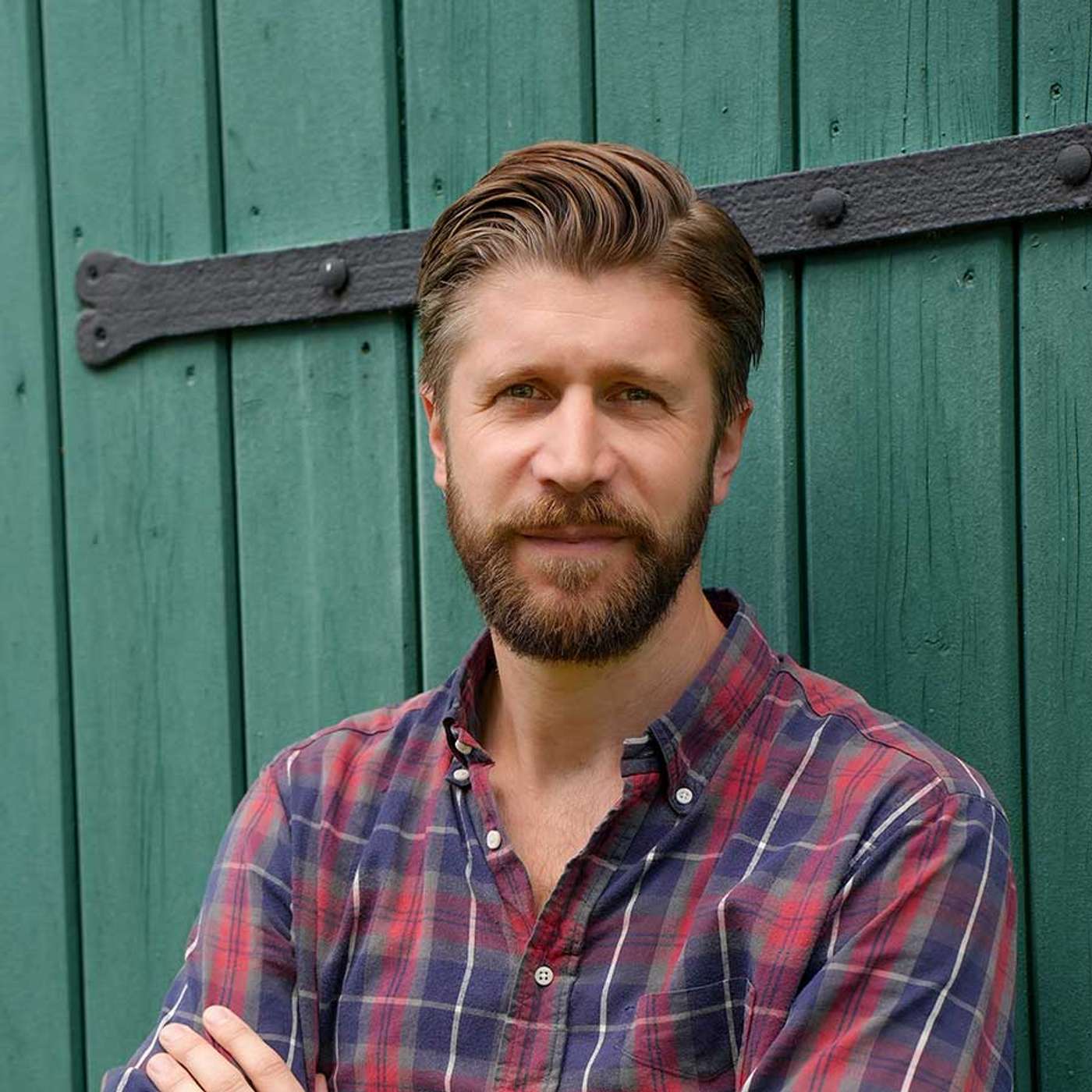
Food and Farming Revolution with regenerative farmer, author and Thrutopian, Benedikt Bösel
It's clear we need a whole new approach to the ways we farm our food - one that treats the natural world as a partner, where we can co-create abundance in service to life. The task now is to create prototypes at scale in many different contexts so that people can experience the difference between real food grown in healthy, life-filled, life-giving soil and the empty calories of the industrially processed semi-edible toxins that our current systems produce. On top of this, we need layers of education to help people appreciate the difference between the lifeless soil, murdered hedgerows and contaminated water of industrial agriculture, compared to the abundant ecosystems of regenerative farming.
We talk about this a lot on the podcast, partly because we live on a regenerative smallholding and we're part way through the Roots2Regeneration training, but even without this, there are some core systems that need to change as part of the overall Thrutopian shift we need to make and our entire food and farming system is a key one of these: everyone needs to eat, but more than this, we need to experience what it is to live in a way that enhances the flourishing of all life on earth. So in searching for people who are living this new system, experimenting, creating radical new ways of engaging, we came across this week's guest.
Benedikt Bösel is an agricultural economist, regenerative farmer, and author of the book Food and Farm Revolution: for our climate, our biodiversity, our health, even our very existence. As you'll hear, when Benedikt took over the family farm, he was faced with a thousand hectares of sand, and he had to find a way to make it work, not just within the current economic system, but in a way that was going to work for the land, for the people living there, for the communities around it - and most of all, for future generations. He brought a background in the finance industry and an early attempt at high tech agriculture, but it was the realisation that even his family's approach to ecological farming - what we'd call organic - was not sustainable that took him down the regenerative route. His book is beautifully put together and reads with the pace of a thriller - it's a memoir, a template, a call to action - and a Thrutopian route map - by the end, he's looking forward to a future where we're in climate breakdown, but we're working with all parts of ourselves, each other and the web of life to create a food system that works at all scales... and uniquely in my experience, he's looked hard at the political and governance shifts that are needed to get us here, as well as the shifts in our current economic model. It's exactly what we need in these times and I will read it regularly, often and there are bits I'm going to print out and stick on the wall. So in the hope that you, too, can be inspired, please do enjoy this episode.
Links
Food and Farm Revolution
Benedikt's 'Living Lab'
Benedikt on LinkedIn
Dirt to Soil by Gabe Brown
—About Accidental Gods—
We offer three strands all rooted in the same soil, drawing from the same river: Accidental Gods, Dreaming Awake and the Thrutopia Writing Masterclass
Our next Open Gathering offered as part of our Accidental Gods Programme is 'DREAMING YOUR YEAR AWAKE' which will run on Sunday 3rd January from 16:00 - 20:00 GMT - Details here. You don't have to be a member of Accidental Gods to come along, but if you are, all Gatherings are half price.
If you'd like to join us at Accidental Gods, this is the membership where we endeavour to help you to connect fully with the living web of life.
If you'd like to train more deeply in the contemporary shamanic work at Dreaming Awake, you'll find us here.
If you'd like to explore the recordings from our last Thrutopia Writing Masterclass, the details are here
Manda and Louise both offer one-to-one Mentoring Calls. Manda is writing a book just now, but if you'd like to contact Louise, details are here.
Manda: Hey people, welcome to Accidental Gods. To the podcast where we do still believe that another world is possible and that if we all work together, there is still time to lay the foundations for that future that we would all be proud to leave to the generations that come after us. I'm Manda Scott, your host and fellow traveller in this journey into possibility. And this week we're looking again at Regenerative Farming. It's obvious and has been obvious on this podcast for a while, that we need a whole new approach to the ways we farm our food; one that treats the natural world as a partner, where we can co-create abundance in service to life. What we need now, knowing this, is to create prototypes at scale in many different contexts, so that people who have nothing to do with farming can experience the difference between real food grown in healthy, life filled, life giving soil, and the empty calories of the industrially processed semi edible toxins that our current systems
produce and to which they are very good at addicting us. On top of this, we need layers of education to help people appreciate the difference between the lifeless soil, the murdered hedgerows and the contaminated water of industrial agriculture, compared to the abundant ecosystems that are brought about by genuinely regenerative farming. We talk about this a lot on the podcast, partly because we live on a regenerative smallholding, and we're part way through the Routes to Regeneration training, which is great. But even without this, there are some core systems that need to change as part of the overall thrutopian shift that has to be made. And once we've got through shifting our politics and our governance, our economics and our finance, then the next thing that we absolutely need to change is our food and farming system.
Manda: Everyone needs to eat. But more than this, we need to experience what it is to live in a way that enhances the flourishing of all life on earth. This is really fundamental. If we don't change how we are and who we are, then changing the rest of the systems will not make a difference to the fact that we are barrelling towards the cliff edge of extinction. So in searching for people who believe in this new system, who are experimenting, who are creating radical new ways of engaging, we came across this week's guest. Benedikt Bosel is an agricultural economist, a regenerative farmer, and author of the book Food and Farm Revolution, which has the subtitle 'for Our Climate, Our biodiversity, Our health, even Our Very Existence'. Benedikt really gets it, as you'll hear. When he took over the family farm one hour east of Berlin, he was faced with a thousand hectares of sand and another 2000 hectares of monoculture pine forest. And it wasn't working. He had to find a way to make it
work, not just within the current economic system, but in a way that was going to work for the land, for the people living there, for the communities around it, and most of all, for future generations. He brought to this work a background in the finance industry and an early attempt at high tech agriculture. But it was the realisation that even his family's approach to ecological farming, what we'd call organic farming, was not sustainable, that took him down the regenerative route. And he had a light bulb moment, much as we did here, because once you understand what regenerative farming can do, how it is such a keystone in the whole movement towards a different system, it is impossible to look elsewhere.
Manda: His book is absolutely beautifully put together and reads with the pace of a thriller. It's a memoir, a template, a call to action, and a thrutopian roadmap. By the end, he is looking forward to a future where we are in climate breakdown, obviously, because that is coming, but we're working with all parts of ourselves, with each other and with the web of life to create a food system that works at all scales. And then uniquely, in my experience, he has looked hard at the political and governance shifts that are needed to get us here, as well as the shifts in our current economic model. He's really looking at all the parts that need to change to make this happen. He's laying out what we need to ask our governments, and how we need to change the ways that we account for stuff. So it is exactly what we need in these times. I am going to read it regularly and often, and there are bits I'm going to print out and stick on the wall. So in the hope that you too will be truly inspired,
will understand what's possible and how we can all be part of the shift, people of the podcast, please do welcome Benedikt Boesel, author of Food and Farm Revolution and amazing regenerative farmer.
Manda: Benedikt Bosel, welcome to the Accidental Gods podcast. How are you? And particularly, where are you? It's a particularly misty, autumnal morning here. Welcome!
Benedikt: Well, thank you for having me. I'm sitting in my office in Alt Madlitz, which is an hour east of Berlin, and I am doing very well.
Manda: Thank you. And the reason that I got to know you is that your publisher sent me your book, which is Food and Farm Revolution. And we talk about regenerative farming a lot on this podcast, partly because we live on a regenerative smallholding. But you're doing things at a scale that I haven't seen before, and with a depth of exploration that I haven't seen before, and with a genuinely thrutopian look forward to where we want to get to and how are we going to get there. And it's blown my mind in several ways, this book. I have so enjoyed reading it. So before we get into the detail, tell us a little bit about your background and how your farming revolution happened.
Benedikt: Sure. So this farm goes back to my step grandfather's family, who had been living here for almost 250 years. And then he, as a 19 year old, fled from the Soviet Union, came past here just at the end of the war and collected his mother and some horses and some people from the area, and they continued into West Germany. And then he and my parents came back when the wall came down and found everything destroyed. And in them grew that vision of saying, we want to rebuild what the farm, the forest, the estate was back in the day. And because my step grandfather fled in a time where you didn't get any restitutional claims, my family had to buy back the land.
Benedikt: So this was a process that took, you know, almost it's still going on in some sense, because through the land reform many of the fields that we work with still have owners that you don't even know, and you have to find them and then buy the Land off them. But it's a very, very historical place. A lot of history has happened here, a lot of difficult history in that sense. And I was lucky to grow up here as a young child. I have two older sisters, so I spent most of my time being outside, laying traps, raising animals, eating animals, hunting, fishing. So I grew very strongly connected to the land, although I wasn't born here. Although I had that strong connection, when the time came that my parents said, we want to move the responsibility into the next generation, who of us kids, my two sisters and I, wants to do it? It wasn't for me a very easy thing to say yes, I want to do ecological farming in eastern Brandenburg. You know, I thought it's not a very sexy proposition. And
also, back in the day, we didn't have an idea of what agriculture means. Not in the way of how much sense it gives you from a life perspective, but also what it means for the greater good and all the things we talk about today.
Benedikt: So I had a little, let's say, a journey of exploration in the financial industry. I was working in an investment bank for three years, went through the financial crisis back in 2007. Then I did restructuring in a real estate company, I worked in private equity and venture capital. And throughout all those experiences, I realised that I was always the odd one out, realising that my true passion lies in nature and ecosystems. And that was what brought me back on the farm ten years after I started my career there. And what I discovered here and what I experienced here was very different to what I imagined, but I'm grateful for everything that happened since that day in December 2016 when I took over here on the farm.
Manda: But you were originally quite focussed on technological agriculture, weren't you? I think that for me that was a very interesting shift. You were going to be the highest high tech farm the world had ever seen. And I think it's worth saying this is a very big farm. Tell us the size. And also you're in an area of very low rainfall and you had very sandy soil. It was not the most obvious, ideal growing place. In regenerative agriculture people tend to say, oh, you can do it on your land, but my land is too wet or dry, or my land it won't work. And I feel that your land was one of those yeah, you could be right, your land is going to be very hard. And yet you made it work. But tell us the size first and then tell us a little bit about the the geology of the area and what grows. And then tell us about the minor venture into tech agriculture.
Benedikt: Sure. So our farm is an hour east of Berlin. 20km to the east is the border of Poland. And we are responsible for roughly 3000 hectares. That's like six, 6500 acres. And a third of that is agricultural land, two thirds of that is forest. And you're absolutely right, the characteristics here are incredibly tough. So this is one of the driest areas of Germany. And we have incredibly low organic matter. So we have very, very sandy soil. And the combination of low precipitation with sandy soil is, of course, incredibly challenging from an economic point of view. However, if you look more into the future, it is actually quite an interesting situation, because this is increasing exponentially across the globe for many different reasons. So the way that I came back here was actually through my last stage, which I was in a venture capital firm. And we were looking at agricultural start-ups. So start-ups in the ag tech scene, so to say. And through that, I realised that agriculture
as an industry has incredible problems, for sure. Specifically looking into the future with fluctuating weather conditions and of course input prices that are accelerating, in so many influences that agriculture obviously has.
Benedikt: So there's such great potential for innovation. Back in the day, I was thinking more of technological innovation, but let's just say amazing potential for innovation. And then there are people that are incredibly knowledgeable and they bring in all the new technological skills that haven't been seen in agriculture before. Then you have the science, which is incredibly advanced. You have large companies with incredible influence and market reach, and then you have different interest groups. And looking at that from an investor's point of view, back in the time when I was doing venture capital, and specifically seeing it through the eyes also of the Start-ups, you could see that although there's so much potential, really nothing changes just because of the power of the interest groups and the, the fixed narratives of those interest groups. And for start-ups, you know, that idea of developing a minimum viable product, which you can do in the internet business or in any other
business quite easily; you cheaply produce something that kind of works, and then you try to make it better with feedback from your potential potential customers, is something that just does not work with farming.
Manda: No, you can't do that in a farm. You have to provide food for people who want to eat it straight away.
Benedikt: Yeah. And from a Start-Up perspective, you need a product that is reliable, understandable, that works and has an immediate benefit to either the bottom line or the amount of work the farmer has to put into whatever he or she is doing. Developing an innovation to that standard is incredibly tough in farming, because you need more capital and you have less potential to make mistakes. And so that was actually what brought me to go back home, because I said I want to create a structure where I will have a sort of venture capital fund to invest into Start-ups. I want to give those start-ups a place to live on the farm, give them the potential to actually work on their products, on the land themselves. Have the immediate communication with the farmers on our land, and then bring in investors, bring in universities, bring in politics. So build like a hybrid accelerator on farm model. And in order to do that, I wanted to cooperate with ECHO, which of course is one of the biggest
agricultural manufacturers in the world. And through that, I realised that in order to establish that sort of base layer of technological, let's say NIVO, I would have to invest incredible amounts, just to have basically our farm be on a level to introduce technology in different sort of projects.
Benedikt: And that came at a time where we had one of the biggest droughts ever. And I had this sort of pivotal moment where I stepped out on one of our largest fields, which is 90 hectares, like 150 acres or whatever. It's huge. And this was in spring, so the time where the photosynthetic capacity should be skyrocketing.
Manda: You should be sowing everything and growing and it's full of abundance.
Benedikt: Exactly. And there was none of that. It was all yellow and brown and the earth was sort of shimmering. And I was just thinking, what am I talking about? What am I doing here? Am I about to take out a loan of 1.5 million to then be completely dependent in the production model that I am completely incapable of adapting to changing climate, changing customer preferences, whatever, whatever. Just keep the farm running to pay back the loan. And I realised that that can't be it. So I had to stop everything that I was thinking. And all the ideas I had for this place turned out to be just not possible, not feasible. But I'm grateful for that experience.
Manda: Exactly. It got you to here. What was it that then led you, because you could have said, okay, not tech farming, not the big venture capital, not all those dreams; we'll just get some really big tractors and plough and do all the chemical farming. What led you instead to the depth of regenerative farming that you're doing? Because I read Gabe Brown a long time ago, probably around the time you probably did. And what he's doing is really interesting, but you're taking it to a whole new level. What took you there?
Benedikt: Well, I mean, I think for me, you know, taking over the family farm, it was never for me and is still not for me to optimise the payout that I can get this year or in five or in ten years. For me, it's all about the next generation. I'm the custodian of the land and I'm basically employed by my kids, without them knowing, so to say. And my parents actually turned the farm to ecological farming, so without any fertiliser, no synthetic inputs in 2004. So that was already very, very early. And we were doing what I call industrial ecological farming. So that means we were growing monocultures, we were ploughing every field every year. So the mechanism of farming is the same as in the conventional model, it's just using different tools. And I could see that that will potentially lead to a place where we will not be able to grow food anymore in 10, 15, 20 years time, because ploughing the land over and over and over just kills soil from a physical, also from a biological
perspective.
Manda: But you knew that, when a lot of other, we would call it organic farming, there's still organic farmers around here who still do exactly this and get terribly upset when we suggest that there might be other ways of doing things. It becomes a mindset.
Benedikt: Well, I mean, I can understand it. We can talk about this in more detail, of course, but what comes with this incredible hardship and incredible difficulty, because you basically need a whole new set of machinery. So you have to invest, also, you have to take out the loan. And changing from tilling to no tilling, specifically in organic agriculture, comes with a yield reduction of 20, 30, 40%. Until you, hopefully, hopefully is because you need nature to play with you; like you need rain, those kind of things to build soil organic matter, which then will help you through the biology to build up the physical structure in the soil, to then overcome the yield reduction by not tilling. So it's a super, super demanding and difficult and costly process. So I understand when people are reluctant, it's really a tough thing to do. But anyway, just to come back, where was I?
Manda: I was asking you, how did you get to regenerative agriculture? I'm really curious to know. You tell us in the book, but tell us on the podcast, what was it that kind of opened your eyes to the potential of doing things differently?
Benedikt: I mean, it was first seeing that the way that we were farming, I thought was not going to be sustainable for a long time. I knew I didn't want to go back into the conventional model, just because I didn't see the large benefit of it, you know, dependency, etc., etc.. And so after realising that this sort of hybrid accelerator, Start-Up, investment fund on farm, whatever thing is not working, I really had this time of saying, what am I going to do? And this was at a time where the farming business and the forestry business at the same time was struggling. Because there was a huge storm in the forest, which meant for 4 or 5 years we'd had to just clean up the forest. So that was basically hardly able to offset it.
Manda: We weren't harvesting trees because they were falling.
Benedikt: Yeah, exactly.
Manda: And it's a monoculture forest, I think worth saying, that you had huge pine monoculture.
Benedikt: Monoculture, 70% monoculture. And the farm was going through one drought after another. So I had two operating companies that were struggling to stay alive. And at the same time, I knew I needed drastic changes to put this into a system, a perspective, that my kids would eventually be able to live off. And myself, of course. So at the time I had no kids and no girlfriend, which helped. But basically, I wrote hundreds and thousands and thousands of emails to people all over the world. Whenever I read an interview here or a newspaper thing there, or saw a video, and basically wrote to everyone: hey there, I've got 1000 hectares of sand. I don't know what to do with it. I know that the way that we are doing it right now is not going to be able to sustain a company in the years to come. And if you work on these kind of topics, let's work together. I don't want any money, but like, if you want to have a practical way of testing it, implementing it, let's do it together. And so of
course, if you have an obscure email address no one is going to text you back. So it took a while until the first people started answering and someone said, have you heard something about agroforestry?
Benedikt: And then I had the first term 'agroforestry'. Back when I started there, regenerative agriculture wasn't a thing yet. We had to come up with the names and find them and then, of course, there was everything already happening. But it wasn't such an easy, obvious thing to do. So from agroforestry, then, I found someone who told me about this guy in the US who has cows in a certain way. And then he told me there is someone called Ellen Savoury. And so I came across all these different pioneers. And then that was for me, really, as if the universe opened a door. And I was like, wow, what is going on? Like, why is not the whole world talking about these guys and pioneers? This is the solution to the biggest problems of our time and no one was talking about it and there was no information, no newspapers, no nothing. And at that moment for me, everything clicked and I knew, okay, this is what I'm going to do. I will bring all of those different methodologies, from composting and
agroforestry and holistic grazing and all the methods out there to our place, on our farm. And my idea was always, if I can prove that these methods are economically, ecologically and socially viable and help us grow the farm in that vision, then if we can do it, everyone can do it, sort of thing.
Manda: Yes, if you can do it on 1000 hectares of sand, then anyone can do it. Yes. Right.
Benedikt: And so that's kind of how it started. And then the next question was how can we finance it?
Manda: You sold your car. You sold your Audi. It was big.
Benedikt: Yeah. I mean, I think I wrote 10 or 11 different grant proposals from, you know, officials, different authorities in the ministries, wanting to basically buy cows and plant trees on an arable land and combine arable farming with agroforestry, trees, and put the cows there. And everything got declined because innovation was only believed to be innovation when it's technical. They're like, why would that be innovative?
Manda: Who else is doing this?
Benedikt: Because you have three harvests on the same field in the same year versus only one. And there's synergetic relationships between the two or the three of them. And they said, no, no, no, no, no, innovation can only be technical. So basically, after all that frustration, I said, all right, I'll do it myself. So I had some bad shares, I was just also a lousy banker and an Audi A4 which I enjoyed back in the day. So I sold them both and, and then I bought the first cows and the first trees. So I always like to say I swapped 200 horsepowers for 20 cow powers.
Manda: And, and those watching on YouTube can see the cows behind you. We can talk about your cows in a minute. And then you went out to find the people that could come and help you and that's part of the book that I really love. This is a beautifully produced book. Apart from anything else, you've got a lot of line drawings, you've got a lot of if you're interested in this little bit that we're talking about, the agroforestry or syntropic agriculture, which we'll come to in a minute; or bringing a restaurant onto your land: here are books that you can read that are also good for this. So it's really useful and it's just really, really beautifully produced. It's got photographs and it's full of really useful information for people who want to do this. And it's a story. You've got a natural storytelling arc in this from your start, and the family farm and trying to get it back and getting to the point where you sell your Audi. And then beginning to bring the people onto the farm. So
tell us a little bit about how you went out and found the people who had the knowledge that you needed. You were creating effectively and intentional community, although in the beginning I think you weren't calling it that.
Benedikt: Yeah. I mean, it was an interesting journey. And also, I think, a journey of self-discovery in some sense. Because I went to the financial industry because I had this idea of I need to start my own career and sort of become my own man and sort of emancipate myself from being a son. And then what I failed to do throughout those years was actually to ask myself the simple questions of life: what do I really want? How do I want to live? How do I want to spend my time? Because I was following this idea of what is good to do, or what I thought my parents would like me to be doing. Or what I thought other people would see me doing and which would make sense in their way. So it took me quite a while to sort of come to myself and realise, you know, I might just not be that person. So that being said, as I described earlier when I said the universe opened and I saw all these pioneers, and I realised that this is just it, this is just enormously fascinating. And this will be the
future. That's when those ten years of having looked for my way in the financial industry or whatever, sort of came back in an explosion of energy and knowingness and fascination.
Benedikt: So of course, suddenly, I was probably the most annoying person to be around, because wherever and whenever I was, I was just like, oh my God! You know who is this guy? Why can't he shut up about soil health and regenerative agriculture and those kind of things? But that kind of energy that you bring to the table, I always believe that there is some higher powers that help you. This idea of serendipity is something that I think you can earn. Like you can earn that by putting in the hours and the amount and the love and the power and the energy. And so much of it really developed kind of from itself, I would say, just by having faith and just doing it without knowing and hoping for and taking risks. And I was just very, very fortunate that the right people came at the right time. And then Corona happened and suddenly many, many people didn't want to spend their times in flats somewhere in the city. So they came out here and started helping us plant thousands of agroforestry
trees and things like that. So it was this energy that kind of started and then it was difficult to stop, so to say.
Manda: Yeah. And if you're going out and you are that enthusiastic, andlike you, once I understood, once all the jigsaw pieces came into this part of the puzzle, there is a sense of why is everybody not doing this? This is a big part of the answer. I remember back in 2017, Dan Kittredge was talking near us and I went to listen, and he said that David Johnson of the Johnson-Su bioreactor had calculated at that point, this was ten years ago, that if every agricultural hectare on the planet was converted from industrial to regenerative, and even if they only created a 1% uptake in soil organic matter, we would be at pre-industrial levels of carbon within ten years. This is a no brainer guys. Yes, Monsanto is going to go out of business. Oh, dear, how sad. We could find other things for the people in Monsanto to be doing. Why are we not doing this? And ten years down the line we're still not doing it, because as you said, there's very, very big vested interests who are crafting a
narrative that you can't possibly 'feed the world' without their stuff. And it's not true. And we know it's not true.
Manda: But you went to meetings and you enthused and you met the people who were similarly enthusiastic, I think. Something about, yes, you can create the serendipity, but also there's an energetic texture, I think, that connects with other people who are equally inspired and want to do it. And you've got a very large amount of land where if you really want to make stuff happen, you can do it. So tell us a tiny bit about the Market Garden, because I think finding your market gardeners was lovely. They made you lots of apple cakes and you've got a really good market garden; you have cattle, you have agroforestry and I want to come and talk about that a little bit in a moment. You have a market garden. You have a lot of different projects moving on this land. Actually, before we go to any of that, tell us a little bit about Syntropic agriculture, because I had never heard of this and I'd never heard of the person in Brazil. I thought I knew about regen ag and this was a whole avenue I'd
never come to. So tell us about that first.
Benedikt: So syntropic agriculture really is a more diverse, more flexible, more living version of a classical agroforestry system, right? So we are thinking also tree lines, but those tree lines are not just one tree or one species, but it's basically an ecosystem in itself. So you have different trees and bushes and whatever you want to combine.
Manda: So all the heights are built into it.
Benedikt: Different heights, exactly. And they all have different functions. And the idea is that you want to basically replicate what you see in your ecosystem, that what works anyway. Because there is a synergetic relationship between trees and plants and fungi and they actually share nutrients and it goes from hormones, pheromones. There's a whole system that you try to really replicate and observe what is going on around you, but you do it in a way where you create a food producing system. So half of that system is for the system itself, by pruning and by choosing species that are nitrogen fixers, for instance, or grow a lot of biomass which you can cut and then bring in sort of as a fertiliser, so to say. And the other half is for food production. So you create this incredible abundance through diversity. And this is happening below ground but also above ground. And so you have not only the abundance of harvestable goods, but you also have the abundance of biodiversity. Weed
pressure has a direct influence on any sort of disease, on any sort of pests.
Benedikt: So what you try is to create a very, very diverse, healthy ecosystem that will look after itself. All you need is, let's say, a lot of love and some pruning. And of course, looking after it; the high value trees also need crafting. So there is a lot of work involved with it. But it's a system that lives in autarky, as a stark contrast to the classical system that we have developed, which is horizontal monoculture, one harvest per year. And I come with a machine, I take all the nutrients off, and then I take off. I try to replenish through synthetics or if I do biological, ecological agriculture, maybe through cover crops, nurse crops, compost or manure. But the idea to create a food system that is actually replenishing itself, because I am looking at it from an ecosystem perspective, that is the beauty of it, so that system still has abundance.
Manda: And in picking the trees, I was really interested at the species. And partly we're in the UK and you're in Germany, but to what extent are you looking at things that would be there in your natural ecosystem, and to what extent are you looking forward 10, 20, 30, 40 years, when summers are going to be hotter? There's going to be less rainfall potentially, or perhaps flooding in the winter? Are you forward casting and planting things that you think will be good later down the climate chaos line? Or were you going for stuff that really is going to thrive in the next decade? Because I noticed that you had: we plant and then in four years we put the chickens in, and then in ten years we can put the cows in. And then you don't need to prune because the cattle will be doing the pruning for you. And maybe somewhere in the middle you put goats in. Who knows? But you have a lot of biological interactions, of living interactions with other things that you want to bring into the farm and
that will co-relate in ways that are synergistic and help everything. Tell us a little bit about the species that you're planting and the ways that you're planting them. And then I want to look at your plots in the forest, because that was fascinating.
Benedikt: I mean, it very much depends on your context as far as the ecosystem is concerned, you're operating it. It depends on the context how your operational other business is concerned. So looking at equipment and machinery, etc. It very much depends also on your own value system; how do you want to grow what in which capacity. Do you want to harvest yourself or do you want to have a technical way of harvesting it? And then that has an influence on what kind of product it could be. Is this something you do because of the love for the countryside, or is it something that you need to have as part of your profit and loss account? So it could be a profit centre. So all of these different things obviously play into it and have an influence on what you're going to plant. The truth is, I think when it comes to us as a species, we tend to always extrapolate the world that we live in right now in perpetuity into the future. And we don't really foresee things to change that much, although
that is exactly what's happening.
Manda: Clearly what's happening.
Benedikt: And although it is happening, no one of us knows what is actually going to happen. There's this author I love, he's not actually that famous, but he has described this in a way that he says: we are driving on a motorway at 200km/h into this thick layer of fog, and we don't actually know what's what's behind, right? And he's of course, specifically talking about artificial intelligence. But it's the same with ecosystems, right? So what is nature's solution to that? It's diversity. So what we do is we look around in the context that we grow, and we collect the seeds of what is growing there well, and which is also growing well through drought, through too much water, through through all the different variations of weather conditions that we see. We observe what actually is able to cope with it.
Benedikt: And so what we do is seeds, seeds, seeds. So we don't plant trees, we plant seeds. So that means that we give some of the, let's say, the intelligence of the system back to Mother Nature if you want. Because we don't plant a tree somewhere like this and say you, tree, and you, microbiome of the soil that is around that tree, you are ought to be together; this will work. Because we don't know that. This could be exactly the wrong spot for that tree. We have no idea of knowing that. Only nature knows that. So what we do instead is we plant, let's say on 30cm, we plant ten seeds of that tree. But just the seeds. Because we give Mother Nature the potential to actually say 'that seed and that seed', both of them are going to germinate. And when they germinate, at that point and they grow strong in the front, that means they also grow strong in the depth as far as the root system is concerned. And then we choose those trees and craft those trees. If it's for a plum or a pear or an
apple, then we craft and use that tree as our underlying growth tree. But then that tree has not come from us saying that you are supposed to grow here, but nature has decided itself. This can grow here. This makes sense to grow here. And that, I think, is the key to context, climate and location adaptation, because we don't try to take the decision, we let nature take the decision. And then we go as high as we can as far as diversity is concerned, because simply we don't know. So if I have, let's say, 3 or 5 different species that have the same function in the system, and from the three, two might not make it in 25 years, I still have one. And I just need one to to uphold that function.
Benedikt: So is it a fast growing pioneer species that's supposed to create a lot of biomass and provide shade in the beginning? Then I use a fast growing tree, it could be a poplar, it could be something else. Or is it a more high value tree like plum or pear? Or do I choose a chestnut which might be a bit more reliant on this or that. But I go high in diversity and I plant them tighter to each other as they would usually stand, because I'm already sort of encountering the fact that probably 1 or 2 will be taken out, and I can afford to do that because I plant them so early as seeds, which is then not a tree that costs €80 or €60 planted as a 2 or 3 year old. But it's just a seed. It takes time, still takes work, but that's our way of trying to start as early and passing the knowledge to nature.
Manda: And I think we have a tendency to think we have to plant a tree because we're saving a lot of time, because it's already 2 or 3 years old, and therefore we've saved ourselves three years. But what I took away, and I may have misunderstood this, but when you did your trial in the forest, which I really want to talk about, you took four hectare blocks and you did five different variants, and you were doing it in conjunction with somebody at the university. So you're really doing this in a controlled way. And you were getting phenomenal growth rates in the block that did best. Can you can you briefly tell us what you did and how you did it and what results you got?
Benedikt: Yeah. I mean, this whole syntropic agriculture, syntropic agroforestry goes back to Ernst Götsch who is Swiss born and has now lived in Brazil most of his life, I would assume. And he's been somewhat of a mentor of mine; so he's been here a few times, we've done quite a few workshops here. He has helped us with some of the syntropic agroforestry systems and their design. And as I said, he is the pioneer as far as that idea of agroforestry, that philosophy of agroforestry is concerned. And during Corona, someone emailed me, have you seen this prize thing going on? So it was a competition where you could hand in an idea for regeneration or something like that. They didn't call it regeneration, but that kind of was what it was. And there was an area of forest and I thought, wow, I mean, we have a huge problem here with pine monoculture. You know, it is really, really difficult to transform that, to regenerate it. Just because of the sheer economics and the long longevity of
change, of course, in the forest. So when I saw that, I was like, okay, this is a great potential for us to actually bring in the kind of same work that we did on agriculture into the forest sector. So I came up with this idea to identify five one hectare plots that are basically more or less similar and then transform them in a different way; from very, very easy and low cost to incredibly difficult, costly mechanical work, hand work. And the idea was, also, as we do in agriculture, to look at ecosystem functions, right? So what kind of mechanism I use, which kind of instrument I use and what is the positives as far as biodiversity, water retention, soil organic matter, etc. is concerned.
Benedikt: Because we have to get a better grip of that relationship. What do I put in and what do I get out? Not just on the sort of numerical economic sense, as far as cost is concerned, but the true ecosystem functions and how can we find ways to monetise that? So that was the kind of same background. And then I spoke to Ernst, who of course loved this idea, and we told him, look, we're going to take down, we're going to do it like this and like this. And he said, no, no, no, no, no, you can't do that. You have to take down every single tree. You have to do a clear cut. And a clear cut is basically going into a standing forest, even if it's a pine monoculture forest and cutting down every single tree. And that is something that, you know, people will sue you if you do that. It's unheard of because it's believed to be really, really bad. And of course there are instances where it is the wrong way to do it, because as always in agriculture, landscapes and forestry, it's always context
dependent. But if it's not that big, it's a different story. Anyway, Ernst said take down all the trees because the old trees will hinder the small trees to grow.
Manda: Yeah, they're putting in the wrong hormones into the soil, was the thing he said. I thought, oh, whoa, okay.
Benedikt: That's what he said. And then we spoke to the university that we did it with, and the professors there said, what? A clear cut? No, no, no, you can't do clear cut. We've done the trials and it doesn't work. The trees, the young trees they will freeze to death in winter and they will burn and dry out in the summer. No way you can do clear cut. And so I was like, all right, we'll do both, just next to each other. So that's what we did. So we planted exactly the same underneath the trees from the professor that we worked with model and with the Ernst model where we took down all the trees. And we prepared the rows in the same way. We had exactly everything the same. And it was really like, you can stand on that line on the right, you have the trees standing, on the left there is no trees. And the principles we applied on both sides were still those syntropic agroforestry systems. So incredibly high diversity on different levels. So always thinking of plant communities. And the
results have been just incredible. I mean, I think we have five times higher biomass growth on the patch where we took down all the big trees, where Ernst said, do that. And then in the other area, you can hardly see that there have been young trees planted. And that has been mind blowing for many of our partners because they came there and like, we cannot believe what we see.
Manda: Right. Is it changing the way they think, Benedikt? That's the key. Do you think they've taken that in and are changing their life philosophies? Or are they just thinking you're doing witchcraft and ignoring it?
Benedikt: I think humans are very complex individuals.
Manda: Changing mindsets is the thing.
Benedikt: You know, I think it's much easier for someone to change the mindset through agriculture, through experiencing it, if you can physically taste, see, touch, smell, when it's not your profession. I think if it's your profession and you come out of your own practical experience or from a scientific experience or whatever it is, it is too much. Like we're asking too much here. Because so much in agriculture, what it means for a farmer or for a forester to change their ways is in some sense, you know, giving up on their own identity. If you've been growing up in the system where this is how we farm, this is the kind of model of tractor we drive, then that is engraved in your personality. This is even something that maybe parents have passed on to you. So to ask of them to change their ways, to see things differently, by people that might actually not know as well as they do what that context needs.
Manda: Yes. It's hard.
Benedikt: I think it's asking too much, and I don't think it's necessarily possible. I mean, now I'm coming off topic a bit, but I think if we want farmers and foresters and people that look after the landscapes to do all those things that they certainly can do for us, we have to identify ways of making it as as attractive as possible for them to do it. I.e. we have to find ways to finance it. We have to find ways to pay for those services, otherwise it will not be delivered. Only by a very few who do it out of passion and out of their own willingness. But they also will give up if they don't find a suitable way of adequately financing it.
Manda: Yeah, exactly. And so I'm aware of the time and I want to honour your next commitment. But very briefly, this thing of how do we shift behaviour? And my theory is we give people a vision of a world that feels better and we create the means to do it. Because there was a generation, 2 or 3 generations ago where nobody farmed with a tractor and nobody poured glyphosate all over the land. And they did it very quickly because it was financially obvious, and people were creating a narrative path that made it get rid of your plough horse and have a tractor. And it was obvious. And people made that shift without it threatening their sense of self. It became what what we do. And so towards the end of the book, you have a thrutopian chapter where you look forward to 2035; how would the world be? And then you work out how do we get there. And that's the bit that so many people are missing, is the how do we get from a recognisable version of the present towards this future where things are
actually beginning to work. And you're not denying the fact that we'll probably be heading for two degrees C of warming and we'll be in climate chaos, but nonetheless, we have to work through that. So talk to me a little bit about how you see that and how we could make the changes in the other systems as well as agriculture, because we don't get to where we need to go without a shift in governance, a shift in people's mindsets, a shift in the way the economy works, all of those shifts. So fix the world for me in roughly eight minutes, please, Benedikt.
Benedikt: Yeah, I mean, thanks for that.
Manda: We'll talk again sometime.
Benedikt: It's just as you say it, I mean, it's the governmental system. It's how the economy works. It's education, of course. It's how science, how the financial markets are involved with it. And this is the hard part. We cannot change agriculture, we cannot change how the world is organised in that sense without looking at all those overarching systems, because they all have, of course, that huge influence and they are so strongly connected to one another. So the task is unbearably large. I think we today know quite well What are specific tools or aspects of doing it. I mean, you mentioned Dan Kittredge earlier; he's a perfect example, talking about nutrient density in food. So talking about the health aspect of food. That direct relation to the health system has an immediate connection and a very tangible one as well, because you can relate the costs of the health care system with food and the way we eat food, the kind of food that we eat as a process or not, how much nutrients
are in it. So there's today quite a few aspects of that, that we could use and build a new narrative around or even build new government structures around.
Benedikt: Another example would be the true cost of food. And looking at the negative externalities of production; we know that also quite well. Looking at flooding. We have incredible amounts that is invested in flood prevention that is completely connected to the way we farm, because it has all to do with the soil's capacity to take up water and to store water. Looking at the financial structure and the financial accounting of a farm is another one. Today, the accounting that we do looking at profit and loss, balance sheet, cash flow statement, it does not reflect the numbers that are actually outside happening. If I do a cover crop, which is good for biodiversity and water retention and whatever, it is only a cost in my profit and loss account, although it should be a maintenance service that I do on my capital, which is soil. So that should be on the balance sheet. And that should enable me to get maybe a cheaper loan from the bank, because the bank can see that I have a different
risk, because I look after my soil.
Manda: Yeah. And your insurance company should also be in there going, well, yes, you're much better to insure. In fact, we will come and pay you to do stuff that means we're not paying out on flood chaos further downstream. There's a whole lot of stuff that could happen.
Benedikt: So in every of those areas. And then in education, there's some beautiful examples in the scientific area. There's also some examples where we need more problem oriented research that is independent, problem oriented research, those kind of things, you know. So I think there's reasons to be hopeful in all these different areas, because more and more people have identified them and more and more attention and energy is put into it. But I think for us, really the first step before anything is maybe a surprising one, but is one of love. It's opening up to farmers and understanding that farmers more or less have always done what they have been asked to do. And many of them have gotten into this situation where they're at, where they're completely dependent on not only world market prices, but of course also from suppliers, etc., etc. many of them are highly in debt. So even if they would want to change, they can't change so fast. So I think what is needed is sort of empathy and
love for them, because they are the ones that do the work. They are the ones that carry the risk. They are the ones that fear for their lives and their families lives. And that is an incredibly hard position to be in. So what they need is not people telling them you're supposed to do that and do that, but support, love, ask what they need. And for us to find ways of accompanying that. If they are the safe gardeners, the custodians of the earth, we have to equip them with everything they need in order to do it as we all want them to do it.
Benedikt: So yeah. I think that is the first step. And that was also for me why I wrote the book and also why I did the book as I did it, because I wanted to to show the beauty from as many angles as I can possibly find, you know, through those pictures, through the drawings, through some explanations, through other people's stories and how they got into farming. And create also new role models around farming, because I think in a ever changing, exponentially changing and more and more frightening world of artificial intelligence and technology building itself better and faster, I think there's so much hope and strength to be found when you understand that you are actually part of nature. That we don't look at the ecosystems as this abstract thing that needs our saving, but rather understand that the ecosystem is what we are. We are protecting ourselves by looking at agriculture. And there's so much to learn from nature and so much strength to find in nature. So I think that is, next
to showing love to farmers, the more important other step is for all of us to realise that we are part of nature and to find that connection again with nature. And I hope that our work here and the book can can be part of that journey.
Manda: Brilliant. You need to go. I did want to talk about what you're doing next. Partly you're going to row across the Atlantic. Just tell us very, very briefly that you are actually going to do that?
Benedikt: We are starting in mid-December, probably.
Manda: Is that a good time to be rowing across the Atlantic? It seems a bit likely to be stormy to me.
Benedikt: We'll see. We're starting with an organisation called World's Toughest Row, and there's 40 other boats, and it's been something that I dreamed of for a long time. And we're supporting a great initiative called Green Wave, who is teaching fishermen and ex fishermen how to regeneratively grow kelp and seaweed.
Manda: Oh, Grand.
Benedikt: There's this connection soil to sea, something I'm quite passionate about, but yeah.
Manda: Okay. Maybe when you're done with that, we can invite you back and we can talk about that.
Benedikt: Yeah, I'd love to.
Manda: All right, you have to go. Thank you so much, Benedikt. This has been such an inspiration. And your book, anyone, whether they're a farmer or would love to be a farmer or know nothing about farming, it's an absolute inspiration. It's beautifully written. So thank you so much for all that you are and do.
Benedikt: Thank you so much. Thanks for having me.
Manda: And I look forward to talking again sometime. Thank you.
Benedikt: Thanks.
Manda: And that's it for another week. Enormous thanks to Benedikt for everything that he is and does. For doing all of the experimental work on his farm. The book really lays out a huge amount of ways that he's comparing and contrasting. Much the way that Charles Dowding does for market gardening, Benedikt is doing for large scale farming. We never got back to the people that he brought together for the market gardening. He's got a master composter. He's got someone who solely tends to the trees. He's brought in the people that the farm needs with the skills that the farm needs. Understanding that there are many different skills, that a farm of this scale needs to make it truly regenerative. And he's found the people who really get it. It's absolutely inspiring. Whoever you are and wherever you are in the whole food and farming system, from producer to grower to collector to distributor, to a person who just eats food; this is a book that you will want to read and then share with all
of your friends, because we all need to be part of this. We all need to step off the treadmill of industrial agriculture, of industrial food processing, of anything that leads back to the degradation of the soil mechanically and chemically. And this book is showing us how we can do it. So go out and get it. Make it something you give people for whatever you do at solstice. Whatever it is in your holidays, if you give gifts, give this book. Right. There we go.
Manda: We will be back next week with another conversation. In the meantime, thanks to Caro C for the music at the Head and Foot. To Alan Lowells of Airtight Studios for the audio production. To Lou Mayor for wrestling with the video production, for doing all of the work on the YouTube channel, for teaching the early years of the Dreaming Awake Foundation courses and everything that goes with them online and offline. And it's a lot more hard work than it looks like from the outside, people. To Anne Thomas for the transcripts, to Faith Tilleray for the website and the tech, and for making all of the gatherings work. To all of the people who came to Dreaming your Death Awake; thank you. I understand that it's hard work, that it often makes us vulnerable, that it asks us to look at things that are hard. But I'm immensely grateful to all of you who come to it to help make the gatherings worthwhile, and to keep us moving forward on those, too. And then, if you're still here, an enormous
thanks to you for listening. It makes all the difference when we have an uptick in downloads like we had this week. It's great. And if you know of anybody else who eats food, who cares about where their food comes from, who wants to understand how we can make a difference to everything that we do in the world, then please do send them this link. And that's it for now. See you next week. Thank you and goodbye.
You May Also Like

Trent Loos Podcast
Trent Loos
Ö1 Wissen aktuell
ORF Ö1

Eye On The Sky
Vermont Public

BrainStuff
iHeartPodcasts

Climate Connections
Yale Center for Environmental Communication
Radiowissen
Bayerischer Rundfunk
New Books in Political Science
New Books Network
New Books in Sociology
New Books Network

Ologies with Alie Ward
Alie Ward

Short Wave
NPR
Trent Loos Podcast
Trent Loos
Ö1 Wissen aktuell
ORF Ö1
Eye On The Sky
Vermont Public
BrainStuff
iHeartPodcasts
Climate Connections
Yale Center for Environmental Communication
Radiowissen
Bayerischer Rundfunk
New Books in Political Science
New Books Network
New Books in Sociology
New Books Network
Ologies with Alie Ward
Alie Ward
Short Wave
NPR
Community discussion