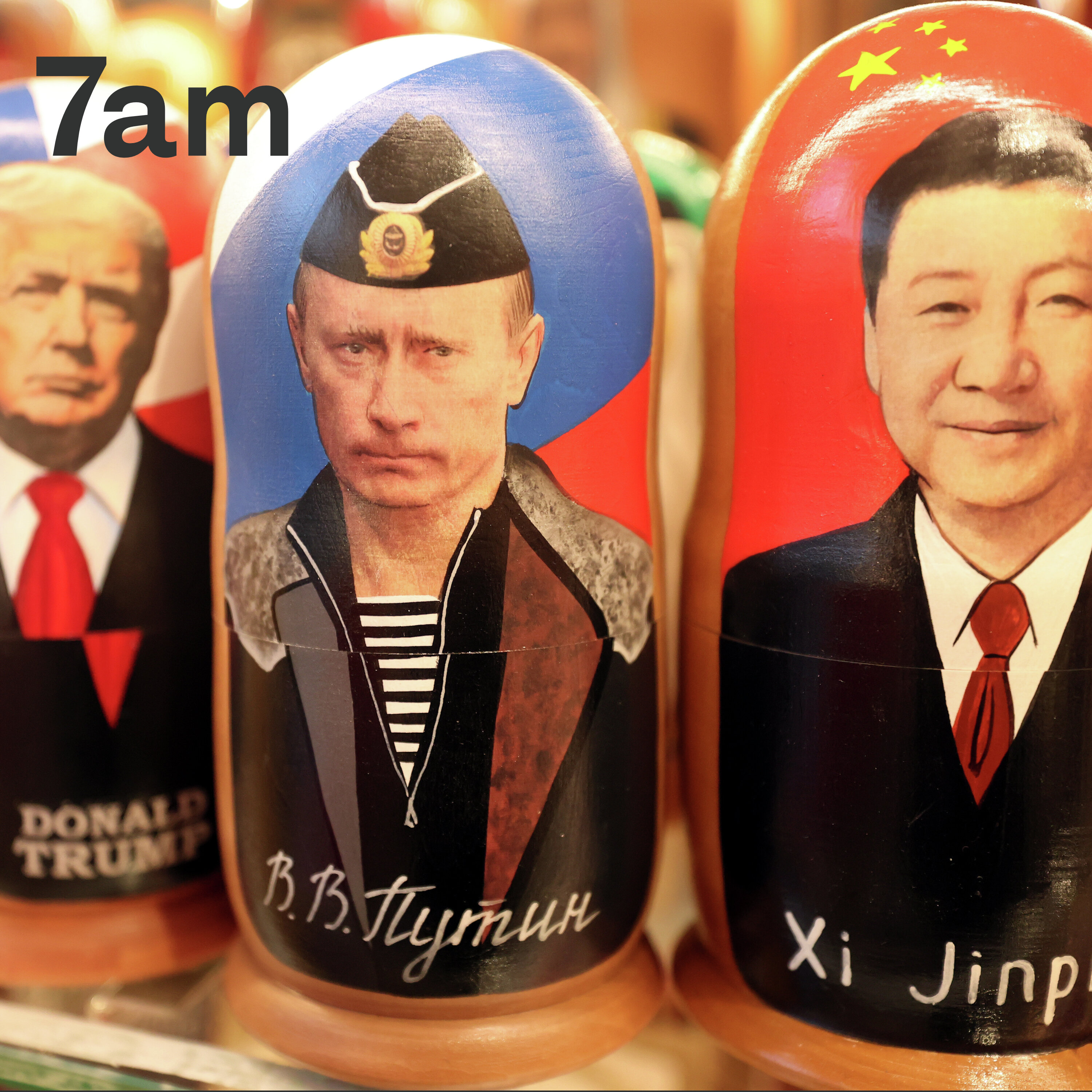
0:02 In 1945, in the Crimean city of Yalta, three global superpowers, America, Great Britain and the Soviet Union, met to carve up the world between them, each claiming their own sphere of influence in the final year of World War II. Now, 0:17 Ukrainian President Volodymyr Zelensky is warning that could happen again. 0:21 It's dangerous for all of us. We all live in Europe. 0:26 We don't want to have Yalta, Yalta II. Yes, we are not ready for such. 0:32 Dubbed Yalta 2.0, today Donald Trump, Xi Jinping and Vladimir Putin will meet in China in their first ever trilateral conference. 0:41 So what can we expect from this meeting of the world's strongman leaders? I'm Ruby Jones and you're listening to 7am. 0:51 7am. 0:53 Today, SAGE International Strategic Analyst Dr John Bruni on what this meeting and the relationship between Xi, Trump and Putin means for the world and for the shifting global order. 1:06 It's Thursday, November 19. Donald Trump, Xi Jinping, Vladimir Putin, they're preparing to meet in China. Ukraine's president, Volodymyr Zelensky, he's warned that this meeting, it could become another Yalta. 1:25 So to begin with, tell me a bit about what actually happened at Yalta and are we seeing something similar today? 1:33 Well, okay, let's put it into a much broader context, shall we, Ruby? First and foremost, Stalin, Churchill and Roosevelt were in the final throes of World War II. Soviet armies had already occupied much of Eastern Europe and was 1:48 already starting to change The political situation on the ground, especially in a place that was heavily contested at that time, Poland. 1:55 And you've got the Western forces led by the Americans and the Brits, and to a degree the French as well, who were occupying the western part of Europe. Everyone wanted to defeat the Nazis, so there was this common aim in 1945. We had to get on top of defeating 2:14 the Nazis, and then we'll try to work out some sort of negotiated settlement, and hopefully we'll be able to create a new world order moving forward that everyone is maybe not 100% happy with, but at least happy enough with. 2:27 If you now take this to 2026, you have a different planet entirely. There is no common war that we're fighting. 2:36 I mean, there are wars that are being waged, but, you know, everyone has a different view as to who is doing what where and how we're going to get on top of this. So there is no common objective among the three powers. That is Russia, the United States 2:50 and China. All three of them are highly competitive and no one is really in charge of anything in particular. 2:57 Donald Trump just had his shellacking from the US midterms just recently passed. And, you know, he's still having to sort of deal with the NVIDIA problem. Vladimir Putin, his country is really doing quite badly against Ukraine. You have 3:15 other countries now that are effectively middle powers in their own right. We're talking about the European countries. We're even talking about Ukraine. We're talking about the global south, which aren't in the thrall of some sort of European imperialism. 3:29 They are their own countries. So you've got three countries now that will be sitting in Shenzhen on Thursday thinking that they have a role in being able to create a new world order centered around what they want. And yet the rest of the world will sit back and 3:45 probably resist them actively. And that's going to be a problem because, again, these three powers don't come to the rest of the world where the rest of the world is on the ropes anymore. They come to the rest of the world as the rest of the world is 4:01 now growing in stature, growing in prestige, growing in military capacity. 4:06 Those are the things that we have to separate between 1945 and 2026. Completely different planets, different in every way. 4:17 And so it was Russia, it was Putin who was the driving force behind this meeting. So tell me why Why does he want to bring Trump and Xi together? 4:27 What does he stand to gain from this? 4:30 Well, it's really very simple. I mean, Russia has been fighting this war in Ukraine now for five years, longer than World War I. His army's capacity to actually do any more than they're currently doing is very limited. So he wants the prestige of being able to sit next 4:49 to two other leaders of powers that the rest of the world look up to. They look up to the United States as the world's largest economy. They look up China as the second largest economy and obviously rival of the United States. And Putin wants to bask in the 5:06 role that Russia isn't a defeated power. It's not a weak power. It is actually an equal of both China and the United States. So it's a prestige thing for Putin. Okay. 5:17 And Trump has been much more enthusiastic about this meeting than Xi has. So Trump has said that he wants to talk about nuclear weapons. He wants to talk about Iran. 5:28 and he wants to talk about his, quote, favorite subject, Ukraine. 5:31 So what is motivating Trump, and what does he think he can actually achieve here? 5:35 Well, Trump only has another two years left in the White House, so he's playing for legacy. He wants to have a big deal. And There's a sense of desperation from Trump as well. His party came in for a massive defeat during the midterms. This is something that he 5:52 may not make anything about because, of course, everything that Trump touches turns to gold. That's both within his own mind and the way that he wants to project himself. 6:01 He wants something that the rest of the world will sit back and say, oh my lord, for years we've tried to get Ukraine over the line in terms of a peace deal or have some sort of new international situation with regard to nuclear weapons. And no other person 6:19 had done it, but Donald Trump delivered. For the first time in his Trump 47 presidency, Trump is a man of substance, not just of style. So that's, I think, where Trump is. I don't know whether that's where he is in his head, but I think that the people 6:34 who are advising him around him want that to be Trump's legacy moving forward. 6:40 And what about Xi Jinping? Because he was initially reluctant to take part in these talks. 6:46 He is the reluctant party in all of this. The only thing he gains out of this is the fact that, again, kind of like with Putin, he basks in the idea of being central to the international order, or at least a kingpin of the international order. And considering the fact 7:04 that He's hosting the APEC meeting, and then there's going to be this trilateral heads of government meeting on the side. 7:12 It gives him a sense of China has come full circle. 7:17 It's no longer a developing country. It is now considered one of the top flight countries in the world. And again, he's playing the prestige card. We are the ones hosting the Russian president and the American president as well. So 7:31 I think from that perspective, there is also... He's playing for prestige, but he doesn't want to have binding commitments come out of this meeting. I mean, Putin's idea is to try to get Xi to support whatever his initiative is for a pro-Russian kind of peace settlement, one that 7:51 favours the Russian Federation. I don't think Xi wants to get involved in that sort of thing. And again, Trump wants to have China enter into some sort of externalized peace effort with regard to getting out of the Iran war. Again, 8:08 Xi is a very cautious person. He doesn't want China burning its bridges all over the place and getting involved in countries and in situations and in wars. It is not prepared to get involved with right now. Now, this may sound a bit weird because when people talk about 8:27 China's growing military power, yes, its military power is growing. 8:31 But China as a country and as a culture is more cautious. They have no interest in spreading Chinese military forces all over the world to help the Americans out here or help the Russians out there. That is not what Xi Jinping wants. That is not his version of 8:47 Chinese power. What keeps China the top flight category is the fact that we're all guessing as to what capacities China actually has. But if they have to deploy forces elsewhere... 8:59 and we find out that, say, Chinese training standards are subpar, their command structure is subpar, their weaponry doesn't really fire off all that well, then all of a sudden the bubble of China being the great power that it thinks it is gets burst. And where is it then? 9:20 Still to come, what does this meeting mean for Australia? 9:34 What do you think that these three leaders can realistically agree on? Because they do seem to be going in with these competing priorities. Trump, for example, wants agreement on nuclear weapons, but even his own administration says that it doesn't expect a deal. 9:51 So what do you. 9:52 Think is likely to be an outcome of this meeting? 9:57 All right. There are going to be some very open promise being made between the three leaders. On the nuclear question, I think what's going to happen is that they'll be talking about nuclear risk rather than nuclear warheads. The reason why I say that is that of the three powers, 10:13 the Chinese have around about 600 warheads. The Americans have six times that amount and the Russians have seven times that amount. The Russians aren't going to sign up to something that makes them less powerful at the nuclear level 10:28 because from a prestige perspective, the only thing that Russia ever brings to the table is its nuclear card. That is where it's most powerful. The Chinese are trying to develop its nuclear weapons program. They want to expand outwards. 10:42 They want to have more than 1,000 weapons. quite possibly up to 2,000 to 3,000 at some point. So they haven't got an abiding interest in cutting back what they're doing. 10:52 So it's highly unlikely that they're going to be signing up on artificial ceilings. What they may be signing up toward is future meetings to discuss nuclear risk. How do we de-escalate a crisis from going out of control and roping in nuclear weapons? I mean, I think that that's 11:10 something that the three powers may be able to easily get away with doing, but I don't think that we're going to see anything with regard to the numerical ceilings with regard to how many nuclear weapons each power has. Okay. 11:24 And European leaders are worried that Trump and Putin might make agreements behind closed doors. There are concerns that Trump could make concessions over Ukrainian territory or over NATO's presence in Eastern Europe. So what's at stake here for Ukraine 11:39 and for the rest of Europe? 11:41 Look, I think that that's a legitimate fear, but let's not forget Ukraine has agency. Ukraine has just destroyed the Kerch Bridge, which is kind of embarrassing for Vladimir Putin. 11:53 The Kerch Bridge is the bridge that connects mainland Russia to occupied Crimea. Now, that bridge was actually opened to great fanfare by Putin himself. Now that the Ukrainians blew it up, just as the summit is going to be held between Putin, Xi, and Trump, it shows again that 12:11 Putin doesn't come to this summit as the strongman that he thinks he is. He comes to the summit just having been clobbered by the Ukrainians. Ukraine and Europe will be able to determine Ukraine's fate. I think that we're starting to see that happen anyway. Trump walked away from 12:30 Ukraine about a year ago. The Europeans are the ones supplying the weapons to the Ukrainians right now. what is odd is that the Europeans haven't owned the diplomacy. They're quite happy for Jared Kushner and Steve Witkoff, two people 12:43 who have absolutely no skills in diplomacy, to go and play the shuttle between Donald Trump and Vladimir Putin. But I think that what we'll see is a growing capacity for other countries to change the facts on the ground, if you will. We can talk about say, Ethiopia, South Africa. 13:02 We can talk about a whole bunch of countries that if they ever got into a scrap or a disagreement with the United States won't just roll over. They will push back. We're seeing that now with good old Canada. Canada, you know, the least harmful of all countries. Now that 13:17 Donald Trump has, you know, basically made a play for that country, you're seeing the Canadians start to harden up, basically. 13:24 And this is an international... situation. This is not something that's temporary. We're going to see this grow as the great powers struggle to figure out exactly what they're in control of. They're really not in control of as much as they think they are. 13:39 And what about for us here in Australia? Because we obviously have the security partnerships with the United States, and China is our largest trading partner. So a world in which these two powers, in which China and the U.S., 13:54 negotiate directly with one another. What does that mean for us? 13:59 Well, for us, we're different. I mean, we claim that we're a middle power, but Ruby, let's be honest, we are Firebase Australia. We have set ourselves up as an American lily pad that will allow US forces to jump 14:13 off the Australian continent and enter into the Indo-Pacific anywhere they want. That is our value to the United States. 14:20 We're not about to change that relationship anytime soon. So as far as we're concerned, it's all the way with DJT. 14:27 I can't imagine the Albanese government or any other future Australian government doubling back and saying, oh, oh, my God, we're an independent country. We're sovereign. We're going to start openly defying our great and powerful friend. We never have 14:40 in the past. I doubt that we're going to be doing that in the future. 14:45 Well, John, thank you so much for speaking with me. 14:48 No worries, Ruby. Thank you for that. 14:57 Also in the news, Prime Minister Anthony Albanese has touched down in Shenzhen ahead of the APEC summit hosted by China. 15:04 Albanese says there is still a role for middle power diplomacy, despite the leaders of the US, China and Russia meeting at APEC. And Cricket Australia has announced a new forum for players and staff to discuss the Sandpapergate scandal. In 2018, 15:19 cricketer Cameron Bancroft was caught using sandpaper on the ball in a Cape Town test match, leading to his suspension and that of Captain Steve Smith and Vice Captain David Warner. 15:30 It remains unclear who else might have known about the tampering plan, but fresh questions have been raised about culpability after Usman Khawaja wrote about the incident in his new memoir. 15:39 I'm Ruby Jones. This is 7am. 15:42 Thanks for listening.










Community discussion