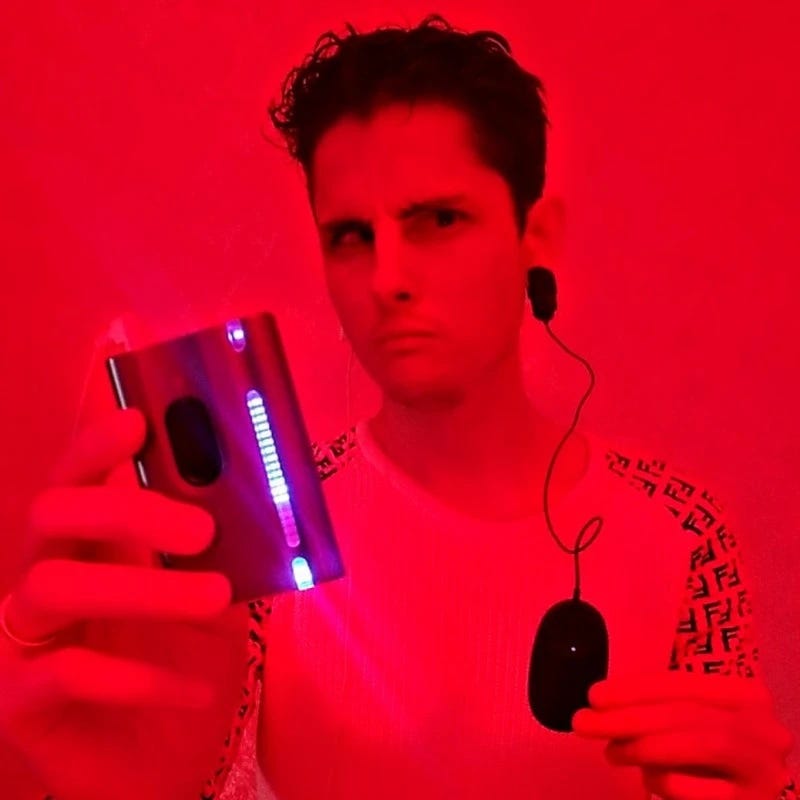
What I’ve learned from +300 Heart Rate Variability training sessions…
Having used Heartmath’s emWave for a while, I decided to take my optimization of heart rate variability to the next level and got the Inner Balance Bluetooth sensor.
In this review, I’ll honestly discuss the pros vs cons, share how I saved nearly 50% on both mindfulness-enhancing devices, compare them to other Biohacking tech I’ve used, and summarize the state-of-the-art science and studies done evaluating Heartmath’s HRV technology.
Inner Balance vs emWave
The major difference is that the Inner Balance is a Bluetooth sensor that gives you real-time HRV biofeedback with a slick Android or IOS app. The app displays your general state of coherence in red, blue, or green along with a heart rate graph. It also gives you a more detailed readout of your coherence score and graphs your performance. I logged into the app with my old Heartcloud account and was pleased to discover that it still had my emWave session data from back in 2014, when I first started making HRV training videos in Medellin, Colombia...
What I like about the emWave is that it's a subtly pleasant and mindful technology; the rising and falling light bar on it is sort of mesmerizing. Unlike my smartphone, it's a zero-distraction piece of technology. When I sit down with my emWave, I'm not going to get sucked down the clickbait rabbit hole on Facebook or Twitter. When I use the Inner Balance, I have to staunchly resist checking social media or being distracted by dinging and vibrating app notifications. The advantage of the emWave is that you use it without your smartphone, which some will find more conducive to real mindfulness.
Inner Balance is an innovative self-monitoring and HRV training system for Android and IOS
Biohackers who rigorously self-quantify and experiment will love the Inner Balance as it allows you to run endless HRV tests to see how different things affect your autonomic nervous system’s well-being...
* Wear it while doing mundane things; watching TV, reading, driving, working on your computer, etc., to establish your baseline HRV.
* Do HRV sessions first thing in the morning and in the evening before bed to see how they compare.
* Measure HRV to see how different supplements and Nootropics affect you - interestingly enough, the smart drug that I get the highest coherence scores on is (reliably) nicotine.
* Measure your HRV while working and listening to focus-inducing music vs a podcast.
* Measure how different meals and foods affect your HRV.
* Get crazy and measure HRV making love (like I did).
HRV training helps you to habituate energetic “nootropic” breathing
When you need a pick-me-up in the afternoon, a 15-minute HRV session will energize you and give you a very clear head.
I like to passively use the Inner Balance sensor while I’m working on my computer and keep an eye on my coherence score on my iPad. It reminds me to be a little more conscious of my breathing, typically while sitting in front of my computer working, my breathing is shallow. The coherence feedback encourages deeper, more energizing breathing, which naturally makes me more productive and pepped up. In this regard, the Inner Balance trains you to breathe better - like a tantric Taoist practitioner or even a Jedi.
Last year, my wife got very upset (actually, the most upset I've ever seen her) about the catastrophic wildfires in Australia and the 500 million animals that have apparently perished in them. She kept going on her phone and looking at pictures of cute Koalas and kangaroos, and she would start crying at their plight there in the fiery forests down under. Eventually, I sat her down, took away her phone, and we did a 15-minute HRV meditation session together - this did a lot for her mood.
A few negatives...
“Mindfulness technology” is nearly an oxymoron; technology is, of course, the main thing robbing us of mindfulness in modernity. A while back, I tried meditating with a friend’s Muse Headband, and I found it kind of irritating to use; it was very tricky to get the band aligned right on my head to read my brainwaves. The Bluetooth that it uses to connect to my smartphone is also not the most reliable technology. The Inner Balance suffers from some of the same issues...
I’d really rather be able to just plug the sensor into my smartphone instead of using Bluetooth. Fortunately for the EMF-avoidant like me, Heartmath now offers the Inner Balance Wired that can just be plugged into an iPhone or Android. I’ve noticed an issue (that probably has something to do with the Bluetooth connectivity), the app chimes different tones as you reach different levels of coherence; however, it sporadically makes this distorted, unpleasant chiming noise that robs a bit of tranquility from meditating with the Inner Balance. But it’s not a big problem because the chiming can just be muted.
The Inner Balance app
It’s not bad, but considering that it’s a mindfulness app for a not-inexpensive device, there’s a lot of room for improvement...
* I’d love it if it had a bit more artistic and hypnotic mandala mode.
* I’m annoyed every time I use it that the app requires that I turn on location services - why the hell does Heartmath want to know where I live? And who are they sharing this information with? I have to deduct a star from my review for this violation of privacy.
* It would be very cool if it played algorithmic music or audio tracks that would rise and fall in intensity with the coherence I reach - the Muse headband does this.
* The app’s chiming noises can be muted, but this also totally mutes my smartphone, so I CAN NOT listen to a Brain.FM meditation. track on my smartphone and have the chiming muted, which is a little annoying but not a big deal because I also have both apps on my iPad.
This feels like an app for a $20 product, not a $160 product.
My main criticism of Heartmath’s products is their underwhelming aesthetics
They look and feel like things that should cost about $15, not well over $100. I paid just $90 for my Inner Balance (it retails for $160) because I bought a lightly used one off eBay. Frankly, I think it’s a bit overpriced at $160. Also, I live in a European country where it would be exceedingly inconvenient to take advantage of Heartmath’s warranty if the device broke, so I decided to take a chance on a used one - so far it works great, you couldn’t tell that it’s not new. I managed to get both the emWave and the Inner Balance for $140, less than what I’d pay for a single brand-new device. My reasoning was that one of them would likely break, so I might as
You May Also Like

Worship & Wonder Daily Devotional
Westminster Presbyterian Church

Scrolls & Secrets
Scrolls & Secrets

Renascença - Pergunte ao Pe. Paulo Franco
Renascença

Darrers podcast - Ràdio Cubelles
Ràdio Cubelles

Darrers podcast - Ràdio Ciutat de Badalona
Ràdio Ciutat de Badalona

CHURCH on SermonAudio
Various Speakers

Church Unity: The Forgotten Treasure
Paul J. Bucknell

Unter Büchern mit Katrin Schumacher
Mitteldeutscher Rundfunk

Podcast Paris United
Paris United

Deep Sessions & Toxic Journey Episodes
Dj zeb
Worship & Wonder Daily Devotional
Westminster Presbyterian Church
Scrolls & Secrets
Scrolls & Secrets
Renascença - Pergunte ao Pe. Paulo Franco
Renascença
Darrers podcast - Ràdio Cubelles
Ràdio Cubelles
Darrers podcast - Ràdio Ciutat de Badalona
Ràdio Ciutat de Badalona
CHURCH on SermonAudio
Various Speakers
Church Unity: The Forgotten Treasure
Paul J. Bucknell
Unter Büchern mit Katrin Schumacher
Mitteldeutscher Rundfunk
Podcast Paris United
Paris United
Deep Sessions & Toxic Journey Episodes
Dj zeb
Community discussion