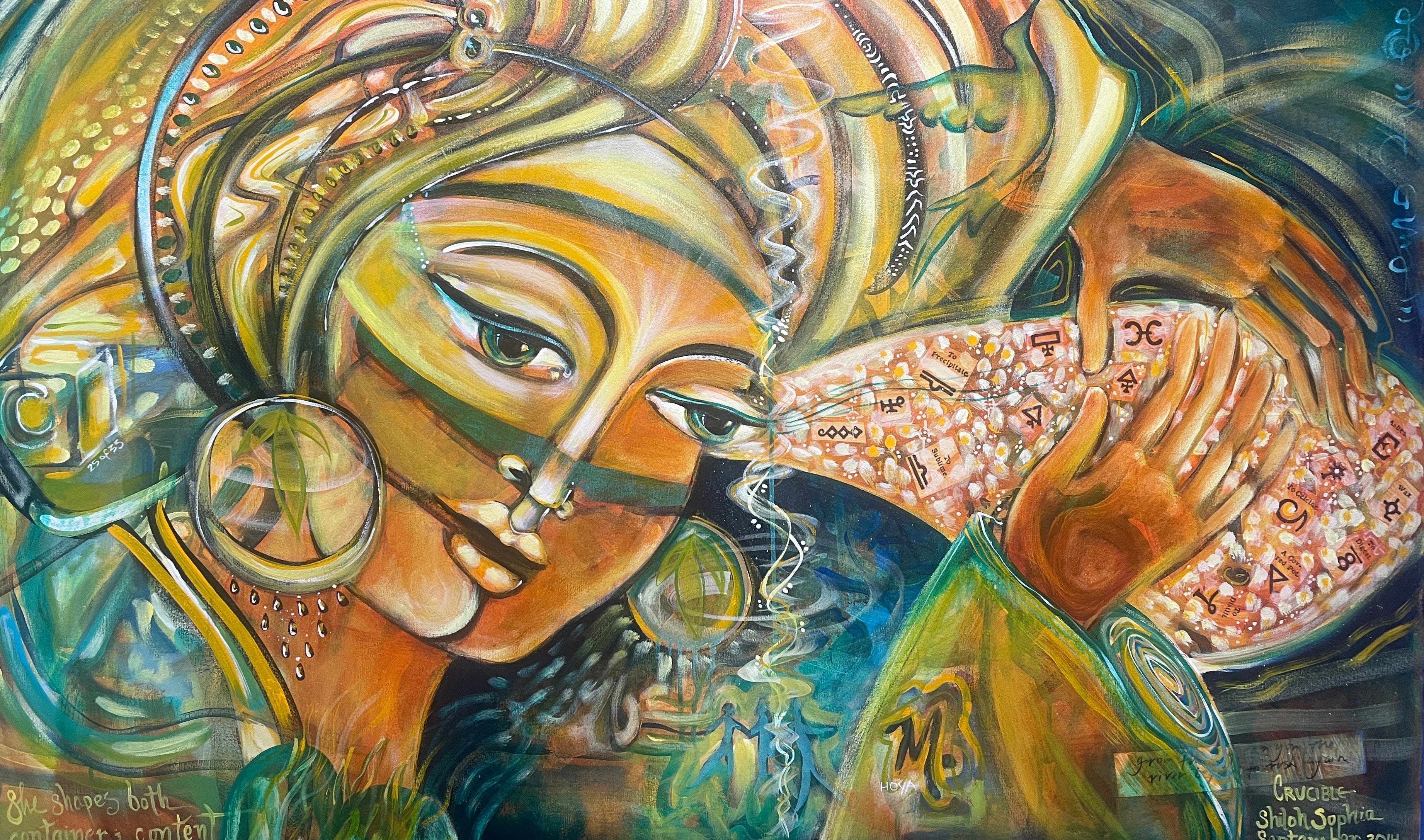
WHAT?! The ♥️ neuroscience 🧠 of self-expression 🎨 (so excited)
Hi Everyone
I hope you can get just as excited about this research as I am. It has been around a while but I am just putting the peices together. References are below.I want you to EXPERIENCE THIS for yourself. Here are three ways NOW!
Shiloh Sophia
Book a call to explore our 9 month training called Stardust Initation starting in June
Join me for my NEW class, called Threshold - we are gonna paint aiwth power!
Come along with me and my BFF Amy Ahlers to explore navigating this wild wild world
The Neuroscience of Self-Expression: Why the Brush Knows Before We Do
I want to speak to you about something I am so passionate about — the neuroscience of self-expression. It comes from my root system, because I come from the Stardust Lineage, and we are creative, spiritual, magical women who pass tools of Intentional Creativity from hand to hand and heart to heart. This isn’t a woo-woo idea, and neither is it entirely scientific. It’s a hybrid. Sometimes the brush knows before we know what’s actually going to happen.
I want to tell you about a researcher at Drexel University who has spent a decade strapping near-infrared sensors onto people’s foreheads and watching what happens when the human brain is firing and wiring the moment the paintbrush touches the paper or the canvas. Do you know how long I’ve wanted to do this? Her name is Girija Kaimal — Wow. I would love to have a cup of tea with her. Of course, she doesn’t know me. She probably will at some point, because I’m going to reach out. And she’s probably never heard the words medicine painting — one of the terms we use for our work, because it’s an approach to painting that’s healing.
Her data has been confirming what the women in our lineage have known since the 1930s. Self-expression is healing. Painting for us is a spiritual practice. It is not just a hobby. It is literally a neurological event. And guess what? When you paint with intention, the event begins before the brush ever touches the canvas. If you’ve worked with me, you know I talk about this all the time as energy equals matter at the speed of light — your energy as thought, expressed through your physical body, the equal sign, manifests matter at the speed of light on the canvas. Are you kidding me? Yes. The neurological awakening of what’s going to happen happens before the brush touches the material.
You may also be aware of another piece of research that adds to our point, by Audrey van der Meer, a Norwegian neuroscientist who has proved that writing by hand wakes up the brain in ways that typing cannot. Imagine how many kids these days are no longer learning to handwrite?! Her work is finding something so incredible about what happens when people are actually handwriting — she’s measuring how the brain encodes the writing of letters into memory, and the brain is lighting up.
When Kaimal’s team did their research, they put 26 people in headbands — the kind that read blood flow inside the prefrontal cortex literally in real time. (Gosh, I wish it were here.) They were given three minutes to color in a mandala, to doodle around a circle, and to free-draw whatever they wanted. The results were published back in 2017 in Art Therapy. Guess what? All three activities lit up the medial prefrontal cortex. Wow. Wow. That region is part of the brain’s reward pathway. Are you picking up what I’m putting down? That’s the same circuit that fires when someone you love walks into the room. This is when you get to have tea with your best friend and you’re jumping up and down. This is when your lover winks at you and you know what’s coming next. This is when those of us in Intentional Creativity know that I’m going to do a power-packed livestream that’s going to knock our red striped socks off. We feel love.
The people she studied were not artists — most of them. And their brain did not care, in a literal way. Their brain didn’t care if they were an artist. Their brain rewarded them anyway, for the simple act of creating color across a page with their hands. What’s interesting too is that working inside of shapes — as in coloring — really does something powerful to the brain and to memory. It’s just so exciting.
In a separate study, the same researchers took 39 adults, gave them 45 minutes with markers, clay, and collage materials — nothing structured — and measured the cortisol in their saliva before and after. I kid you not. Cortisol in the saliva. Cortisol is the hormone your body produces under stress, the one that keeps so many of us awake at three in the morning, especially those of us going through midlife. Seventy-five percent of the participants showed lower cortisol after making art. No skill required. No talent required. No making it pretty. No perfectionism required. It is not an act of performance. It is an act of self-expression. The brain is responding to the act itself. It’s in a way metacognition — becoming conscious of becoming conscious, while being intentional about what you’re creating.
There’s something else I want to add, because when you’re coloring and your brain doesn’t have to make decisions, you can actually break a psychotic loop. This comes from nurses at Stanford who use my coloring books, Color of Woman. If they could get patients to color, they could break a psychotic loop. Wow. Why are we not talking about this more? Whether you’re in a psychotic loop or not, wouldn’t it be helpful to know that you could sit down and color and you would start to go into a different brain state? This is so important. (And it doesn’t work if there’s a blank page — for that psychotic-loop piece.)
Now, our part in this. For close to 30 years I have been working with creating with intention, and since 2008 I’ve been training others to work with Intentional Creativity. I have not been teaching people to become brilliant artists — though some of them are. I have not been teaching people to make perfect paintings, though some of them do. I have not been teaching perfection technique to make a painting that would hang on the wall of a gallery. No. We’ve been into self-expression — to see what happens inside when you express yourself.
Painting like this is a way of
* Exploring our inner world.
* A way of coming face to face with the often hidden identity within ourselves.
* A way of activating the inner healer and the energies that go with that.
* A way of catalyzing the brainwaves to move from beta to alpha to theta, so we can cross over into that state of the imagination and reach the subconscious domains.
* A way of allowing the canvas itself to be a portal — to hold what the body carries
* To express into form what was once inside and didn’t have anywhere to go.
* A composting of energy, now expressed onto the canvas. We call it medicine painting. Tens of thousands of people in our community have painted with it, and before I started doing it, we had two generations of artists who did it before me.
Here’s what the neuroscientists have not measured — but I would bet my brushes and my striped socks they would receive incredible results. The study in Kaimal’s lab gave people markers and said, Go. There wasn’t an intention set. Of course, the intention was that they were being measured. BUT. There wasn’t an invocation. There wasn’t a prayer. There wasn’t a lighting of a candle. There wasn’t a moment of asking what the piece of paper or the canvas wants to express to us. There wasn’t a moment of what message are you receiving. And the cortisol still dropped. BOOOM DIGGITY. The reward pathway still lit up. The body still received a measurable gift — and the “able to experience it” part is super important to me. Because when we do this work and invite people to experience and acknowledge that it’s happened,
You May Also Like

Le Cours de l'histoire
France Culture
Podcast Patapoe
0d0a

SUNNY's Podcast
SUNNY
The FrogPants Studios Ultra Feed!
Scott Johnson

داستان شب
DASTANESHAB

そろそろ美術の話を...
アートテラー・とに~

Fresh Air
Fresh Air

All Of It
WNYC
Onironautas Podcast
Sére Skuld y Noviembre Nocturno

Audio Poem of the Day
Poetry Foundation
Le Cours de l'histoire
France Culture
Podcast Patapoe
0d0a
SUNNY's Podcast
SUNNY
The FrogPants Studios Ultra Feed!
Scott Johnson
داستان شب
DASTANESHAB
そろそろ美術の話を...
アートテラー・とに~
Fresh Air
Fresh Air
All Of It
WNYC
Onironautas Podcast
Sére Skuld y Noviembre Nocturno
Audio Poem of the Day
Poetry Foundation
Community discussion