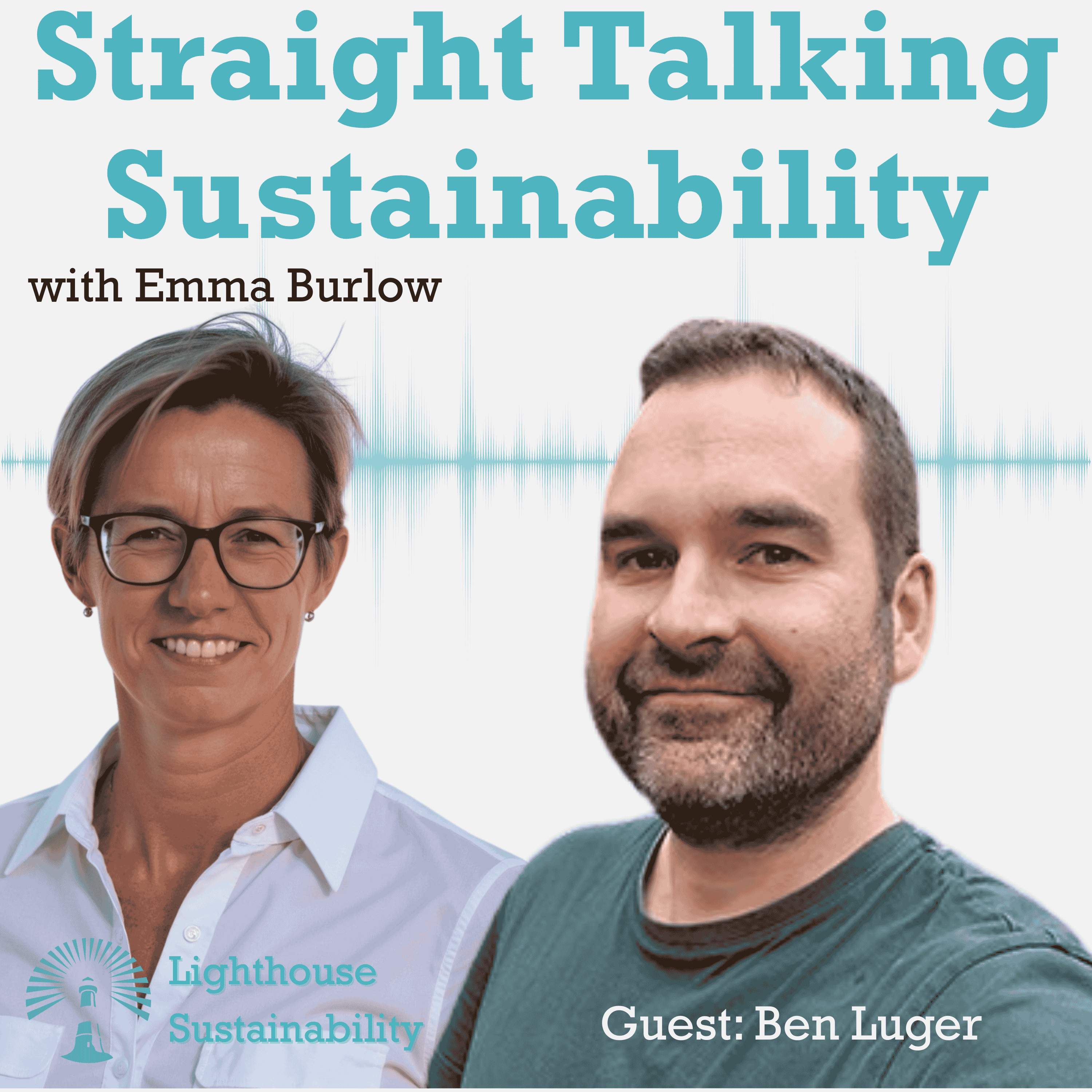
The Untapped Power of Volunteering: How Community Action Cured My Climate Anxiety with Ben Luger, Ecosurety
In this inspiring and deeply personal episode of Straight Talking Sustainability, host Emma Burlow sits down with Ben Luger, Marketing Project Specialist at Ecosurety, to explore how volunteering can be the secret weapon for engaging people in climate action whilst simultaneously improving mental health and building stronger communities.
Ben's journey from delivering carbon literacy training to establishing a thriving community tree nursery in just 12 months demonstrates how individual action, when channelled through community organising, creates exponential impact without the overwhelming time and energy drain that most people fear.
Ben traces his volunteering journey back to an unexpected source: delivering carbon literacy training for the packaging sector.
Whilst training others about the causes and impacts of the climate crisis, he found himself experiencing increasing climate anxiety despite making personal lifestyle changes (not flying, barely using a car, cutting meat consumption, sustainable banking).
The deep dive into climate science that carbon literacy demands created an "itching urge" to do more, which reached a tipping point at the Blue Earth Summit in 2024.
After two days of talks, panels, and workshops, Ben felt simultaneously enlightened and frustrated by what he describes as an "echo chamber of the same people coming together to talk about it."
The breakthrough came during a session called Reasons To Be Cheerful featuring inspiring community activists including Speech Debelle (who launched Black Fish to connect Black communities with fishing and nature) and No Ven (who transformed a community garden whilst escaping years of abuse).
Two days after that talk, Ben was writing emails to launch his own community tree nursery project.
What makes Ben's story particularly powerful for sustainability professionals experiencing burnout is how he found an existing community organisation (Rooted Chippenham) rather than starting from scratch.
By approaching an established Community Interest Company with an existing volunteer base of 30 people, polytunnel, and governance structure, Ben could piggyback on infrastructure whilst contributing his marketing and communications skills.
The group launched a crowd funder with match funding and hit their initial target within 24 hours, ultimately raising nearly three times their goal (£4,300) by the campaign's end.
The conversation explores why volunteering works where other engagement approaches fail. Ben describes discovering an "extended family" of like-minded people on his doorstep who share the same worries, anxieties, and motivations.
This social connection creates energy rather than draining it, transforming what could feel like another burden into something people actively look forward to.
Emma relates her own volunteering experiences (parkrun, local library, helplines) and reflects on how people outside the volunteering world consistently underestimate the benefits whilst overestimating the time commitment.
Ben candidly discusses how volunteering has become his antidote to climate and biodiversity crises, particularly during a difficult year when grief from his father's death resurfaced a decade later. His GP prescribed nature, which led Ben to recognise how local nature-based projects offer something uniquely cleansing and energising.
Now running both the tree nursery (growing around 1,000 trees annually for free distribution to local residents) and community bat walks, Ben describes feeling "unburdened" compared to the anxiety that previously consumed him.
For workplace applications, Ben explains that whilst Ecosurety offers three volunteering days annually (with corporate sponsorship for his projects), only about one third of employees across organisations typically use these days.
The challenge is not lack of provision but rather helping people overcome the perception of volunteering as an energy drain when they already feel stretched. Ben and his colleagues have discovered that team volunteering days (tree planting, coastal walks for charity) become "the most incredible team building days" because people accomplish something meaningful whilst strengthening workplace bonds away from their desks.
The episode provides practical guidance for listeners feeling called to action: look for existing community groups before starting something new, consider how your professional skills (marketing, communications, finance, project management, horticulture) could support community projects, start with a simple social media post to gauge interest, and recognise that monthly or even weekly commitments need not be overwhelming.
Ben emphasises the importance of measuring and communicating impact (volunteer numbers, trees distributed, community engagement touchpoints) to demonstrate value and attract additional support.
Throughout the conversation, both Emma and Ben challenge the notion that individuals cannot make a difference in the face of the climate and biodiversity crises.
By focusing on tangible, local, joyous activities that bring communities together around nature, volunteering creates positive climate action that feels achievable rather than overwhelming.
Ben's nine-year-old son now co-leads bat walks and has joined the local youth council, demonstrating how parental volunteering creates ripple effects across generations.
In this community volunteering and climate action episode, you'll discover:
- How carbon literacy training can catalyse personal community action and address climate anxiety
- Why finding existing community organisations beats starting projects from scratch
- The unexpected mental health benefits of nature-based volunteering (even GP-prescribed)
- How crowdfunding can validate community desire for environmental projects (£4,300 raised in five weeks)
- Why only one-third of employees use workplace volunteering days despite generous policies
- The skills transfer between professional work and community projects that creates impact
- How to measure volunteering impact beyond just numbers (touchpoints, engagement, community validation)
- Why volunteering energises rather than drains when approached as joyous community building
- Practical frameworks for starting local environmental projects without overwhelming time commitments
Key Volunteering and Community Action Insights:
(02:30) The carbon literacy catalyst: "I think delivering carbon literacy training, like taking this deep dive in the causes and impacts of a climate crisis... I felt like I just needed to be doing more personally... I had this itching urge that I had to be doing something more, really."
(04:41) The tipping point moment: "Something clicked when I was there listening to that and it's like, I need to get off my arse and do something. I literally had that thing of like, oh my God, stop thinking about it. Literally two days after that event, I was writing loads of emails to kick off my project."
(07:59) Finding community infrastructure: "I just approached them and I went to volunteer and said, I've got this mad idea. I'm going to set up a tree nursery. I'm going to grow thousands of trees. Give them all away. Can I do it here? And they went, yeah, we'll support you. And I just fell into this incredible group of people."
(09:46) Discovering local allies: "My eyes were opened immediately... it was just this lovely bunch of people. And half of it was just socialising. And I was like, oh, this is why connecting with the community is good. It's like suddenly I've got to know those people locally."
(11:26) Energy versus drai
You May Also Like

Shimon Davis
Shimon Davis

STOPTIME: Live in the Moment.
Lisa Hopkins, Wide Open Stages
The You Project
Craig Harper

Motivational Speeches
Motivationly

Hamza Selfimprovement
Adonis Gang

Rick Warren Sermons
Word Life

Playlist Culture G : les podcasts pour apprendre chaque jour
Acast France

Life Hacks DIY & More - Transform Your Everyday With Simple Tricks and DIY Magic!
Byte & Pieces

Happy English Podcast
Michael DiGiacomo Happy English

Un bonbon sur la langue
RTL
Shimon Davis
Shimon Davis
STOPTIME: Live in the Moment.
Lisa Hopkins, Wide Open Stages
The You Project
Craig Harper
Motivational Speeches
Motivationly
Hamza Selfimprovement
Adonis Gang
Rick Warren Sermons
Word Life
Playlist Culture G : les podcasts pour apprendre chaque jour
Acast France
Life Hacks DIY & More - Transform Your Everyday With Simple Tricks and DIY Magic!
Byte & Pieces
Happy English Podcast
Michael DiGiacomo Happy English
Un bonbon sur la langue
RTL
Community discussion