Are Your Brain Supplements Sawdust?
Let me confirm something you already know on a gut level...
The supplement industry is a capitalist wild wild west, a profiteers’ paradise, a mostly unregulated free market, and smart consumers should beware.
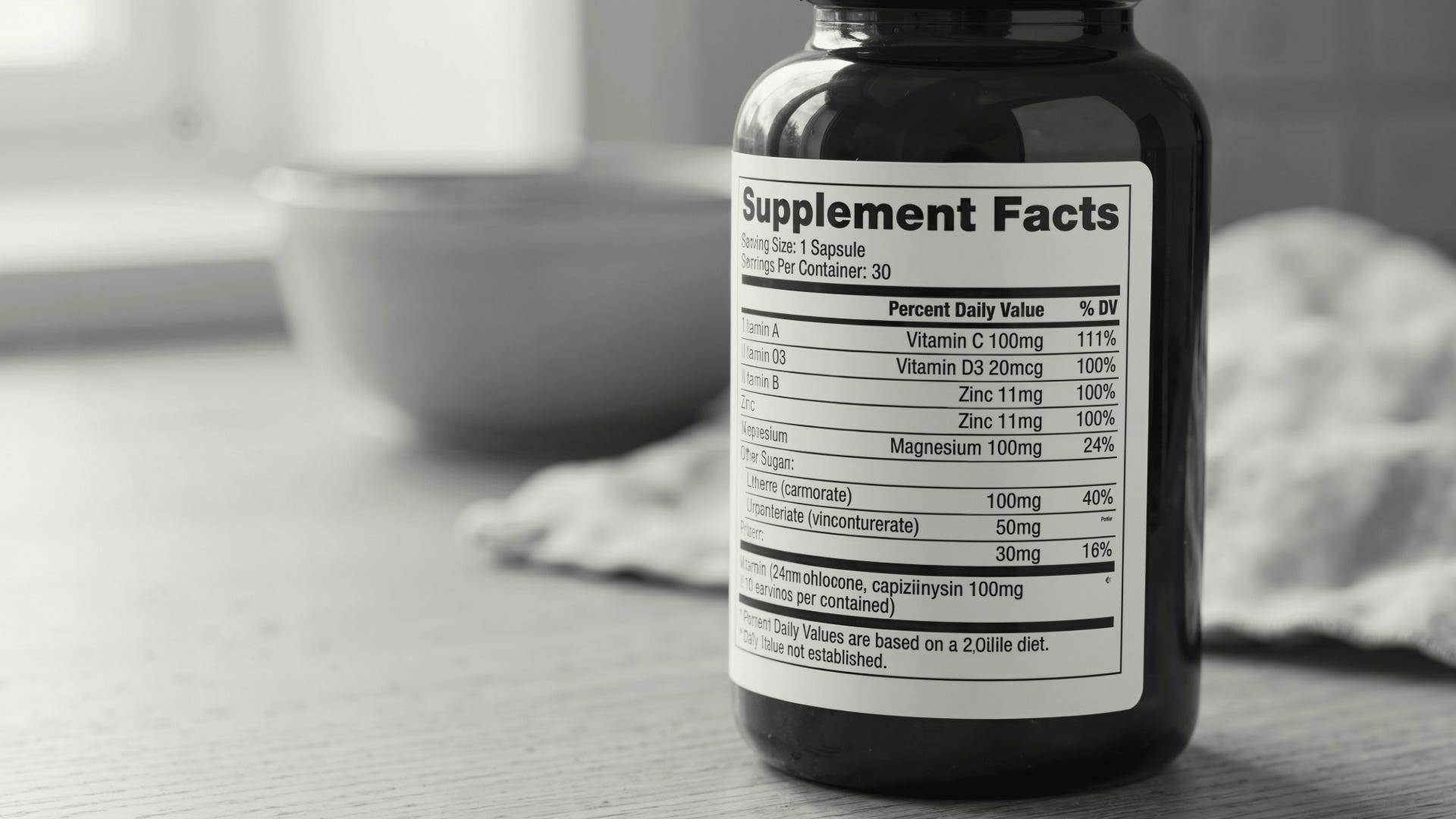
While the ubiquitous white Nutrition Facts box you see on the labeling of the packaging looks official, anyone with basic word processing software can create such a representation of the ingredients ostensibly in a product. When you realize that no one verifies that the actual individual ingredients are in a given product, you realize how much of a decision to buy and take a supplement is based upon trust.
The Nutrition “Facts”
When supplement companies sell products to consumers, they can count on most consumers not verifying what they are consuming. Sure, the consumers could send products off for testing at a third-party laboratory, but that costs between hundreds and thousands of dollars. While some consumer spectroscopy devices are coming to market that promise to disrupt multiple industries that prey on the voracious consumer, at the current time consumers have virtually no way of personally determining what they are actually putting in their bodies.
The good news: to make almost certain that you are getting the real stuff, insist on always buying pharmaceutical-grade supplements.
Why trust Pharmaceutical Grade?
When a University spends six figures (or more) to conduct a major double-blind, placebo-controlled study with dozens of human participants, they verify that the compounds, ingredients, drugs, or supplements they are using are real. The potential negative repercussions of not doing so are huge...
* A study conducted with illegitimate ingredients would produce inaccurate results. Scientists know that once their study is published in a journal, their colleagues at other universities will recreate their experiments to verify their findings. Not to mention, these scientists have to spend sometimes as much as $30,000 – $40,000 just on the publishing of their studies.
* Many a feud between scientists and universities has its origins in one researcher challenging the conclusions another reached after a study.
* Making a mistake in process or methodology during a study, referred to as having “dirty test tubes,” can result in a researcher being fired, a University’s reputation being damaged, or an organization losing its funding from the government.
These guys are seriously motivated to make certain they are using the real stuff, and in their laboratories, they have the means to do so. They spend extra to get Pharmaceutical Grade and so should you! Pharmaceutical-grade manufacturers and distributors aren’t intrinsically more ethical; it’s just that they know their products are going to be tested for legitimacy and purity by their most important customers - business they stand to lose if they put out anything less than the real thing.
What are the grades of supplements?
Pharmaceutical Grade
The purity, dissolution, and absorption of a given vitamin are third-party tested and verified to meet regulatory standards that come from the national Pharmacopeia. Pharmaceutical Grade can be obtained without a prescription, but typically they are sold by licensed health care practitioners. Companies that distribute this grade will typically be Good Manufacturing Practice (GMP) certified, so look for GMP Certified on the labeling and websites of the products you order from. It’s required to be 98-99% pure; you’re never going to get 100% pure, but this grade is required to be within a couple of percentage points of it.
Medical Grade
They are also high-grade, high-purity vitamins, although they may not undergo the stringent third-party verification process that Pharmaceutical Grade vitamins have to. If Pharmaceutical Grade is not available, you will usually be fine taking Medical Grade supplements, and the benefits you experience will be very similar.
Cosmetic / Nutritional Grade
These are what you will typically find on the shelves of health food stores. They are not tested for absorption or purity; indeed, no one actually tests the contents of these products. In this age of convenient eCommerce, you are better off just avoiding this grade altogether and ordering Pharmaceutical grade online. Supplements of this grade will contain some very dubious extra ingredients, like cornstarch, folic acid, and chemical preservatives - some that the FDA does not even require the manufacturer to list on the label.
Food Grade
For additions to food products; think about “healthy breakfast cereals” that boast about being fortified with vitamins and nutrients - typically this will be very low quality. The food business is a doggedly competitive arena, where most consumers make decisions completely on price, so food manufacturers are almost always looking for the lowest-cost individual ingredients.
Feed or Veterinarian Grade
For consumption by our furry friends and industrial animals.
Let’s take a further look at the eight most popular types of Nootropics...
The human brain is an incredibly complex system with thousands of different types of processes occurring at any given moment. For Biohackers, this gives us a lot of different angles to take on cognitive enhancement. These categories represent hundreds of different mechanisms of action that enhance cognition, improve memory, treat depression, empower neuroplasticity, speed up skill acquisition, help with focus, and minimize stress, along with preventing and even reversing cognitive decline.
For my up-to-date, vetted sources of…
* Amino Acids
* Acetylcholine Precursors
* Adaptogens
* Antioxidants
* B Vitamins
* Herbs
* Mitochondrial Support
* Modafinil
* NAD+ Boosters
* Nutraceuticals
* Nutrients
* Peptides
* Racetams
Check out this article here…
Pharmaceutical Grade Stacks?
I’ve been a hardcore consumer of Nootropics for over a decade now, and I’m increasingly less and less of a believer in the majority of Nootropic Stacks. You can’t fit three grams of Piracetam and a gram of choline in a single pill, so manufacturers trying to add 5-10 different ingredients to a single pill will need to decrease the quantities to truly insignificant amounts. I believe in taking Nootropics in the dosages recommended by the human studies that demonstrated a cognition-enhancing effect from them in the first place, and most Nootropic Stacks just don’t offer this.
Also, supplement stack distributors are less likely to have stringent quality standards for individual ingredients; most stack distributors are just white-labeling ingredients. This is a business model prone to low quality; let’s say their source of pharmaceutical-grade B vitamins (which comprise 40% of the ingredients in their stack) runs out, are they going to stop selling their product while they look for another source of equal quality? Not likely. What they will typically do is switch to another vendor who can get the raw materials to them as soon as possible, regardless
You May Also Like

Worship & Wonder Daily Devotional
Westminster Presbyterian Church

Scrolls & Secrets
Scrolls & Secrets

Renascença - Pergunte ao Pe. Paulo Franco
Renascença

Darrers podcast - Ràdio Cubelles
Ràdio Cubelles

Darrers podcast - Ràdio Ciutat de Badalona
Ràdio Ciutat de Badalona

CHURCH on SermonAudio
Various Speakers

Church Unity: The Forgotten Treasure
Paul J. Bucknell

Podcast Paris United
Paris United

Deep Sessions & Toxic Journey Episodes
Dj zeb

La Série fiction
France Culture
Worship & Wonder Daily Devotional
Westminster Presbyterian Church
Scrolls & Secrets
Scrolls & Secrets
Renascença - Pergunte ao Pe. Paulo Franco
Renascença
Darrers podcast - Ràdio Cubelles
Ràdio Cubelles
Darrers podcast - Ràdio Ciutat de Badalona
Ràdio Ciutat de Badalona
CHURCH on SermonAudio
Various Speakers
Church Unity: The Forgotten Treasure
Paul J. Bucknell
Podcast Paris United
Paris United
Deep Sessions & Toxic Journey Episodes
Dj zeb
La Série fiction
France Culture
Community discussion