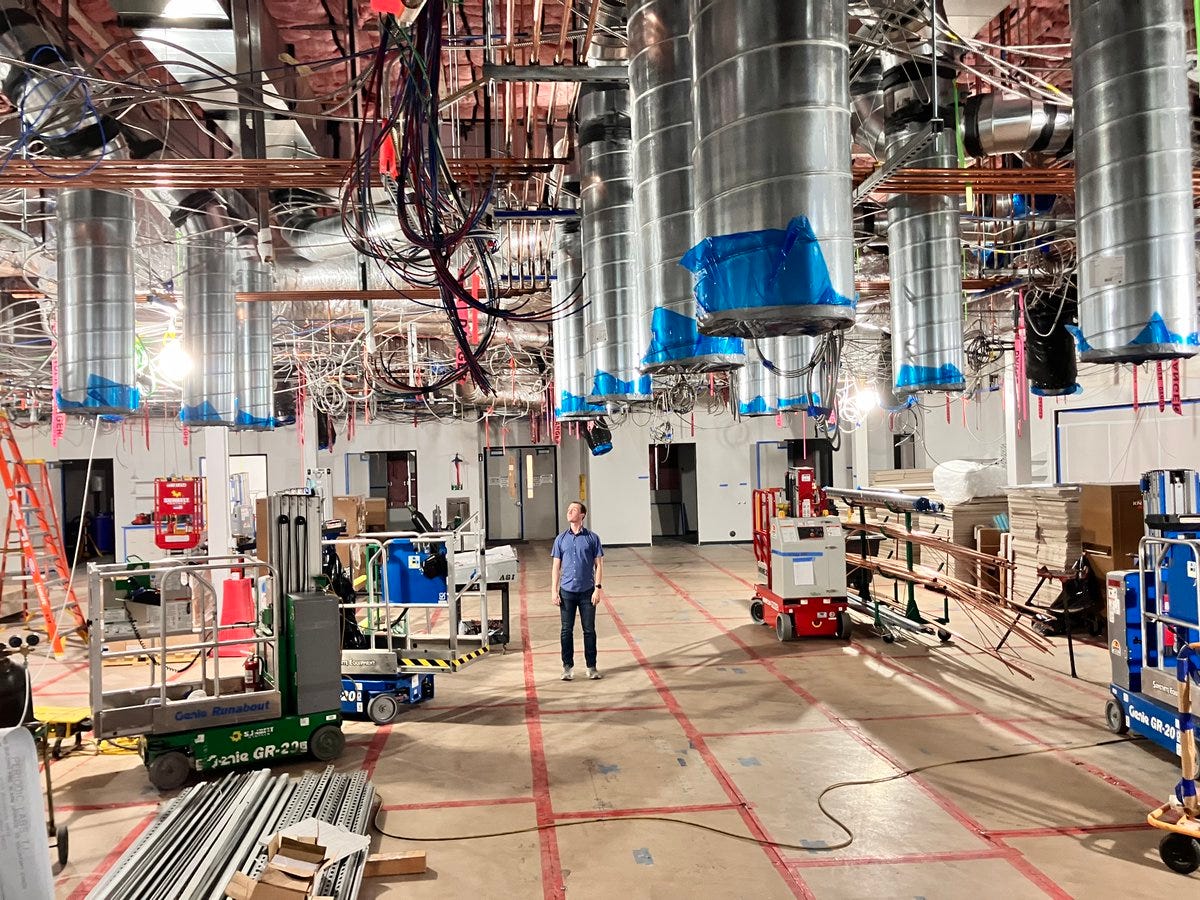
Synthesis Superintelligence: from Semiconductors to Superconductors — Periodic Labs’ Liam Fedus and Ekin Dogus Cubuk
It’s hard to believe that Periodic was only launched last September:
One year later, it is considered one of the pre-eminent AI scientist labs, with dizzying talent density and astonishing progress in the autonomous lab buildout:
Most people are familiar with the standard credentials of Liam and Dogus, but we found an incredible “talent slope” while learning more about Periodic, where each successive employee seems more impressive than the last:
From building AI systems that reason over noisy physical experiments to creating laboratories where every instrument can become intelligent, Periodic Labs is betting that the next frontier of AI won’t come from simply training on more internet data, it will come from letting models experiment with the real world. In this episode, Periodic Labs’ Liam Fedus and Ekin Dogus Cubuk join swyx and Brandon to explain why scientific discovery is fundamentally different from math and coding, and what it takes to build AI scientists that can actually discover new materials.
We go deep on Periodic’s vision for “synthesis superintelligence”: reinforcement learning grounded in physical experiments, AI-powered materials characterization, simulations and density functional theory, high-throughput labs, and systems that learn from the entire process of doing science rather than only its published results. Liam and Dogus also explain why frontier models will still need experiments, why failed experiments may be some of the most valuable training data, what it means to give every piece of lab equipment “140 IQ,” and how autonomous experimentation could compress decades of scientific trial-and-error into months.
We discuss:
* Why intelligence alone isn’t enough for scientific discovery
* How reinforcement learning changes when the environment is the physical world
* Why science requires reasoning under uncertainty, noise, and missing information
* Prediction, synthesis, and characterization in the materials discovery loop
* Why physics and materials science are still far from “solved”
* The “matter compiler” and Periodic’s goal of synthesis superintelligence
* Phase transitions, X-ray diffraction, and AI-powered materials characterization
* DFT, simulations, and why experiments remain the ultimate ground truth
* Room-temperature superconductors, new magnets, batteries, and more efficient compute
* Why quantum computing may not automatically solve materials discovery
* What it means for every piece of lab equipment to have “140 IQ”
* Why data quality and negative results matter more than simply throwing more compute at science
* Training models on the process of doing science rather than the final answer
* Why even future frontier models will still need to physically experiment
* Scaling autonomous labs across AI, chemistry, physics, and custom hardware
* How automated experimentation could massively increase the “surface area for luck” in discovering new materials
Liam Fedus
* LinkedIn: https://www.linkedin.com/in/liam-fedus-26547811/
Ekin Dogus Cubuk
* LinkedIn: https://www.linkedin.com/in/ekin-dogus-cubuk-9148b8114/
Timestamps
00:00:00 Introduction
00:02:49 AI and Reinforcement Learning in the Physical World
00:09:17 The End-to-End Materials Discovery Loop
00:13:28 Why Physics Isn’t “Solved”
00:19:04 The Matter Compiler and AI Characterization
00:30:22 DFT, Simulation, and Experimental Ground Truth
00:42:27 Dream Materials, Compute, and Quantum Computing
00:45:57 Giving Every Lab Instrument “140 IQ”
00:50:02 Automating the Lab
00:53:16 Data, Models, and Negative Results
00:58:13 Training AI on the Process of Science
01:00:20 Why Frontier AI Still Needs Experiments
01:06:06 Scaling Autonomous Labs
01:10:45 Building the Team and Deploying to Industry
01:17:01 From AI Copilots to Scientific Outcomes
01:20:57 Automating the Search for Superconductors
Transcript
Introduction: Intelligence Must Meet Reality
Swyx [00:00:00]: Okay. We’re here at Periodic. We’re here today with Liam and Doğuş from Periodic. Welcome, and thanks for having us at yours.
Liam Fedus [00:00:11]: Yeah, great to be here, and yeah, thanks for coming in.
Swyx [00:00:13]: I want to start off with one of these quotes that I love from your website. It says, “Intelligence is necessary but not sufficient. New knowledge is created when ideas are found to be consistent with reality.” It seems so straightforward, but why is it non-obvious?
Liam Fedus [00:00:29]: I think that’s sort of the thesis and premise behind Periodic that Doğuş and I thought when we were building this, which is you can’t just think your way to a solution. The universe is so complicated that in order to actually push the frontier of knowledge and to make progress, you need to create these conjectures and then actually see whether or not it holds. No amount of rereading that textbook or paper, thinking, or disappearing into a room is going to allow you to think through all possible experimental outcomes, expected and unexpected, and you really need this iterative process. And that’s our core belief for putting this together, and that’s why from the very beginning, we’re like, “We need to have the AI systems, the simulations of the physical world, but then also to build up the physical high-throughput experiment.” And we think a different type of intelligence emerges from that.
Swyx [00:01:21]: I think it’s also notable, like with OpenAI and Google, you don’t have those resources in those big labs. You had to come out and do your own thing, because you’re kind of inventing your own playbook as you go along.
Building an Interdisciplinary Lab for AI Science
Ekin Doğuş Çubuk [00:01:34]: Yeah, and a team like this has never existed, I think. We try to bring together solid-state chemists, solid-state physicists, experimentalists, theorists, hardware engineers, LLM experts, computer scientists, and some of these technologies are very recent. The high-throughput experimentation, the robotic arms have only been tried in the last three years or so. The force field expertise, some of these force fields are also very recent. But yeah, we felt like having a
You May Also Like

Mark Tilbury
Mark Tilbury Fan
AI Unraveled: Latest AI News & Trends, ChatGPT, Gemini, DeepSeek, Gen AI, LLMs, Agents, Ethics, Bias
Etienne Noumen

The Daily AI Show
The Daily AI Show Crew - Brian, Beth, Jyunmi, Andy and Karl

a16z Show
Andreessen Horowitz

TechCrunch Daily Crunch
TechCrunch
ChatGPT - Sol Good Shorts
Sol Good Network
Monde Numérique (Actu Tech)
Jerome Colombain

Theo - t3․gg
Theo - t3․gg

All-In with Chamath, Jason, Sacks & Friedberg
All-In Podcast, LLC

Artificial Intelligence Masterclass
AI Masterclass
Mark Tilbury
Mark Tilbury Fan
AI Unraveled: Latest AI News & Trends, ChatGPT, Gemini, DeepSeek, Gen AI, LLMs, Agents, Ethics, Bias
Etienne Noumen
The Daily AI Show
The Daily AI Show Crew - Brian, Beth, Jyunmi, Andy and Karl
a16z Show
Andreessen Horowitz
TechCrunch Daily Crunch
TechCrunch
ChatGPT - Sol Good Shorts
Sol Good Network
Monde Numérique (Actu Tech)
Jerome Colombain
Theo - t3․gg
Theo - t3․gg
All-In with Chamath, Jason, Sacks & Friedberg
All-In Podcast, LLC
Artificial Intelligence Masterclass
AI Masterclass
Community discussion